Best 50-Amp RV Surge Protector
Fifty-amp service is two legs, not one big one. That changes what a protective device has to watch, and it is the reason a 30-amp unit plus an adapter is not the answer.
Heads up: this page contains affiliate links. If you buy through one, Camp & Chock may earn a commission at no extra cost to you. It never changes which product we put first — how this site is funded.
The short answer
Buy a 50-amp electrical management system that monitors both legs independently. A 50-amp service is two separate 120-volt legs, and a fault can appear on one while the other looks perfectly healthy. If you would rather read that from inside the rig, the Watchdog reports per-leg voltage to a phone app.
Part of our power and surge protection guide. If your trailer's shore cord has a three-prong plug you are on 30 amp, and that page is here.
Our picks at a glance
Tap any row to jump to the full write-up.
| # | Product | Best for | Beginner fit | Price |
|---|---|---|---|---|
| 1 |  Progressive Industries EMS-PT50X Portable EMS (50 amp)The 50-amp version of the same argument: it monitors both legs and disconnects on the voltage faults a surge-only device ignores. | 50-amp rigs, no compromise | Good | |
| 2 | Hughes Autoformers Power Watchdog (50 amp)The 50-amp Watchdog: per-leg voltage on your phone, plus the replaceable surge module that makes a bad night survivable. | 50-amp rigs with a phone | Strong | |
| 3 |  Camco PowerGrip Dogbone Adapter (50 amp to 30 amp)A short cord that converts one plug shape into another. Buy the pair you might need before the trip, not at the pedestal. | Whatever the pedestal has | Strong |
Prices are not published here. They change constantly and a stale number is worse than no number, so every button goes straight to the current Amazon listing. #ad — these are affiliate links and photographs are stock images of the category, not of the individual product.
What 50-amp service actually is
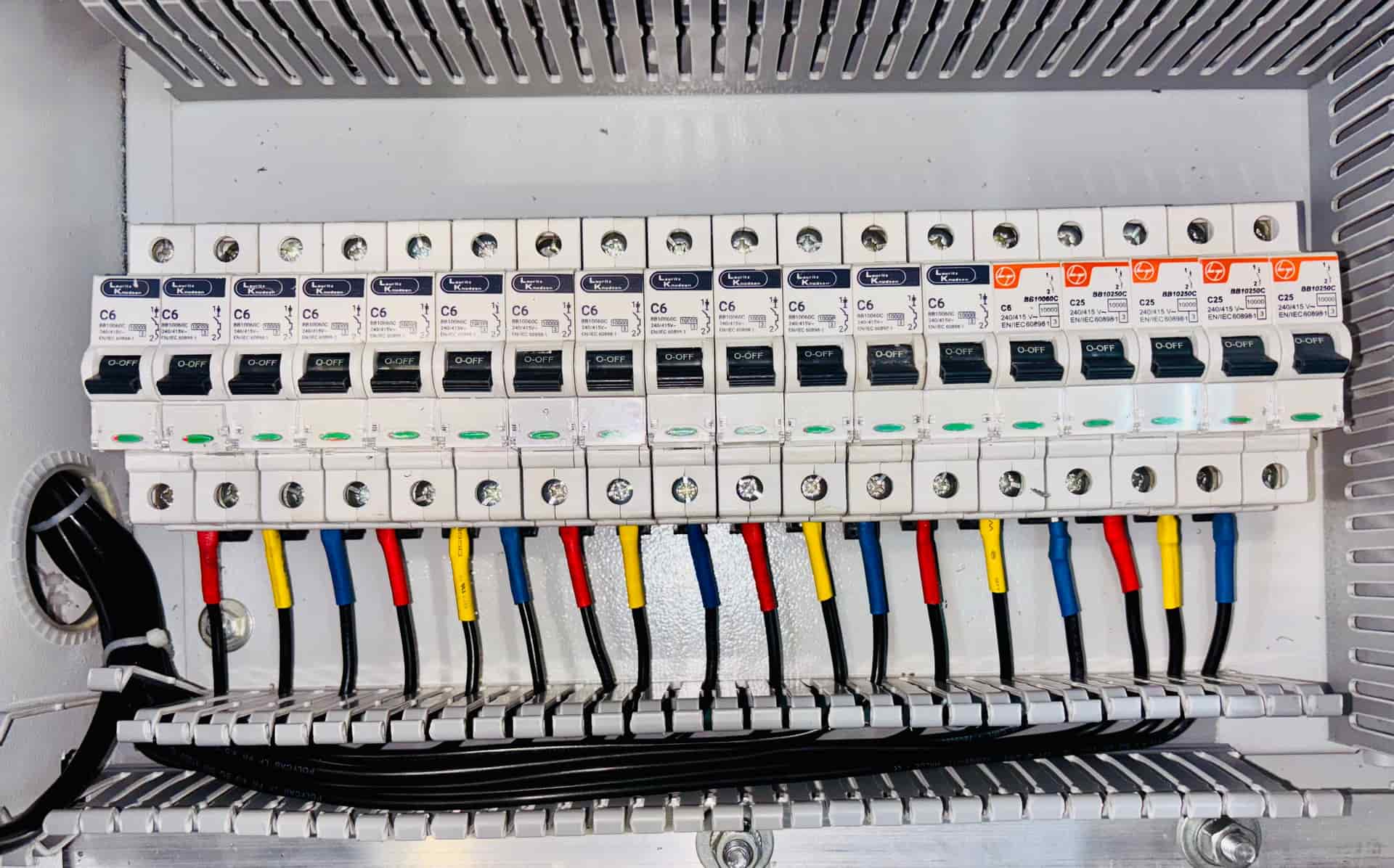
This is worth getting straight, because the name misleads almost everyone at first. A 50-amp RV service is not one 50-amp circuit. It is two separate 120-volt legs, each rated 50 amps, sharing a neutral.
That is why a 50-amp rig has so much more available power than a 30-amp one — it is not 50 versus 30, it is closer to four times the capacity. It is also why the protection problem is different.
Each leg can misbehave independently. One leg can sag while the other is fine. A pedestal can be wired with a fault that only shows on one side. A device that averages the two, or only watches one, will miss faults that matter.
Why the leg count changes the requirement
| 30 amp | 50 amp | |
|---|---|---|
| Legs | One 120-volt leg | Two 120-volt legs |
| Plug | Three prongs | Four prongs |
| Typical rig | Travel trailer, one air conditioner | Large trailer or fifth wheel, two air conditioners |
| What the protector must watch | One voltage | Both voltages, independently |
| Common failure mode | Whole-loop voltage sag | One leg sagging or a shared-neutral fault |
The picks
1. Best for 50-amp rigs, no compromise
Progressive Industries EMS-PT50X Portable EMS (50 amp)
The 50-amp version of the same argument: it monitors both legs and disconnects on the voltage faults a surge-only device ignores.
- Specification
- 50 amp portable unit
- Specification
- Full EMS with voltage and wiring monitoring
- Specification
- Automatic reconnect after a fault clears
What it does well
- Watches both legs of a 50-amp service, which is where the interesting faults hide
- Same automatic reconnect behavior, so an overnight brownout does not cost you a fridge full of food
- Clear fault codes rather than one warning light
The real tradeoff
- The most expensive thing most first-season owners buy that is not furniture
- Heavy, and it hangs off the pedestal unless you support it
How it measures up
These are judgments from published specifications and what we see at the lodge, not laboratory results. How we choose.
- Beginner fit
- Good — Same as the 30-amp unit.
- Protection breadth
- Strong — Both legs, voltage, wiring, surges.
- Diagnostics
- Strong — Named fault codes.
- Value
- Adequate — It costs real money. So does a 50-amp rig's electronics.
Specifications from Progressive Industries.
2. Best for 50-amp rigs with a phone
Hughes Autoformers Power Watchdog (50 amp)
The 50-amp Watchdog: per-leg voltage on your phone, plus the replaceable surge module that makes a bad night survivable.
- Specification
- 50 amp
- Specification
- Bluetooth app reporting per leg
- Specification
- Replaceable surge module
What it does well
- Per-leg voltage in the app, which is genuinely useful on 50-amp service
- The replaceable module keeps a lightning-adjacent event from being a total loss
The real tradeoff
- Expensive
- Heavy enough that it wants a strap or a shelf at the pedestal
How it measures up
These are judgments from published specifications and what we see at the lodge, not laboratory results. How we choose.
- Beginner fit
- Strong — The app does the explaining.
- Protection breadth
- Strong — Both legs, voltage cutoff, surge.
- Diagnostics
- Strong — Per-leg history.
- Value
- Adequate — A serious purchase, justified by what it protects.
Specifications from Hughes Autoformers.
3. Best for Whatever the pedestal has
Camco PowerGrip Dogbone Adapter (50 amp to 30 amp)
A short cord that converts one plug shape into another. Buy the pair you might need before the trip, not at the pedestal.
- Specification
- Short adapter cord
- Specification
- Molded grip handles
- Specification
- Common 50-to-30 and 30-to-15 variants
What it does well
- Turns an incompatible pedestal into a usable one for very little money
- The short-cord format takes strain off the connector, unlike a rigid block adapter
The real tradeoff
- An adapter does not create amps. A 30-amp rig on a 15-amp outlet is still a 15-amp rig
- Easy to buy the wrong direction. Read which end is male
How it measures up
These are judgments from published specifications and what we see at the lodge, not laboratory results. How we choose.
- Beginner fit
- Strong — Plug A to plug B. Check the direction once.
- Protection breadth
- Adequate — None. Keep the protector in the chain.
- Diagnostics
- Adequate — Not applicable.
- Value
- Strong — Cheap insurance against a wasted night.
Specifications from Camco.
The adapter question, answered honestly
You will arrive at a park that only has 30-amp pedestals. A dogbone adapter lets you plug a 50-amp rig into one, and this is a completely normal thing to do.
What it does not do is give you 50-amp power. You now have one 30-amp leg feeding a rig that expects two 50-amp legs, which in practice means one air conditioner, carefully, and not much else at the same time. Running two air conditioners on a 30-amp pedestal will trip the breaker, and repeatedly tripping a breaker is not a neutral event for the pedestal.
Protection-wise, keep your 50-amp device in the chain where the manufacturer's documentation says it can go, or carry a 30-amp protector for exactly this case. The adapter itself provides no protection whatsoever — it is a short cord with different ends, covered properly in the power cord and adapter guide.
What to look for on a 50-amp unit
Independent per-leg monitoring. Not an average. The display or app should be able to show you two separate voltages.
Automatic disconnect and reconnect. Same argument as at 30 amp, with more at stake: a 50-amp rig usually has two air conditioners and often a residential fridge.
Physical support. A 50-amp portable unit plus a 50-amp cord is heavy, and hanging all of it off the pedestal receptacle puts real strain on the connector. Use the mounting loop, a strap, or a small shelf.
A lock. Fifty-amp units are the most expensive thing in this category and they sit outside unattended.
Mistakes first-timers make
Expecting an adapter to unlock 50-amp capacity. It does not. Plan the evening around one air conditioner.
Hanging the whole assembly off the receptacle. Support it. A stressed connector gets warm, and warm connectors are the start of a much worse story.
Ignoring one leg reading differently. A meaningful gap between the two legs is information. If the device is showing it, look at it.
Questions people actually ask
Is 50 amp service really two legs?
Yes. A 50-amp RV service provides two separate 120-volt legs sharing a neutral, each rated 50 amps. That is why it offers far more capacity than 30 amp, and why a protective device needs to watch both legs independently.
Can I plug a 50 amp RV into a 30 amp pedestal?
Yes, with a dogbone adapter, and it is a normal thing to do. You will have roughly 30 amps of capacity rather than 50, which in practice means one air conditioner and not much else at the same time.
Do I need a 50 amp surge protector if I mostly use 30 amp pedestals?
Protect at the level your rig runs. Many owners carry both: the 50-amp unit for 50-amp sites and a 30-amp unit for the adapter situation. Check your device's documentation for how the manufacturer intends it to be used with an adapter.
Why is one leg reading lower than the other?
Unbalanced loads inside the rig can cause a small difference. A large or persistent gap points at the pedestal or the park's supply, and it is worth reporting to the park and considering a different site.
Should a 50 amp protector be portable or hardwired?
Hardwired removes the theft and weather exposure and is a common choice on rigs people keep. Portable is simpler for a first season, but support its weight rather than letting it hang off the receptacle.
Sources
Read next
Power & Surge Protection
Best RV Surge Protector for a First Travel Trailer
Surge protectors and full electrical management systems compared, with the low-voltage problem explained properly.
Power & Surge Protection
Best 30-Amp RV Surge Protector
Four 30-amp options from full EMS to a budget surge-only unit, and how to tell which service your trailer has.
Power & Surge Protection
Best RV Power Cords and Adapters
Extension cords, dogbone adapters and replacement cords, with the one rule about adapters that everyone learns late.
Power & Surge Protection
RV Electrical Hookup for Beginners (Step by Step)
The full pedestal connection sequence, why order matters, and what to do when the protective device refuses.
Reviewed September 25, 2026. Spot something out of date? Tell us and we will fix it.