How to Level a Travel Trailer (Step by Step for Beginners)
Side to side first, while still hitched. Front to back after. Getting that order right is most of the job, and it is the part nobody demonstrates at the dealership.
Heads up: this page contains affiliate links. If you buy through one, Camp & Chock may earn a commission at no extra cost to you. It never changes which product we put first — how this site is funded.

Level side to side first, using blocks under the low-side wheels, while the trailer is still hitched. Chock the wheels. Then unhitch and level front to back with the tongue jack. Then lower the stabilizers. Doing it in that order means you never do any of it twice, and the trailer is never free to move while you are working around it.
This is the practical companion to our leveling and chocks guide. If you have not bought anything yet, start with the leveling blocks roundup instead and come back.
What you will need
Leveling blocks or a curved leveler, a pair of wedge chocks per side, a small spirit level (a phone app works, but a real bubble level on the floor is easier to read from outside), and pads for the stabilizer jacks if your sites are soft.
The gear for this job
Blocks to change the height, chocks so nothing moves, pads so the jacks do not sink. Three cheap things and the job is covered.
Best for Most first trailers
Camco FasTen Leveling Blocks (10-pack)
The default first purchase for a travel trailer: interlocking blocks you stack into a ramp, cheap enough to buy two sets.

Best for The non-negotiable basics
Camco Heavy-Duty Wheel Chocks (pair)
The chock that stops the trailer rolling. Not the one that stops it rocking, which is a different product, and you need both.
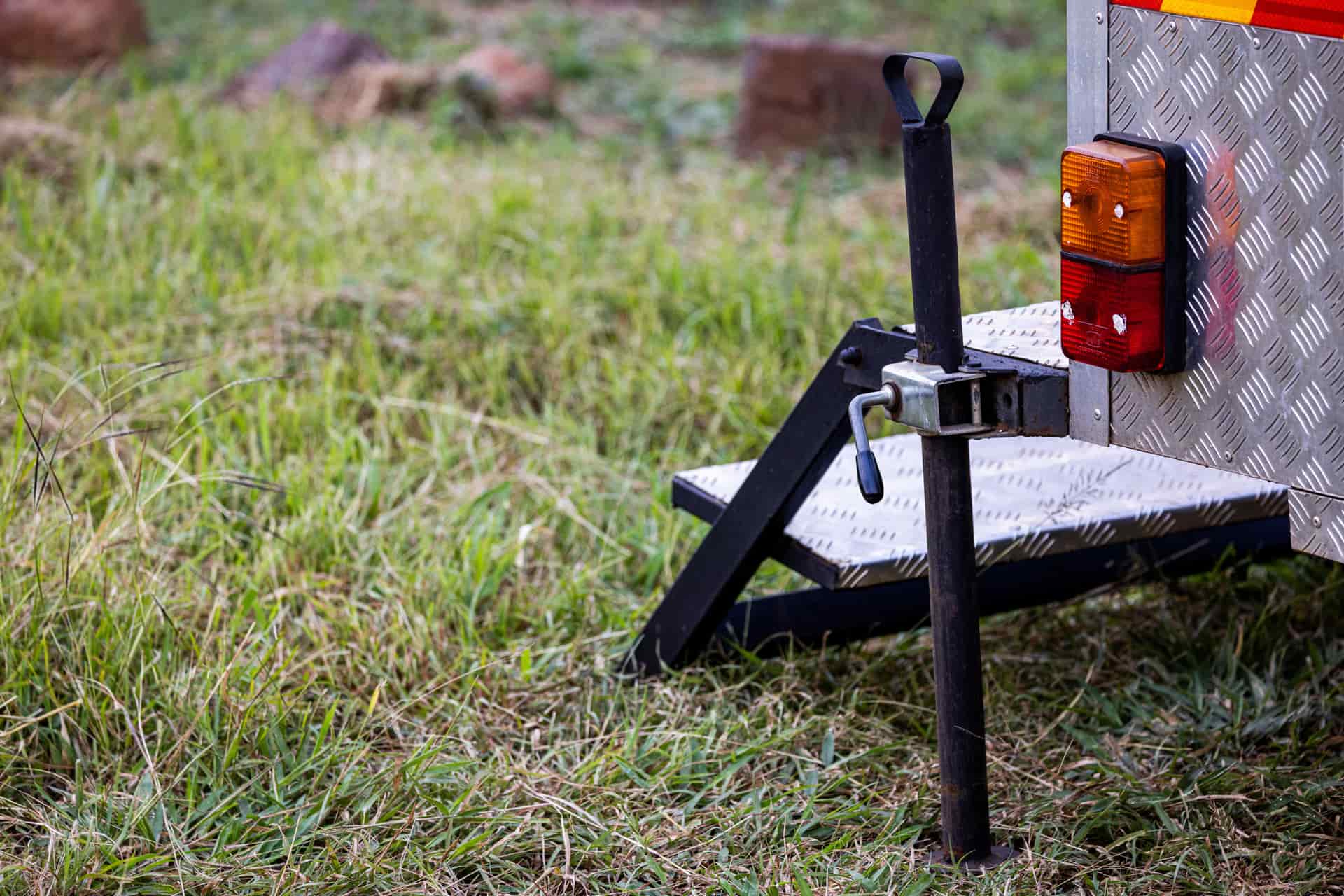
Best for Stopping jacks sinking
Camco Stabilizing Jack Pads
Four squares of plastic that stop your stabilizer jacks burying themselves in a wet grass site overnight.
Before you start
Walk the site first. Thirty seconds of looking saves ten minutes of repositioning: find the flattest strip, check where the hookups are so your sewer hose and power cord will reach, and notice which way the ground falls.
It is almost always easier to park the low side of the trailer where the ground is highest rather than trying to lift a lot of height with blocks. Moving the trailer three feet sideways can remove the need for a second layer entirely.
The steps
1. Park, then find out which way it leans
Get the trailer roughly into position. Put a level on the floor inside, across the trailer rather than along it, and see which side is low. Many people stick a small bubble level permanently to the tongue and to the side of the frame, which means you can read it from outside without opening the door.
2. Work out how much lift you need
As a rough guide, one standard block is about an inch of lift, and most sites need one or two. If you find yourself planning a three-high stack, reposition the trailer instead. The full arithmetic, including how to convert a bubble reading into a block count, is in how many leveling blocks you need.
3. Build a ramp, not a step
Lay the blocks so the tire climbs a slope rather than hitting a wall. Interlocking blocks are designed for this: lay the bottom layer longer than the top so there is a stair to drive up. On a tandem axle, build the same ramp under both wheels on the low side, because both tires need to end up supported.
4. Drive up slowly and stop
Pull forward until the tires are fully on the stack. Fully is the important word: no part of the tread hanging over an edge, and certainly no sidewall resting on a block corner. If you have someone with you, have them watch and say stop. If you are alone, get out and look rather than guessing.
5. Check, adjust, repeat
Check the level again. Overshooting is common on the first attempt and it is not a problem — pull back off, take a block out, try again. This is the part a curved leveler is designed to eliminate, and if you find yourself doing it three times a weekend, that is what the upgrade buys you.
6. Chock the wheels, while still hitched
A wedge in front of and behind a tire, on both sides. This happens before you unhitch, because until the chocks are in, the tow vehicle is the only thing holding the trailer. Which chock does what is covered in X-chocks versus wheel chocks.
7. Unhitch, then level front to back
Now disconnect. Raise or lower the tongue jack until the trailer is level along its length. Put a pad or a block under the tongue jack foot before you put weight on it, especially on grass — a tongue jack carries a lot of load on a very small foot.
8. Set the stabilizers last
Lower each stabilizer jack until it takes weight and stop there. They are stabilizers, not jacks: their job is to stop the trailer moving, not to hold it up, and winding them down hard enough to lift a corner puts load into the frame that the frame was not designed for.
What goes wrong
The trailer looks level but the fridge complains. Absorption fridges care more than you do. Check the level on the fridge shelf rather than the floor, and get it closer.
The blocks sink overnight. Soft ground, narrow stack. Lay blocks two wide instead of two high, and put pads under the stabilizer feet. This is the most common overnight complaint we see at the lodge, and it is always footprint rather than block strength.
The stack shifts as the tire rolls on. Either the blocks are not interlocking, or you are driving up too fast, or you built a step rather than a ramp. Usually the last one.
You drive off with the blocks still in place. Everyone does it once. The cure is a fixed departure routine and a bag the blocks live in, so an empty space in the bag is obvious.
Leveling on uneven or soft ground
On a badly sloped site, reposition before you build. A trailer needing three blocks under one side is usually a trailer parked in the wrong part of the pitch.
On soft ground, the answer is always area rather than height. Wide boards or blocks laid side by side under the tire spread the load; a tall narrow stack concentrates it into a small patch and finds the softest thing underneath.
Can you level a trailer without moving it?
Partly. Once the trailer is parked and unhitched, the tongue jack gives you front-to-back adjustment without moving anything. Side to side is different: the only way to raise one side is to get something under that side's tires, and that means rolling the trailer onto it.
Which is precisely why side to side comes first, while the tow vehicle is still attached and moving the trailer three feet is trivial.
Quick reference
| Problem | Fix |
|---|---|
| One side low | Blocks under that side's wheels, while hitched |
| Nose high or low | Tongue jack, after unhitching |
| Trailer rocks when you walk | X-chocks on a tandem axle, stabilizers otherwise |
| Jacks sinking into grass | Pads under every jack foot, including the tongue |
| Blocks sinking | Lay them wider, not higher |
Questions people actually ask
Should I level side to side or front to back first?
Side to side first, while the trailer is still hitched, because that is the only adjustment that requires moving the trailer. Front to back comes afterwards using the tongue jack, which works fine once you are parked.
How level does a travel trailer need to be?
Close enough that the absorption fridge works and doors do not swing on their own. Manufacturers generally want an absorption fridge within a couple of degrees, so check the level on a fridge shelf rather than just the floor.
Can I level a travel trailer without moving it?
Front to back, yes, with the tongue jack. Side to side, no. Raising one side means putting something under that side's tires, and that means rolling onto it.
Can I use stabilizer jacks to level the trailer?
No. Stabilizer jacks steady a trailer that is already level. Using them to lift a corner puts loads into the frame that it was not designed to carry, and it can bend the jack.
How to level a travel trailer with cinder blocks?
Do not. Hollow concrete blocks are specified for distributed load inside a wall, not a point load under a tire, and they fail suddenly. Purpose-made leveling blocks or solid lumber are the correct options.
How do I level on soft ground?
Spread the load rather than stacking higher. Lay blocks or wide boards side by side so the weight sits on a larger area, and put pads under every stabilizer jack foot.
Sources
Read next
Leveling & Chocks
Best RV Leveling Blocks for a First Travel Trailer
Interlocking blocks, curved levelers and jack pads compared for someone leveling a trailer for the first time.
Leveling & Chocks
How Many Leveling Blocks Do I Need?
Block counts by axle setup, how to estimate lift from a bubble reading, and when more blocks is the wrong answer.
First-Season Starter Kit
RV Setup and Departure Checklist
The arrival and departure sequence for a travel trailer, in the order that avoids redoing work or damaging something.
Leveling & Chocks
RV Leveling Blocks vs Wood: An Honest Comparison
Blocks against lumber on cost, weight, stacking, storage and safety, plus the ramp trick that makes wood work.
Reviewed September 25, 2026. Spot something out of date? Tell us and we will fix it.