Best RV Tire Covers for a Travel Trailer
Trailer tires usually age out before they wear out, and sunlight is most of the reason. Covers are cheap insurance, as long as you buy the right size and fit them dry.
Heads up: this page contains affiliate links. If you buy through one, Camp & Chock may earn a commission at no extra cost to you. It never changes which product we put first — how this site is funded.
The short answer
Measure your tire diameter first, then buy the cheapest opaque cover that fits it. For a standard 15-inch travel trailer wheel that is usually a cover rated around 27 to 29 inches. If your trailer sits out in open wind, pay a little more for a cover with an elasticized back hem so you are not refitting it every week.
This page sits in our first-season starter kit guide. It is for the stretch nobody plans for when they buy a trailer: the weeks and months it spends parked between trips, which on most trailers is far more of the year than the camping.
Our picks at a glance
Tap any row to jump to the full write-up.
| # | Product | Best for | Beginner fit | Price |
|---|---|---|---|---|
| 1 | Camco Wheel and Tire Protector Covers (pair)Basic vinyl covers that do the one job that matters: keeping sun off the sidewalls. Buy two pairs for a tandem axle. | The cheapest way to stop UV damage | Strong | |
| 2 | 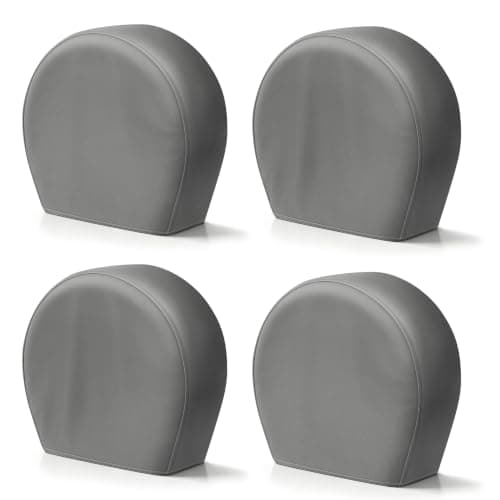 Explore Land RV Tire Covers (4-pack)The simplest way to cover a tandem-axle trailer: four covers, one order, a drawcord instead of a size gamble. Expect a light fabric for the money. | Covering all four tires in one order | Strong | |
| 3 | Classic Accessories OverDrive RV Wheel Covers (pair)What to buy if your trailer sits outside in open wind. The elastic hem is the difference between a cover that stays on and one you keep refitting. | A snug fit that stays on in wind | Strong | |
| 4 | Classic Accessories OverDrive RV Dual Axle Wheel CoverThe tidy answer for a tandem-axle travel trailer: one panel per side, both tires shaded, half the fitting work. | Tandem axles, one cover per side | Strong |
Prices come from Amazon and were last checked October 6, 2026. They change constantly, so a price older than 48 hours is withdrawn rather than shown stale — those rows read “Check price on Amazon” instead and go straight to the current listing. #ad — these are affiliate links.
What a tire cover is actually for
Trailer tires rarely wear out. A travel trailer might cover a couple of thousand miles a year, which is nothing in tread terms, and then sit still for the other eleven months. What finishes those tires is age and exposure, not mileage.
Two things do the damage. Ultraviolet light breaks down the rubber at the surface, and ozone in the air attacks it as well, particularly where the sidewall is flexed or loaded. The visible result is fine cracking in the sidewall, usually appearing first in the curved area above the bead. That cracking is why trailer tires get replaced on age rather than on tread depth.
A tire cover does exactly one thing about this: it blocks the sunlight. That is not a cure for age, and no cover stops ozone in the air. It is a cheap way to slow down the fastest-acting cause of sidewall cracking, on a part that is carrying your trailer at highway speed.
Be clear-eyed about the limit. Covers do not extend a tire’s service life indefinitely, and tire makers do not agree on how much they help. What they do is remove the one variable you can remove for about the price of a tank of fuel. Every tire carries a DOT date code on the sidewall, and that date, not the cover, is what eventually decides when the tire comes off.
Who needs them and who does not
Buy covers if your trailer is parked outdoors between trips, which covers most people with a driveway, a side yard or a storage lot space. The more southern and sunnier your parking spot, the more this matters.
Skip them if the trailer lives in a barn, a garage or a covered storage building. Sunlight is the problem; shade already solved it. Also skip them if you are a full-timer who moves every few days, because a cover you fit and remove constantly gets left behind at a campsite.
How we choose
We do not run a test lab and we do not claim to. What this site has is a lodge that hosts RV sites every weekend, which means watching a lot of gear used on the same ground by people at every level of experience. Covers are a category where the failures are mundane and repeat: wrong size, fitted over a wet tire, or blown off in the first storm.
Beyond that, picks are judged against published manufacturer specifications, current availability from real retailers, and whether a beginner can get it right on the first attempt. Our full methodology is here.
The criteria that decide this purchase
1. Size, which is the only way to get this wrong
Covers are sold in diameter bands, and the band is your tire’s overall diameter, not the wheel size stamped on the rim. You can work it out from the code on the sidewall in about thirty seconds.
Take a common trailer tire, ST205/75R15. The 205 is the section width in millimeters. The 75 is the aspect ratio, meaning the sidewall height is 75 percent of that width, so about 154 mm or just over 6 inches. The 15 is the wheel diameter in inches. Add a sidewall at the top and another at the bottom: 15 + 6 + 6 gives roughly 27 inches overall.
That is why a 15-inch trailer wheel needs a cover rated around 27 to 29 inches rather than a 15-inch cover. Getting this backwards is the single most common returned-item story in the category. If arithmetic is not your idea of a holiday, run a tape measure across the face of the tire instead and use that number.
2. Material, and the damp problem
Vinyl is the cheap, standard choice. It is opaque, it wipes clean, and it is water resistant rather than breathable. Cloth covers, usually oxford fabric, breathe more and hold dirt more.
The practical consequence is the same for both: a cover fitted over a wet tire traps that moisture against the rubber and the wheel. Fit covers dry, and if you pull them off a wet trailer in spring, let both the tire and the cover dry before they go back on or into storage. A cover is not a reason to skip the damp control you use inside the trailer either, for the same reason.
3. How it stays on
Three mechanisms, in rising order of how well they survive wind. A buckle and strap is the cheapest and works, but a cover that is a little loose will flap. An elasticized back hem pulls the whole cover in behind the tire so there is nothing for the wind to get under. A drawcord with a locking toggle does the same job and also lets one size band fit a wider range of tires.
If your trailer sits in open ground with nothing upwind of it, this is the criterion to spend money on. If it is tucked beside a building, straps are fine.
4. One per tire, or one per side
On a tandem-axle trailer you have four tires and therefore four individual covers, which is two packs of two from most brands. The alternative is a single dual-axle panel per side, which covers both tires and the gap between them in one piece. That is two covers for the whole trailer instead of four, and less fitting each time.
The trade is wind. A big single panel catches more of it than two small ones, and dual-axle covers assume roughly standard wheel spacing. Measure the distance between your tires before committing to that route.
Which cover suits which setup
| Your situation | What to buy | Why |
|---|---|---|
| Single axle, tight budget | A pair of vinyl covers | Two tires, one pack, lowest cost |
| Tandem axle, four tires | A four-pack of cloth covers | One order, one size, no mismatch |
| Tandem axle, want it tidy | One dual-axle panel per side | Two covers for the whole trailer |
| Parked in open wind | Elasticized hem or drawcord | Nothing for the wind to get under |
| Spare on the rear or ladder | A single spare tire cover | The spare ages in the sun like the rest |
The picks
1. Best for The cheapest way to stop UV damage
Camco Wheel and Tire Protector Covers (pair)
Basic vinyl covers that do the one job that matters: keeping sun off the sidewalls. Buy two pairs for a tandem axle.
- Specification
- Sold in pairs, in stepped diameter ranges such as 27-29 in and 30-32 in
- Specification
- Vinyl with seams sewn in heavy nylon thread
- Specification
- Buckle and strap fastening
What it does well
- The least money that genuinely solves the problem, which is sunlight hitting the sidewall
- Buckle and strap goes on in seconds and does not need the tire to be a perfect match for the cover
- Wipes clean, so it goes back in the compartment dry rather than damp
The real tradeoff
- Vinyl is water resistant rather than breathable, so a cover put on a wet tire stays wet underneath
- You have to know your tire diameter before ordering, and the stepped sizes are unforgiving
- A pair covers one side of a tandem axle, so most trailers need two packs
How it measures up
These are judgments from published specifications and what we see at the lodge, not laboratory results. How we choose.
- Beginner fit
- Strong — Strap it on. Check your tire diameter first.
- UV protection
- Strong — Opaque vinyl, which is the whole point.
- Fit and stay-put
- Good — The strap holds; wind can still flap a loose cover.
- Value
- Strong — The cheapest honest answer in the category.
Specifications from Camco.
2. Best for Covering all four tires in one order
Explore Land RV Tire Covers (4-pack)
The simplest way to cover a tandem-axle trailer: four covers, one order, a drawcord instead of a size gamble. Expect a light fabric for the money.
- Specification
- Four covers per pack
- Specification
- Oxford cloth, listed by the maker as 210D
- Specification
- Sold in diameter bands; the listing we link is 26-28.75 in, which covers a standard 15-in trailer tire
- Specification
- Elastic cord with an auto-lock toggle
What it does well
- A tandem-axle trailer is covered in one order with no second pack and no size mismatch
- The drawcord and toggle tighten to the tire you actually have, rather than to a size band
- Cloth construction breathes more than vinyl, which helps if a cover goes on slightly damp
The real tradeoff
- 210D oxford is a light fabric. It is not the material to leave out through a hard winter
- The size bands run small, so measure before ordering rather than assuming a trailer size fits
- Cloth holds dirt more than wipe-clean vinyl does
How it measures up
These are judgments from published specifications and what we see at the lodge, not laboratory results. How we choose.
- Beginner fit
- Strong — Pull on, cinch the cord.
- UV protection
- Good — Opaque cloth; lighter than vinyl.
- Fit and stay-put
- Strong — The auto-lock cord adjusts to the tire.
- Value
- Strong — Four covers for the price of two pairs elsewhere.
3. Best for A snug fit that stays on in wind
Classic Accessories OverDrive RV Wheel Covers (pair)
What to buy if your trailer sits outside in open wind. The elastic hem is the difference between a cover that stays on and one you keep refitting.
- Specification
- Two covers per pack
- Specification
- Sized by wheel diameter and tire width, e.g. 27-30 in diameter and 8.75 in width
- Specification
- Water-resistant vinyl with a soft non-scratch backing
- Specification
- Elasticized back hem
What it does well
- The elastic hem pulls the cover in behind the tire, so it does not balloon and work loose in wind
- Soft backing means the inside face is not scuffing the sidewall every time you fit it
- Sized by tire width as well as diameter, which is why these tend to fit properly
The real tradeoff
- Costs more than plain vinyl covers for the same UV protection
- Slip-on fit means you need clearance behind the tire, which is tight on some fender skirts
- Still a water-resistant cover rather than a breathable one
How it measures up
These are judgments from published specifications and what we see at the lodge, not laboratory results. How we choose.
- Beginner fit
- Strong — Slips on. Measure diameter and width.
- UV protection
- Strong — Opaque, and it covers the whole sidewall.
- Fit and stay-put
- Strong — The elastic hem is the reason to pay more.
- Value
- Good — A real improvement for a modest premium.
Specifications from Classic Accessories.
4. Best for Tandem axles, one cover per side
Classic Accessories OverDrive RV Dual Axle Wheel Cover
The tidy answer for a tandem-axle travel trailer: one panel per side, both tires shaded, half the fitting work.
- Specification
- One piece covering both tires on a tandem axle
- Specification
- Sized by wheel diameter, e.g. 27-30 in and 30-33 in
- Specification
- Sold as a single cover, so a tandem trailer needs two
What it does well
- One cover per side instead of two, which is two fewer things to fit, fold and store
- Spans the gap between the tires, so the inner sidewalls get shaded too
- Nothing to line up between the wheels, which is the fiddly part of fitting separate covers
The real tradeoff
- Only makes sense on a tandem axle, and the wheel spacing has to be close to standard
- A big single panel catches more wind than two small ones
- Sold singly, so the price you see is for one side of the trailer
How it measures up
These are judgments from published specifications and what we see at the lodge, not laboratory results. How we choose.
- Beginner fit
- Strong — One cover, one side, done.
- UV protection
- Strong — Covers the gap between tires as well.
- Fit and stay-put
- Good — Fits standard tandem spacing; a big panel in wind.
- Value
- Good — Remember you need two of them.
Specifications from Classic Accessories.
Fitting them so they last
There is not much to this, but each step exists because of a failure we have seen.
- Fit them dry. Wash and dry the tire first if it is muddy, because grit between a cover and a sidewall is an abrasive.
- Pull the hem or cord in behind the tire properly. A cover sitting on the front face of the tire like a plate is the one that leaves in the first gust.
- Cover the spare as well. It is usually the oldest tire on the trailer and it lives in full sun on the rear wall or the ladder.
- Take them off before you tow. Obvious written down, easy to forget at 6 am, and a cover that stays on at speed either shreds or wraps around a brake assembly.
- Store them dry and folded, not stuffed damp into a compartment.
Mistakes first-timers make
Buying by wheel size. A 15-inch wheel does not take a 15-inch cover. Work out the overall tire diameter, or measure it.
Covering wet tires in the fall. This is the one that actually does harm rather than merely wasting money. Trapped moisture against a wheel for four months is worse than four months of sun.
Treating a cover as a substitute for age. Covers slow sun damage. They do not reset the DOT date code on the sidewall. A trailer tire that is old is old whether it was covered or not.
Forgetting the rest of the parked trailer. If you are already thinking about the months between trips, the other two jobs are keeping the jacks out of soft ground with jack pads and keeping the inside dry. Tires, jacks, damp. That is the storage list.
So which one
A single-axle trailer in a normal driveway: a pair of vinyl Camco covers, the right diameter band, done. A tandem-axle trailer: the four-pack of cloth covers is the simplest single order, and the drawcord takes the size guesswork out. Parked somewhere genuinely windy: pay for the elasticized hem. Want two covers instead of four: the dual-axle panel, once you have measured the gap between your tires.
Questions people actually ask
What size RV tire cover do I need for 15-inch wheels?
Usually a cover rated for 27 to 29 inches. Covers are sized by the overall diameter of the tire, not the wheel. A common ST205/75R15 trailer tire works out to roughly 27 inches overall, so a 15-inch wheel needs a 27-inch-plus cover.
Are RV tire covers worth it?
If your trailer is parked outdoors between trips, yes, on cost alone. Sunlight is the fastest-acting cause of sidewall cracking on tires that will never wear their tread out. If the trailer is stored indoors, covers add nothing.
Do tire covers stop dry rot?
They slow the part of it caused by sunlight. Rubber also ages from the inside and from ozone in the air, which no cover prevents. Treat covers as damage limitation, and go by the DOT date code on the sidewall for replacement.
Should tire covers be waterproof or breathable?
Either works, as long as you fit them to a dry tire. The failure case is trapping moisture against the rubber and the wheel for months, which is a real risk with any cover put on wet.
How many tire covers do I need for a travel trailer?
One per tire, so four for a tandem axle and two for a single axle, plus one for the spare. Most brands sell them in pairs, so a tandem trailer needs two packs unless you buy a four-pack or a single dual-axle panel per side.
Can I leave tire covers on while towing?
No. Take them off before you move. At speed they tear, and a loose cover can end up wrapped around a brake or suspension component.
Sources
Read next
First-Season Starter Kit
Best RV Dehumidifier for Damp Trailers and Winter Storage
Desiccant absorbers versus powered dehumidifiers, matched to camping use and to unpowered winter storage.
Leveling & Chocks
Best RV Jack Pads for a Travel Trailer
Jack pads and jack blocks compared on the one number that matters: how much ground they spread the load across.
First-Season Starter Kit
Travel Trailer Essentials Checklist
A first-trip checklist for a new travel trailer, grouped by utility with the commonly forgotten items called out.
Towing & Security
Best RV Tire Pressure Monitoring System
Tire pressure monitoring systems compared, with the reason a trailer needs one far more than a car does.
Reviewed October 5, 2026. Spot something out of date? Tell us and we will fix it.