Best RV Jack Pads for a Travel Trailer
A jack foot is a few square inches carrying hundreds of pounds. On grass it will find its way into the ground overnight. Here is what to put under it, and how much is enough.
Heads up: this page contains affiliate links. If you buy through one, Camp & Chock may earn a commission at no extra cost to you. It never changes which product we put first — how this site is funded.
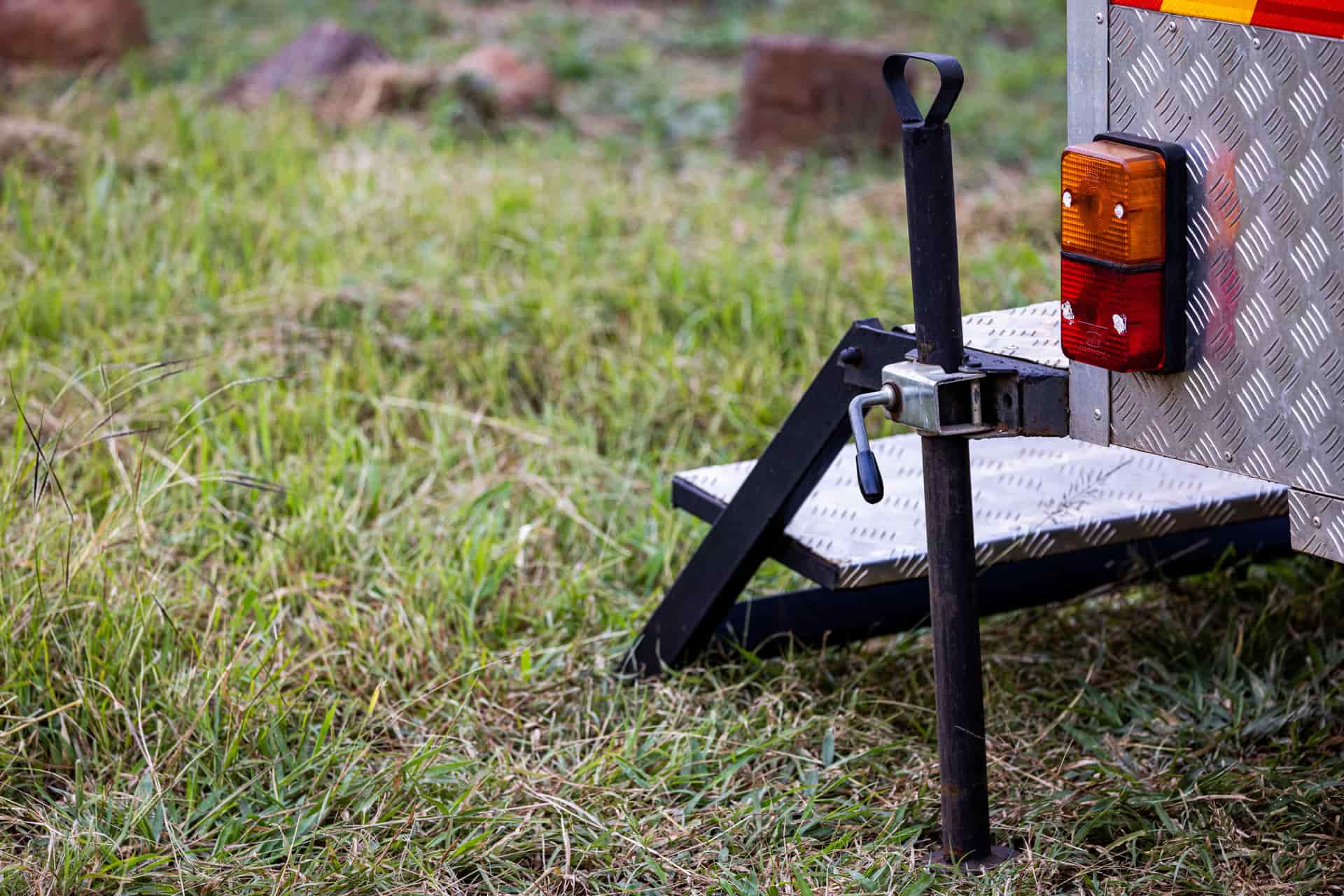
The short answer
Buy a four-pack of plastic jack pads for the stabilizer jacks. They cost very little, they live permanently in one compartment, and they stop the one failure that ruins a night: a jack quietly sinking into soft ground while you sleep. If a jack cannot reach the ground at all, that is a different problem and you want a tall jack block, not a thin pad.
This page is part of our leveling and chocks guide. It is the companion to the leveling blocks that go under your tires: those change the trailer’s height, these stop the jacks that hold it steady from disappearing into the ground.
Our picks at a glance
Tap any row to jump to the full write-up.
| # | Product | Best for | Beginner fit | Price |
|---|---|---|---|---|
| 1 | 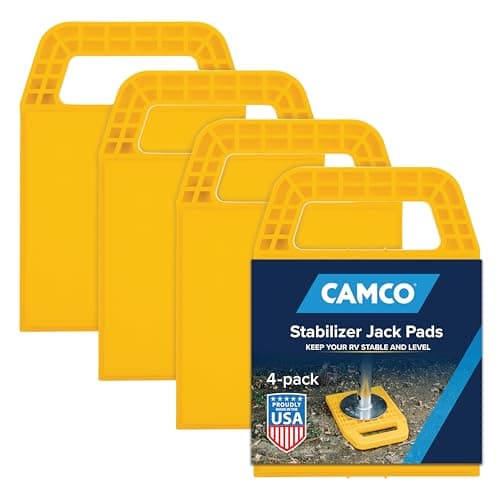 Camco Stabilizing Jack PadsFour squares of plastic that stop your stabilizer jacks burying themselves in a wet grass site overnight. | Stopping jacks sinking | Strong | |
| 2 | 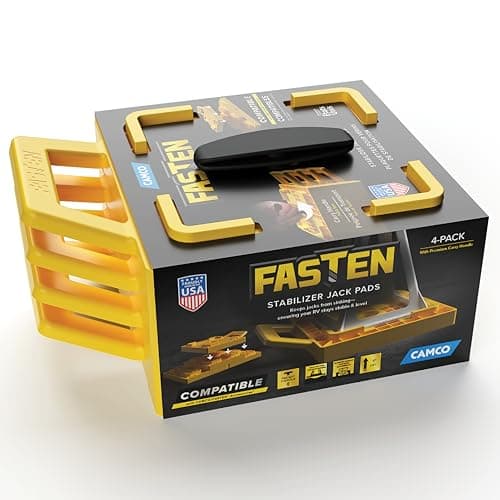 Camco FasTen RV Stabilizer Jack Pads (4-pack)The pad to buy if your leveling blocks are Camco FasTen: the two systems lock together, so a tall stack under a jack stays a stack. | Pads that stack with your leveling blocks | Strong | |
| 3 | 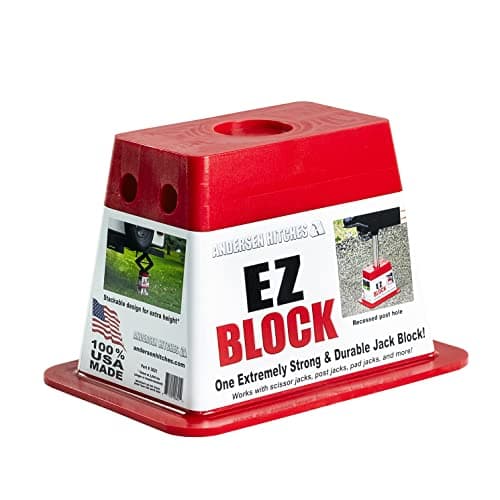 Andersen Hitches EZ Block Jack Block (3621)Height, not just a footprint. The block to buy when a jack will not reach the ground, rather than the one to buy four of. | A jack that cannot reach the ground | Strong | |
| 4 | Valterra Stabilizer Jack PadsFunctionally interchangeable with any other jack pad. Buy whichever is in stock, but do buy a spare for the tongue jack. | A second set for the tongue jack | Strong | |
| 5 | 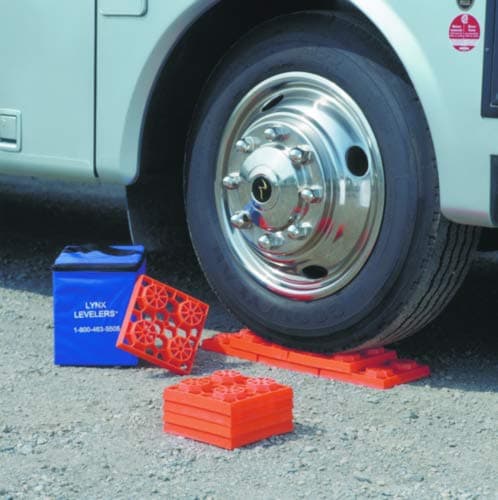 Tri-Lynx Lynx Levelers (10-pack)The upgrade you make after your first soft-ground site: the same stacking idea with a structure that spreads weight instead of concentrating it. | Heavier rigs and soft ground | Good |
Prices come from Amazon and were last checked October 6, 2026. They change constantly, so a price older than 48 hours is withdrawn rather than shown stale — those rows read “Check price on Amazon” instead and go straight to the current listing. #ad — these are affiliate links.
Three jacks, three different jobs
Before buying anything, be clear about which jack you are supporting, because the right answer is not the same for all of them.
The tongue jack at the front carries real weight. A travel trailer’s tongue typically takes something like 10 to 15 percent of its loaded weight, so on a 6,000-pound trailer that is roughly 600 to 900 pounds through one small foot. This is the jack that most needs a pad, and the one where a cheap thin pad is working hardest.
Stabilizer jacks — the scissor jacks at the corners — are not holding the trailer up. They are taking the slack out of the suspension so the trailer stops rocking when you walk around inside. They carry much less load, but they are the jacks that sit on grass and dirt, four of them, all night.
Leveling jacks on larger rigs with hydraulic systems are a different category again, usually with round feet and a snap-on pad designed for that specific foot. If that is your setup, buy the pad made for your jack rather than anything on this page.
Why a jack sinks, in one piece of arithmetic
This is the whole category in one calculation, and it explains why paying for a tougher pad is usually the wrong instinct.
A tongue jack foot is commonly around 3 inches across, which is about 7 square inches of contact. Put 700 pounds through that and the ground underneath is carrying roughly 100 pounds per square inch. Wet grass does not carry 100 psi; it gives way, which is exactly what you find in the morning.
Now put a pad of roughly 11 by 8.5 inches under it. That is about 93 square inches, and the same 700 pounds becomes about 7.5 pounds per square inch. Nothing about the jack or the load changed. You simply spread it over more than ten times the area, and soft ground copes with that comfortably.
The lesson: area is the product. A thicker, stronger, more expensive small pad does far less than a cheap wide one, because the failure was never the pad breaking. It was the ground giving up.
How we choose
We do not run a test lab and we do not pretend to. What this site has is a lodge that hosts RV sites every weekend, on the same ground, in every kind of weather. Jacks sinking into a grass pitch is one of the most predictable things we see, and so is the moment somebody realizes their four plastic pads are still at home.
Beyond that, picks are judged on published manufacturer specifications, current availability from real retailers, and whether a first-season owner can use them correctly without reading a forum thread. Our full methodology is here.
The criteria that decide this purchase
1. Footprint
Covered above and it dominates everything else. Look for the pad dimensions on the listing, not the load rating. Anything around 8 by 10 inches or larger per pad is doing real work; a pad barely bigger than the jack foot is decoration.
2. Height, and whether you need any
Most jack pads are around an inch thick, which is all you want: enough to spread load, not enough to use up jack travel. But there is a second, different situation — a jack that cannot reach the ground because the trailer is parked high, or because the site’s pad has been scooped out. For that you need height, which means a tall purpose-built jack block rather than a pad. Stacking four thin pads to make a tower is how pads shoot out sideways under load.
3. Load rating, read honestly
Ratings matter most under the tongue jack, where there is genuinely several hundred pounds in play. A purpose-made jack block rated in the thousands of pounds is the sensible choice there. For the corner stabilizers, a standard plastic pad is carrying far less and the rating is rarely the limiting factor.
4. Whether it stays where you put it
Two features matter here. A recessed hole or lip locates a post or scissor jack so the pad cannot squirt out sideways as the jack takes load. And an interlocking design lets a pad lock into your leveling blocks, which is the correct way to build height under a jack when you genuinely need it.
5. Whether you will still own them next season
Jack pads are the most-lost item in RVing, because you fit them in daylight and collect them in the dark. Pads that nest flat and live in one bag get counted. Loose pads scattered in a compartment get left under a trailer in Pennsylvania.
Which support suits which jack
| The jack | What to put under it | Why |
|---|---|---|
| Tongue jack on grass | One large pad or a rated jack block | Several hundred pounds through one small foot |
| Four corner stabilizers | A four-pack of plastic pads | Low load, high exposure to soft ground |
| A jack that will not reach | A tall jack block, stacked at most two high | You need height, not just area |
| Jacks on a concrete pad | Nothing, or a thin pad to stop scuffing | Concrete already carries the load |
| Hydraulic leveling feet | The snap-on pad made for your jack | Round feet need a matched pad |
The picks
1. Best for Stopping jacks sinking
Camco Stabilizing Jack Pads
Four squares of plastic that stop your stabilizer jacks burying themselves in a wet grass site overnight.
- Specification
- Set of four
- Specification
- Spreads jack-foot load
- Specification
- Stackable with leveling blocks
What it does well
- Spreads the jack foot over a much larger area, which is the whole reason jacks bury themselves in grass
- Cheap, light, and they live permanently in the same compartment
The real tradeoff
- One more thing to remember to collect when you leave
- Does nothing for a jack already at full extension
How it measures up
These are judgments from published specifications and what we see at the lodge, not laboratory results. How we choose.
- Beginner fit
- Strong — Put one under each foot.
- Stability once set
- Good — A real difference on soft ground.
- Speed to level
- Strong — Adds seconds.
- Value
- Strong — Small money, and it prevents a bad morning.
Specifications from Camco.
2. Best for Pads that stack with your leveling blocks
Camco FasTen RV Stabilizer Jack Pads (4-pack)
The pad to buy if your leveling blocks are Camco FasTen: the two systems lock together, so a tall stack under a jack stays a stack.
- Specification
- Four pads per pack
- Specification
- Each pad about 11 x 8.5 in, giving roughly 1 in of lift
- Specification
- Interlocks with the FasTen leveling block system
- Specification
- Molded plastic, nests flat for storage
What it does well
- Interlocks with FasTen leveling blocks, so a jack that needs more height gets a proper stack instead of a tower of loose pieces
- Nests flat, which is the difference between pads you keep and pads you lose
- Wide enough to make a real difference on grass, which is the only reason to own them
The real tradeoff
- Only interlocks with Camco's own FasTen blocks, so it is a weaker match if your blocks are another brand
- Plastic, so it will flex on a stone and eventually crack if you abuse it
- Does nothing for a jack that is already extended to its limit
How it measures up
These are judgments from published specifications and what we see at the lodge, not laboratory results. How we choose.
- Beginner fit
- Strong — One pad under each foot, before you crank.
- Stability once set
- Strong — The interlock stops a stack walking apart.
- Speed to level
- Strong — Seconds per jack.
- Value
- Strong — Small money for a problem that ruins a night.
Specifications from Camco.
3. Best for A jack that cannot reach the ground
Andersen Hitches EZ Block Jack Block (3621)
Height, not just a footprint. The block to buy when a jack will not reach the ground, rather than the one to buy four of.
- Specification
- Rated by Andersen at 2,000 lb per block
- Specification
- 8 in tall, or 14 in when two are stacked
- Specification
- Base 12 x 8.5 in, top pad 8 x 4.5 in
- Specification
- About 3.1 lb each, sold singly
- Specification
- Recessed 2.5-in post hole; fits scissor, post and pad jacks
What it does well
- Solves the problem a thin pad cannot: a jack with nothing under it, on a site where the pad has been dug out or the trailer is sitting high
- Stacks to two blocks for 14 inches of height, with the rating held at 2,000 lb
- The recessed post hole locates a post or scissor jack so the block cannot squirt out sideways
- Light enough at 3.1 lb that two of them live in the truck without comment
The real tradeoff
- Several times the price of a four-pack of thin plastic pads, per block
- Sold singly, so covering four stabilizer jacks gets expensive quickly
- 2,000 lb per block is plenty for a tongue or stabilizer jack and is not a rating to take liberties with
- Overkill if your jacks already reach the ground comfortably
How it measures up
These are judgments from published specifications and what we see at the lodge, not laboratory results. How we choose.
- Beginner fit
- Strong — Set it down, lower the jack into the recess.
- Stability once set
- Strong — 2,000 lb per block, and the post hole locates it.
- Speed to level
- Strong — Faster than stacking loose blocks.
- Value
- Adequate — Expensive per block. Buy it where height is the problem.
Specifications from Andersen Hitches.
4. Best for A second set for the tongue jack
Valterra Stabilizer Jack Pads
Functionally interchangeable with any other jack pad. Buy whichever is in stock, but do buy a spare for the tongue jack.
- Specification
- Molded pad set
- Specification
- Fits standard jack feet
- Specification
- Nestable for storage
What it does well
- Nest flat, so a second set costs almost no storage space
- Covers the tongue jack, which the standard four-pack often does not
The real tradeoff
- Functionally very close to every other jack pad on the market
How it measures up
These are judgments from published specifications and what we see at the lodge, not laboratory results. How we choose.
- Beginner fit
- Strong — Put it under the foot.
- Stability once set
- Good — Same spread-the-load job.
- Speed to level
- Strong — Seconds.
- Value
- Good — Buy on price. They are equivalent.
Specifications from Valterra.
5. Best for Heavier rigs and soft ground
Tri-Lynx Lynx Levelers (10-pack)
The upgrade you make after your first soft-ground site: the same stacking idea with a structure that spreads weight instead of concentrating it.
- Specification
- Interlocking 10-pack
- Specification
- Open honeycomb structure
- Specification
- Stacks up or spreads sideways
What it does well
- The honeycomb structure spreads load, which is the one thing that helps most on soft sites
- Laid two wide instead of two high, they sink far less than a narrow stack
- Long-lived. These are the ones you still own in five years
The real tradeoff
- Costs more than a basic interlocking set for a difference you only notice on bad ground
- The open structure collects gravel and mud
How it measures up
These are judgments from published specifications and what we see at the lodge, not laboratory results. How we choose.
- Beginner fit
- Good — Same idea as any stacking block, slightly more to carry.
- Stability once set
- Strong — The wide footprint is what stops the slow sink.
- Speed to level
- Adequate — Still stack and check.
- Value
- Good — Worth it if your regular sites are grass or dirt.
Specifications from Tri-Lynx.
What about wood
Plenty of people use timber offcuts and it works. We are not going to pretend otherwise, and if you already have suitable wood in the garage you can start there. Two rules if you do.
Use solid lumber, not plywood. A 2x8 or 2x10 offcut, cut to around 10 inches long, gives you roughly the area a bought pad gives you. Plywood delaminates once water gets into the edges, and it fails by splitting apart rather than by compressing.
Never use concrete block. Hollow masonry units are designed to carry distributed compression inside a wall. Loaded in the middle of their top face by a jack foot they fail suddenly, which is the problem. We go through this in full in leveling blocks versus wood.
What wood will not do is nest flat, stay dry in a compartment, or interlock with anything. That, rather than strength, is why most people end up buying pads after a season of carrying timber around.
Mistakes first-timers make
Buying pads and leaving them home. The most common failure in the category. Keep them in the same compartment as the leveling blocks, in a bag, and fit them as part of the setup sequence rather than as an afterthought.
Using the stabilizer jacks to lift the trailer. Scissor stabilizers are stabilizers. They are not jack stands and they are not rated to lift. Stabilizing is the job; leveling happens before they come down, with blocks under the tires and the tongue jack doing the front. The order is in our guide to leveling a travel trailer.
Building a tall tower out of thin pads. Two pads is fine. Four stacked loose pads under a loaded jack is a mechanism, not a foundation. If you need height, use a block designed to stack or interlocking leveling blocks.
Forgetting the tongue jack. Four-packs cover the four corners and leave the jack carrying the most weight sitting on bare ground. Buy a spare pad, or a rated block, for the front.
Confusing this with rocking. If the trailer moves when someone walks across it, pads are not the fix. That is a suspension and chock question, covered in X-chocks versus wheel chocks.
So which one
For a first season: one four-pack of plastic pads for the corners, plus either a spare pad or one rated jack block for the tongue jack. If your leveling blocks are already Camco FasTen, buy the matching FasTen pads so the two systems lock together. And if the trailer is going into storage for the winter, pads under the jacks and covers on the tires are the same half-hour of work.
Questions people actually ask
Do I really need RV jack pads?
On gravel, grass or dirt, yes. A jack foot is a few square inches carrying hundreds of pounds, which is more pressure than soft ground can hold. On a concrete pad they are optional and mostly stop scuffing.
How many jack pads do I need?
One per jack. That means four for the corner stabilizers plus one more for the tongue jack, so a four-pack alone leaves the hardest-working jack uncovered.
What is the difference between jack pads and leveling blocks?
Leveling blocks go under the tires to change the trailer's height and get it level. Jack pads go under the jack feet to spread load so they do not sink. They do different jobs and most trailers want both.
Can I use wood for RV jack pads?
Yes, if it is solid lumber rather than plywood and it is wider than the jack foot by a good margin. A 2x8 or 2x10 offcut around 10 inches long is roughly the area of a bought pad. Never use hollow concrete block, which fails suddenly under a point load.
How thick should a jack pad be?
About an inch is plenty for spreading load, and keeping them thin preserves jack travel. Thickness only becomes the point when a jack cannot reach the ground, and then you want a purpose-built block that is designed to stack rather than several pads piled up.
Can I stack jack pads to get more height?
Two is reasonable, especially if the design interlocks or has a recess that locates the jack. Beyond that, use a jack block rated for stacking or interlocking leveling blocks, because a loose stack can slide out sideways as the jack loads it.
Sources
Read next
Leveling & Chocks
RV Stabilizers vs Levelers: What Each One Is For
The difference between leveling gear and stabilizing gear, and why using a stabilizer jack to lift can damage the frame.
Leveling & Chocks
Best RV Leveling Blocks for a First Travel Trailer
Interlocking blocks, curved levelers and jack pads compared for someone leveling a trailer for the first time.
Leveling & Chocks
How to Level a Travel Trailer (Step by Step for Beginners)
The full arrival sequence for leveling a towed trailer, in the order that means you only do it once.
First-Season Starter Kit
Best RV Tire Covers for a Travel Trailer
Vinyl, cloth and single-panel tandem covers compared, plus how to measure your tire diameter before you order.
Reviewed October 5, 2026. Spot something out of date? Tell us and we will fix it.