Best Wheel Chocks for a Single-Axle Trailer
One axle means one tire per side, which rules out the most-recommended chock on the internet. Here is what works instead, and how to use it so the trailer stops moving.
Heads up: this page contains affiliate links. If you buy through one, Camp & Chock may earn a commission at no extra cost to you. It never changes which product we put first — how this site is funded.

The short answer
For a single-axle trailer, buy a pair of wedge chocks and place them on opposite sides of the same tire — one in front, one behind. That is the whole answer, and it costs very little. If your site is smooth concrete, buy the solid rubber version instead, because plastic skates on damp concrete. Do not buy an X-chock: it works by pushing two tires apart and you only have one.
This page is part of our leveling and chocks guide, and it exists because the single-axle question has a genuinely different answer from the tandem one. Search for the best RV wheel chocks and the top recommendation is almost always a tire-locking X-chock. On a single-axle trailer that product cannot be fitted at all. Nobody says so, you buy it, and it goes back.
Our picks at a glance
Tap any row to jump to the full write-up.
| # | Product | Best for | Beginner fit | Price |
|---|---|---|---|---|
| 1 | Camco Heavy-Duty Wheel Chocks (pair)The chock that stops the trailer rolling. Not the one that stops it rocking, which is a different product, and you need both. | The non-negotiable basics | Strong | |
| 2 | 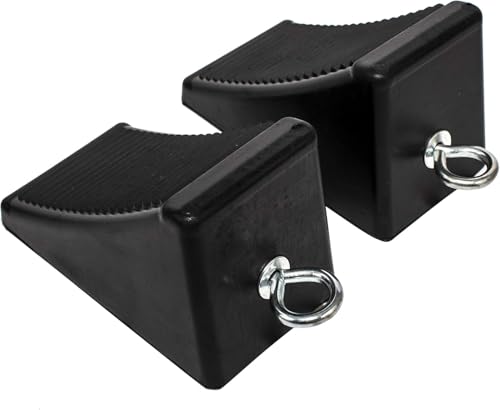 MaxxHaul Solid Rubber Wheel Chocks (pair)Rubber rather than plastic: the version that does not slide when the pad is smooth and slightly damp. | Smooth concrete pads | Strong | |
| 3 | 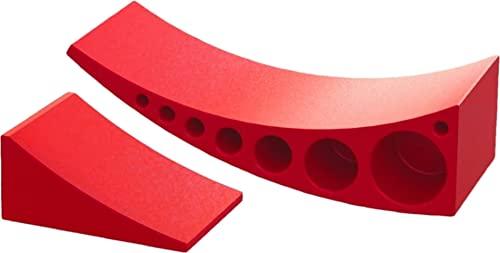 Andersen Hitches Camper LevelerThe one that removes the trial and error: a curved ramp you drive up until level, then stop, with a chock that drops in behind. | Leveling in one attempt | Strong | |
| 4 | 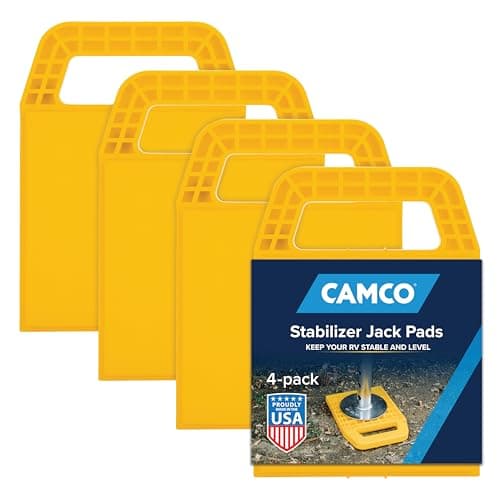 Camco Stabilizing Jack PadsFour squares of plastic that stop your stabilizer jacks burying themselves in a wet grass site overnight. | Stopping jacks sinking | Strong |
Prices come from Amazon and were last checked November 12, 2026. They change constantly, so a price older than 48 hours is withdrawn rather than shown stale — those rows read “Check price on Amazon” instead and go straight to the current listing. #ad — these are affiliate links.
Why the X-chock is out
A tire-locking chock sits in the gap between two tires on the same side of a tandem axle and ratchets outward, pressing against both of them. The force that stops the trailer rocking is the force between those two tires. Take one tire away and there is nothing to push against — the device has no geometry to work in. This is not a fit issue an adapter solves. It is what the product is.
So the entire tire-locking branch of the category closes, and what is left is wedges: ramps of plastic or rubber that sit against the tread and stop the wheel turning. The good news is that wedges are cheap, and the method matters more than the brand.
The method that actually holds a single-axle trailer
With one tire per side you have two chocking positions per tire, and you want both of them. Put one chock hard against the front of the tire and one hard against the back. Opposing chocks remove the small forward-and-back creep a single chock allows, and that creep is what you feel as the trailer shifting when you climb the step.
Do it on both sides. A pair of chocks is two chocks, which covers one tire properly or two tires badly. For a single-axle trailer the correct purchase is two pairs — four chocks, front and back of each tire. They cost so little that buying one pair to save money is a false economy you will notice on the first night.
Order of operations matters as much as the product. Chocks go in while the trailer is still hitched to the truck, before you touch the tongue jack. A single-axle trailer is lighter and shorter than a tandem, which means it is easier to move, which means an unchocked one on a slight slope can roll while you are standing in front of it cranking a jack. Our leveling walkthrough sets out the whole sequence.
How we choose
We do not run a test lab and do not claim to. What this site has instead is a lodge that hosts RV sites every weekend, so we watch the same gear go down on the same ground over and over. Beyond that, picks are judged on published manufacturer specifications, current availability, and whether a first-season owner can use the thing correctly without reading a forum thread first. The full methodology is here.
The picks
1. Best for The non-negotiable basics
Camco Heavy-Duty Wheel Chocks (pair)
The chock that stops the trailer rolling. Not the one that stops it rocking, which is a different product, and you need both.
- Specification
- Wedge chock, sold in pairs
- Specification
- Molded grip handle
- Specification
- Works on any axle count
What it does well
- This is the part you are practically obliged to have, and it costs very little
- Works on any trailer, any axle count. There is no compatibility question
- Bright color means you notice them before you drive off
The real tradeoff
- Stops rolling, does nothing about rocking
- Plastic wedges skate on wet concrete if you do not seat them properly
How it measures up
These are judgments from published specifications and what we see at the lodge, not laboratory results. How we choose.
- Beginner fit
- Strong — Push it against the tire. That is the whole method.
- Stability once set
- Good — Against rolling, yes. Against rocking, no.
- Speed to level
- Strong — Instant.
- Value
- Strong — The cheapest genuinely essential thing on this site.
Specifications from Camco.
2. Best for Smooth concrete pads
MaxxHaul Solid Rubber Wheel Chocks (pair)
Rubber rather than plastic: the version that does not slide when the pad is smooth and slightly damp.
- Specification
- Solid rubber
- Specification
- Sold in pairs
- Specification
- Heavier than molded plastic
What it does well
- Rubber grips concrete instead of skating across it
- Heavy enough that it stays where you put it in wind
The real tradeoff
- Noticeably heavier to carry and store
- Rubber marks whatever shares a compartment with it
How it measures up
These are judgments from published specifications and what we see at the lodge, not laboratory results. How we choose.
- Beginner fit
- Strong — Identical method, better grip.
- Stability once set
- Strong — The grip is the whole point.
- Speed to level
- Strong — Instant.
- Value
- Good — A small premium for a real improvement on concrete.
3. Best for Leveling in one attempt
Andersen Hitches Camper Leveler
The one that removes the trial and error: a curved ramp you drive up until level, then stop, with a chock that drops in behind.
- Specification
- Curved ramp plus matching chock
- Specification
- One unit per side
- Specification
- Continuous height adjustment within its range
What it does well
- You drive up until the bubble centers and stop. No stacking, no guessing, no second attempt
- Any height within its range, rather than the fixed steps a block stack gives you
- The matching chock drops in behind the tire, so one product covers two jobs
The real tradeoff
- Several times the price of a bag of blocks
- Wants a genuinely firm surface. The curved face concentrates load more than a wide block stack does
- Bulky to store for what it is
How it measures up
These are judgments from published specifications and what we see at the lodge, not laboratory results. How we choose.
- Beginner fit
- Strong — The clearest cause and effect in the category.
- Stability once set
- Good — Fine on firm ground, less happy on soft.
- Speed to level
- Strong — One pull-up. This is what you are paying for.
- Value
- Adequate — Expensive per unit of plastic, cheap per hour of frustration.
Specifications from Andersen Hitches.
4. Best for Stopping jacks sinking
Camco Stabilizing Jack Pads
Four squares of plastic that stop your stabilizer jacks burying themselves in a wet grass site overnight.
- Specification
- Set of four
- Specification
- Spreads jack-foot load
- Specification
- Stackable with leveling blocks
What it does well
- Spreads the jack foot over a much larger area, which is the whole reason jacks bury themselves in grass
- Cheap, light, and they live permanently in the same compartment
The real tradeoff
- One more thing to remember to collect when you leave
- Does nothing for a jack already at full extension
How it measures up
These are judgments from published specifications and what we see at the lodge, not laboratory results. How we choose.
- Beginner fit
- Strong — Put one under each foot.
- Stability once set
- Good — A real difference on soft ground.
- Speed to level
- Strong — Adds seconds.
- Value
- Strong — Small money, and it prevents a bad morning.
Specifications from Camco.
What to look for
Material, which is really a surface question
Molded plastic wedges are the default and they are fine on gravel, grass and dry asphalt, where the surface itself provides grip. On smooth concrete — especially concrete that is damp, or dusted with the fine grit that collects on a hardstand — a plastic wedge can slide under load instead of biting. Solid rubber does not do this. If your home site or your usual campground is a poured pad, pay the small premium.
Size against your tire
A chock needs to reach a useful height up the tire to resist rolling rather than being squeezed out from under it. Travel trailer tires are commonly in the two-foot-plus diameter range, and chocks sold for RV use are sized for that. Chocks sold for cars are shorter and lower and are not a substitute, however similar the shape looks in a photograph.
Whether you want the chock bundled with the leveler
A curved camper leveler includes a matching chock that drops in behind the tire once you have driven up the ramp. On a single-axle trailer that bundling is unusually attractive, because leveling and chocking happen at the same single tire and one product covers both. It is the most expensive way to arrive at a chock, but you are buying the one-attempt leveling as well — compared properly in best RV leveling blocks.
Single-axle chocking, by situation
| Your site | What to buy | Why |
|---|---|---|
| Gravel or grass | Two pairs of plastic wedges | The surface supplies the grip; cheapest correct answer |
| Smooth or damp concrete | Two pairs of solid rubber | Plastic slides on a poured pad |
| Sloping pitch | Rubber wedges, front and back of each tire | Opposing chocks stop creep in both directions |
| You are also buying levelers | Curved leveler with bundled chock | One product, both jobs, at the same tire |
| Trailer still rocks once chocked | Jack pads under the stabilizers | Rocking is a stabilizer problem, not a chock problem |
Mistakes we see most
One chock per trailer. It is the single most common sight on a weekend. One wedge, behind one tire, on a trailer that then moves whenever anyone walks inside.
Chocking after unhitching. The trailer is at its most likely to move at exactly the moment it stops being attached to something heavy. Chocks first.
Expecting chocks to stop rocking. They will not, and that is not a defect. Sway comes from the suspension and the stabilizer jacks, which is a different fix entirely — see how to keep a travel trailer from rocking.
If you came here and then counted two wheels on each side, you want the tandem version of this page instead, where the shopping list is longer because the tire-locking chock becomes available: best wheel chocks for a tandem-axle trailer.
Questions people actually ask
Can you use X-chocks on a single-axle trailer?
No. A tire-locking X-chock works by ratcheting outward against two tires on the same side of a tandem axle. A single-axle trailer has one tire per side, so there is nothing for it to brace against. It is not a fit problem an adapter can solve.
How many chocks do I need for a single-axle trailer?
Four. One in front and one behind each of the two tires. Opposing pairs remove the small forward-and-back creep that a single chock allows, and chocks are cheap enough that buying two pairs is not a real decision.
Should chocks go in before or after unhitching?
Before, always, while the trailer is still attached to the tow vehicle. The trailer is most likely to move at the moment it is freed from the hitch, and that is also when you are standing at the tongue working the jack.
Do rubber chocks work better than plastic?
On smooth concrete, clearly yes, because rubber grips where plastic slides. On gravel, grass or dry asphalt the difference is small and the plastic wedges are fine. The surface decides it, not the trailer.
Will chocks stop my single-axle trailer rocking?
No. Chocks stop the wheels turning. Rocking is movement in the suspension and the stabilizer jacks and needs a different fix, usually jack pads and correctly loaded stabilizers.
Sources
Read next
Leveling & Chocks
Best RV Wheel Chocks for a Travel Trailer
Wedge chocks, X-chocks and the difference between a trailer that rolls and a trailer that rocks.
Leveling & Chocks
X-Chocks vs Wheel Chocks: What Each One Actually Stops
The difference between rolling and rocking, which chock fixes which, and why the answer is usually both.
Leveling & Chocks
How to Keep a Travel Trailer From Rocking
Why a parked trailer still moves, and the order of operations plus gear that stops it.
Leveling & Chocks
How to Level a Travel Trailer (Step by Step for Beginners)
The full arrival sequence for leveling a towed trailer, in the order that means you only do it once.
Reviewed October 10, 2026. Spot something out of date? Tell us and we will fix it.