How to Keep a Travel Trailer From Rocking
The trailer is level, the chocks are in, and it still moves every time someone walks to the back. That is a stabilizer problem, and it has a sequence.
Heads up: this page contains affiliate links. If you buy through one, Camp & Chock may earn a commission at no extra cost to you. It never changes which product we put first — how this site is funded.
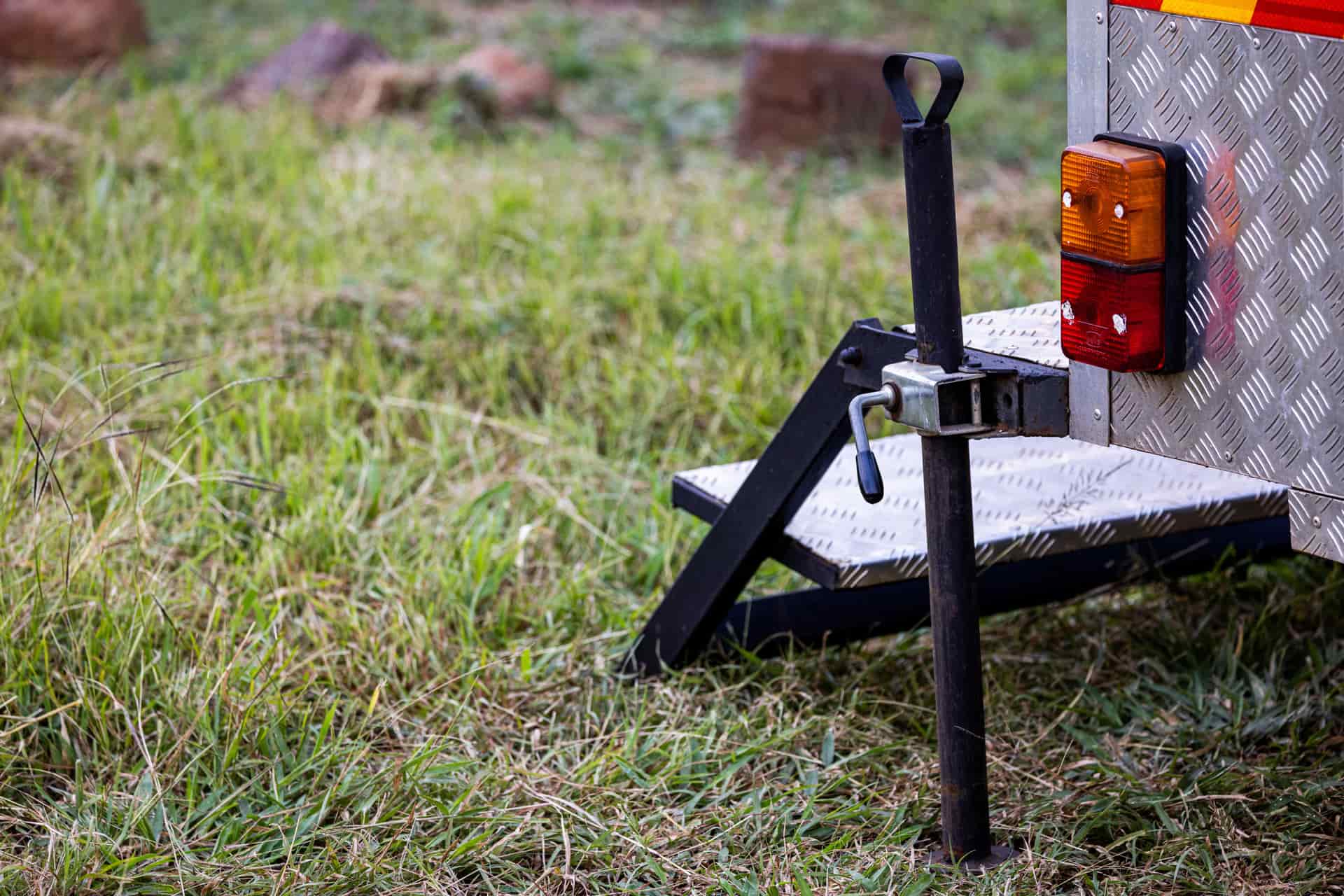
A travel trailer rocks because it is still sitting on its suspension. The springs and tires are designed to move, the trailer is tall and narrow, and anyone walking inside it is a large moving weight. Chocks will not fix this and neither will more leveling blocks. What stops the rocking is taking load off the suspension: tires chocked in opposing pairs, stabilizer jacks extended onto pads firm enough that they do not sink, and — on a tandem axle — a tire-locking chock between the two tires. Done in that order it takes about five minutes.
This is part of our leveling and chocks guide, and it is the question people actually ask. Nobody searches for a stabilizer category. They search because the trailer moved when someone walked to the bathroom and it felt wrong.
The three sources of movement, in order of how much they matter
1. The suspension, which is most of it
A parked trailer is a box on leaf springs. Walk from the door to the rear bunk and several hundred pounds moves four or five feet along a structure sprung to absorb exactly that kind of load. The trailer leans, the springs push back, and you get the slow front-to-back rock people describe as the trailer bouncing.
You cannot remove the suspension, but you can stop asking it to carry the whole trailer. That is what the stabilizer jacks are for — and the word is stabilizer, not leveler. They are not built to lift the trailer, they are built to brace it once it is already level.
2. The stabilizer jacks not being properly loaded
A scissor jack that is merely touching the ground does nothing. It has to be cranked down until it takes real weight, so the frame is wedged between the jack and the ground with no slack left. The usual error is stopping the moment the foot makes contact, which leaves a fraction of an inch of movement at the jack and considerably more at the far corner of the trailer.
The second usual error is a jack foot that is loaded correctly and then sinks. A stabilizer foot is only a few square inches, and on wet grass those few square inches will find their way into the ground over the course of an evening. By midnight you are back to a trailer sitting on its springs. Pads under the feet are the entire fix, and we work the pressure arithmetic through in best RV jack pads.
3. Side-to-side sway on a tandem axle
If you have two axles there is a third motion available: the two tires on each side can rock slightly toward and away from each other, which reads as a side-to-side shimmy. A tire-locking chock fitted into the gap and ratcheted outward removes it, which is why that product exists and why it is the standard answer for a trailer that rocks.
On a single-axle trailer this motion does not exist, so the tire-locking chock has nothing to do and cannot be fitted. See best wheel chocks for a single-axle trailer for what to buy instead.
The sequence, in the order it has to happen
Every step depends on the one before it, which is why doing them in a different order means doing some of them twice.
What this sequence needs
A tire-locking chock for a tandem axle, pads so the jacks stop sinking, and wedges that hold the wheels while you work.
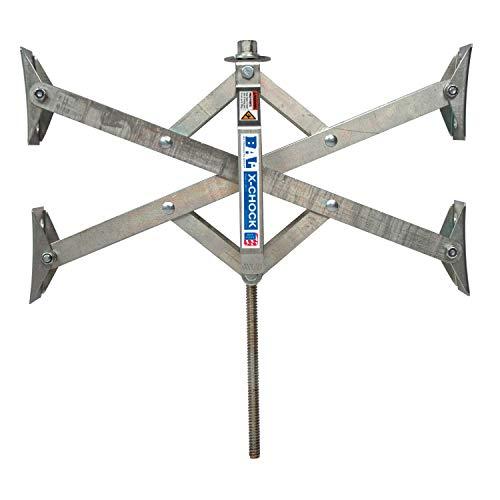
Best for Tandem-axle rigs that rock
BAL X-Chock Tire Locking Chock
The standard answer to a trailer that rocks when you walk across it, and only useful if you have two axles per side.
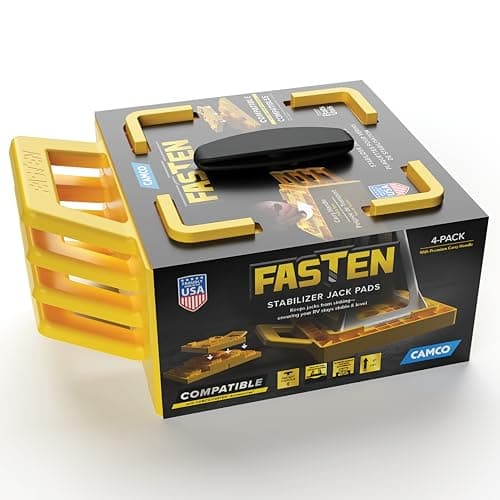
Best for Pads that stack with your leveling blocks
Camco FasTen RV Stabilizer Jack Pads (4-pack)
The pad to buy if your leveling blocks are Camco FasTen: the two systems lock together, so a tall stack under a jack stays a stack.
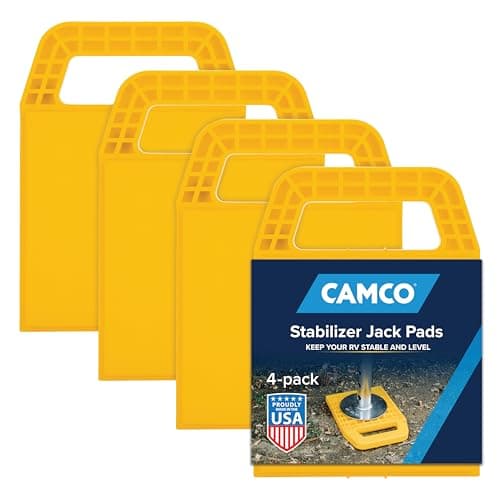
Best for Stopping jacks sinking
Camco Stabilizing Jack Pads
Four squares of plastic that stop your stabilizer jacks burying themselves in a wet grass site overnight.
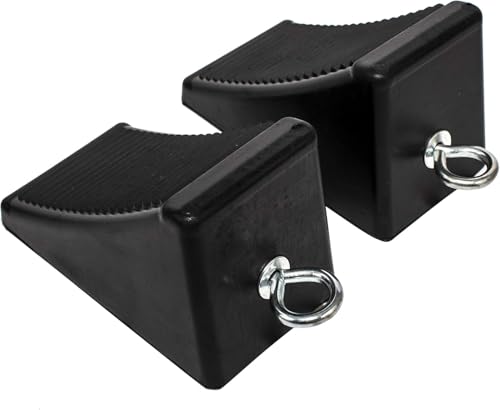
Best for Smooth concrete pads
MaxxHaul Solid Rubber Wheel Chocks (pair)
Rubber rather than plastic: the version that does not slide when the pad is smooth and slightly damp.
Step by step
Follow it once with the list in front of you and it becomes automatic by the third trip.
The five-minute stabilizing routine
| Step | What you do | Why this order |
|---|---|---|
| 1 | Level side to side with blocks, still hitched | Height changes after this point undo everything else |
| 2 | Chock in opposing pairs, still hitched | The trailer cannot be allowed to move once unhitched |
| 3 | Fit the tire-locking chock between tandem tires | Easiest while the trailer is at its most settled |
| 4 | Unhitch and level front to back on the tongue jack | Front-to-back is the tongue jack's job, not the blocks' |
| 5 | Put a pad under every stabilizer foot | Place them before the jack is down, never after |
| 6 | Crank each stabilizer until it genuinely loads | Contact is not enough; the slack is the rocking |
What not to do
Do not lift the trailer on the stabilizer jacks. They are not rated for it, the frame is not meant to be jacked at those points, and a trailer resting on four scissor jacks instead of its tires is less stable rather than more. Get level on the tires first.
Do not chase it with more leveling blocks. Rocking and being out of level are different problems. A perfectly level trailer rocks exactly as much as an unlevel one if the stabilizers are not loaded.
Do not substitute cinder blocks for pads. Hollow concrete masonry is engineered for distributed compression inside a wall and fails suddenly under a point load. We cover why the question keeps coming up in how to level a travel trailer.
How much movement is reasonable
Worth setting an expectation, because the goal is not a trailer that feels like a house. A correctly stabilized travel trailer still moves a little when someone walks the length of it. What should disappear is the slow sprung rock that continues for a second or two after the person stops, and the side-to-side shimmy when you climb the step.
If what remains is a short, immediate flex that stops the moment the weight does, that is the floor and the frame doing what they do, and no amount of additional gear changes it. Chasing that last bit with more stabilizers or heavier chocks is how people end up with a compartment full of hardware and the same feeling.
For the broader question of which product does which job — and why stabilizers and levelers get confused constantly — see RV stabilizers versus levelers. And if the movement you are feeling is actually a trailer sitting off level after you already unhitched, what can and cannot be corrected from a parked position is set out in how to level a camper without moving it.
Questions people actually ask
Why does my travel trailer rock when I walk in it?
Because it is still sitting on its suspension. The springs and tires are designed to move, and a person walking from one end to the other is a large shifting load. Taking weight off the suspension with properly loaded stabilizer jacks is what stops it.
Do stabilizer jacks stop a trailer rocking?
Yes, if they are cranked down until they genuinely carry weight and are sitting on something that will not sink. A jack that is only touching the ground leaves slack, and that slack is the rocking you feel.
Should I use X-chocks or stabilizer jacks?
Both, if you have a tandem axle. The tire-locking chock removes side-to-side movement between the two tires; the stabilizer jacks take load off the suspension. They address different motions and neither replaces the other.
Can I lift the trailer with the stabilizer jacks to stop the rocking?
No. Stabilizer jacks are for bracing a trailer that is already level on its tires, not for lifting it. Lifting on them stresses the frame at points not designed for it and makes the trailer less stable, not more.
Why do my stabilizer jacks sink into the ground?
The foot is only a few square inches, so the pressure on the ground underneath it is high. On grass or soft dirt it works its way in over an evening. A pad under each foot spreads the same load over a much larger area and solves it.
Sources
Read next
Leveling & Chocks
RV Stabilizers vs Levelers: What Each One Is For
The difference between leveling gear and stabilizing gear, and why using a stabilizer jack to lift can damage the frame.
Leveling & Chocks
Best RV Jack Pads for a Travel Trailer
Jack pads and jack blocks compared on the one number that matters: how much ground they spread the load across.
Leveling & Chocks
Best Wheel Chocks for a Single-Axle Trailer
Chocks that work on a one-axle trailer, including why the X-chock everyone recommends is the wrong buy for your rig.
Leveling & Chocks
Best RV Wheel Chocks for a Travel Trailer
Wedge chocks, X-chocks and the difference between a trailer that rolls and a trailer that rocks.
Reviewed October 10, 2026. Spot something out of date? Tell us and we will fix it.