RV Leveling Ramps vs Blocks
A ramp is continuous and fast and concentrates load. A block stack is stepped and slower and spreads load. On firm ground the ramp wins; on soft ground it is the other way around.
Heads up: this page contains affiliate links. If you buy through one, Camp & Chock may earn a commission at no extra cost to you. It never changes which product we put first — how this site is funded.
The verdict
Buy a curved ramp leveler if your sites are firm — gravel pads, concrete, compacted dirt — because driving up until the bubble centers and stopping removes the trial and error entirely. Buy stacking blocks if your sites are grass, soft dirt or anything that gives underfoot, because a wide block footprint sinks far less than a ramp’s curved contact patch. If you only want to own one set and your ground varies, buy the blocks: they are cheaper, they work everywhere, and the cost is a second pull-forward.
Part of our leveling and chocks guide, and the format comparison our leveling blocks roundup raises and does not resolve. We settle the blocks-versus-timber question separately in leveling blocks versus wood; this page is about the two purpose-built formats.
Our picks at a glance
Tap any row to jump to the full write-up.
| # | Product | Best for | Beginner fit | Price |
|---|---|---|---|---|
| 1 | 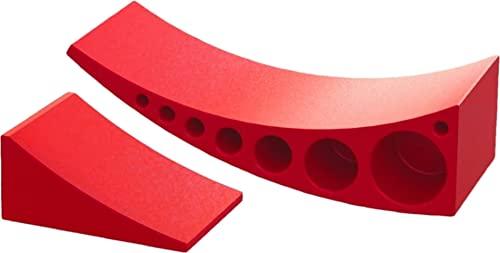 Andersen Hitches Camper LevelerThe one that removes the trial and error: a curved ramp you drive up until level, then stop, with a chock that drops in behind. | Leveling in one attempt | Strong | |
| 2 | 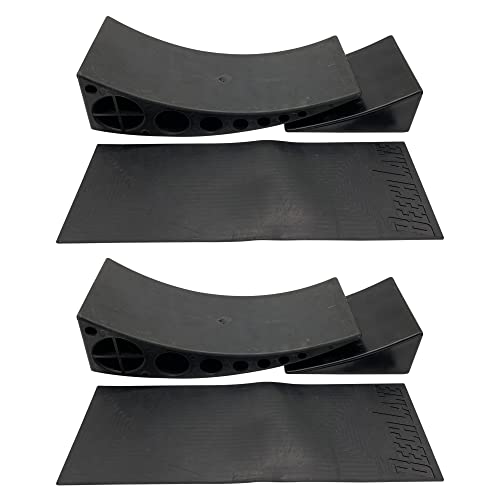 Beech Lane Camper Leveler KitThe same drive-up-and-stop mechanism as the category leader, usually bundled more completely and usually for less. | The curved-ramp idea for less | Strong | |
| 3 | 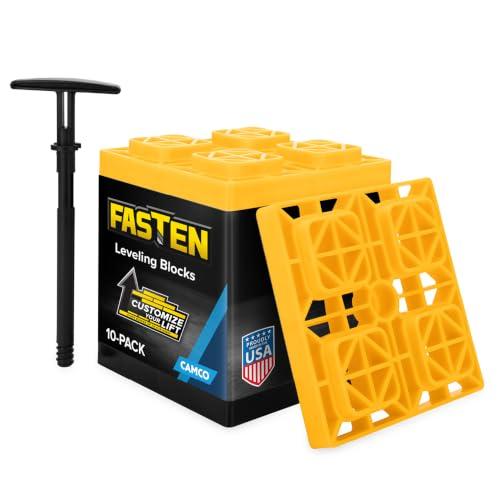 Camco FasTen Leveling Blocks (10-pack)The default first purchase for a travel trailer: interlocking blocks you stack into a ramp, cheap enough to buy two sets. | Most first trailers | Strong | |
| 4 | 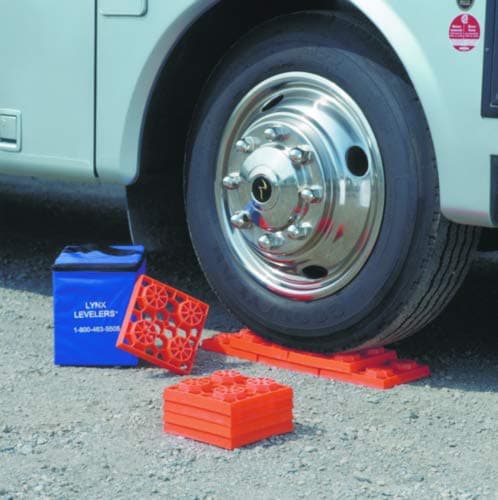 Tri-Lynx Lynx Levelers (10-pack)The upgrade you make after your first soft-ground site: the same stacking idea with a structure that spreads weight instead of concentrating it. | Heavier rigs and soft ground | Good |
Prices come from Amazon and were last checked November 12, 2026. They change constantly, so a price older than 48 hours is withdrawn rather than shown stale — those rows read “Check price on Amazon” instead and go straight to the current listing. #ad — these are affiliate links.
They solve the same problem two different ways
Side-to-side leveling means raising the low-side tires by some number of inches that you do not know in advance. Both formats answer that. They differ in how they get the height, and that single difference produces every other difference on this page.
A ramp gives you a continuous height
A curved leveler is a wedge with a rising curve. You place it in front of the low-side tire, drive up the curve, and stop when the bubble centers. Because the curve is continuous, you can stop anywhere on it, which means you can achieve any height within its range — not 1 inch or 2 inches, but 1 and three-eighths if that is what the site wants. One pull-up, one stop, done.
The cost of that is load concentration. At the moment you stop, the tire is resting on a curved surface, so the contact patch is narrower than it would be on a flat block. On firm ground that is irrelevant. On wet grass it is the mechanism by which the leveler presses itself into the ground and your trailer quietly goes out of level overnight.
A block stack gives you fixed steps and a wide footprint
Stacking blocks give you height in increments — roughly an inch per layer. You guess how many you need, build the ramp, drive up, check the bubble, and quite often pull forward and add or remove a layer. That is the trial and error people complain about, and it is real: a first-timer should expect two attempts.
What you get for it is a flat, wide bearing surface, and on soft ground that is worth more than the convenience. Laid two blocks wide rather than two blocks high, the footprint spreads load over several times the area of a ramp’s contact patch, and the stack stays where you put it.
The decision, in one table
Ramp against block stack
| Consideration | Curved ramp | Stacking blocks |
|---|---|---|
| Height available | Continuous within its range - stop anywhere | Stepped, roughly an inch per layer |
| Attempts to get level | Usually one pull-up | Often two, sometimes three |
| Soft ground | Weaker - the curve concentrates load | Stronger - lay them wide and they spread load |
| Cost | Several times the price of a block set | The least money that does the job properly |
| Storage | Bulky for what it is, awkward shape | Stacks flat, wants a bag so you stop losing them |
| Chock included | Normally yes, a matching chock drops in behind | No - chocks are a separate purchase |
The picks
1. Best for Leveling in one attempt
Andersen Hitches Camper Leveler
The one that removes the trial and error: a curved ramp you drive up until level, then stop, with a chock that drops in behind.
- Specification
- Curved ramp plus matching chock
- Specification
- One unit per side
- Specification
- Continuous height adjustment within its range
What it does well
- You drive up until the bubble centers and stop. No stacking, no guessing, no second attempt
- Any height within its range, rather than the fixed steps a block stack gives you
- The matching chock drops in behind the tire, so one product covers two jobs
The real tradeoff
- Several times the price of a bag of blocks
- Wants a genuinely firm surface. The curved face concentrates load more than a wide block stack does
- Bulky to store for what it is
How it measures up
These are judgments from published specifications and what we see at the lodge, not laboratory results. How we choose.
- Beginner fit
- Strong — The clearest cause and effect in the category.
- Stability once set
- Good — Fine on firm ground, less happy on soft.
- Speed to level
- Strong — One pull-up. This is what you are paying for.
- Value
- Adequate — Expensive per unit of plastic, cheap per hour of frustration.
Specifications from Andersen Hitches.
2. Best for The curved-ramp idea for less
Beech Lane Camper Leveler Kit
The same drive-up-and-stop mechanism as the category leader, usually bundled more completely and usually for less.
- Specification
- Curved ramp plus chock
- Specification
- Sold as a two-side kit
- Specification
- Rubber grip pads in most kits
What it does well
- Works the same way as the better-known curved leveler and usually costs less
- Kits normally arrive with the chocks and grip mats, so nothing is missing on night one
- The grip pads genuinely help on smooth concrete pads
The real tradeoff
- Same soft-ground caveat as every curved leveler
- Kit contents vary between listings, so read what is actually in the box
How it measures up
These are judgments from published specifications and what we see at the lodge, not laboratory results. How we choose.
- Beginner fit
- Strong — Drive up, stop, chock. Nothing to learn.
- Stability once set
- Good — The grip pads are a real help on concrete.
- Speed to level
- Strong — Single attempt, same as the original.
- Value
- Strong — The reason most people end up here instead.
Specifications from Beech Lane.
3. Best for Most first trailers
Camco FasTen Leveling Blocks (10-pack)
The default first purchase for a travel trailer: interlocking blocks you stack into a ramp, cheap enough to buy two sets.
- Specification
- Interlocking 10-pack
- Specification
- Stacks into a ramp
- Specification
- Carry bag sold separately
What it does well
- The blocks lock together, so a two-high stack does not shuffle apart when the tire rolls onto it
- Ten blocks covers one axle on most sites and two axles on gently sloped ones
- Cheap enough that losing one in the grass is annoying rather than expensive
The real tradeoff
- You still guess how many to stack, then pull forward and re-check
- On soft ground they sink, and nothing in the design prevents that
How it measures up
These are judgments from published specifications and what we see at the lodge, not laboratory results. How we choose.
- Beginner fit
- Strong — No instructions needed. Stack, drive up, stop.
- Stability once set
- Good — The interlock is what keeps a stack honest.
- Speed to level
- Adequate — Trial and error. You will pull forward twice.
- Value
- Strong — The least money you can spend and still do this properly.
Specifications from Camco.
4. Best for Heavier rigs and soft ground
Tri-Lynx Lynx Levelers (10-pack)
The upgrade you make after your first soft-ground site: the same stacking idea with a structure that spreads weight instead of concentrating it.
- Specification
- Interlocking 10-pack
- Specification
- Open honeycomb structure
- Specification
- Stacks up or spreads sideways
What it does well
- The honeycomb structure spreads load, which is the one thing that helps most on soft sites
- Laid two wide instead of two high, they sink far less than a narrow stack
- Long-lived. These are the ones you still own in five years
The real tradeoff
- Costs more than a basic interlocking set for a difference you only notice on bad ground
- The open structure collects gravel and mud
How it measures up
These are judgments from published specifications and what we see at the lodge, not laboratory results. How we choose.
- Beginner fit
- Good — Same idea as any stacking block, slightly more to carry.
- Stability once set
- Strong — The wide footprint is what stops the slow sink.
- Speed to level
- Adequate — Still stack and check.
- Value
- Good — Worth it if your regular sites are grass or dirt.
Specifications from Tri-Lynx.
If you own blocks already, is a ramp worth adding?
Only if the trial and error genuinely annoys you, and for some people it genuinely does. A ramp does not level your trailer better than blocks do; it levels it in one attempt instead of two. That is worth real money to someone who arrives at a site tired and in the dark several times a season, and it is worth nothing to someone who does not mind pulling forward once.
What it is not is an upgrade in stability. If your complaint about blocks is that the trailer still rocks once it is level, the answer is not a ramp — it is a chock that works on the rocking rather than the rolling. See how to keep a travel trailer from rocking.
If you own a ramp already, should you also carry blocks?
Yes, and this is the combination most experienced owners end up with. The ramp handles firm pads, which is most commercial campgrounds, and a small set of blocks covers the grass site, the stabilizer jacks that cannot reach the ground, and the time the slope exceeds the ramp’s range. Blocks are cheap enough that carrying them as the backup is not a real decision.
What we would actually buy
A curved kit for firm pads, a set of interlocking blocks as the backup, and the honeycomb set instead if your regular sites are grass.
Best for The curved-ramp idea for less
Beech Lane Camper Leveler Kit
The same drive-up-and-stop mechanism as the category leader, usually bundled more completely and usually for less.
Best for Most first trailers
Camco FasTen Leveling Blocks (10-pack)
The default first purchase for a travel trailer: interlocking blocks you stack into a ramp, cheap enough to buy two sets.
Best for Heavier rigs and soft ground
Tri-Lynx Lynx Levelers (10-pack)
The upgrade you make after your first soft-ground site: the same stacking idea with a structure that spreads weight instead of concentrating it.
Neither format does the front-to-back job
Both of these are side-to-side tools. Front-to-back leveling is done with the tongue jack, before you unhitch, and it has nothing to do with what is under the tires. People sometimes buy a second set of blocks expecting to solve a nose-high trailer with them, and that is not what they are for. The sequence is covered in how to level a travel trailer, and the specific case of leveling without repositioning is in how to level a camper without moving it.
Questions people actually ask
Are RV leveling ramps better than blocks?
On firm ground, yes, because you drive up until level and stop instead of guessing a stack height. On soft ground, no, because a ramp's curved contact patch concentrates load and presses into the ground, where a wide block footprint spreads it.
Can I use a curved leveler on grass?
You can, but it is the format's weak case. The curve concentrates load, so on wet grass the leveler sinks and the trailer goes out of level. If your regular sites are soft, lay blocks wide instead.
Do curved levelers come with chocks?
Most kits do. A matching chock drops in behind the tire once you have stopped on the ramp, which means one product covers both jobs. Stacking blocks do not include chocks, so budget for a pair separately.
Should I own both ramps and blocks?
It is the combination most experienced owners end up with. The ramp handles firm commercial pads; a small set of blocks covers grass sites, stabilizer jacks that cannot reach the ground, and slopes past the ramp's range.
Sources
Read next
Leveling & Chocks
Best RV Leveling Blocks for a First Travel Trailer
Interlocking blocks, curved levelers and jack pads compared for someone leveling a trailer for the first time.
Leveling & Chocks
RV Leveling Blocks vs Wood: An Honest Comparison
Blocks against lumber on cost, weight, stacking, storage and safety, plus the ramp trick that makes wood work.
Leveling & Chocks
How to Level a Camper Without Moving It
What you can fix from a parked position, what you genuinely cannot, and the least-bad options when you are already set up.
Leveling & Chocks
Andersen vs Beech Lane Camper Leveler: Which Should You Buy?
The two curved levelers compared on mechanism, kit contents, grip and price. A clear winner for most first trailers.
Reviewed October 11, 2026. Spot something out of date? Tell us and we will fix it.