RV Dogbone Adapters Explained
An adapter converts a plug shape. It does not create amps, and that single sentence prevents most of the trouble people get into with them.
Heads up: this page contains affiliate links. If you buy through one, Camp & Chock may earn a commission at no extra cost to you. It never changes which product we put first — how this site is funded.

For a 30-amp travel trailer, the adapter to own is 50 amp to 30 amp — a female 50-amp end for the pedestal and a male 30-amp end for your cord — because the pedestal you cannot use otherwise is the 50-amp-only one. Buy a 30-to-15 as well if you ever plug in at home. The adapter changes the connector shape and nothing else. It does not increase the current available to your trailer, and it does not reduce it either; that is set by the breaker feeding the outlet.
Part of our power and surge protection guide. Our RV power cord roundup mentions adapters in passing; this page is the decision, because the direction is the thing people buy wrong.
Why it is called a dogbone
Because it is a short length of cable with a connector lump at each end, which is roughly the shape of a cartoon bone. The alternative format is a rigid block adapter where the two connectors are molded back to back with no cable between them, and the dogbone is better for a reason worth knowing.
A rigid block adapter hangs off the pedestal outlet with the whole weight of your power cord pulling on it, levering sideways on the outlet contacts. Over time that loosens the connection, and a loose high-current connection makes heat. The dogbone’s short cable lets the cord hang from the cable rather than from the socket, which takes that strain off the contacts entirely. For the few dollars difference, buy the dogbone every time.
The direction problem, which is the only real mistake
Adapters are described by what they adapt from and to, and sellers are not consistent about which order they write it in. The reliable way to think about it is in terms of the physical ends.
One end has to be female — the socket end — and that end goes onto the pedestal’s male plug. The other end has to be male — the pin end — and your trailer’s cord plugs into it. Work out what the pedestal has and what your cord has, and the adapter you need is the one whose female end matches the pedestal.
Which adapter for which situation
| You have | Pedestal offers | Adapter needed |
|---|---|---|
| 30-amp trailer | 50 amp only | 50 amp female to 30 amp male - the common one to own |
| 30-amp trailer | A household 15/20-amp outlet | 15 amp male to 30 amp female - and expect to run very little |
| 50-amp rig | 30 amp only | 30 amp female to 50 amp male - and you are limited to 30 amps |
| 30-amp trailer | 30 amp | None. Plug straight in |
The sentence that prevents the trouble
An adapter does not create amps. A 30-amp trailer on a 15-amp household outlet through an adapter is still a 15-amp supply, and the breaker in your house panel is what decides that. The trailer has no idea it is on a small supply and will happily try to run the air conditioner, at which point the house breaker opens and you learn the hard way.
On a 15-amp household outlet, plan to run the fridge, the lights, the water pump and the charger, and nothing with a heating element or a compressor. No air conditioning, no electric water heater element, no microwave, not two of those at once and not one of them on its own either. This is normal and fine for keeping a trailer cool and the battery topped up on a driveway; it is not a camping hookup.
What to buy
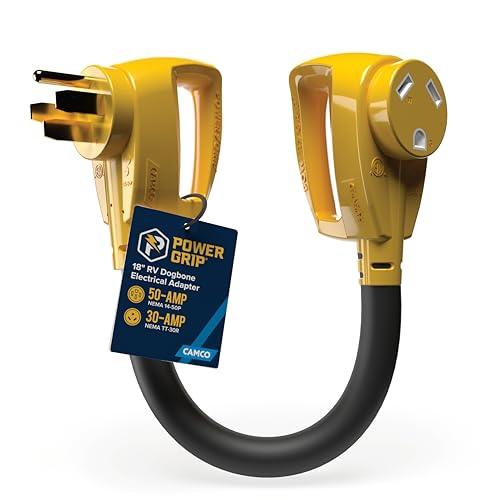
1. Best for Whatever the pedestal has
Camco PowerGrip Dogbone Adapter (50 amp to 30 amp)
A short cord that converts one plug shape into another. Buy the pair you might need before the trip, not at the pedestal.
- Specification
- Short adapter cord
- Specification
- Molded grip handles
- Specification
- Common 50-to-30 and 30-to-15 variants
What it does well
- Turns an incompatible pedestal into a usable one for very little money
- The short-cord format takes strain off the connector, unlike a rigid block adapter
The real tradeoff
- An adapter does not create amps. A 30-amp rig on a 15-amp outlet is still a 15-amp rig
- Easy to buy the wrong direction. Read which end is male
How it measures up
These are judgments from published specifications and what we see at the lodge, not laboratory results. How we choose.
- Beginner fit
- Strong — Plug A to plug B. Check the direction once.
- Protection breadth
- Adequate — None. Keep the protector in the chain.
- Diagnostics
- Adequate — Not applicable.
- Value
- Strong — Cheap insurance against a wasted night.
Specifications from Camco.
2. Best for Reaching the pedestal
Camco PowerGrip 30-Amp Extension Cord (25 ft)
The spare cord you buy after your first site where the pedestal was on the wrong side, with handles that make the plug manageable.
- Specification
- 30 amp, 25 ft
- Specification
- Molded grip handles at both ends
- Specification
- Outdoor-rated jacket
What it does well
- The grip handles matter more than they sound. A 30-amp plug is stiff and cold hands lose to it
- Twenty-five feet covers the sites where the pedestal is behind you rather than beside you
The real tradeoff
- Heavy and stiff in the cold
- A second cord is one more bulky thing in a small compartment
How it measures up
These are judgments from published specifications and what we see at the lodge, not laboratory results. How we choose.
- Beginner fit
- Strong — It is an extension cord with good handles.
- Protection breadth
- Adequate — None. This is a cord, not a protector.
- Diagnostics
- Adequate — Not applicable.
- Value
- Good — Standard money for a cord that will not crack.
Specifications from Camco.
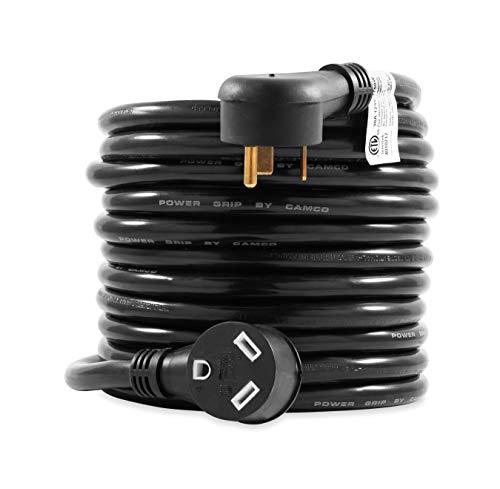
3. Best for Replacing a damaged cord
Camco Heavy-Duty RV Power Cord (30 amp, 25 ft)
The replacement cord. Buy it when yours is damaged, not before, and replace it the day it is rather than the season after.
- Specification
- 30 amp, 25 ft
- Specification
- Outdoor-rated
- Specification
- Standard RV connector at the rig end
What it does well
- A direct replacement when the factory cord gets crushed in a compartment door, which happens more than you would think
- Cheaper than the consequences of continuing to use a damaged cord
The real tradeoff
- Bulky
- Not an upgrade over a healthy factory cord, only a replacement
How it measures up
These are judgments from published specifications and what we see at the lodge, not laboratory results. How we choose.
- Beginner fit
- Strong — Swaps straight in.
- Protection breadth
- Adequate — Not a protector.
- Diagnostics
- Adequate — Not applicable.
- Value
- Good — Sensible money against the alternative.
Specifications from Camco.
What 50 amp actually means, since it is not what it sounds like
Worth clearing up, because it affects whether an adapter is a compromise or an upgrade.
A 30-amp RV connection is one 120-volt leg at 30 amps. A 50-amp RV connection is two 120-volt legs at 50 amps each, which is why 50-amp rigs can run two air conditioners. So a 50-amp pedestal is not “a bit more” than a 30-amp one; it is several times the capacity.
The consequence for a 30-amp trailer is good news: plugging into a 50-amp pedestal through a 50-to-30 adapter gives you a full, clean 30 amps with enormous headroom upstream. There is no downside and nothing to be careful about. The consequence for a 50-amp rig on a 30-amp pedestal is the opposite: you have one leg at 30 amps and you must manage your loads accordingly, which usually means one air conditioner and some discipline.
Three-prong and four-prong, which is where people get confused
A 30-amp RV plug has three prongs: hot, neutral, ground. A 50-amp RV plug has four: two hots, neutral, ground. That fourth prong is the second leg, and it is why the two connectors are not interchangeable and why an adapter has to exist at all rather than just a different shape of plug.
It is also why you should never attempt to make your own. The wiring decisions inside a 50-to-30 adapter — which leg is used, how neutral and ground are handled — are not obvious, and getting them wrong on a shore power connection is a fire or shock risk rather than an inconvenience. Buy the molded part.
The two things to carry
A 50-to-30 dogbone for the pedestal you cannot otherwise use, and a 25 ft extension cord for the pedestal that is on the wrong side of the site.
Best for Whatever the pedestal has
Camco PowerGrip Dogbone Adapter (50 amp to 30 amp)
A short cord that converts one plug shape into another. Buy the pair you might need before the trip, not at the pedestal.
Best for Reaching the pedestal
Camco PowerGrip 30-Amp Extension Cord (25 ft)
The spare cord you buy after your first site where the pedestal was on the wrong side, with handles that make the plug manageable.
The rest of the pedestal kit
A dogbone solves a connector problem. Two other site problems look similar and have different answers.
The pedestal is too far away. That is an extension cord, not an adapter. Buy a 25-foot cord in your own amperage rather than chaining household extension leads, which is how you get a voltage drop that makes an air conditioner work hard and run hot.
The pedestal works but the voltage sags in the evening. That is a supply problem and no adapter or cord fixes it. An EMS will at least tell you, and will disconnect you before low voltage damages a compressor. The distinction between a surge protector and an EMS is in surge protector versus EMS.
Your own cord is damaged. Replace it, now rather than next season. A cut jacket or a discolored plug is the one symptom in this category worth acting on the same day, and the replacement cord is cheap against the alternative.
Buy the pair before the trip
The practical advice is simply to own both common adapters before you need them. They are cheap, they take almost no space, and the moment you discover you need one is the moment you are standing at a pedestal at dusk with no shop open. Keep them in the same compartment as the cord and the surge protector, so the whole electrical kit comes out together. Our electrical hookup guide walks through the connection order once you have everything.
Questions people actually ask
What dogbone adapter do I need for a 30-amp travel trailer?
A 50-amp female to 30-amp male adapter, so you can use a pedestal that only offers a 50-amp outlet. A 15-amp to 30-amp adapter is worth owning as well if you ever plug in at home.
Does a dogbone adapter give my RV more power?
No. It changes the connector shape only. The current available is set by the breaker feeding the outlet, so a 30-amp trailer on a household 15-amp outlet is still working with 15 amps.
Can I run my air conditioner on a 15-amp household outlet with an adapter?
No. On a 15-amp supply plan to run the fridge, lights, water pump and charger and nothing with a heating element or a compressor. Trying the air conditioner will open the house breaker.
Is a dogbone better than a block adapter?
Yes, and for a mechanical reason. A rigid block adapter leaves your power cord hanging off the pedestal socket, levering on the contacts and loosening them over time. The dogbone's short cable takes that strain off the socket.
Can I plug a 50-amp RV into a 30-amp pedestal?
With a 30-amp female to 50-amp male adapter, yes, but you are down to one 120-volt leg at 30 amps instead of two at 50. In practice that means one air conditioner and managing your loads.
Sources
Read next
Power & Surge Protection
Best RV Power Cords and Adapters
Extension cords, dogbone adapters and replacement cords, with the one rule about adapters that everyone learns late.
Power & Surge Protection
RV Electrical Hookup for Beginners (Step by Step)
The full pedestal connection sequence, why order matters, and what to do when the protective device refuses.
Power & Surge Protection
RV Surge Protector vs EMS: What the Cheaper One Misses
The clearest explanation of surge-only versus full electrical management, and which faults each one actually catches.
Power & Surge Protection
Do I Really Need an RV Surge Protector?
The honest cost-benefit case for a protective device, and the small rigs where it genuinely matters less.
Reviewed October 11, 2026. Spot something out of date? Tell us and we will fix it.