Best RV Portable Waste Tank for a Travel Trailer
A tote tank is what lets you stay on a site with water and power but no sewer. Here is the size a first-season owner can genuinely handle, and the four tanks worth buying.
Heads up: this page contains affiliate links. If you buy through one, Camp & Chock may earn a commission at no extra cost to you. It never changes which product we put first — how this site is funded.
The short answer
For a first travel trailer, buy a tote tank in the 20-gallon range rather than the biggest one on the shelf. A full 21-gallon tank already weighs around 175 pounds, which is about as much as one person can move on a gravel road without regretting it. If you plan to tow the tank behind a truck or a golf cart instead of pulling it by hand, step up to a four-wheel tank and buy the capacity you want.
This page is part of our sewer and water guide, written for someone in their first season with a travel trailer. A tote tank is the piece of gear nobody mentions at the dealership and then everybody needs the first time they book a site with water and power but no sewer connection.
Our picks at a glance
Tap any row to jump to the full write-up.
| # | Product | Best for | Beginner fit | Price |
|---|---|---|---|---|
| 1 | 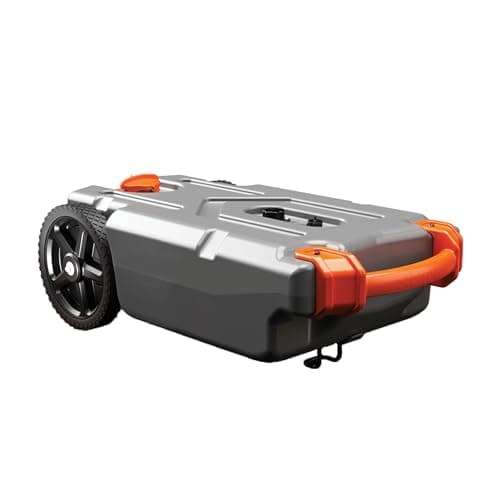 Camco Rhino Portable Waste Tank (21 gallon)The sensible first tote: big enough to be worth the trip to the dump station, small enough that a full one does not get away from you. | A first tote for a travel trailer | Strong | |
| 2 | Barker 4-Wheeler Tote-Along Portable Waste Tank (32 gallon)The tank to buy if you will be towing it rather than pulling it: four wheels take the weight and the 3-in valve means no tipping. | Towing to the dump station | Good | |
| 3 | Thetford Titan 4-Wheel Portable Waste Tank (35 gallon)The most beginner-proof tote on the list: the level gauge stops the overfill mistake, and nothing ever needs tipping. | No overfilling and no tipping | Strong | |
| 4 | 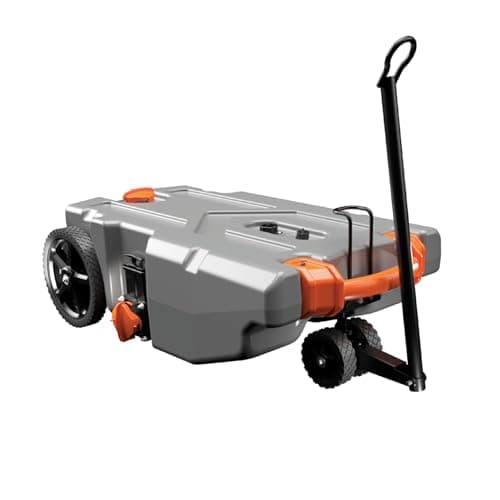 Camco Rhino Portable Waste Tank (36 gallon)The right tank if you stay put for a week without a sewer hookup. Too much tank if you plan to pull it by hand. | Long stays and bigger tanks | Good | |
| 5 | 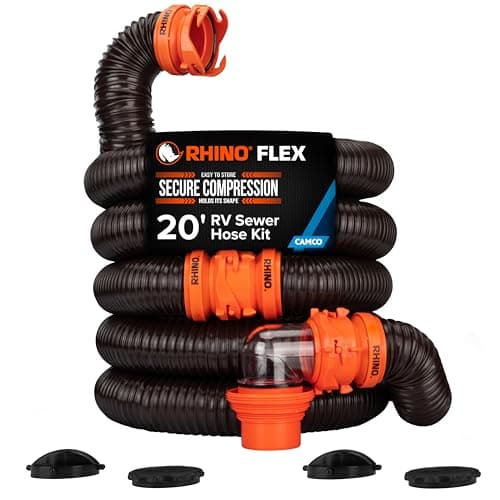 Camco RhinoFLEX 20-Ft Sewer Hose KitThe complete first kit: 20 ft in two sections, both fittings, and a clear elbow so you can see when the tank is actually done. | The first sewer hose to own | Strong | |
| 6 | Heavy-Gauge Disposable Nitrile Gloves (box)Keep a box in the sewer compartment itself. The gloves that live inside the trailer are the gloves you do not use. | The obvious thing nobody packs | Strong |
Prices come from Amazon and were last checked October 6, 2026. They change constantly, so a price older than 48 hours is withdrawn rather than shown stale — those rows read “Check price on Amazon” instead and go straight to the current listing. #ad — these are affiliate links.
What a tote tank actually does
A portable waste tank is a wheeled container you connect to your trailer’s drain, fill from your gray or black tank, and then wheel or tow to the campground dump station. You empty it there, rinse it, and bring it back. That is the whole product.
It exists because of a specific and very common campsite layout: water hookup, electric hookup, no sewer. On a site like that your gray tank fills in two or three days of showers and dishes, and without a tote your only options are to break camp and drive the whole trailer to the dump station or to stop using the sink. Neither is a holiday.
You do not need one if you always book full-hookup sites, or if you are out for two or three nights at a time and your tanks comfortably last the trip. Plenty of people camp for years without one. The moment it becomes essential is the first week-long stay on a partial-hookup site.
How we choose
We do not run a test lab and we do not pretend to. What this site has instead is a lodge that hosts RV sites every weekend, which means watching people arrive with gear and use it on the same ground over and over. Tote tanks are a category where that is unusually informative, because the failure is never the tank breaking. It is somebody filling 36 gallons and then discovering they cannot move it.
Beyond that, picks here are judged against published manufacturer specifications, current availability from real retailers, and whether a beginner can use the thing correctly on the first attempt. Our full methodology is here, including what we deliberately do not do.
The criteria that decide this purchase
Four things matter, and they matter in this order. Everything else is detail.
1. Weight when full, which is really the only question
Waste water weighs roughly the same as water: about 8.3 pounds a gallon. That arithmetic decides your purchase more than any feature on any box.
What a full tank weighs, and what that means
| Capacity | Rough weight when full | Realistic way to move it |
|---|---|---|
| 21 gallons | About 175 lb | One person pulling, on a reasonable surface |
| 32 gallons | About 265 lb | Four wheels, or towed at walking pace |
| 35 gallons | About 290 lb | Towed. Pulling this by hand is not a plan |
| 36 gallons | About 300 lb | Towed, on a surface without a hill in it |
Nobody sells a tank by its loaded weight, which is why people buy too much tank. The honest rule: if you will be walking it to the dump station, buy the smaller tank and make two trips. If you have a tow vehicle, a golf cart or a side-by-side and a campground that allows towing a tote at walking speed, then buy the capacity.
2. Two wheels or four
On a two-wheel tank the wheels are at one end and you carry the other end. That is fine at 21 gallons and genuinely unpleasant above it. A four-wheel tank carries its whole weight itself, and the front pair usually swivels so it tracks where you point it.
The other half of this question is the tire. Hard plastic no-flat wheels never need air and never go flat in storage, but they drop into every soft patch. Pneumatic tires roll over gravel and grass far better and can go flat, which on a loaded tank is a problem you solve by emptying it where it stands.
3. How it empties
Cheap totes are emptied by tipping the tank up on its end so the contents run out of the top fitting. That works, and it is also the step where people make a mess, because you are lifting a heavy and unbalanced object over an open drain.
A tank with a proper 3-inch valve at one end empties horizontally. You connect a short hose, open the valve, and nothing gets lifted. This is the single feature most worth paying for after the wheels, and it is why the Barker 4-Wheeler is on this list despite costing more than its capacity suggests.
4. Knowing when to stop filling
You cannot see into a tote tank. If it has no gauge you are guessing, and the guess that goes wrong is the one where it is too heavy to move. A float gauge or a mechanical bobber indicator takes that guess away. On the Thetford Titan it is built in; on other tanks it is sometimes a separate part.
The picks
1. Best for A first tote for a travel trailer
Camco Rhino Portable Waste Tank (21 gallon)
The sensible first tote: big enough to be worth the trip to the dump station, small enough that a full one does not get away from you.
- Specification
- 21 gallon capacity
- Specification
- Two no-flat wheels plus a removable steel tow adapter
- Specification
- UV-stabilized blow-molded HDPE
- Specification
- Ladder hook for storing it empty
What it does well
- The size a first-time owner can actually move: a full 21 gallons is heavy, but it is still a one-person job on a level road
- No-flat wheels mean nothing to inflate and nothing to find flat in spring
- Comes with the hose and fittings needed to fill it and empty it, so there is no second order
- Hooks on the rear ladder when empty instead of taking up a pass-through compartment
The real tradeoff
- Two wheels, not four, so you carry part of the weight in your arms the whole way
- 21 gallons is roughly one tank's worth for a small trailer and half a tank for a big one
- The tow adapter is for walking pace behind a truck or cart, not for a road trip
How it measures up
These are judgments from published specifications and what we see at the lodge, not laboratory results. How we choose.
- Beginner fit
- Strong — Fill, wheel, dump, rinse. Nothing to learn.
- Moving it full
- Good — Two wheels means your arms take some of the load.
- Capacity
- Adequate — One gray tank on a small trailer.
- Value
- Strong — Hose and fittings included.
Specifications from Camco.
2. Best for Towing to the dump station
Barker 4-Wheeler Tote-Along Portable Waste Tank (32 gallon)
The tank to buy if you will be towing it rather than pulling it: four wheels take the weight and the 3-in valve means no tipping.
- Specification
- 32 gallon capacity, 11.5 x 24 x 45 in
- Specification
- Four wheels with a front-swivel pair, pneumatic tires
- Specification
- Standard 3-in valve, so no tipping to empty
- Specification
- Blow-molded polyethylene with zinc-plated steel and aluminum hardware
What it does well
- Four wheels carry the whole weight, which is the single biggest difference between totes once they are full
- The 3-in valve empties horizontally, so you never tip a full tank on its end
- Pneumatic tires roll over gravel and grass far better than small hard wheels
- Heavy-duty tow handle and a full-tank indicator come in the box
The real tradeoff
- Pneumatic tires can go flat, and a flat on a loaded tote is a genuinely bad afternoon
- Costs noticeably more than a two-wheel tank of the same size
- 45 inches long, so it wants a dedicated storage spot
How it measures up
These are judgments from published specifications and what we see at the lodge, not laboratory results. How we choose.
- Beginner fit
- Good — Easy to use, slightly more parts to understand.
- Moving it full
- Strong — Four wheels and real tires.
- Capacity
- Strong — 32 gallons covers most gray tanks.
- Value
- Good — You pay for the wheels, and they are worth it.
Specifications from Barker Manufacturing.
3. Best for No overfilling and no tipping
Thetford Titan 4-Wheel Portable Waste Tank (35 gallon)
The most beginner-proof tote on the list: the level gauge stops the overfill mistake, and nothing ever needs tipping.
- Specification
- 35 gallon capacity, 50.75 x 23.75 x 17.31 in, about 29 lb empty
- Specification
- Four swivel wheels and a hitch-ball tow handle
- Specification
- AutoStop level gauge to stop an overfill
- Specification
- Large washout port, horizontal emptying
- Specification
- One-year limited warranty
What it does well
- The AutoStop gauge is the feature beginners actually need: it tells you to stop before the tank is heavier than you can move
- Empties horizontally, so a full tank never has to be lifted or tipped
- Light for its size at around 29 lb empty, which makes storing and positioning it easier
- Big washout port, so rinsing it out is quick rather than a chore you skip
The real tradeoff
- Replaces the discontinued SmartTote2 LX, so some older reviews and spare parts no longer line up
- The longest tank here at just over 50 inches
- Carries the shortest warranty of the group at one year
How it measures up
These are judgments from published specifications and what we see at the lodge, not laboratory results. How we choose.
- Beginner fit
- Strong — The gauge removes the one mistake that hurts.
- Moving it full
- Strong — Four swivel wheels, tow handle for the hitch ball.
- Capacity
- Strong — 35 gallons, with a gauge so you use it sensibly.
- Value
- Good — Premium price, premium convenience.
Specifications from Thetford.
4. Best for Long stays and bigger tanks
Camco Rhino Portable Waste Tank (36 gallon)
The right tank if you stay put for a week without a sewer hookup. Too much tank if you plan to pull it by hand.
- Specification
- 36 gallon capacity
- Specification
- 47 x 25.5 x 16 in, about 45 lb empty
- Specification
- Two steerable 6-in no-flat front wheels
- Specification
- Built-in gate valve and removable steel tow adapter
What it does well
- Takes a whole gray tank in one trip on most travel trailers, which is the difference between one walk and three
- Steerable front wheels, so it tracks where you point it instead of fighting you
- Sloped interior and a low drain hole, so it empties properly rather than holding an inch of sludge
- Tie-down grooves, which matters if you ever carry it in a truck bed
The real tradeoff
- 36 gallons of waste weighs roughly 300 lb. This is a tow-it-slowly tank, not a pull-it-by-hand tank
- At 47 inches long it needs real storage space, and that is usually the reason people size down
- Heavy enough empty, at about 45 lb, that lifting it onto a ladder hook is a two-hand job
How it measures up
These are judgments from published specifications and what we see at the lodge, not laboratory results. How we choose.
- Beginner fit
- Good — Simple to use, easy to overfill past what you can move.
- Moving it full
- Adequate — Realistically a tow, not a walk.
- Capacity
- Strong — A full gray tank in one trip.
- Value
- Good — Costs more, saves trips.
Specifications from Camco.
5. Best for The first sewer hose to own
Camco RhinoFLEX 20-Ft Sewer Hose Kit
The complete first kit: 20 ft in two sections, both fittings, and a clear elbow so you can see when the tank is actually done.
- Specification
- 20 ft supplied as two 10 ft sections
- Specification
- Swivel bayonet fitting at the rig end
- Specification
- Clear 45-degree adapter included in the kit
What it does well
- The kit arrives complete: hose, both fittings and the clear elbow, so nothing is missing at the first dump station
- Two 10 ft sections means you use 10 ft at most sites and 20 ft when you need it, instead of coiling slack
- The clear elbow lets you see when the tank has actually finished, which is the entire job
The real tradeoff
- Bulkier collapsed than a thin-wall hose, and a 4-inch bumper will not take 20 ft of it
- The bayonet fittings need a firm quarter-turn. A lazy connection is how people end up with a mess
How it measures up
These are judgments from published specifications and what we see at the lodge, not laboratory results. How we choose.
- Beginner fit
- Strong — Nothing to buy separately, nothing to work out.
- Durability
- Good — Thicker than the hose bundled with a used trailer.
- Storage
- Adequate — Twenty feet will not fit a 4-inch bumper. Plan for that.
- Value
- Strong — The category default, and deservedly.
Specifications from Camco.
6. Best for The obvious thing nobody packs
Heavy-Gauge Disposable Nitrile Gloves (box)
Keep a box in the sewer compartment itself. The gloves that live inside the trailer are the gloves you do not use.
- Specification
- Box of disposable gloves
- Specification
- Nitrile rather than latex
- Specification
- Keep the box in the sewer compartment
What it does well
- The sewer compartment should have its own box, so you never handle the hose bare-handed because the gloves were inside
- Cheap enough that using two pairs is not a decision
The real tradeoff
- Thin gloves tear on bayonet fittings, so buy a heavier gauge than the kitchen box
How it measures up
These are judgments from published specifications and what we see at the lodge, not laboratory results. How we choose.
- Beginner fit
- Strong — Gloves.
- Durability
- Adequate — Buy a heavier gauge than the kitchen box.
- Storage
- Strong — A box.
- Value
- Strong — Almost nothing.
What you need alongside the tank
A tote tank is not a complete system on its own, and the two missing pieces catch people out on the first use.
A hose to fill it with. Most tanks include a short length of 3-inch hose, which is enough to reach from the trailer outlet down into the tank if the tank is parked right underneath. It is not enough if the tank has to sit a few feet away, which is usually the case. Your normal 20-foot sewer hose does this job, and the fittings are the same bayonet standard. If you are unsure what you already own, we cover it in what size RV sewer hose you need.
Somewhere to put it. A 45 to 50-inch tank does not fit in a pass-through compartment next to the chairs. Two-wheel Camco tanks hook onto a rear ladder when empty, which is the neatest answer for a travel trailer. Four-wheel tanks generally travel in a truck bed, strapped down. Decide this before you order, not after it arrives.
How to use one without making a mess
The order of operations is most of the skill, and it is short enough to learn in one go.
- Park the tote on level ground near the trailer drain, with the filler cap up and the gate valve closed.
- Wear gloves. Connect your sewer hose to the trailer outlet first and to the tote second, so the open end is never the one you are handling.
- Pull the gray valve, not the black one, for your first few uses. Gray water is the tank that fills fastest and it is a far more forgiving thing to practice with.
- Watch the gauge, or count. Close the trailer valve while you still have capacity to spare, then disconnect and cap both ends.
- Wheel or tow it to the dump station at walking pace. A full tote carries a lot of moving weight and it will push you downhill.
- Empty it, rinse it through the washout port with a dedicated rinse hose, drain it completely, and leave the caps off until it has dried out.
That last step is the one everybody skips and the one that decides whether your storage compartment smells next month. The same logic applies to the trailer’s own tanks, which we cover in the black tank flush guide.
Mistakes first-timers make
Buying the biggest tank available. Covered above and worth repeating, because it is the only mistake in this category that cannot be undone with technique. A tank you cannot move is not a tank.
Dumping black into the tote first. You can tote black water and plenty of people do. But the first time you use a new tank, use gray. You will learn the connections, the weight and the route with the version that is mostly soap and shower water.
Using the drinking water hose to rinse it. Never. Keep a separate, clearly different hose for anything on the waste side, and keep your drinking water hose for drinking water only. Different color, stored separately, no exceptions.
Towing it at driving speed. Tow adapters on these tanks are designed for walking pace on campground roads. The tanks are not trailers, they have no suspension and no lights, and a loaded one that comes off a ball at 20 mph is a story the whole campground repeats.
Leaving it loaded overnight. Empty it when you fill it. A tote sitting full in the sun is pressure, smell and weight you have chosen to keep.
So which one
If you are in your first season with a travel trailer and you will be moving the tank yourself, buy the 21-gallon Camco. If you have a vehicle to tow it with and you want to stop thinking about gray water on a week-long stay, buy the Barker 4-Wheeler for the valve and the wheels, or the Thetford Titan if you want the overfill gauge doing the thinking for you. The 36-gallon Camco is the most capacity here and the least forgiving if you misjudge it.
Questions people actually ask
What size RV tote tank should I buy?
Match it to how you will move it, not to your tank size. If you are pulling it by hand, 20 to 25 gallons is the practical limit, because a full 21-gallon tank already weighs about 175 pounds. If you can tow it slowly with a vehicle or a cart, 32 to 36 gallons saves trips.
How much does a full RV tote tank weigh?
Waste water weighs roughly 8.3 pounds per gallon, so a 21-gallon tank is around 175 pounds full, a 32-gallon tank is around 265 pounds, and a 36-gallon tank is around 300 pounds. Add the empty weight of the tank itself, which is typically 29 to 45 pounds.
Can you put black water in a portable waste tank?
Yes. The tanks are designed for it and most owners do it. For your first use, run gray water instead so you learn the connections and the weight on something more forgiving, then move on to black.
Can I tow a tote tank behind my truck?
At walking pace, on campground roads, if the tank has a tow adapter and the park allows it. These tanks have no suspension, no brakes and no lights, so they are not road-legal trailers and should never be towed at road speed.
Do I need a separate sewer hose for a tote tank?
Most tanks include a short 3-inch hose, which only works if the tank sits directly below the trailer outlet. In practice you will use your regular 20-foot sewer hose to fill it, and you want a separate, clearly marked rinse hose for washing it out.
How do you stop a tote tank from smelling in storage?
Rinse it through the washout port after every use, drain it completely, and store it with the caps off so the inside dries. A tank put away wet and sealed is the one that smells, regardless of what you treat your tanks with.
Sources
Read next
Sewer & Water
Best RV Sewer Hose for a First Travel Trailer
Complete sewer hose kits compared on length, wall thickness, fittings and storage, for someone doing this for the first time.
Sewer & Water
How to Hook Up an RV Sewer Hose (Step by Step)
The full sewer connection and dumping sequence, in order, with the two checks that prevent the story you tell for years.
Sewer & Water
How to Flush an RV Black Tank
Black tank flushing with a built-in inlet or an add-on rinser, and why the sensors read wrong.
Sewer & Water
What Size RV Sewer Hose Do I Need?
Sewer hose length and diameter settled, with a table matching site layouts to the length you will actually need.
Reviewed October 5, 2026. Spot something out of date? Tell us and we will fix it.