Best RV Tire Inflator for a Travel Trailer
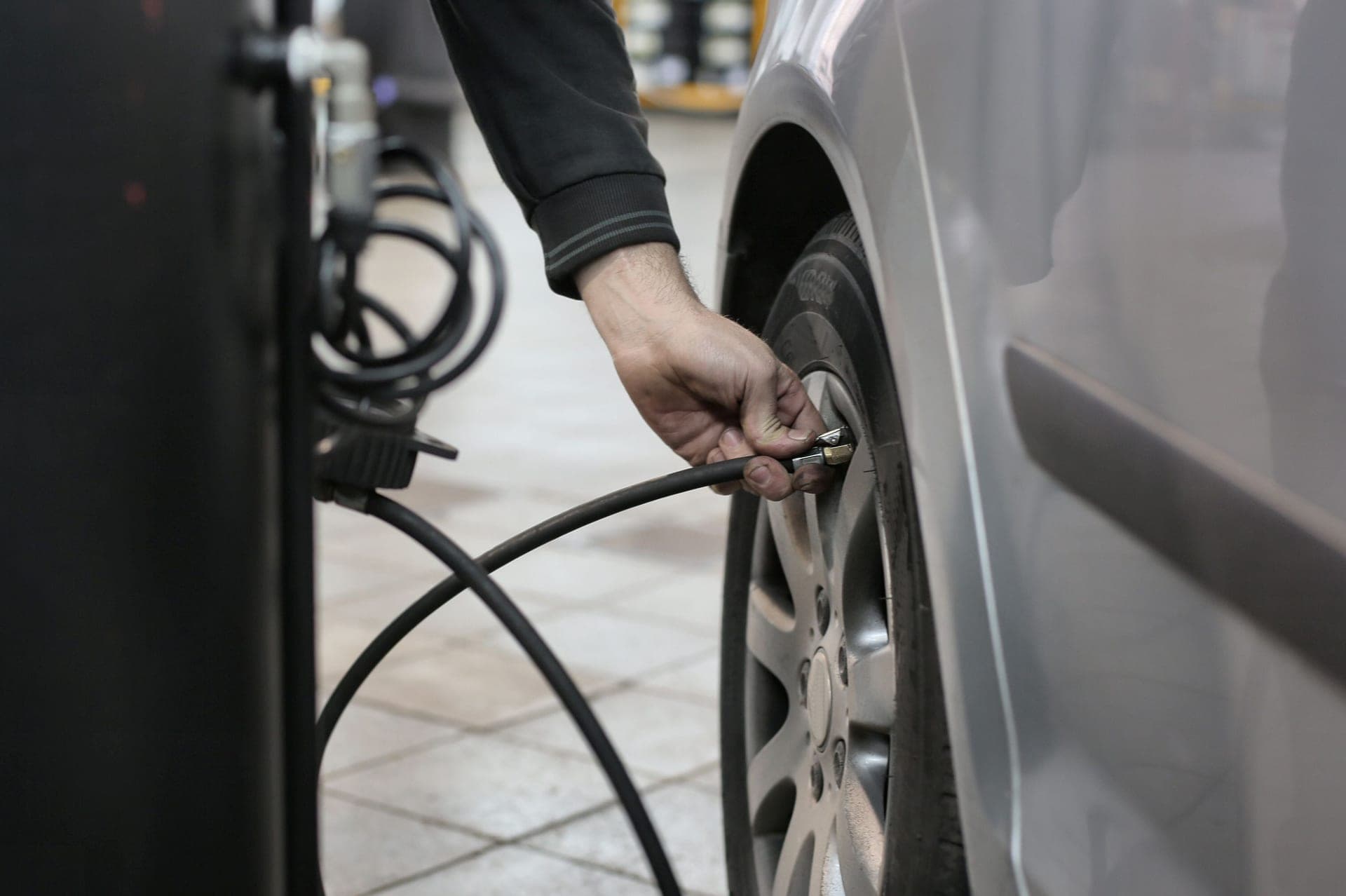
A car tire inflator stops being useful at about 40 psi. A trailer tire needs 50 to 80, held, on four tires, in a campground with no air hose anywhere.
Heads up: this page contains affiliate links. If you buy through one, Camp & Chock may earn a commission at no extra cost to you. It never changes which product we put first — how this site is funded.
The short answer
Buy a 12-volt compressor rated to 150 psi with a published duty cycle at 100 psi, not a cigarette-lighter inflator rated to 150 psi for ten minutes at 30. On a trailer, the two specifications that decide everything are the duty cycle at pressure and how far the hose reaches, because you are filling four tires at 65 to 80 psi from one battery connection.
Part of our towing and security guide. Our tire pressure monitoring roundup tells you when a tire is low, which is half of an answer. This is the other half.
Our picks at a glance
Tap any row to jump to the full write-up.
| # | Product | Best for | Beginner fit | Price |
|---|---|---|---|---|
| 1 | 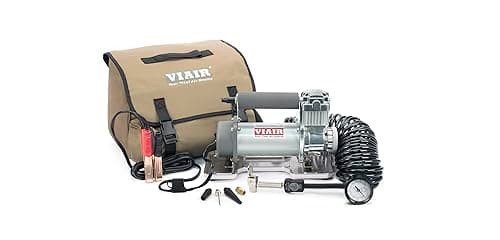 VIAIR 400P Portable CompressorThe sweet spot for a travel trailer: full 150 psi capability and the trigger gun, without paying for the second extension hose. | Most travel trailers | Good | |
| 2 | VIAIR 400P-RV Automatic Portable CompressorThe one that actually fills trailer tires: 150 psi capability, a usable duty cycle at pressure, and 60 feet of hose so you connect once. | Trailer tires at 65 psi and up | Good | |
| 3 | 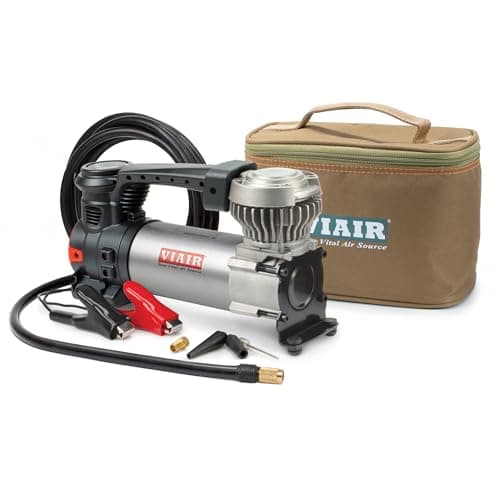 VIAIR 88P Portable CompressorThe small one: genuinely useful for the tow vehicle and for topping up, out of its depth filling a trailer tire from flat. | Topping off, and tow vehicle tires | Strong | |
| 4 | 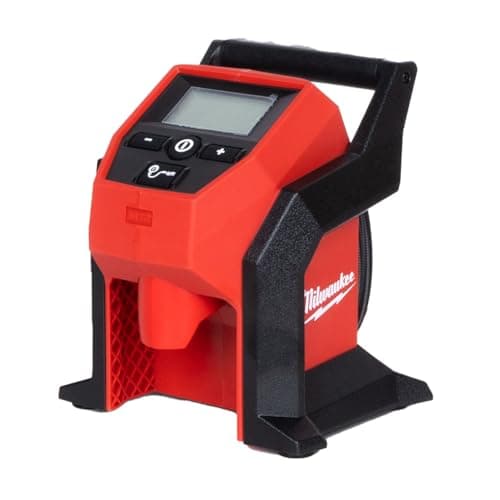 Milwaukee M12 Compact Inflator (2475-20)The convenient one, with an honest limit: excellent for setting pressure before a trip, slow and battery-hungry filling from flat. | People already on the M12 battery | Strong |
Prices come from Amazon and were last checked November 12, 2026. They change constantly, so a price older than 48 hours is withdrawn rather than shown stale — those rows read “Check price on Amazon” instead and go straight to the current listing. #ad — these are affiliate links.
Who this is for
Someone with a travel trailer that has been sitting since last season, four tires that have each quietly lost pressure, and a storage lot or driveway with no compressed air. Or someone 40 miles from the nearest town whose tire monitor just reported a tire down 8 psi. Both situations are ordinary, and a gas station air hose solves neither — most are regulated well below trailer tire pressure, when they work at all.
It is also for anyone who has worked out the uncomfortable fact behind trailer tires: underinflation is the usual cause of the blowouts you see on the shoulder of the interstate, and a trailer tire gives you almost no feedback before it fails. The compressor is the cheap half of that problem. Knowing the pressure is the other half.
How we choose
Duty cycle at pressure, first and above everything. A compressor’s headline number is its maximum working pressure, and it is the less useful figure. What matters is how long it can run before it needs to cool. The models here publish “33% at 100 psi” and “25 minutes at 30 psi,” and the difference between those two statements is the whole decision: one is quoted where trailer tires live, the other well below it.
Then pressure headroom. A compressor rated to 120 psi filling an 80 psi tire is working near its ceiling, slowly. A 150 psi rating gives you margin, and margin is speed.
Then reach. This is the specification nobody thinks about until they are lying on gravel. Your air supply clamps to a battery; your tires are at four corners of a trailer that may be 25 feet long. A 16-foot hose means moving the compressor. A 30-foot hose with a 30-foot extension means connecting once and walking.
Then how you read the pressure. An inline gauge at the compressor means walking back and forth. A trigger gun with its own gauge means you set pressure standing at the tire. On four tires that difference is several minutes and a lot less crouching.
We do not test these and we do not publish numbers we did not get from the manufacturer. Every figure below is VIAIR’s or Milwaukee’s own published specification, linked at the end. Full methodology here.
Why a car tire inflator is the wrong tool here
This is the single most expensive mistake in the category, and it is made by reasonable people, because the cheap inflator says 150 psi on the box too.
A travel trailer rides on ST-rated tires, and ST tires are generally run at the maximum cold pressure molded into the sidewall rather than at some softer figure for comfort. Read your own sidewall: for many trailer tires that number is between 50 and 80 psi, and a loaded tandem axle sits at the top of that range. Compare that with a car, where 32 to 35 psi is normal, and you can see what happens to a compressor designed for the car number.
Two things go wrong. The first is time: airflow collapses as pressure rises, so a small compressor that fills a car tire in a minute may take five or ten minutes on a trailer tire, per tire. The second is heat. Duty cycle exists because these motors overheat, and a cheap inflator quoted at 30 psi is being quoted in conditions you will never be in.
Published specifications, side by side
| 400P | 400P-RV | 88P | M12 2475-20 | |
|---|---|---|---|---|
| Max working pressure | 150 psi | 150 psi | 120 psi | Over 120 psi |
| Duty cycle | 33% at 100 psi | 33% at 100 psi | 25 min. at 30 psi | Not published |
| Air delivery | 2.30 CFM at 0 psi | 2.30 CFM at 0 psi | 1.97 CFM at 0 psi | Not published |
| Hose | 30 ft. | 30 ft. plus a 30 ft. extension | 16 ft. | 26 in. |
| Power | Battery clamps, 8 ft. cord | Battery clamps, 8 ft. cord | Battery clamps, 10 ft. cord | M12 battery, sold separately |
| Weight | 10.70 lb. | 10.75 lb. | 4.75 lb. | Not published |
| Gauge | Trigger gun with 160 psi gauge | Trigger gun with 160 psi gauge | Inline gauge | Auto shut-off at a set psi |
| Published tire claim | Up to 37 in. tires | 275/80R22.5 from 80 to 90 psi in under 3 min. | Not published | Car tire in under 1 min. at 28-35 psi |
The picks
1. Best for Most travel trailers
VIAIR 400P Portable Compressor
The sweet spot for a travel trailer: full 150 psi capability and the trigger gun, without paying for the second extension hose.
- Specification
- 150 psi max working pressure
- Specification
- 33% duty cycle at 100 psi
- Specification
- 30 ft hose, 10.70 lb
What it does well
- The same 150 psi rating, the same 33% duty cycle at 100 psi and the same 2.30 CFM as the RV-badged version
- The gas-station-style trigger gun carries its own 160 psi gauge, so pressure is set standing at the tire
- 30 feet of hose reaches most of a travel trailer from one battery connection, and it is rated for tires up to 37 inches
The real tradeoff
- No second 30 ft extension hose, so a long tandem-axle trailer may mean moving the clamps once
- Battery clamps with a 40-amp inline fuse, not a 12-volt socket. It needs a battery post
- At 10.70 lb plus hose and bag it is bulky in a pass-through bay
How it measures up
These are judgments from published specifications and what we see at the lodge, not laboratory results. How we choose.
- Beginner fit
- Good — Clamp on, squeeze the trigger, read the gun.
- Pressure headroom
- Strong — 150 psi rated, 33% duty at 100 psi.
- Reach
- Good — 30 ft, one hose.
- Value
- Strong — The capability without the long-hose premium.
Specifications from VIAIR 400P specifications.
2. Best for Trailer tires at 65 psi and up
VIAIR 400P-RV Automatic Portable Compressor
The one that actually fills trailer tires: 150 psi capability, a usable duty cycle at pressure, and 60 feet of hose so you connect once.
- Specification
- 150 psi max working pressure
- Specification
- 33% duty cycle at 100 psi
- Specification
- 30 ft hose plus a 30 ft extension
What it does well
- The class of compressor that fills a loaded trailer tire to 65 or 80 psi without stopping to cool down
- Sixty feet of hose across the two lines reaches all four trailer tires plus the truck from one battery connection
- The trigger gun has its own 160 psi gauge, so you set pressure at the tire instead of walking back to the compressor
The real tradeoff
- Battery clamps, not a 12-volt socket. It has to reach a battery post, which means the trailer tongue or the tow vehicle
- At 10.75 lb plus hoses it is a real piece of luggage in a pass-through bay
- Far more compressor than anyone needs for a bicycle or a car tire
How it measures up
These are judgments from published specifications and what we see at the lodge, not laboratory results. How we choose.
- Beginner fit
- Good — Clamps to a battery, then it is point and squeeze.
- Pressure headroom
- Strong — 150 psi rated, 33% duty at 100 psi.
- Reach
- Strong — 30 ft hose plus a 30 ft extension.
- Value
- Good — Expensive, and the capability is the reason.
Specifications from VIAIR 400P-RV specifications.
3. Best for Topping off, and tow vehicle tires
VIAIR 88P Portable Compressor
The small one: genuinely useful for the tow vehicle and for topping up, out of its depth filling a trailer tire from flat.
- Specification
- 120 psi max working pressure
- Specification
- 25 minute duty cycle at 30 psi
- Specification
- 16 ft hose, 4.75 lb
What it does well
- Light enough that it lives in the truck year round instead of being left at home
- Fine for tow vehicle tires, and for topping a trailer tire up a few psi
- Costs a fraction of the 150 psi models
The real tradeoff
- The published duty cycle is quoted at 30 psi. Trailer tires live at 50 to 80 psi, where run time before a cool-down is much shorter
- A 120 psi ceiling leaves little headroom above an 80 psi trailer tire
- 16 ft of hose will not reach both axles from one connection point
How it measures up
These are judgments from published specifications and what we see at the lodge, not laboratory results. How we choose.
- Beginner fit
- Strong — Light, simple, no setup to speak of.
- Pressure headroom
- Adequate — 120 psi, duty cycle quoted at 30 psi.
- Reach
- Adequate — 16 ft hose, 10 ft cord.
- Value
- Strong — Cheap, within its limits.
Specifications from VIAIR 88P specifications.
4. Best for People already on the M12 battery
Milwaukee M12 Compact Inflator (2475-20)
The convenient one, with an honest limit: excellent for setting pressure before a trip, slow and battery-hungry filling from flat.
- Specification
- Rated to deliver over 120 psi
- Specification
- Auto shut-off at a set pressure
- Specification
- 26 inch hose, bare tool
What it does well
- No battery clamps, no engine running, no cord. You walk to the tire and squeeze the trigger
- The auto shut-off is set by number, so it stops at the pressure you asked for instead of you watching a gauge
- If you already own M12 tools, this is the cheapest way into an inflator you will actually use
The real tradeoff
- Bare tool. Battery and charger are sold separately, which changes the real price completely if you are not already on the platform
- A 26 inch hose means the tool hangs at the valve stem rather than sitting on the ground
- Published fill times are for car and light-truck pressures. It is a top-off tool, not a fill-from-flat tool for a trailer tire
How it measures up
These are judgments from published specifications and what we see at the lodge, not laboratory results. How we choose.
- Beginner fit
- Strong — Set the number, pull the trigger.
- Pressure headroom
- Good — Rated over 120 psi.
- Reach
- Weak — 26 inch hose. It goes to the tire.
- Value
- Adequate — Only if you own the battery already.
Specifications from Milwaukee 2475-20 specifications.
The 400P and the 400P-RV are the same compressor
This is the thing to understand before you spend the extra money, because the two listings sit next to each other and look like different machines. On the published figures they are not: both are rated to 150 psi, both publish a 33% duty cycle at 100 psi, both move 2.30 CFM at zero, and both come with the gas-station-style trigger gun and its 160 psi gauge.
What the RV version adds is a second 30-foot extension hose — 60 feet of reach rather than 30 — and VIAIR’s published claim for filling a 275/80R22.5 truck tire from 80 to 90 psi in under three minutes. That reach is the difference between connecting the clamps once and connecting them twice on a long tandem-axle trailer. It is convenience rather than capability, and whether it is worth the difference depends entirely on the length of your trailer and how far your battery is from your rearmost tire.
So: buy the standard version first. If you tow something long, or you found yourself moving the compressor halfway down the trailer and disliking it, the long-hose version is the upgrade, and it is the same compressor you already know.
Where the small one is genuinely the right buy
The 88P is not a bad product, it is a correctly-sized product for a different job. If your trailer is a 3,000-pound single axle on tires rated at 50 psi, and what you need is to top up a few psi before each trip and handle the tow vehicle’s tires, it is light, cheap, and enough. Read its duty cycle honestly though: 25 minutes is quoted at 30 psi, and at 50 to 65 psi you will be pausing to let it cool.
The cordless case, and its limit
A cordless inflator on a battery platform you already own is a different proposition from any of the above: no clamps, no engine running, no 8 feet of power cord to drape across a hitch. You walk to the tire, dial the number, pull the trigger, and it stops at the pressure you asked for. For the pre-trip routine of setting four tires that are each 3 to 5 psi low, that is the nicest tool here.
Its limit is equally clear. The hose is 26 inches, so the tool hangs off the valve stem rather than sitting on the ground; the published fill times are for car and light-truck pressures; and the battery is sold separately, which changes the price completely if you are not already on the platform. Treat it as the tool for topping off, and keep a real compressor for a tire that is genuinely flat.
Inflating four trailer tires without making a job of it
The routine matters more than the product, and it is short.
Check cold, not after driving. Pressure rises as tires heat, so a reading taken after an hour on the interstate is not the number on the sidewall. Set pressure in the morning before you move, or after the trailer has sat for a few hours.
Clamp to the battery, not a 12-volt socket. These compressors draw more current than most accessory sockets will carry. The clamps exist for a reason, and an extension lead for a socket is a blown fuse waiting to happen. On a trailer, the tongue battery is usually the nearest post; otherwise run the clamps to the tow vehicle with the engine running.
Lay the hose out before you start. Walk the full hose around the trailer once, so you know whether you are reaching all four tires from here or moving the clamps halfway through. This is the step that makes a 30-foot hose feel worth the money.
Do the spare. Nobody does the spare. It is the tire you will need in the worst circumstances, and it is flat right now.
Let it cool when the specification says to. A 33% duty cycle at 100 psi means roughly a third of the time running. Four tires at 65 psi is well within that; four tires from flat is not. Pausing is not a fault.
What else belongs in the same bag
A compressor on its own leaves two gaps. The first is knowing the pressure while you drive, which is what a tire pressure monitoring system is for — it is the one piece of towing gear that warns you about a trailer tire before it destroys a fender. The second is the pre-departure routine that makes you check at all, which is on our towing safety checklist. If you are still assembling the basics, the compressor sits alongside the other genuinely-used items in RV must-haves for beginners.
Pick by the job you are doing
A travel trailer and one hose that reaches: the 400P. A long trailer where you want 60 feet of reach: the 400P-RV. Tow vehicle tires and small top-ups: the 88P. Already own M12 batteries and want pre-trip convenience: the cordless.
Best for Most travel trailers
VIAIR 400P Portable Compressor
The sweet spot for a travel trailer: full 150 psi capability and the trigger gun, without paying for the second extension hose.
Best for Trailer tires at 65 psi and up
VIAIR 400P-RV Automatic Portable Compressor
The one that actually fills trailer tires: 150 psi capability, a usable duty cycle at pressure, and 60 feet of hose so you connect once.
Best for Topping off, and tow vehicle tires
VIAIR 88P Portable Compressor
The small one: genuinely useful for the tow vehicle and for topping up, out of its depth filling a trailer tire from flat.
Best for People already on the M12 battery
Milwaukee M12 Compact Inflator (2475-20)
The convenient one, with an honest limit: excellent for setting pressure before a trip, slow and battery-hungry filling from flat.
What we would skip
Anything that only quotes a maximum psi. A 150 psi rating with no published duty cycle tells you what the motor can reach once, not what it can do on four tires. If the specification sheet is silent on duty cycle, assume the answer is unflattering.
Cigarette-lighter-only models, for trailer tires. The plug limits current, which limits airflow at the exact pressures you need. They are fine for a car and a bicycle.
12-volt tank-and-compressor combos, for this use. A small tank buys you a burst of fast air, then you wait for the pump that fills it — which is the pump you were trying to avoid. For four tires in sequence, continuous airflow wins.
A compressor only helps once you know the number you are filling to, and that number is on your own trailer rather than in any article: what psi should travel trailer tires be covers where to read it and why it has to be checked cold.
Questions people actually ask
What psi do travel trailer tires need?
Read the sidewall. ST-rated trailer tires are generally run at the maximum cold pressure molded into the tire rather than a softer figure, and for many trailer tires that number falls between 50 and 80 psi. Never use the car number, and never use a figure from an article in place of your own sidewall and the trailer's placard.
Can I use a car tire inflator on an RV tire?
It will work slowly and may overheat. The published duty cycle on a small inflator is usually quoted at about 30 psi, well below trailer tire pressure, and airflow drops as pressure rises. For a trailer tire at 65 to 80 psi, a compressor rated to 150 psi with a duty cycle quoted at 100 psi is the right tool.
What does a 33% duty cycle at 100 psi mean?
It is the manufacturer's statement of how much of the time the compressor can run at that pressure before it needs to cool - roughly one third. It is the most useful number on the spec sheet, because it describes sustained work rather than a single peak reading.
Do I need a 30-foot hose?
You need enough hose to reach every tire from wherever you can clamp to a battery. On a tandem-axle travel trailer that is usually more than 16 feet and comfortably satisfied by 25 to 30 feet. The alternative is moving the compressor and re-clamping between axles, which works fine if you do not mind it.
Should I trust the gauge built into the compressor?
Use it as a working display and confirm with a separate tire gauge on a cold tire. Built-in gauges vary, and an optimistic reading at 80 psi leaves you underinflated, which is the condition most often behind trailer tire failures.
Sources
Read next
Towing & Security
Best RV Tire Pressure Monitoring System
Tire pressure monitoring systems compared, with the reason a trailer needs one far more than a car does.
Towing & Security
Best Tow Mirrors for a Travel Trailer
Universal clip-on and clamp-on towing mirrors compared on published fit range, glass size and how much width they add.
Towing & Security
RV Towing Safety Checklist
A pre-departure towing checklist covering hitch, chains, brakes, tires, loading and the rooftop items people forget.
First-Season Starter Kit
RV Must-Haves for Beginners
The first-season shortlist, ordered by when you need each item: leaving the lot, arriving, hooking up, the first night, the first dump.
Reviewed October 12, 2026. Spot something out of date? Tell us and we will fix it.