What PSI Should Travel Trailer Tires Be?
We are not going to print a number, because the correct one is stamped on your tire and nowhere else. Here is how to find it and how to hold it.
Heads up: this page contains affiliate links. If you buy through one, Camp & Chock may earn a commission at no extra cost to you. It never changes which product we put first — how this site is funded.
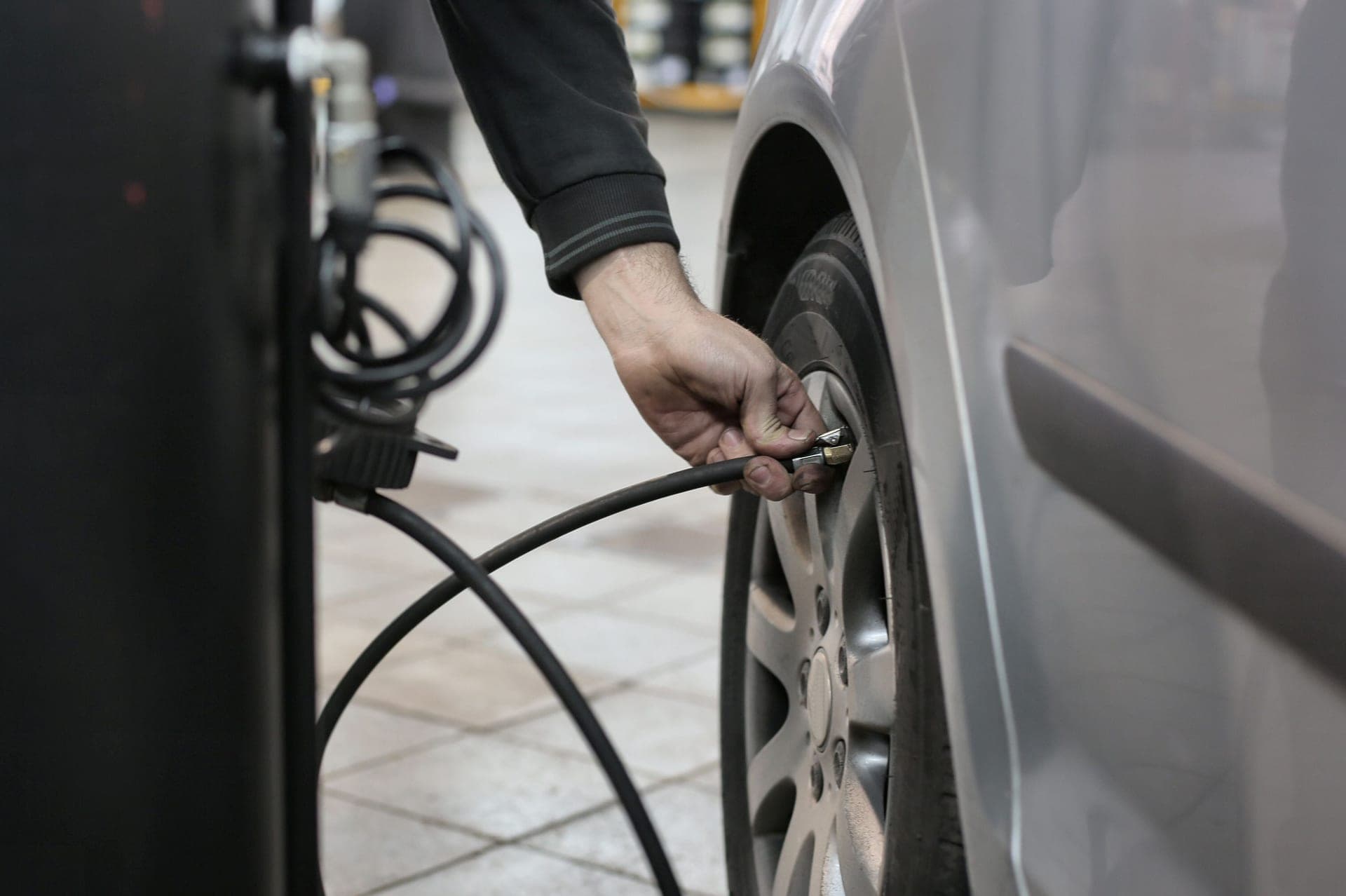
Use the cold inflation pressure on your trailer’s own tire and loading information placard, treat the figure molded into the tire sidewall as the ceiling rather than the target, and check it cold — before you drive, not after. Trailer tires are not car tires and the number is not transferable between rigs: it depends on the specific tire fitted, its load range and what your trailer actually weighs. Any article that gives you a single psi figure for “travel trailer tires” is guessing, and the consequence of running on a guess is the failure mode this whole page is about.
Part of our towing and security guide. This page is deliberately a method rather than a number, and the rest of it is about how to find yours and how to hold it.
Why we will not print a number
It would be the easiest thing in the world to put a psi figure in bold here and collect the search traffic. We do not publish numbers we cannot source, and there is no honest single answer to this question.
Trailer tires are made in several load ranges, and the maximum cold pressure that each is designed for differs. Two trailers of the same length can carry different tires. The same trailer can have different tires after a replacement. And the pressure interacts with how much the trailer actually weighs, which varies by how you load it.
The number that is correct for your trailer is printed in two places on your own rig, which is both more accurate and faster to check than any article.
Where your number actually is
| Where to look | What it tells you | Notes |
|---|---|---|
| The trailer's tire and loading information placard | The tire size and cold pressure the trailer manufacturer specifies. This is the target | Usually on the forward left side of the trailer body |
| The tire sidewall | The maximum cold inflation pressure that tire is designed for. This is the ceiling, not a recommendation | Molded into the rubber. Read it on every tire, including the spare |
| The owner's manual | The same figures, plus the trailer's weight ratings | Useful if a label has faded or been painted over |
| The replacement tire's own documentation | Applies if the tires are not the ones the trailer shipped with | The tire on the rig wins over a label describing a tire that is gone |
The placard is the figure to aim for; the sidewall number is a maximum rather than a recommendation, and it sets the upper limit. Where the two cannot both be satisfied — which happens when the trailer has been re-shod with a different tire from the one it shipped on — the tire actually fitted governs its own ceiling, and a tire shop will read the correct figure off for you in two minutes without charging you.
Cold is not a detail, it is the whole specification
Inflation pressures are specified cold, meaning before the trailer has been driven. Rolling heats a tire and heat raises the pressure inside it, which means a pressure you set after an hour on the interstate is a number taken at the wrong time.
The practical rules that follow:
Check in the morning, before you move. Parked overnight is as cold as it gets.
Do not bleed air out of a hot tire to get back to the number. The rise is normal and expected. Letting air out hot means you are under-inflated once it cools, which is the condition that destroys trailer tires.
Expect pressure to fall as the season cools. A trailer set correctly in August will read lower in October without anything being wrong. Re-check at the start of every trip.
Check the spare. It is the one tire nobody checks and the one you will need under the worst circumstances.
Why under-inflation is the one that hurts
A tire that is low does not squeal or pull or do anything you would notice. It flexes more in the sidewall, which generates heat, and heat is what destroys a tire. That is the mechanism behind most trailer tire blowouts.
And here is the part that makes it a trailer problem specifically: a trailer gives you no feedback at all. A low front tire on your truck changes the steering. A low tire on a trailer twenty-five feet behind you changes nothing you can feel, until it fails and takes a section of fender with it.
Which is why this question is really two questions. Finding the right number is the easy half. Knowing that all four tires are still at it, while you drive, is the half that needs equipment.
The two pieces of equipment that make this practical
A tire pressure monitoring system is the only warning you get. Sensors screw onto the valve stems and report pressure and temperature per wheel to a monitor in the cab, so a slow leak becomes an alert at 60 mph instead of a blowout at 70. Temperature matters as much as pressure here, because heat is how a failing tire announces itself before it fails. Flow-through sensors let you add air without unscrewing anything, which is the difference between a system you top up and one you fight.
A compressor that can actually reach trailer pressures is the other half, and it is where most people buy the wrong thing. A cigarette-lighter inflator rated for car tires runs out of usable duty cycle well below the pressures trailer tires live at. What you want is a 12-volt compressor with a published duty cycle at pressure — the 150 psi class units publish 33 percent at 100 psi — and enough hose to reach all four trailer tires from one battery connection. The full comparison is in the RV tire inflator roundup.
What you need to hold the number
A tire pressure monitor is the only warning a trailer gives you, because a low trailer tire changes nothing you can feel. A 150 psi class compressor with 60 feet of hose fills four trailer tires from one battery connection. The small 120 psi inflator is genuinely useful for the tow vehicle and for topping off, and out of its depth filling a trailer tire from flat.
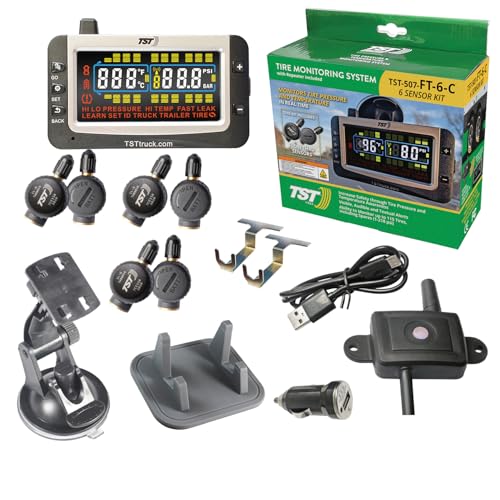
Best for Knowing before the blowout
TST 507 Tire Pressure Monitoring System
The only warning you get before a trailer tire fails, because a trailer gives you no feedback through the steering wheel.
Best for Trailer tires at 65 psi and up
VIAIR 400P-RV Automatic Portable Compressor
The one that actually fills trailer tires: 150 psi capability, a usable duty cycle at pressure, and 60 feet of hose so you connect once.
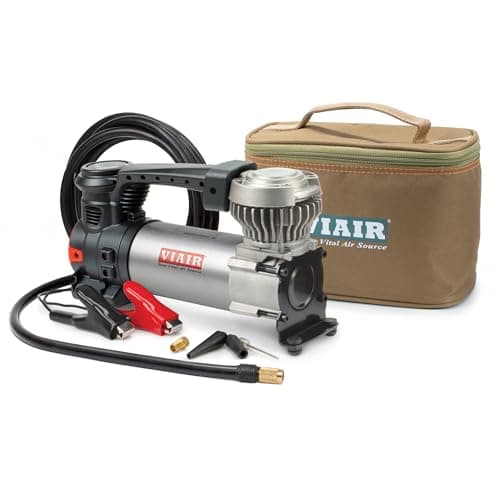
Best for Topping off, and tow vehicle tires
VIAIR 88P Portable Compressor
The small one: genuinely useful for the tow vehicle and for topping up, out of its depth filling a trailer tire from flat.
The pre-trip routine, which takes four minutes
Before the trailer moves, cold, walk around it with a gauge. All four tires plus the spare. Write the numbers on your phone the first few times so you learn what normal looks like for your rig.
Correct any that are low, to the specified cold pressure. Not to a number from an article, and not to whatever the gas station air hose happens to deliver.
Look at the sidewalls while you are down there. Cracking, bulges, or anything embedded. Thirty seconds, and it is the check that catches the problem a gauge cannot.
Check the lug nuts are tight, especially after a wheel has been off. Loose lugs are a separate failure that looks like a tire failure.
Pair the monitor and confirm all sensors are reporting. A monitor showing three of four wheels is telling you about a sensor battery, and the time to find that out is in the driveway.
This belongs in the same pass as the rest of the departure checks — see the RV towing safety checklist.
Questions this does not answer
Should I run less than the maximum to soften the ride? Trailer tire pressures are specified for load carrying rather than for ride comfort, and deliberately running below the specified cold pressure increases sidewall flex and heat. If ride quality is your concern, the answer is suspension and loading, not under-inflation.
What about the tow vehicle? Different tire, different label, different number — the sticker in your driver’s door jamb, not the trailer’s. Do not carry one rig’s number across to the other.
How do I know what my trailer weighs? A scale. The brochure dry weight excludes everything you own, which is the same problem that makes hitch sizing harder than it looks.
Questions people actually ask
What PSI should travel trailer tires be?
The cold inflation pressure on your trailer's own tire and loading information placard. The figure molded into the tire sidewall is a maximum rather than a recommendation, so treat it as the ceiling. There is no single correct number for travel trailers: it depends on the tire fitted, its load range and what the trailer weighs, so any article quoting one figure for all trailers is guessing.
Should trailer tires be checked hot or cold?
Cold, before the trailer has been driven. Rolling heats a tire and heat raises the pressure inside it, so a reading taken after an hour on the road is taken at the wrong time. Check in the morning before you move.
Should I let air out of a hot trailer tire?
No. The pressure rise from heat is normal and expected, and bleeding air out hot leaves the tire under-inflated once it cools. Under-inflation increases sidewall flex and heat, which is the mechanism behind most trailer tire blowouts.
Where do I find the correct tire pressure for my trailer?
Two places on the rig itself. The trailer's tire and loading information placard, usually on the forward left side of the body, gives the cold pressure the manufacturer specifies - that is the target. The figure molded into each tire's sidewall is the maximum cold inflation pressure for that tire, which is the ceiling rather than a recommendation.
Why do I need a TPMS on a travel trailer?
Because a trailer gives you no feedback. A low tire on your tow vehicle changes the steering; a low tire twenty-five feet behind you changes nothing you can feel until it fails. A monitor reports pressure and temperature per wheel, so a slow leak becomes an alert rather than a blowout.
Can I use a normal car tire inflator on trailer tires?
For topping off a few psi, often yes. For filling a trailer tire from flat, usually not - small inflators publish their duty cycle at car-tire pressures and run out of usable run time well below where trailer tires live. A 12-volt compressor with a published duty cycle at 100 psi is the right class of tool.
Sources
Read next
Towing & Security
Best RV Tire Pressure Monitoring System
Tire pressure monitoring systems compared, with the reason a trailer needs one far more than a car does.
Towing & Security
Best RV Tire Inflator for a Travel Trailer
Portable 12-volt compressors compared on published max pressure, duty cycle and hose reach, for trailer tires rather than car tires.
Towing & Security
RV Towing Safety Checklist
A pre-departure towing checklist covering hitch, chains, brakes, tires, loading and the rooftop items people forget.
First-Season Starter Kit
Best RV Tire Covers for a Travel Trailer
Vinyl, cloth and single-panel tandem covers compared, plus how to measure your tire diameter before you order.
Reviewed October 17, 2026. Spot something out of date? Tell us and we will fix it.