Best RV Leveling Kit for a Travel Trailer
Nobody sells a single box called a leveling kit that is actually complete. This is the four-part kit that is, in the order you use it, with what each piece costs right now.
Heads up: this page contains affiliate links. If you buy through one, Camp & Chock may earn a commission at no extra cost to you. It never changes which product we put first — how this site is funded.
The short answer
Build the kit around a 10-pack of Camco FasTen blocks. They interlock, they stack to any height you need, they are the top pick for most first trailers, and they are the only part of this kit you cannot improvise. Add a pair of solid rubber chocks so the trailer cannot roll off what you just drove it onto, a graduated bubble level so you know how far out you are before you get out of the truck, and a set of jack pads so the stabilizers are not standing in gravel. The MaxxHaul rubber chocks are the budget pick of the whole kit — the cheapest item here that does a job nothing else does. Expect four small purchases rather than one, because no boxed kit on the market contains all four.
Part of our leveling and chocks guide. If you only want the blocks ranked against each other, that is the leveling blocks roundup. If you have not done this before at all, start with how to level a travel trailer and come back here for the shopping list.
Our picks at a glance
Tap any row to jump to the full write-up.
| # | Product | Best for | Beginner fit | Price |
|---|---|---|---|---|
| 1 | 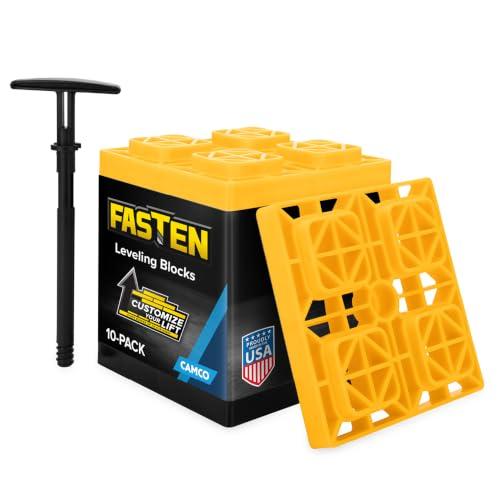 Camco FasTen Leveling Blocks (10-pack)The default first purchase for a travel trailer: interlocking blocks you stack into a ramp, cheap enough to buy two sets. | Most first trailers | Strong | |
| 2 | 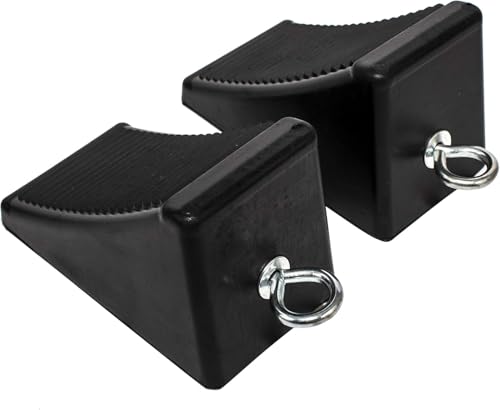 MaxxHaul Solid Rubber Wheel Chocks (pair)Rubber rather than plastic: the version that does not slide when the pad is smooth and slightly damp. | Smooth concrete pads | Strong | |
| 3 | 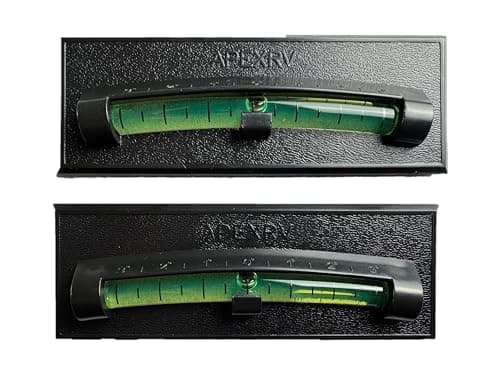 Apex RV Graduated Bubble Level (2-pack)The upgrade over a plain bubble for a couple of dollars: graduations, so the level tells you how much out you are and the block count follows. | Reading how far out of level the trailer is, not just which way | Good | |
| 4 | 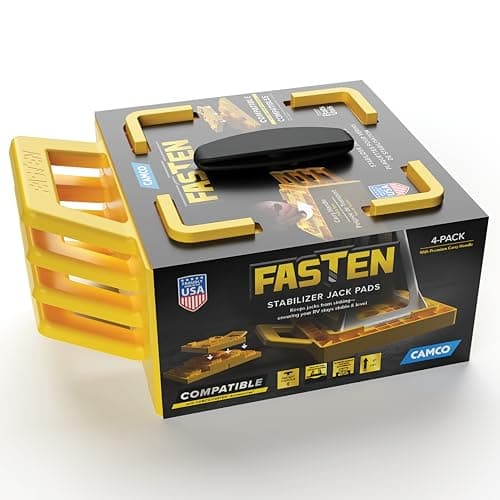 Camco FasTen RV Stabilizer Jack Pads (4-pack)The pad to buy if your leveling blocks are Camco FasTen: the two systems lock together, so a tall stack under a jack stays a stack. | Pads that stack with your leveling blocks | Strong | |
| 5 | 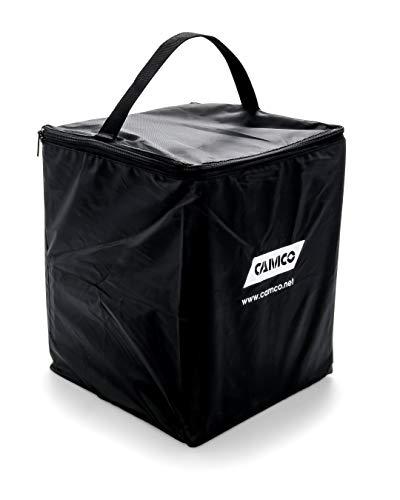 Camco Leveling Block Storage BagA bag, honestly. But the reason people lose leveling blocks is that they never had anywhere to put them. | Not losing blocks | Strong |
Prices come from Amazon and were last checked November 27, 2026. They change constantly, so a price older than 48 hours is withdrawn rather than shown stale — those rows read “Check price on Amazon” instead and go straight to the current listing. #ad — these are affiliate links.
Why “kit” is a misleading word in this category
Search for an RV leveling kit and you will mostly be shown a bag of plastic blocks. Blocks are one of four jobs, and the other three get skipped by first-season owners constantly — usually in the same order.
Raising a low wheel is the blocks. That is the part everybody buys.
Stopping the trailer rolling is the chocks, and it is a separate product with a separate purpose. A trailer parked on top of a stack of blocks is a trailer sitting on a small ramp. Blocks do not chock. This is the single most common gap in a half-built kit, and it is covered in detail in how many wheel chocks you need.
Knowing when to stop is the level. Doing this by eyeballing the fridge door is how you end up driving on and off the blocks five times. A graduated level mounted on the A-frame and the side rail tells you both axes and, crucially, how far out you are — which is how many blocks, not just which side.
Keeping the jacks out of the dirt is the pads. A scissor jack foot is a few square inches of steel. On gravel, grass or a soft shoulder it sinks, and the trailer you just levelled settles overnight.
How we chose each part
Interlocking over loose. Blocks that lock together stay as a stack when a tire climbs them. Loose pads squirt sideways, which is both annoying and the mechanism behind most block breakage. Every block pick here interlocks.
Published capacity, where anyone publishes one. Camco and Tri-Lynx both publish load figures for their block systems. The chock and pad market is far looser, and where a figure comes from a listing rather than a manufacturer sheet we say so on the product card rather than repeating it as fact.
Readable, not just accurate. A level that only tells you “left side low” makes you guess the block count. A graduated one tells you roughly how far, which turns a guess into a number.
Cheap where cheap is honest. Three of the five items here cost less than a tank of fuel. We are not going to pretend a rubber wedge is a technology purchase. The money in this category goes into the blocks, and everything else is a few dollars that removes a specific failure.
We do not test products and say so on how we choose. No block here was load-tested by us and no stack was measured. What we can do is read the published specifications against each other, say which figures have a manufacturer behind them, and sequence the kit the way an arrival actually goes.
The picks
1. Best for Most first trailers
Camco FasTen Leveling Blocks (10-pack)
The default first purchase for a travel trailer: interlocking blocks you stack into a ramp, cheap enough to buy two sets.
- Specification
- Interlocking 10-pack
- Specification
- Stacks into a ramp
- Specification
- Carry bag sold separately
What it does well
- The blocks lock together, so a two-high stack does not shuffle apart when the tire rolls onto it
- Ten blocks covers one axle on most sites and two axles on gently sloped ones
- Cheap enough that losing one in the grass is annoying rather than expensive
The real tradeoff
- You still guess how many to stack, then pull forward and re-check
- On soft ground they sink, and nothing in the design prevents that
How it measures up
These are judgments from published specifications and what we see at the lodge, not laboratory results. How we choose.
- Beginner fit
- Strong — No instructions needed. Stack, drive up, stop.
- Stability once set
- Good — The interlock is what keeps a stack honest.
- Speed to level
- Adequate — Trial and error. You will pull forward twice.
- Value
- Strong — The least money you can spend and still do this properly.
Specifications from Camco.
2. Best for Smooth concrete pads
MaxxHaul Solid Rubber Wheel Chocks (pair)
Rubber rather than plastic: the version that does not slide when the pad is smooth and slightly damp.
- Specification
- Solid rubber
- Specification
- Sold in pairs
- Specification
- Heavier than molded plastic
What it does well
- Rubber grips concrete instead of skating across it
- Heavy enough that it stays where you put it in wind
The real tradeoff
- Noticeably heavier to carry and store
- Rubber marks whatever shares a compartment with it
How it measures up
These are judgments from published specifications and what we see at the lodge, not laboratory results. How we choose.
- Beginner fit
- Strong — Identical method, better grip.
- Stability once set
- Strong — The grip is the whole point.
- Speed to level
- Strong — Instant.
- Value
- Good — A small premium for a real improvement on concrete.
3. Best for Reading how far out of level the trailer is, not just which way
Apex RV Graduated Bubble Level (2-pack)
The upgrade over a plain bubble for a couple of dollars: graduations, so the level tells you how much out you are and the block count follows.
- Specification
- Graduated scale rather than a single center bubble, so the vial shows degrees of tilt
- Specification
- Adhesive backing; sold as a two-pack so one covers side-to-side and the other front-to-back
- Specification
- Sold in white and in black
What it does well
- A graduated vial is the bridge between a bubble and a wireless unit: it gives you a magnitude, which is what decides how many blocks to put down
- Two in the pack covers both directions for less than the price of lunch
- Adhesive mount, so there is no drilling into the trailer skin
The real tradeoff
- Two separate levels instead of one T, so you are reading two places on the trailer
- No manufacturer specification page and no published tolerance - the graduations are a guide, not a calibrated instrument
- Adhesive on a dirty or cold trailer skin is a bad bond. Clean the spot and fit it warm
How it measures up
These are judgments from published specifications and what we see at the lodge, not laboratory results. How we choose.
- Beginner fit
- Good — Slightly more to read than a plain bubble.
- Install effort
- Good — Adhesive, two spots, trailer must be level first.
- Accuracy
- Adequate — Graduated but unspecified; treat it as indicative.
- Value
- Strong — Two levels for pocket change.
4. Best for Pads that stack with your leveling blocks
Camco FasTen RV Stabilizer Jack Pads (4-pack)
The pad to buy if your leveling blocks are Camco FasTen: the two systems lock together, so a tall stack under a jack stays a stack.
- Specification
- Four pads per pack
- Specification
- Each pad about 11 x 8.5 in, giving roughly 1 in of lift
- Specification
- Interlocks with the FasTen leveling block system
- Specification
- Molded plastic, nests flat for storage
What it does well
- Interlocks with FasTen leveling blocks, so a jack that needs more height gets a proper stack instead of a tower of loose pieces
- Nests flat, which is the difference between pads you keep and pads you lose
- Wide enough to make a real difference on grass, which is the only reason to own them
The real tradeoff
- Only interlocks with Camco's own FasTen blocks, so it is a weaker match if your blocks are another brand
- Plastic, so it will flex on a stone and eventually crack if you abuse it
- Does nothing for a jack that is already extended to its limit
How it measures up
These are judgments from published specifications and what we see at the lodge, not laboratory results. How we choose.
- Beginner fit
- Strong — One pad under each foot, before you crank.
- Stability once set
- Strong — The interlock stops a stack walking apart.
- Speed to level
- Strong — Seconds per jack.
- Value
- Strong — Small money for a problem that ruins a night.
Specifications from Camco.
5. Best for Not losing blocks
Camco Leveling Block Storage Bag
A bag, honestly. But the reason people lose leveling blocks is that they never had anywhere to put them.
- Specification
- Zippered bag
- Specification
- Sized for a 10-block set
- Specification
- Carry handles
What it does well
- Blocks live in one place instead of loose in a bumper compartment
- Wet, muddy blocks go back in the bag instead of onto everything else
The real tradeoff
- It is a bag. Any tote works. This one is simply the right size
How it measures up
These are judgments from published specifications and what we see at the lodge, not laboratory results. How we choose.
- Beginner fit
- Strong — Nothing to understand.
- Stability once set
- Adequate — Not applicable. It is storage.
- Speed to level
- Good — Faster only because you can find your blocks.
- Value
- Good — Cheap, and it ends a recurring annoyance.
Specifications from Camco.
What each part of the kit is for
| Part | The job | What happens without it | Skip it? |
|---|---|---|---|
| Camco FasTen blocks (10-pack) | Raise the low side, side to side and front to back | You are hunting for scrap lumber at every site | No. This is the kit. |
| MaxxHaul rubber chocks (pair) | Stop the trailer rolling once it is unhitched | A trailer on a block stack is on a ramp with nothing holding it | No. Cheapest item, biggest consequence. |
| Apex graduated bubble level (2-pack) | Tell you which way and roughly how far out of level you are | Repeated drive-on, get-out, look, drive-off cycles | Not if you value your arrival time. |
| Camco FasTen jack pads (4-pack) | Spread the stabilizer jack load on soft ground | Jacks sink overnight and the trailer settles off level | Only on a concrete pad. |
| Camco block storage bag | Keep ten blocks together in the bay | You own six blocks by next season | Yes, for one trip. No, for a season. |
The three-item version, if you are buying today
If you want the shortest possible list that is still honest: blocks, chocks, a level. Pads and a bag can follow next month. Nothing on that shortlist substitutes for another item on it.
Best for Most first trailers
Camco FasTen Leveling Blocks (10-pack)
The default first purchase for a travel trailer: interlocking blocks you stack into a ramp, cheap enough to buy two sets.
Best for Smooth concrete pads
MaxxHaul Solid Rubber Wheel Chocks (pair)
Rubber rather than plastic: the version that does not slide when the pad is smooth and slightly damp.
Best for Reading how far out of level the trailer is, not just which way
Apex RV Graduated Bubble Level (2-pack)
The upgrade over a plain bubble for a couple of dollars: graduations, so the level tells you how much out you are and the block count follows.
How the kit gets used, in order
Before you unhitch. Pull onto the pad roughly where you want to end up and read the level. Side-to-side comes first, because that is the axis you fix by driving. Front-to-back you fix with the tongue jack afterwards.
Lay the blocks in front of the low-side tires. Stepped, so the tire climbs rather than hits a wall. On a tandem axle both tires on that side need a stack, which is the whole point of the tandem-axle page.
Drive on slowly, with a spotter if you have one. Then re-read the level. One pass is normal; three means the first read was a guess.
Chock before you unhitch, not after. This is the step people reverse, and it is the one that matters. The tow vehicle is the only thing holding the trailer until the chocks are in.
Then the tongue jack, then the stabilizers on pads. Front-to-back level comes from the tongue jack. The stabilizer jacks come down last and they are not lifting anything — they are taking the bounce out. See stabilizers versus levelers if that distinction is new.
Mistakes that make a complete kit behave like a cheap one
Chocking only one wheel on a tandem axle. Two axles, four wheels, and a single chock leaves three free. The chock count page has the arithmetic.
Stacking blocks like a tower instead of a ramp. A vertical face is a kerb. Step the stack down in front of the tire so the tire rolls up it.
Putting pads under the leveling blocks. Pads are for the jacks. Blocks under a tire want to sit on the ground, spread as wide as the stack allows.
Levelling to the bubble on the fridge. Factory bubble levels are often glued on at the factory with the trailer on a not-quite-flat floor. Trust a level you fitted yourself with a known reference.
Buying a boxed “kit” and assuming it is complete. Read the contents list. Most are blocks and a bag. That is two of the five jobs on this page.
Questions people actually ask
What should be in an RV leveling kit?
Four things do four different jobs: interlocking leveling blocks to raise a low wheel, wheel chocks to stop the trailer rolling once it is unhitched, a level you can read to tell you which way and how far out you are, and jack pads so the stabilizer jacks do not sink into soft ground. A storage bag is the fifth item and the one that keeps the other four together. No single boxed product on the market contains all of them.
How many leveling blocks do I need for a travel trailer?
A 10-pack covers almost every travel trailer situation, because you are usually stacking two or three blocks under each tire on one side. On a tandem axle you need a stack under both tires on the low side, which doubles the count immediately - that is the main reason we recommend the 10-pack rather than a smaller bag. Our full breakdown is on how many leveling blocks do I need.
Do leveling blocks work as wheel chocks?
No, and treating them as chocks is the most common mistake in a half-built kit. Leveling blocks are a ramp you deliberately drove onto; a chock is a wedge that stops the wheel rolling. Once the tow vehicle is disconnected, the chocks are the only thing holding the trailer, which is why they go in before you unhitch rather than after.
Do I need jack pads if I have leveling blocks?
They solve different problems. Blocks go under tires to change the trailer's height; pads go under the stabilizer jack feet to spread their load. A jack foot is only a few square inches, and on gravel or grass it sinks overnight and the trailer settles back off level. On a poured concrete pad you can skip pads; on anything softer they are a few dollars well spent.
Is a bubble level or a wireless level better for a travel trailer?
A graduated bubble level is cheaper, needs no battery and no phone, and reads at the trailer. A wireless system reads inside the tow vehicle before you get out, which saves the walk. Both are honest products; the bubble level belongs in the baseline kit on this page and the wireless option is covered on our best RV level indicator roundup.
What order do you level and chock a travel trailer in?
Read the level, lay the blocks in front of the low-side tires, drive on slowly, re-read the level, chock the wheels, and only then unhitch. Front-to-back level comes from the tongue jack after unhitching, and the stabilizer jacks go down last onto pads. Chocking before unhitching is the step most often reversed and the one with the worst consequence.
Sources
Read next
Leveling & Chocks
Best RV Leveling Blocks for a First Travel Trailer
Interlocking blocks, curved levelers and jack pads compared for someone leveling a trailer for the first time.
Leveling & Chocks
Best Leveling Blocks for a Tandem-Axle RV
Two axles rule out the curved-ramp levelers. Stackable interlocking blocks, two stacks per side, and what to chock.
Leveling & Chocks
Best RV Leveling Blocks Under $50
Interlocking stackable blocks and the supporting kit, all of it under $50 at today's prices.
Leveling & Chocks
How Many Leveling Blocks Do I Need?
Block counts by axle setup, how to estimate lift from a bubble reading, and when more blocks is the wrong answer.
Reviewed November 22, 2026. Spot something out of date? Tell us and we will fix it.