Best Leveling Blocks for a Tandem-Axle RV
The popular curved-ramp levelers are sold for single-axle trailers. If your trailer has four wheels on the ground, this is the product class that actually works and how much of it you need.
Heads up: this page contains affiliate links. If you buy through one, Camp & Chock may earn a commission at no extra cost to you. It never changes which product we put first — how this site is funded.
The short answer
On a tandem axle, buy interlocking stackable blocks and buy enough of them: the Camco FasTen 10-pack is the pick, because a dual-axle trailer needs a stack under both tires on the low side and a 4-pack runs out immediately. Tri-Lynx Lynx Levelers are the same idea with a wider footprint for heavier rigs and soft ground. FasTen is also the budget pick — it is the cheapest product here that does the whole job. The reason this page exists: the curved-ramp levelers everyone recommends (Andersen, Beech Lane) are published for single-axle trailers, so the most popular product in the category is the wrong answer for your trailer.
Part of our leveling and chocks guide, and the leveling half of a pair: the chock side of a two-axle setup is on best wheel chocks for a tandem-axle trailer. For the general ranking regardless of axle count, see the leveling blocks roundup.
Our picks at a glance
Tap any row to jump to the full write-up.
| # | Product | Best for | Beginner fit | Price |
|---|---|---|---|---|
| 1 | 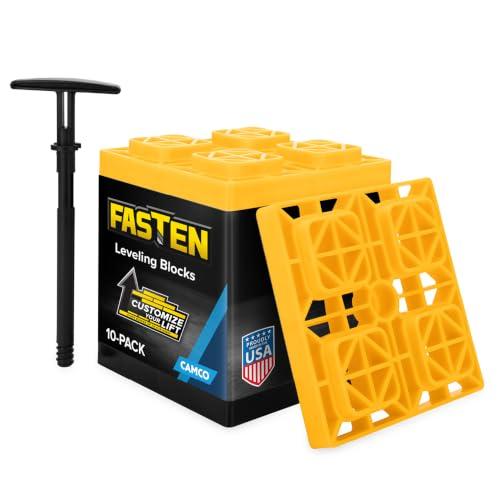 Camco FasTen Leveling Blocks (10-pack)The default first purchase for a travel trailer: interlocking blocks you stack into a ramp, cheap enough to buy two sets. | Most first trailers | Strong | |
| 2 | 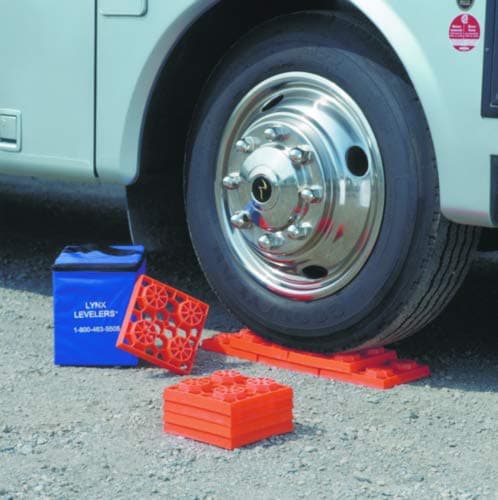 Tri-Lynx Lynx Levelers (10-pack)The upgrade you make after your first soft-ground site: the same stacking idea with a structure that spreads weight instead of concentrating it. | Heavier rigs and soft ground | Good | |
| 3 | 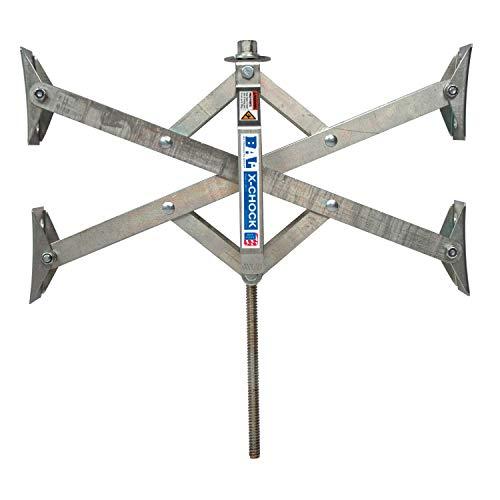 BAL X-Chock Tire Locking ChockThe standard answer to a trailer that rocks when you walk across it, and only useful if you have two axles per side. | Tandem-axle rigs that rock | Good | |
| 4 | 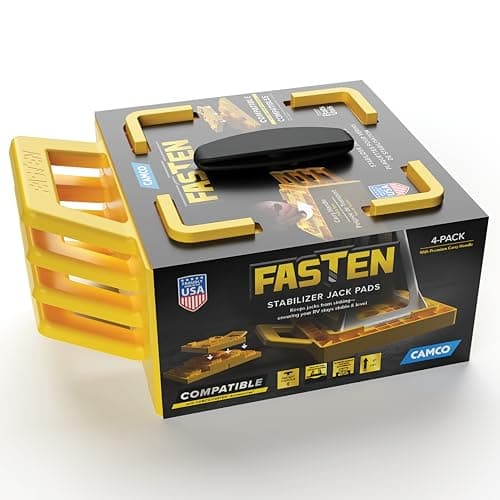 Camco FasTen RV Stabilizer Jack Pads (4-pack)The pad to buy if your leveling blocks are Camco FasTen: the two systems lock together, so a tall stack under a jack stays a stack. | Pads that stack with your leveling blocks | Strong | |
| 5 | 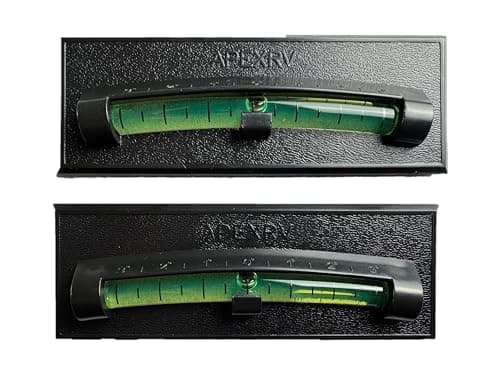 Apex RV Graduated Bubble Level (2-pack)The upgrade over a plain bubble for a couple of dollars: graduations, so the level tells you how much out you are and the block count follows. | Reading how far out of level the trailer is, not just which way | Good |
Prices come from Amazon and were last checked November 27, 2026. They change constantly, so a price older than 48 hours is withdrawn rather than shown stale — those rows read “Check price on Amazon” instead and go straight to the current listing. #ad — these are affiliate links.
Why the axle count changes the product, not just the quantity
A curved ramp leveler is a single-wheel device. The Andersen and Beech Lane style levelers work by letting one tire drive up a curved wedge and then chocking it at whatever height it stopped at. Both are published and sold for single-axle trailers. On a tandem axle the second tire on that side is still sitting on the ground, so the ramp either cannot be used at all or you are asking one tire to carry a share of the load it was not meant to. We cover the ramp design itself on ramps versus blocks and the brand question on Andersen versus Beech Lane. Neither page changes the answer here.
Stackable blocks scale to any number of wheels. You build one stack per tire. Four wheels on the ground means two stacks on the low side, at matching height, with both stepped so each tire climbs its own ramp. That is why the product class, not the brand, is the decision on a dual-axle trailer.
And it changes the count. If you need three blocks of lift, that is three per tire and six for the side. A 4-pack cannot do it and an 8-pack is tight. This is the single clearest argument for the 10-pack, and the arithmetic is laid out on how many leveling blocks do I need.
How we chose
Does it work with two tires per side at all. That test alone removes the curved-ramp class, which is most of the category’s marketing.
Interlocking, not loose. Two stacks means twice the chance of a stack shifting under a climbing tire. Blocks that lock together behave as one piece.
Enough blocks in one purchase. We rank the pack size that covers a tandem axle, not the cheapest pack on the shelf.
Published load figures where they exist. Camco and Tri-Lynx publish capacity for their systems. Where a number comes from a retail listing instead, the product card says so.
What stops the rocking afterwards. A tandem axle has a specific complaint — fore-and-aft rock between the two axles — and the X-chock is the product aimed at it, which is why it is on this page rather than only on the chock page. See X-chocks versus wheel chocks.
We do not test products and say so on how we choose. No block was load-tested here; the single-axle limitation on curved-ramp levelers is the makers’ own published positioning, reported as such.
The picks
1. Best for Most first trailers
Camco FasTen Leveling Blocks (10-pack)
The default first purchase for a travel trailer: interlocking blocks you stack into a ramp, cheap enough to buy two sets.
- Specification
- Interlocking 10-pack
- Specification
- Stacks into a ramp
- Specification
- Carry bag sold separately
What it does well
- The blocks lock together, so a two-high stack does not shuffle apart when the tire rolls onto it
- Ten blocks covers one axle on most sites and two axles on gently sloped ones
- Cheap enough that losing one in the grass is annoying rather than expensive
The real tradeoff
- You still guess how many to stack, then pull forward and re-check
- On soft ground they sink, and nothing in the design prevents that
How it measures up
These are judgments from published specifications and what we see at the lodge, not laboratory results. How we choose.
- Beginner fit
- Strong — No instructions needed. Stack, drive up, stop.
- Stability once set
- Good — The interlock is what keeps a stack honest.
- Speed to level
- Adequate — Trial and error. You will pull forward twice.
- Value
- Strong — The least money you can spend and still do this properly.
Specifications from Camco.
2. Best for Heavier rigs and soft ground
Tri-Lynx Lynx Levelers (10-pack)
The upgrade you make after your first soft-ground site: the same stacking idea with a structure that spreads weight instead of concentrating it.
- Specification
- Interlocking 10-pack
- Specification
- Open honeycomb structure
- Specification
- Stacks up or spreads sideways
What it does well
- The honeycomb structure spreads load, which is the one thing that helps most on soft sites
- Laid two wide instead of two high, they sink far less than a narrow stack
- Long-lived. These are the ones you still own in five years
The real tradeoff
- Costs more than a basic interlocking set for a difference you only notice on bad ground
- The open structure collects gravel and mud
How it measures up
These are judgments from published specifications and what we see at the lodge, not laboratory results. How we choose.
- Beginner fit
- Good — Same idea as any stacking block, slightly more to carry.
- Stability once set
- Strong — The wide footprint is what stops the slow sink.
- Speed to level
- Adequate — Still stack and check.
- Value
- Good — Worth it if your regular sites are grass or dirt.
Specifications from Tri-Lynx.
3. Best for Tandem-axle rigs that rock
BAL X-Chock Tire Locking Chock
The standard answer to a trailer that rocks when you walk across it, and only useful if you have two axles per side.
- Specification
- Fits between tandem-axle tires
- Specification
- Ratchet-driven expansion
- Specification
- One per side is the normal setup
What it does well
- It pushes the two tires apart instead of blocking them, which is what actually stops the side-to-side rock
- The ratchet means you tighten by feel and it stays tight
- Survives being left outside for years
The real tradeoff
- Useless on a single-axle trailer. There is no second tire to push against
- Needs a wrench or the matching ratchet, which is one more thing to keep track of
- Tight tire gaps on some rigs make it a fight to seat the first time
How it measures up
These are judgments from published specifications and what we see at the lodge, not laboratory results. How we choose.
- Beginner fit
- Good — Simple once shown, mildly fiddly the first time.
- Stability once set
- Strong — This is the one thing it does, and it does it.
- Speed to level
- Good — Thirty seconds a side with the ratchet.
- Value
- Good — Buy one per side, not one per trailer.
4. Best for Pads that stack with your leveling blocks
Camco FasTen RV Stabilizer Jack Pads (4-pack)
The pad to buy if your leveling blocks are Camco FasTen: the two systems lock together, so a tall stack under a jack stays a stack.
- Specification
- Four pads per pack
- Specification
- Each pad about 11 x 8.5 in, giving roughly 1 in of lift
- Specification
- Interlocks with the FasTen leveling block system
- Specification
- Molded plastic, nests flat for storage
What it does well
- Interlocks with FasTen leveling blocks, so a jack that needs more height gets a proper stack instead of a tower of loose pieces
- Nests flat, which is the difference between pads you keep and pads you lose
- Wide enough to make a real difference on grass, which is the only reason to own them
The real tradeoff
- Only interlocks with Camco's own FasTen blocks, so it is a weaker match if your blocks are another brand
- Plastic, so it will flex on a stone and eventually crack if you abuse it
- Does nothing for a jack that is already extended to its limit
How it measures up
These are judgments from published specifications and what we see at the lodge, not laboratory results. How we choose.
- Beginner fit
- Strong — One pad under each foot, before you crank.
- Stability once set
- Strong — The interlock stops a stack walking apart.
- Speed to level
- Strong — Seconds per jack.
- Value
- Strong — Small money for a problem that ruins a night.
Specifications from Camco.
5. Best for Reading how far out of level the trailer is, not just which way
Apex RV Graduated Bubble Level (2-pack)
The upgrade over a plain bubble for a couple of dollars: graduations, so the level tells you how much out you are and the block count follows.
- Specification
- Graduated scale rather than a single center bubble, so the vial shows degrees of tilt
- Specification
- Adhesive backing; sold as a two-pack so one covers side-to-side and the other front-to-back
- Specification
- Sold in white and in black
What it does well
- A graduated vial is the bridge between a bubble and a wireless unit: it gives you a magnitude, which is what decides how many blocks to put down
- Two in the pack covers both directions for less than the price of lunch
- Adhesive mount, so there is no drilling into the trailer skin
The real tradeoff
- Two separate levels instead of one T, so you are reading two places on the trailer
- No manufacturer specification page and no published tolerance - the graduations are a guide, not a calibrated instrument
- Adhesive on a dirty or cold trailer skin is a bad bond. Clean the spot and fit it warm
How it measures up
These are judgments from published specifications and what we see at the lodge, not laboratory results. How we choose.
- Beginner fit
- Good — Slightly more to read than a plain bubble.
- Install effort
- Good — Adhesive, two spots, trailer must be level first.
- Accuracy
- Adequate — Graduated but unspecified; treat it as indicative.
- Value
- Strong — Two levels for pocket change.
What works on two axles and what does not
| Product class | Tandem axle? | Why | Example here |
|---|---|---|---|
| Interlocking stackable blocks | Yes - the right answer | One stack per tire, any height, any number of wheels | Camco FasTen, Tri-Lynx Lynx Levelers |
| Curved ramp leveler | No | Published and sold as a single-axle product | Andersen, Beech Lane (both covered elsewhere on this site) |
| X-chock between the tires | Yes - tandem only | Expands between two tires on one side; needs two axles to work | BAL X-Chock |
| Solid wedge chocks | Yes | Still needed. Blocks are a ramp, not a brake | See the tandem-axle chock page |
| Jack pads | Yes | Unrelated to axle count; stops the stabilizers sinking | Camco FasTen jack pads |
The dual-axle shortlist
Blocks to get level, a second brand of blocks if your rig is heavy or the ground is soft, and an X-chock for the fore-aft rock that only tandem axles get. Everything else on this page is support.
Best for Most first trailers
Camco FasTen Leveling Blocks (10-pack)
The default first purchase for a travel trailer: interlocking blocks you stack into a ramp, cheap enough to buy two sets.
Best for Heavier rigs and soft ground
Tri-Lynx Lynx Levelers (10-pack)
The upgrade you make after your first soft-ground site: the same stacking idea with a structure that spreads weight instead of concentrating it.
Best for Tandem-axle rigs that rock
BAL X-Chock Tire Locking Chock
The standard answer to a trailer that rocks when you walk across it, and only useful if you have two axles per side.
Getting a tandem axle level on the first attempt
Read the level before you touch anything. Side to side first. A graduated level tells you roughly how far out, and roughly how far out is roughly how many blocks.
Build both stacks, stepped, in front of both low-side tires. Line them up with the tire centre, not the fender.
Drive on in one smooth pull. Stopping halfway up a stack and restarting is how blocks get pushed out. If you have a spotter, this is what they are for.
Re-read, then chock all four wheels. Four wheels on the ground means four wheels that can roll. Then unhitch.
Front to back with the tongue jack, then the stabilizers. Pads under the jack feet. If the trailer still moves when someone walks through it, that is a stabilizing problem rather than a leveling one, and how to keep a travel trailer from rocking is the page for it.
Mistakes specific to two axles
Buying a curved-ramp leveler because it is the popular one. It is popular, it is well made, and it is published for single-axle trailers. Axle count beats popularity.
Levelling one axle. Raising only the front tire on a side lifts that corner and loads the rear tire. Both tires, same height.
Using the X-chock as your only chock. An X-chock reduces rocking between two tires. It is not a parking brake and its maker does not sell it as one.
Running out of blocks on site. Six blocks for a three-high stack on both tires is the common case. Count before you leave the driveway.
Questions people actually ask
Can you use an Andersen or Beech Lane camper leveler on a tandem-axle trailer?
No - both are published and sold as single-axle products. The curved-ramp design works by driving one tire up a wedge and chocking it where it stops, which assumes that tire is the only one on that side. On a dual-axle trailer the second tire is still on the ground, so the ramp either will not fit the use case or loads one tire unevenly. Interlocking stackable blocks are the product class for two axles.
How many leveling blocks do I need for a tandem-axle RV?
Twice what a single-axle trailer needs, because you build a stack under both tires on the low side. A three-block lift means three blocks per tire and six for the side, which is why a 10-pack rather than a 4-pack is the sensible purchase. Our how many leveling blocks do I need page works through the counts.
Do both tires on one side need to be on blocks?
Yes, and at the same height. Raising only one tire on a tandem axle transfers load to the other tire and puts a twist through the frame and suspension. Count the blocks in each stack rather than eyeballing them - interlocking blocks make this easy because a stack of three is visibly three.
Do I still need wheel chocks if I have leveling blocks?
Always. Leveling blocks are a ramp you drove up on purpose; nothing about them stops the wheel rolling back down. On a tandem axle there are four wheels able to roll, and the chocks are the only thing holding the trailer once the tow vehicle is disconnected. Chock before you unhitch.
Are X-chocks a substitute for leveling blocks on a dual-axle trailer?
No, they do a different job. An X-chock expands between the two tires on one side of a tandem axle to reduce the fore-and-aft rocking that two axles allow. It does not raise the trailer and its maker does not present it as a parking brake. It is a good addition to a tandem-axle setup after the blocks and chocks are sorted.
Sources
Read next
Leveling & Chocks
Best RV Leveling Blocks for a First Travel Trailer
Interlocking blocks, curved levelers and jack pads compared for someone leveling a trailer for the first time.
Leveling & Chocks
Best Wheel Chocks for a Tandem-Axle Trailer
Wedge chocks and tire-locking chocks for a two-axle travel trailer, with the count you actually need on each side.
Leveling & Chocks
RV Leveling Ramps vs Blocks
Curved ramps against stacking blocks, decided by ground firmness rather than price. Four picks across both formats.
Leveling & Chocks
Best RV Leveling Kit for a Travel Trailer
The complete arrival kit: stackable blocks, chocks, a readable level, jack pads and somewhere to keep them.
Reviewed November 22, 2026. Spot something out of date? Tell us and we will fix it.