What Size Extension Cord for an RV?
Not a hardware-store cord, and not the longest one you can find. Match the cord to your rig's amperage, keep it as short as the site allows, and plug the protector in first.
Heads up: this page contains affiliate links. If you buy through one, Camp & Chock may earn a commission at no extra cost to you. It never changes which product we put first — how this site is funded.

Buy an extension cord made for RV use and rated for your rig’s service — 30 amp for a 30-amp trailer, 50 amp for a 50-amp rig — in the shortest length that reaches the pedestal, which for most sites means 25 feet. A household extension cord is not a smaller version of the right part; it is a different part, with a different connector and a conductor sized for a lamp rather than an air conditioner. The cord also has to carry the full load continuously for days, which is not what a garage cord is built to do.
Part of our power and surge protection guide. The companion page is the RV power cord roundup, which covers which cord to buy once you know what size you need.
First, work out what service your trailer uses
Look at the plug on the end of your trailer’s factory cord. Three large flat blades is a 30-amp RV connector. Four blades is 50-amp. A normal household plug means your rig is a 15 or 20-amp unit, which is common on very small trailers and pop-ups.
Everything downstream of that answer follows from it. The extension cord, the surge protector and any adapter all have to match the service your trailer is wired for, and mixing classes is where people create problems that look electrical but are really shopping mistakes.
Match the cord to the rig, not to the pedestal
| Your trailer's plug | What that service is | Extension cord to buy |
|---|---|---|
| Three flat blades | 30 amp RV service, the common travel trailer setup | A 30-amp RV extension cord with matching RV connectors |
| Four blades | 50 amp RV service, larger rigs and most fifth wheels | A 50-amp RV extension cord, which is substantially heavier |
| A normal household plug | 15 or 20 amp, small trailers and pop-ups | A heavy outdoor-rated cord, as short as the site allows |
How long, and why shorter is better
The instinct is to buy the longest cord available so the pedestal is never a problem. Resist it, for two reasons.
Voltage drop. Every foot of cord costs a little voltage, and the load on an RV cord is large and continuous rather than brief. Low voltage at the trailer is the fault that damages air conditioner compressors. Adding length to a marginal pedestal makes the marginal pedestal worse.
Bulk. An RV cord is thick, heavy and stiff in the cold. Fifty feet of it is a genuine storage problem in a pass-through compartment that is already holding your sewer kit and your leveling blocks.
Twenty-five feet is the length that solves the problem people actually have, which is the pedestal being behind the trailer rather than beside it. Buy that, and treat anything longer as a solution to a problem you have not met yet.
What to look for on the cord itself
RV connectors on both ends, matching your service. Not an adapter bodged onto a household cord. The connector is part of the rating.
An outdoor-rated jacket. The cord lies on wet grass, in sun, for days. A cord rated for indoor use cracks, and a cracked jacket on a 30-amp conductor is not a cosmetic problem.
Grip handles at both ends. This sounds like a nice-to-have and is not. A 30-amp RV plug is a stiff, tight fit by design, and pulling it out by the cord is how the conductors get strained at the connector. In cold weather, with gloves, the handles are the difference between a two-second job and a fight.
A length you will actually carry. The best cord is the one in the compartment, not the one at home because it was too bulky.
What to buy once you know the size
A 30-amp, 25-foot RV extension cord with grip handles is the right first purchase for a travel trailer. A full replacement cord is for when the factory one is damaged, not an upgrade over a healthy one. A dogbone adapter handles a pedestal with the wrong socket - but it does not change how many amps are available.
Best for Reaching the pedestal
Camco PowerGrip 30-Amp Extension Cord (25 ft)
The spare cord you buy after your first site where the pedestal was on the wrong side, with handles that make the plug manageable.
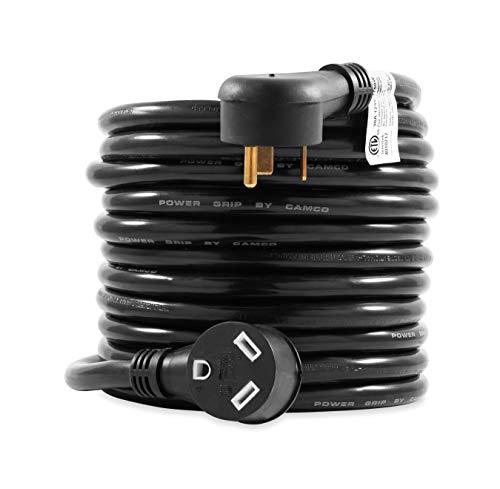
Best for Replacing a damaged cord
Camco Heavy-Duty RV Power Cord (30 amp, 25 ft)
The replacement cord. Buy it when yours is damaged, not before, and replace it the day it is rather than the season after.
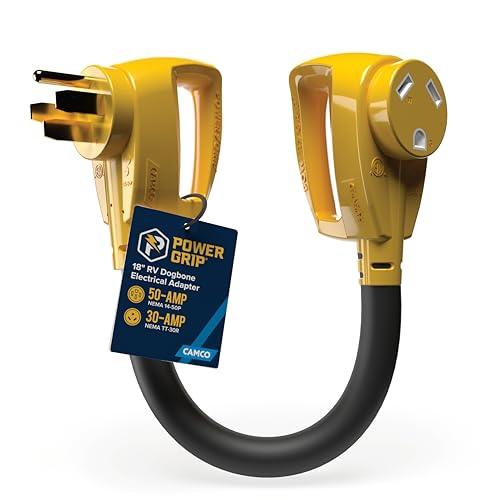
Best for Whatever the pedestal has
Camco PowerGrip Dogbone Adapter (50 amp to 30 amp)
A short cord that converts one plug shape into another. Buy the pair you might need before the trip, not at the pedestal.
The order everything plugs in, which matters
Once you own a protector, an extension cord and possibly an adapter, there is a correct sequence and a common wrong one.
Protector closest to the pedestal. The surge protector or EMS goes into the pedestal socket first, with everything else downstream of it. Its job includes refusing a miswired pedestal before any of your equipment is connected to it, and it cannot do that from the far end of a cord.
Adapter next, if you need one. If the pedestal has a 50-amp socket and your trailer is 30-amp, the dogbone goes between the pedestal and the protector — check the protector’s own instructions, because some are specific about it.
Extension cord after that, then the trailer cord. The extension is making up distance, so it belongs in the middle of the chain rather than at the pedestal end.
Keep the connections off the ground where you can. A joint lying in a puddle is the one thing in this chain that is both easy to avoid and genuinely dangerous. Loop the cord over the pedestal bracket rather than leaving the connection in the dirt.
The full arrival sequence, including what to check at the pedestal before any of this, is in the RV electrical hookup guide.
An adapter is not an upgrade
This is the single most common misunderstanding in this part of the site, so it is worth being blunt. A dogbone adapter changes the shape of a plug. It does not change how much current is available behind it.
A 30-amp trailer on a 15-amp household outlet through an adapter is a trailer with 15 amps. That runs a converter and lights and maybe a small heater — and “small” is doing real work in that sentence, which is why the space heater roundup includes a 200 W option for exactly this case. It does not run an air conditioner, and trying will trip the breaker at best. Going the other way — a 30-amp rig on a 50-amp pedestal — is fine, because you are drawing less than what is available.
Buy the adapters you might need before the trip rather than at the pedestal, because the pedestal is where you discover you need one. The dogbone adapter guide covers which direction is which, which is easy to get wrong on a listing.
When the answer is a new trailer cord instead
If your factory cord is crushed, cut, scorched at the plug or has been repaired with tape, an extension cord is not the purchase you need. A damaged cord is a fire and shock hazard and nothing downstream of it helps. Replace it, and replace it now rather than next season — the replacement is cheap relative to any version of the alternative.
A healthy factory cord, on the other hand, does not need replacing. A heavy-duty replacement is a replacement, not an upgrade.
Questions people actually ask
Can I use a regular extension cord for my RV?
Not for a 30 or 50-amp trailer. A household cord has the wrong connector and a conductor sized for intermittent light loads, while an RV cord carries a large load continuously for days. For a small 15 or 20-amp trailer or pop-up, a heavy outdoor-rated cord as short as the site allows is acceptable.
What size extension cord do I need for a 30-amp RV?
A cord made for RV use, rated for 30 amps, with matching 30-amp RV connectors on both ends, in the shortest length that reaches the pedestal. Twenty-five feet covers the sites where the pedestal is behind the trailer rather than beside it.
Is a longer RV extension cord worse?
Yes, in two ways. Every foot costs a little voltage under a large continuous load, and low voltage at the trailer is the fault that damages air conditioner compressors. Longer cords are also heavy and stiff enough to become a storage problem. Buy the shortest cord that reaches.
Can I plug two RV extension cords together?
Avoid it. Each joint is another connection to work loose, another place for water to enter, and the voltage drop of both cords adds up. If one cord will not reach, use one longer cord or ask for a site closer to the pedestal.
Does the surge protector go before or after the extension cord?
Before - plug the protector into the pedestal socket with everything else downstream of it. Part of its job is refusing a miswired pedestal before your equipment is connected, and it cannot do that from the far end of a cord.
Sources
Read next
Power & Surge Protection
Best RV Power Cords and Adapters
Extension cords, dogbone adapters and replacement cords, with the one rule about adapters that everyone learns late.
Power & Surge Protection
Best RV Space Heater for a Travel Trailer
Space heaters for a travel trailer, ranked by what they cost you in amps: thermostats, low settings, and the propane option's conditions.
Power & Surge Protection
RV Dogbone Adapters Explained
Which direction of adapter to buy, what a 30-amp rig can and cannot do on a 50-amp or household outlet, and why the short cord format matters.
Power & Surge Protection
RV Electrical Hookup for Beginners (Step by Step)
The full pedestal connection sequence, why order matters, and what to do when the protective device refuses.
Reviewed October 17, 2026. Spot something out of date? Tell us and we will fix it.