What Size Portable RV Waste Tank Do I Need?
Waste weighs roughly eight pounds a gallon. That single fact decides this question, and it is why the biggest tote is not the best one.
Heads up: this page contains affiliate links. If you buy through one, Camp & Chock may earn a commission at no extra cost to you. It never changes which product we put first — how this site is funded.
Size the tote by how you will move it full, not by how big your gray tank is. Waste weighs roughly eight pounds per gallon, so a 21-gallon tank is around 170 pounds loaded and a 36-gallon tank is in the region of 300. If you are pulling it by hand, 21 gallons is the sensible ceiling. If you will tow it slowly behind a vehicle or a cart on four wheels, 32 to 36 gallons saves you trips. Buying more capacity than you can move is the most common mistake in this category.
Part of our sewer and water guide. Which specific tank to buy is in the portable waste tank roundup; this page is the sizing decision that comes first.
Start with the weight, because everything follows from it
Water weighs about 8.3 pounds a gallon and waste water is close enough to that for planning. Run the arithmetic before you shop and the question mostly answers itself.
Capacity against loaded weight, roughly
| Capacity | Approximate loaded weight | How you move that |
|---|---|---|
| 21 gallons | Around 170 lb | One person can walk it on two wheels, on level ground |
| 32 gallons | Around 265 lb | Four wheels, or a slow tow. Not an arm job |
| 35 gallons | Around 290 lb | Four wheels, or a slow tow |
| 36 gallons | Around 300 lb | Realistically a tow rather than a walk |
Those weights are the capacity multiplied by the weight of water; they are arithmetic rather than a manufacturer figure, and the empty weight of the tank is on top. The point is not the precise number. The point is that the difference between 21 and 36 gallons is the difference between a tank you can handle and a tank that handles you.
Then count the trips you are trying to avoid
The reason to buy a bigger tote is to take a whole tank in one trip instead of three. So look up your trailer’s gray tank capacity in the owner’s manual — it is the bigger of the two tanks on most travel trailers — and compare.
A 21-gallon tote is roughly one gray tank on a small trailer and half a tank on a larger one. A 32 to 36-gallon tote takes a whole gray tank on most travel trailers in one go. If you are dry camping for a week, that is the difference between one walk to the dump station per tank and three.
If you are at a site with water and power but no sewer for a weekend, the smaller tank is almost certainly enough and far easier to live with.
Two wheels or four is a bigger decision than the gallons
This is the specification people skim and then regret, so it is worth being explicit.
Two wheels means the tank is a wheelbarrow: the wheels carry part of the weight and your arms carry the rest, the whole way. That is fine at 21 gallons on a paved road and unpleasant at 36 gallons on gravel.
Four wheels means the tank carries its own weight and you are only steering it. With a swiveling front pair it tracks where you point it. This is the single biggest usability difference between totes once they are full, and it is what the price premium on the larger tanks is mostly buying.
Pneumatic versus no-flat tires is the sub-decision. Pneumatic tires roll over grass and gravel far better; they can also go flat, and a flat on a loaded tote is a genuinely bad afternoon. No-flat wheels never strand you and never roll as well. Gravel sites favor pneumatic; a storage lot that sits all winter favors no-flat.
Published figures for the four tanks on this site
| Camco Rhino 21 | Barker 4-Wheeler 32 | Thetford Titan 35 | Camco Rhino 36 | |
|---|---|---|---|---|
| Capacity | 21 gal | 32 gal | 35 gal | 36 gal |
| Wheels | Two, no-flat | Four, pneumatic, front swivel | Four, swivel | Two steerable, no-flat |
| Dimensions | Not published in this form | 11.5 x 24 x 45 in | 50.75 x 23.75 x 17.31 in | 47 x 25.5 x 16 in |
| Empty weight | Not published | Not published | About 29 lb | About 45 lb |
| Valve | Included fittings | Standard 3 in, empties horizontally | Horizontal, large washout port | Built-in gate valve |
| Level indicator | No | Full-tank indicator | AutoStop level gauge | No |
| Tow adapter | Removable steel | Heavy-duty tow handle | Hitch-ball tow handle | Removable steel |
“Not published” means exactly that: the manufacturer does not publish the figure, so we are not printing one. Note the row that matters most for storage — the larger tanks are 45 to 51 inches long, and that length, rather than the price, is usually what sends people back down a size.
The storage question nobody asks first
A tote has to live somewhere for the 95 percent of the time it is not in use, and it is an awkward shape. Before you choose a capacity, go and look at the space.
Measure your pass-through compartment. A 45 to 51-inch tank does not fit in many of them, and if it does it has displaced your chairs, your blocks and your hose.
Check whether it will hang on the rear ladder. Several tanks are designed to, which keeps a compartment free — but the heavier tanks are a two-hand lift onto a hook, which is worth knowing before you buy one at 45 pounds empty.
Think about the truck bed. If it rides in the bed, look for tie-down grooves. A loose tote in a pickup bed is a projectile.
Pick by how you will move it
Pulling it by hand on a paved loop: 21 gallons on two wheels. Towing it slowly on gravel: a four-wheel 32-gallon tank with pneumatic tires. Nervous about overfilling: the 35-gallon tank with the level gauge. A full gray tank in one trip and somewhere to store 47 inches: the 36-gallon tank.
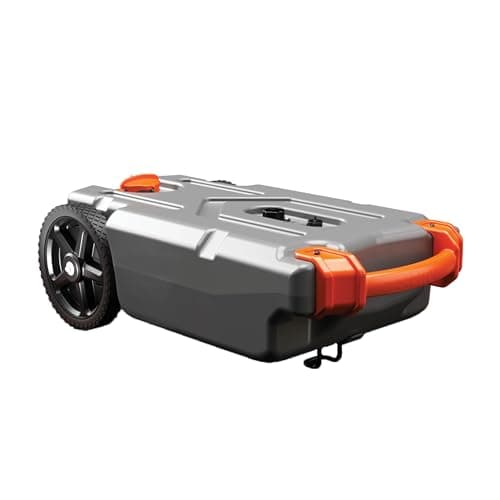
Best for A first tote for a travel trailer
Camco Rhino Portable Waste Tank (21 gallon)
The sensible first tote: big enough to be worth the trip to the dump station, small enough that a full one does not get away from you.
Best for Towing to the dump station
Barker 4-Wheeler Tote-Along Portable Waste Tank (32 gallon)
The tank to buy if you will be towing it rather than pulling it: four wheels take the weight and the 3-in valve means no tipping.
Best for No overfilling and no tipping
Thetford Titan 4-Wheel Portable Waste Tank (35 gallon)
The most beginner-proof tote on the list: the level gauge stops the overfill mistake, and nothing ever needs tipping.
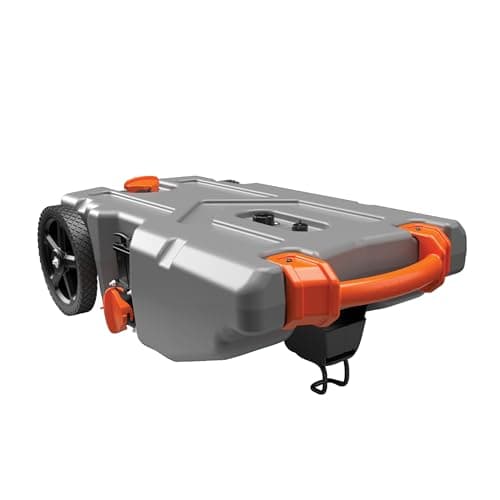
Best for Long stays and bigger tanks
Camco Rhino Portable Waste Tank (36 gallon)
The right tank if you stay put for a week without a sewer hookup. Too much tank if you plan to pull it by hand.
What size to buy, in one paragraph each
Buy 21 gallons if this is your first tote, your sites are mostly full hookup with the occasional exception, you will be moving it yourself, and storage is tight. It is enough to be worth the trip and small enough that a full one does not get away from you.
Buy 32 to 36 gallons if you regularly stay several days without a sewer connection, you have a vehicle or cart to tow it with, and you have measured somewhere for it to live. Four wheels, and a level gauge if you can get one.
Buy nothing if your sites have sewer hookups. A tote solves a problem you do not have, and it is a large object to store for nothing. The small sewer accessories are a far better use of the same money.
Using one without making a mess
Fill it from the trailer with the tote on level ground. A tote on a slope reads as fuller or emptier than it is.
Dump black into it only if you intend to rinse it properly. Many people use a tote for gray water only and move the trailer for the black tank, which is a legitimate strategy.
Empty it with the valve, not by tipping. A horizontal three-inch valve exists so a full tank never has to be lifted on its end.
Rinse it out every time, through the washout port. A tote that gets rinsed is a piece of equipment. One that does not becomes something you avoid using, and then you have stored it for nothing. Use a dedicated rinse hose, never the drinking water hose.
Questions people actually ask
What size portable RV waste tank should I buy?
Size it by how you will move it full. Waste weighs roughly eight pounds a gallon, so 21 gallons is around 170 lb and is the sensible ceiling for pulling by hand. If you will tow it on four wheels, 32 to 36 gallons takes a whole gray tank in one trip on most travel trailers.
How much does a full portable waste tank weigh?
About eight pounds per gallon of contents, plus the empty weight of the tank. A 21-gallon tote is around 170 lb loaded and a 36-gallon tote is in the region of 300 lb. Those are arithmetic from the weight of water, not manufacturer figures.
Are four-wheel tote tanks worth the extra money?
For anything above about 21 gallons, yes. Four wheels carry the whole weight so you are only steering, and a swiveling front pair tracks where you point it. On two wheels your arms carry part of the load the entire way.
Should I get pneumatic or no-flat wheels on a tote tank?
Pneumatic tires roll over gravel and grass far better but can go flat, and a flat on a loaded tote is a serious nuisance. No-flat wheels never strand you and never roll as well. Gravel sites favor pneumatic; a tank that sits in storage all winter favors no-flat.
Do I need a portable waste tank at all?
Only if you stay at sites without a sewer connection. At a full hookup site a tote solves a problem you do not have and is a large, awkward thing to store. The alternative on a dry site is moving the trailer to the dump station.
Can I fill a tote tank to its rated capacity?
You can, but do not. Fill to the weight you can actually move, because a tank that is too heavy cannot be partly emptied where it stands. A tank with a level gauge removes the guesswork, which is the main beginner argument for paying more.
Sources
Read next
Sewer & Water
Best RV Portable Waste Tank for a Travel Trailer
Tote tanks compared on the thing that decides the purchase: how much you can move once it is full.
Sewer & Water
How Often Should You Dump an RV Black Tank?
When to dump black and gray tanks, why fill level beats a schedule, and the valve habit that prevents most tank problems.
Sewer & Water
Best RV Sewer Hose Accessories
Clear elbows, seal donuts, gloves and tank rinsers - the small sewer accessories a first trailer genuinely needs.
Sewer & Water
How to Hook Up an RV Sewer Hose (Step by Step)
The full sewer connection and dumping sequence, in order, with the two checks that prevent the story you tell for years.
Reviewed October 17, 2026. Spot something out of date? Tell us and we will fix it.