Trimax vs Master Lock Coupler Lock
Two coupler locks, two different arguments. One is a heavy obstacle for a trailer parked where strangers walk past it; the other is the lock you will actually bother to fit.
Heads up: this page contains affiliate links. If you buy through one, Camp & Chock may earn a commission at no extra cost to you. It never changes which product we put first — how this site is funded.
The verdict
If the trailer is ever parked somewhere strangers walk past it — a storage lot, a truck stop, a street — buy the heavy universal lock. Bulk and visible mass are what make a thief choose the next trailer along. If it lives in your own driveway behind a gate and you want a lock you will actually fit every time, the lighter one is the honest answer. Check your coupler size before either purchase.
Part of our towing and security guide, and the detailed version of a choice our coupler lock roundup raises and does not settle. These two products come up together constantly, and the usual comparison treats them as competitors at the same job. They are not quite.
Our picks at a glance
Tap any row to jump to the full write-up.
| # | Product | Best for | Beginner fit | Price |
|---|---|---|---|---|
| 1 | 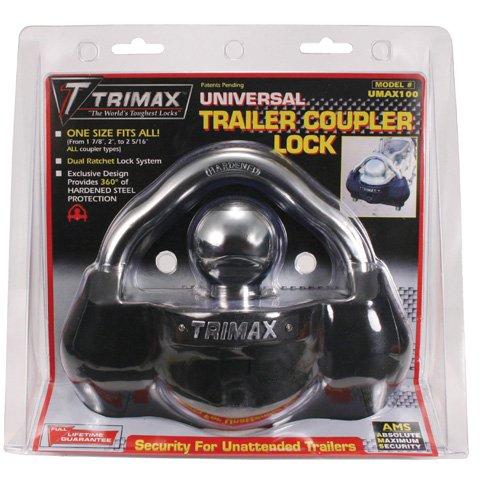 Trimax UMAX100 Universal Coupler LockThe lock that matters when the trailer is parked and unhitched: it blocks the coupler so it cannot be dropped onto another ball. | Locking the trailer itself | Good | |
| 2 | 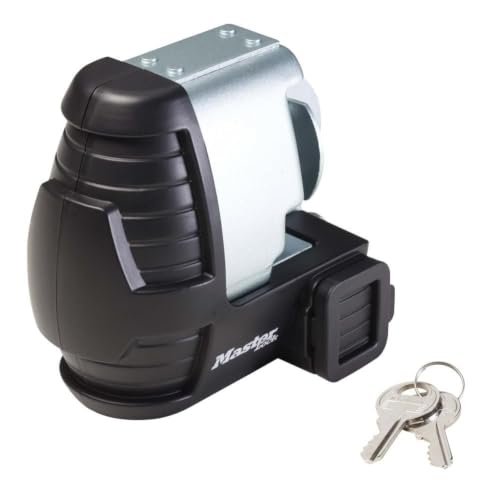 Master Lock Trailer Coupler LockThe lighter coupler lock. Easier to fit and carry, a less serious obstacle, and the right trade for a driveway rather than a truck stop. | A simpler, lighter coupler lock | Strong | |
| 3 | 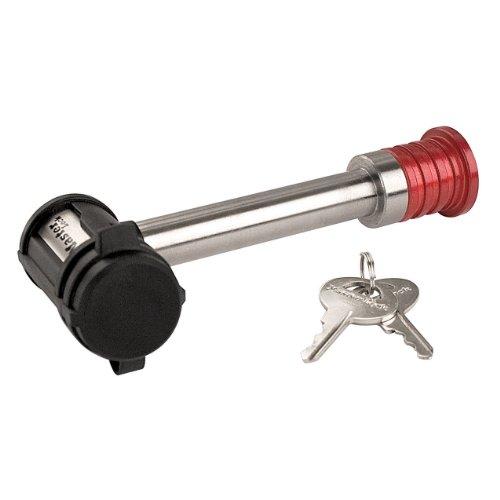 Master Lock Receiver Hitch Pin LockReplaces the clip pin anyone can pull out in a parking lot. It protects the ball mount, not the trailer. | Keeping the ball mount | Strong |
Prices come from Amazon and were last checked November 12, 2026. They change constantly, so a price older than 48 hours is withdrawn rather than shown stale — those rows read “Check price on Amazon” instead and go straight to the current listing. #ad — these are affiliate links.
What a coupler lock is for, exactly
A coupler lock fills or blocks the coupler on your trailer tongue so that nobody can back up to it, drop it onto their own ball, and drive away. That specific theft is quick, quiet, and requires no tools, which is why it happens. The lock does not stop a determined thief with an angle grinder and twenty minutes. It makes your trailer slower to steal than the unlocked one parked beside it, and that is the whole mechanism.
It is a different product from a receiver pin lock, which secures the ball mount into the receiver on your truck. People buy one and think they have the other. We separate them properly in hitch lock versus coupler lock.
The picks, head to head
1. Best for Locking the trailer itself
Trimax UMAX100 Universal Coupler Lock
The lock that matters when the trailer is parked and unhitched: it blocks the coupler so it cannot be dropped onto another ball.
- Specification
- Universal coupler lock
- Specification
- Hardened steel body
- Specification
- Fits a range of coupler sizes
What it does well
- Blocks the coupler so nobody can drop your trailer onto their own ball and drive away
- The universal fit covers common coupler sizes, so it survives a trailer upgrade
- Heavy enough to look like more trouble than the next trailer along
The real tradeoff
- Bulky and heavy to stow
- Universal fit means it is not a perfect fit on anything in particular
How it measures up
These are judgments from published specifications and what we see at the lodge, not laboratory results. How we choose.
- Beginner fit
- Good — Fitting it the first time takes a minute of fiddling.
- Install effort
- Strong — None.
- Deterrence
- Strong — Visible, heavy and slow to defeat.
- Value
- Good — Real money, real deterrence.
Specifications from Trimax.
2. Best for A simpler, lighter coupler lock
Master Lock Trailer Coupler Lock
The lighter coupler lock. Easier to fit and carry, a less serious obstacle, and the right trade for a driveway rather than a truck stop.
- Specification
- Coupler lock
- Specification
- Fits common coupler sizes
- Specification
- Keyed cylinder
What it does well
- Lighter and easier to fit than the heaviest universal locks
- Widely stocked, and keys can often be matched across other locks in the range
The real tradeoff
- A lighter build is a lighter deterrent
- Check your coupler size before buying. Fit is not truly universal
How it measures up
These are judgments from published specifications and what we see at the lodge, not laboratory results. How we choose.
- Beginner fit
- Strong — Straightforward.
- Install effort
- Strong — None.
- Deterrence
- Good — Opportunists, yes.
- Value
- Strong — Sensible price.
Specifications from Master Lock.
3. Best for Keeping the ball mount
Master Lock Receiver Hitch Pin Lock
Replaces the clip pin anyone can pull out in a parking lot. It protects the ball mount, not the trailer.
- Specification
- Locking receiver pin
- Specification
- Common 5/8 in diameter for 2 in receivers
- Specification
- Weather-resistant
What it does well
- Replaces the clip pin anyone can pull out in a parking lot in two seconds
- Stops the ball mount walking off, which is the cheap theft that happens constantly
The real tradeoff
- Protects the ball mount, not the trailer. A coupler lock is a different product
- The lock cylinder wants a squirt of lubricant once a season
How it measures up
These are judgments from published specifications and what we see at the lodge, not laboratory results. How we choose.
- Beginner fit
- Strong — Swap it for the clip pin.
- Install effort
- Strong — None.
- Deterrence
- Good — Stops opportunists, not a determined thief.
- Value
- Strong — Cheap relative to a ball mount.
Specifications from Master Lock.
Where they genuinely differ
The decision, in four rows
| Consideration | Heavy universal lock | Lighter coupler lock |
|---|---|---|
| Visible deterrence | High - it reads as trouble from a distance | Moderate - clearly a lock, less clearly an obstacle |
| Fit | Covers a range of coupler sizes | Fits common sizes; confirm yours first |
| Weight and stowage | Heavy, and it takes real space | Easy to carry and easy to store |
| Likelihood you use it | Lower, because fitting it is an effort | Higher, because it is quick |
That last row is the one people underrate. A lock in a storage bin protects nothing. If the heavy lock means you skip it on a one-night stop, the lighter lock is objectively protecting you more. The right answer is whichever one you will put on the coupler every time the trailer is unhitched.
On fit, which is the only way to buy the wrong one
Universal is a claim about range, not about every coupler ever made. Travel trailer couplers come in a small number of common sizes, and both of these products list the sizes they cover. Measure the coupler on your trailer — or read the stamping on it — before you order. A lock that does not seat properly is not a lock.
On keys
If you already own locks from one of these ranges, matching keys across them is worth more than it sounds. The alternative is a keyring where you try four keys at a dark storage lot in the rain. Buy within one range where you can.
What we would actually do
Own both kinds of lock, not both coupler locks. The heavy coupler lock for storage and overnight stops, and the receiver pin lock on the truck so the ball mount does not walk off in a parking lot while you are shopping. Together they cost less than the deductible on most policies and they close the two easy thefts.
If you only buy one thing today, buy the coupler lock. The trailer is worth many times the ball mount, and a trailer parked unhitched with an open coupler is the single easiest target in the lot. Our hitch lock roundup covers the truck side.
Fitting either one without the common mistakes
Both locks go on in under a minute once you have done it once, and there are three ways to get it wrong.
Leaving the coupler latch open underneath the lock. Some coupler locks fit over a closed latch and some fill the throat with the latch open. Read which yours is. A lock sitting on top of a mechanism that is still free to move is doing considerably less than it looks like it is doing.
Buying for the ball size rather than the coupler. The dimension that matters is the coupler, which is stamped with its size on the casting. A lock sold for a 2-inch coupler will not seat correctly on a 2 5/16-inch one, and the difference is not something to judge by eye in a storage lot.
Never lubricating the cylinder. Both of these live outdoors on a tongue that gets rained on and road-salted. A squirt of lubricant in the keyway once a season is the difference between a lock you use and a lock you stop using because it has become a fight. This is the single most common reason an owned lock stops being fitted.
What layers on top of the lock
A coupler lock is one layer, and the layers that go with it are mostly free. Park so the coupler faces something solid, because the reverse-up-and-hitch method needs clear access to the front of the trailer and removing that access costs nothing. Photograph the VIN plate and keep it somewhere that is not in the trailer. If the trailer sits in one place for weeks at a time, a wheel clamp is a visibly different kind of obstacle and worth considering alongside the coupler lock rather than instead of it.
Check what your insurance actually asks for, too. Some policies specify a lock type or a storage condition, and a claim is a poor time to discover the requirement. None of this is expensive; most of it is a decision about where you point the tongue.
Questions people actually ask
Is the Trimax or the Master Lock coupler lock better?
The heavy universal lock is the stronger deterrent and the better choice anywhere strangers walk past the trailer. The lighter Master Lock is easier to fit and carry, which makes it the better choice for a driveway where the real risk is that you skip the lock entirely.
Are coupler locks universal?
They cover a range of common coupler sizes rather than every coupler made. Measure or read the stamping on your coupler before ordering, because a lock that does not seat properly provides no security at all.
Do I need a coupler lock and a hitch lock?
They protect different things. A coupler lock stops someone towing your trailer away; a receiver pin lock stops someone walking off with the ball mount from your truck. Most owners want both, and the coupler lock first.
Will a coupler lock stop a determined thief?
No. A grinder defeats any of them given time. The point is to be slower to steal than the trailer parked next to you, which covers the overwhelming majority of actual trailer thefts.
Where should I lock the trailer when it is in storage?
At the coupler, with the tongue pointed somewhere awkward to reach - toward a wall, fence or another vehicle. Making the coupler hard to get a tow vehicle in front of is worth as much as the lock itself.
Sources
Read next
Towing & Security
Best Trailer Coupler Lock
Coupler locks compared on deterrence, fit and weight, with fitting instructions and the sizing check to do first.
Towing & Security
Hitch Lock vs Coupler Lock: What Each One Protects
The two lock types compared on what they protect, when each applies, and the situations that need both at once.
Towing & Security
Best RV Hitch Lock
Receiver locks and coupler locks explained, with what each actually protects and why you want both.
Towing & Security
RV Towing Safety Checklist
A pre-departure towing checklist covering hitch, chains, brakes, tires, loading and the rooftop items people forget.
Reviewed October 10, 2026. Spot something out of date? Tell us and we will fix it.