Best RV Level Indicator for a Travel Trailer
Leveling a camper is two jobs: knowing how far out you are, and fixing it. The blocks fix it. This page is about the part that tells you - and about why a four-dollar bubble and a hundred-dollar sensor can both be the right answer.
Heads up: this page contains affiliate links. If you buy through one, Camp & Chock may earn a commission at no extra cost to you. It never changes which product we put first — how this site is funded.
The short answer
If you move the trailer more than a few times a year, buy a wireless Bluetooth leveler: it shows side-to-side and front-to-back at the same time on your phone, which means you can read the pad from the driver’s seat instead of getting out, guessing, moving and guessing again. If you camp a couple of weekends a season, a stick-on T level for the price of a bag of ice does the same job more slowly and never needs a battery. Whichever you buy, the thing that decides whether it is useful is mounting it while the trailer is already level — a level fitted to an out-of-level trailer is wrong by exactly that much, forever, and it will be confidently wrong.
Part of our leveling and chocks guide. The level tells you the problem; leveling blocks and the block-count guide are how you solve it, and how to level a travel trailer is the order to do all of it in.
Our picks at a glance
Tap any row to jump to the full write-up.
| # | Product | Best for | Beginner fit | Price |
|---|---|---|---|---|
| 1 | 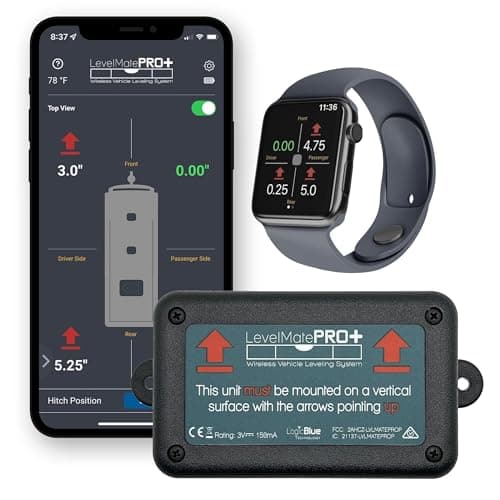 LogicBlue Technology LevelMatePRO+ Apple Watch CompatibleThe leveling tool worth the money if you move the trailer often: both directions, live, on your phone, from the driver's seat - and it remembers hitch height for the way home. | Knowing how far out of level you are before you get out of the truck | Strong | |
| 2 | 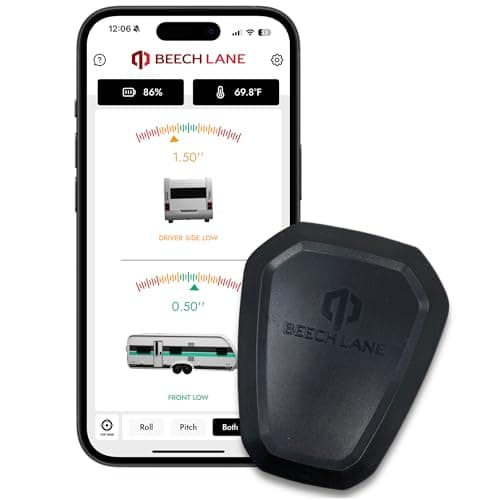 Beech Lane Wireless RV Leveling SystemThe budget wireless leveler: the same workflow as a LevelMate for less money, with less published specification behind it. | A wireless leveling readout at the lowest price of the three | Strong | |
| 3 | 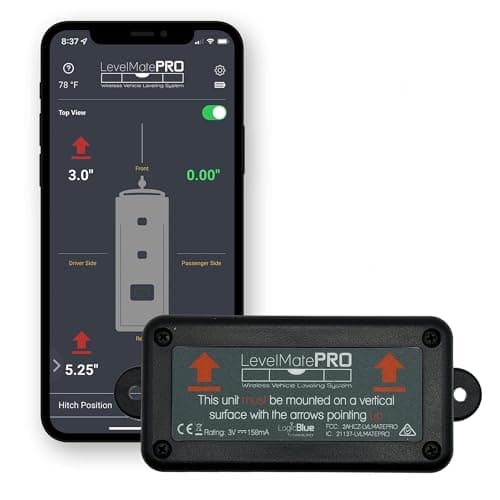 LogicBlue Technology LevelMatePROThe older sibling: same sensor, same accuracy claim, fewer extras. Buy it if the price gap to the PRO+ is real on the day you shop. | The same wireless leveling readout without paying for the newer model | Strong | |
| 4 | 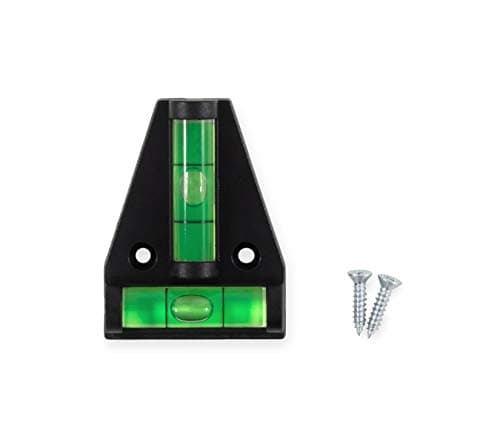 Camco Camper/RV T Level (25543)The honest cheap answer. If leveling a trailer twice a season is your use case, this part and a bit of care at install time is all the level you need. | The cheapest permanent way to see both directions at the trailer | Strong | |
| 5 | 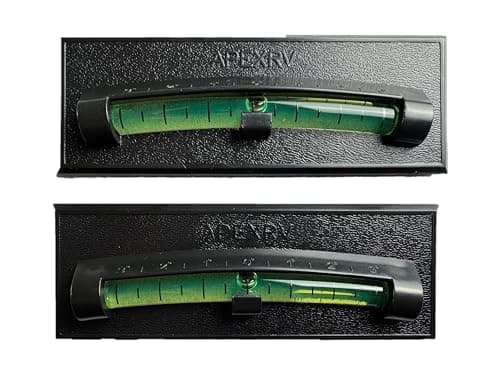 Apex RV Graduated Bubble Level (2-pack)The upgrade over a plain bubble for a couple of dollars: graduations, so the level tells you how much out you are and the block count follows. | Reading how far out of level the trailer is, not just which way | Good |
Prices come from Amazon and were last checked November 12, 2026. They change constantly, so a price older than 48 hours is withdrawn rather than shown stale — those rows read “Check price on Amazon” instead and go straight to the current listing. #ad — these are affiliate links.
What an RV level indicator is actually for
Three things, and only the first one is obvious.
Keeping the fridge working. An absorption refrigerator depends on liquid flowing by gravity through its cooling circuit, and running it well out of level is the classic way to damage one. This is the reason leveling a camper is not a cosmetic exercise, and it is why the trailer needs to be level side-to-side before you care how it looks.
Making the inside livable. A door that swings shut on its own, a shower that will not drain at one end, a bed that tips you toward the wall all night. None of it is dangerous and all of it is the difference between a good weekend and a long one.
Telling you how much to lift, not just which way. This is the part people miss when they buy their first level. A single center-bubble vial tells you the low side. A graduated vial or a digital readout tells you roughly how far out you are, which is what converts into a block count — and a block count is what stops the pull-forward-and-try-again cycle.
The three kinds, and who each one is for
Stick-on bubble levels. A sealed vial in a plastic body, screwed or taped to the trailer frame or A-frame. Cheap, permanent, battery-free, and read by walking to it. A T-shaped one puts both directions in one part, which is the only version worth buying — two separate bubbles in two places is a worse version of the same idea unless you want graduations.
Graduated vials. The same idea with a scale printed on the glass, so instead of “the low side is the left” you get a rough magnitude. For a couple of dollars more this is the honest upgrade, because magnitude is what you actually need.
Wireless Bluetooth levelers. A sensor box mounted inside the trailer or on the frame, reporting side-to-side and front-to-back live to a phone app. The case for one is entirely about workflow: you sit in the tow vehicle, watch the numbers, and stop when they read zero. For somebody leveling alone, in the dark, at a site with a crosswise slope, that is worth real money. The case against is that it is a battery and an app standing between you and a job a sealed glass tube does for four dollars.
How we choose
Does it show both directions at once? Leveling is a two-way problem and solving them one at a time is how people end up chasing it around the site. Every pick here reads both, either in one part or in one app screen.
Does it tell you how much, or only which way? Magnitude is what turns a reading into a decision about blocks. We rank a graduated or digital readout above a plain center bubble for exactly this reason.
Can a first-season owner mount it correctly? Every level on this page is only as true as its installation, so the honest question is whether the product makes that easy — adhesive versus screws, and whether the app has a calibration step that forgives a slightly crooked mount.
What happens when the battery is flat? A bubble has no answer to give because it has no battery. A wireless unit should take a user-replaceable cell you can buy at a gas station, and it should not need to be re-calibrated after a swap.
Is the published specification actually published? LogicBlue states 0.1 degrees and a Bluetooth range around 50 ft. Beech Lane does not state an accuracy figure. Neither of the bubble levels states a tolerance. We say which is which instead of comparing numbers that do not exist.
We do not test products and say so on how we choose. Nothing here is an accuracy we measured against a reference, and no battery life below was timed on a trailer. What we can do is read what each maker publishes, be clear about what is missing, and be blunt about the mounting error that dominates all of it. The sources are linked at the end.
The picks
1. Best for Knowing how far out of level you are before you get out of the truck
LogicBlue Technology LevelMatePRO+ Apple Watch Compatible
The leveling tool worth the money if you move the trailer often: both directions, live, on your phone, from the driver's seat - and it remembers hitch height for the way home.
- Specification
- Three-way digital accelerometer, published accuracy of 0.1 degrees
- Specification
- Reads side-to-side and front-to-back at the same time on one screen
- Specification
- Bluetooth to a phone app on iOS and Android, with a published range of about 50 ft, plus Apple Watch support
- Specification
- Hitch position memory, so the app can tell you how to get back to hitch height
- Specification
- User-replaceable lithium button cell
- Specification
- Hand-calibrated in the USA
What it does well
- It turns leveling from a two-person guessing game into one number: you sit in the truck, read the app, and know whether to pull forward or add another block
- Reading side-to-side and front-to-back at once is the actual advantage over a bubble level - you stop solving one direction and undoing the other
- The hitch memory is the feature nobody buys it for and everybody uses, because dropping back onto the ball at the right height is the other half of the job
The real tradeoff
- You are paying roughly twenty times the price of a bubble level for convenience, not for accuracy a stick-on level cannot reach
- It has to be mounted level to the trailer and then calibrated, and a sloppy mount is a confidently wrong number forever
- Bluetooth means a phone, an app and a battery in the loop - three more things than a bubble
- Published accuracy and range are the maker's figures. We did not measure them
How it measures up
These are judgments from published specifications and what we see at the lodge, not laboratory results. How we choose.
- Beginner fit
- Strong — Removes the part of leveling that beginners find hardest.
- Install effort
- Good — Mount it level, calibrate once, forget it.
- Accuracy
- Strong — Published 0.1 degrees, both directions at once.
- Value
- Adequate — Convenience money. A bubble level is still a bubble level.
Specifications from LogicBlue Technology LevelMate.
2. Best for A wireless leveling readout at the lowest price of the three
Beech Lane Wireless RV Leveling System
The budget wireless leveler: the same workflow as a LevelMate for less money, with less published specification behind it.
- Specification
- Wireless sensor reporting real-time leveling measurements to a phone app
- Specification
- Runs on AA batteries, included
- Specification
- Made in the USA; the maker describes the design as patented
- Specification
- Same job as the LevelMate units: read how far out of level the trailer is without walking around it
What it does well
- Usually the least expensive of the app-based levelers, from a brand this site already recommends in the ramp-leveler category
- AA cells rather than a button cell, which is one fewer odd battery to keep in the trailer
- Beech Lane publishes a direct support line for its products, which matters on a device you calibrate
The real tradeoff
- Beech Lane does not publish an accuracy figure the way LogicBlue does, so there is no number to compare - and we are not going to invent one
- Fewer independent reference points than the LevelMate line, which has been sold for longer
- Same mount-it-level-then-calibrate discipline, and the same phone dependency
How it measures up
These are judgments from published specifications and what we see at the lodge, not laboratory results. How we choose.
- Beginner fit
- Strong — App readout, no interpretation needed.
- Install effort
- Good — Mount level, calibrate, done.
- Accuracy
- Good — No published figure; treat it as a leveling aid, not an instrument.
- Value
- Strong — Cheapest way into a wireless readout.
Specifications from Beech Lane.
3. Best for The same wireless leveling readout without paying for the newer model
LogicBlue Technology LevelMatePRO
The older sibling: same sensor, same accuracy claim, fewer extras. Buy it if the price gap to the PRO+ is real on the day you shop.
- Specification
- Three-way digital accelerometer, published accuracy of 0.1 degrees
- Specification
- Side-to-side and front-to-back readout in the same iOS and Android app
- Specification
- Bluetooth, user-replaceable lithium battery
- Specification
- No Apple Watch support - that is the PRO+ feature
- Specification
- Hand-calibrated in the USA
What it does well
- The original, still sold and still supported by the same app, for less than the PRO+
- Identical published accuracy, so the cheaper model is not the less accurate model
- One fewer feature to care about if you were never going to level a trailer from a watch
The real tradeoff
- Close enough in price to the PRO+ that the gap is often not worth the loss of features - check both before ordering
- Same mounting discipline required: level mount, then calibrate
- Same dependency on a phone, an app and a battery
How it measures up
These are judgments from published specifications and what we see at the lodge, not laboratory results. How we choose.
- Beginner fit
- Strong — Same one-number routine as the PRO+.
- Install effort
- Good — Mount level, calibrate once.
- Accuracy
- Strong — Published 0.1 degrees, as the PRO+.
- Value
- Good — Only if it is genuinely cheaper that day.
Specifications from LogicBlue Technology LevelMate.
4. Best for The cheapest permanent way to see both directions at the trailer
Camco Camper/RV T Level (25543)
The honest cheap answer. If leveling a trailer twice a season is your use case, this part and a bit of care at install time is all the level you need.
- Specification
- T-shaped body with front-to-back and side-to-side vials in one part
- Specification
- Published size 1.625 in x 2.25 in x 0.56 in
- Specification
- Mounts with screws or with the supplied adhesive tape
- Specification
- Camco part number 25543
What it does well
- Costs about as much as a bag of ice and never needs a battery, an app or a pairing
- Both directions in one part, which is the whole reason to buy a T level instead of two separate bubbles
- Permanent: once it is on the trailer it is always there, including the trip where you forgot your phone charger
The real tradeoff
- You have to walk to it and read it, which is the entire difference between this and a wireless unit
- It is only as true as its mounting. Fit it with the trailer already level, or every reading after that is wrong by the same amount
- A bubble tells you which way, not how much. Pairing it with our block-count guide is how you turn it into a number
How it measures up
These are judgments from published specifications and what we see at the lodge, not laboratory results. How we choose.
- Beginner fit
- Strong — A bubble is a bubble. Nothing to learn.
- Install effort
- Good — Easy, but it must go on while the trailer is level.
- Accuracy
- Good — As good as the mount; no published tolerance.
- Value
- Strong — The least expensive useful thing in this category.
Specifications from Camco.
5. Best for Reading how far out of level the trailer is, not just which way
Apex RV Graduated Bubble Level (2-pack)
The upgrade over a plain bubble for a couple of dollars: graduations, so the level tells you how much out you are and the block count follows.
- Specification
- Graduated scale rather than a single center bubble, so the vial shows degrees of tilt
- Specification
- Adhesive backing; sold as a two-pack so one covers side-to-side and the other front-to-back
- Specification
- Sold in white and in black
What it does well
- A graduated vial is the bridge between a bubble and a wireless unit: it gives you a magnitude, which is what decides how many blocks to put down
- Two in the pack covers both directions for less than the price of lunch
- Adhesive mount, so there is no drilling into the trailer skin
The real tradeoff
- Two separate levels instead of one T, so you are reading two places on the trailer
- No manufacturer specification page and no published tolerance - the graduations are a guide, not a calibrated instrument
- Adhesive on a dirty or cold trailer skin is a bad bond. Clean the spot and fit it warm
How it measures up
These are judgments from published specifications and what we see at the lodge, not laboratory results. How we choose.
- Beginner fit
- Good — Slightly more to read than a plain bubble.
- Install effort
- Good — Adhesive, two spots, trailer must be level first.
- Accuracy
- Adequate — Graduated but unspecified; treat it as indicative.
- Value
- Strong — Two levels for pocket change.
How the five compare on the things that decide this
| Pick | Reads | Published accuracy | Power |
|---|---|---|---|
| LevelMatePRO+ | Side-to-side and front-to-back, live, in the app and on an Apple Watch | 0.1 degrees (maker's figure) | User-replaceable lithium cell |
| Beech Lane wireless | Side-to-side and front-to-back, live, in the app | Not published | AA cells, included |
| LevelMatePRO | Side-to-side and front-to-back, live, in the app | 0.1 degrees (maker's figure) | User-replaceable lithium cell |
| Camco T level (25543) | Side-to-side and front-to-back, at the trailer | Not published | None |
| Apex graduated bubble (2-pack) | One direction per level, with graduations | Not published | None |
Note what the table does not show: a meaningful accuracy gap. A sealed vial mounted carefully is not the thing standing between you and a level trailer. The difference you are buying with a wireless unit is where you are standing when you read it.
If you only buy one
Moving the trailer most weekends, often alone: the wireless unit, because reading it from the driver's seat is the entire point. Two trips a season: the T level, which costs less than a bag of firewood. Want a magnitude without a battery: the graduated pair.
Best for Knowing how far out of level you are before you get out of the truck
LogicBlue Technology LevelMatePRO+ Apple Watch Compatible
The leveling tool worth the money if you move the trailer often: both directions, live, on your phone, from the driver's seat - and it remembers hitch height for the way home.
Best for The cheapest permanent way to see both directions at the trailer
Camco Camper/RV T Level (25543)
The honest cheap answer. If leveling a trailer twice a season is your use case, this part and a bit of care at install time is all the level you need.
Best for Reading how far out of level the trailer is, not just which way
Apex RV Graduated Bubble Level (2-pack)
The upgrade over a plain bubble for a couple of dollars: graduations, so the level tells you how much out you are and the block count follows.
Reading the level into a block count
A level reading is only useful if it turns into an action, so here is the loop we use at the lodge when somebody pulls in.
Side to side first. Read which side is low and roughly how much. Build the stack on the low side, pull up onto it, read again. Do not touch the tongue jack yet — it will only lie to you while the trailer is leaning.
Then front to back, with the tongue jack. That direction is adjustable without moving the trailer, which is why it comes second. Leveling a camper without moving it covers the case where you have already unhitched.
Chock before you unhitch, every time. The level has nothing to do with the trailer staying still — that is chocks, and the two jobs get confused constantly. Our stabilizers vs levelers page is the other half of the same confusion.
Then stabilize. Jacks down onto pads, not onto bare gravel. Stabilizing is about stopping the rocking, not about height.
How many blocks each reading needs depends on your tire size, so the arithmetic lives in how many leveling blocks do I need, and how to use RV leveling blocks covers stacking them without the pyramid collapsing.
Wireless or bubble: the honest comparison
What the wireless unit genuinely buys you. One trip around the site instead of three. A number you can read in the dark. A hitch-height memory that makes re-hitching a one-person job. Nobody standing behind the trailer shouting directions at the driver. If any of those describe your weekends, the money is well spent.
What it does not buy you. Accuracy you could not get from a carefully mounted bubble. A level trailer without blocks. Any help at all once the phone is flat.
What the bubble genuinely buys you. Permanence. A level that is still working in the ninth season, has never needed an app update, and cost less than a bag of ice. For a trailer that goes out twice a year, this is not the budget option, it is the correct option.
And the free option, stated plainly. A phone with a level app on the trailer floor will tell you which way the trailer leans for nothing at all. It is awkward - you have to be inside, on a surface you hope is flat, while somebody else drives - which is exactly the awkwardness a mounted level removes. But if you are between trips and deciding whether this category is worth money to you, try that first and see how much the walking bothers you.
Mistakes that make a level indicator useless
Mounting it on something that flexes. A thin bumper, a propane cover, a storage door. Put it on the A-frame or the main frame rail, or inside on a structural surface.
Mounting it with the trailer on a slope. Covered above and still the most common error by a distance.
Adhesive on a cold, dirty frame. Clean the spot, fit it warm, and use screws if the surface will take them. A level that falls off in July was never really mounted.
Trusting one direction only. A trailer level side-to-side and three inches down at the tongue is not a level trailer. The fridge cares about both.
Expecting it to cope with a hill. There is a point where the honest reading is “move the trailer”, and leveling a camper on a hill is about recognizing it.
Where this sits in a first season
Blocks and chocks come first — they are what make the trailer level and keep it still, and they are in the starter kit. A level indicator is the next thing, and for most owners it is a four-dollar part fitted in ten minutes on the first weekend. Upgrade to the wireless version when you notice that you are leveling the trailer every weekend and doing three laps of the site each time — and if you are also getting out to check the door and the bays at every stop, the door lock roundup is the other small upgrade that pays back in convenience rather than in security.
Questions people actually ask
What is the best RV level indicator for a beginner?
A stick-on T level is the right first purchase for most first-season owners: it shows both directions in one part, costs about as much as a bag of ice, and has no battery to go flat. Move up to a wireless Bluetooth leveler when you find you are leveling the trailer most weekends and walking around it three times to do it.
Is a wireless RV leveler more accurate than a bubble level?
Not meaningfully, and that is not the reason to buy one. LogicBlue publishes 0.1 degrees for the LevelMate units; a carefully mounted bubble vial is also well inside what a trailer fridge needs. What the wireless unit buys is where you read it from - the driver's seat, in the dark, without a second person - plus a hitch-height memory for re-hitching.
Where should I mount an RV level?
On the A-frame or a main frame rail, or inside on a structural surface - never on a bumper, a propane cover or a storage door, all of which flex. And mount it only after the trailer is already level, adjusting the level until it reads center before you tighten it down. A level mounted on a slope is permanently wrong by that amount.
Do I need a level in both directions?
Yes. A trailer that is level side-to-side but nose-down is still not level, and an absorption refrigerator cares about both. That is why a T-shaped bubble level - or any wireless unit, which reads both at once - is worth more than a single vial.
LevelMatePRO or Beech Lane: which wireless leveler should I buy?
They do the same job in the same way. LogicBlue publishes an accuracy figure of 0.1 degrees and has sold the LevelMate line for longer; Beech Lane is usually cheaper, runs on AA cells and publishes no accuracy figure, so there is no number to compare. If the price gap is small, the published specification is worth having; if Beech Lane is meaningfully cheaper on the day, it is the same workflow for less.
Can I just use a phone app to level my camper?
You can, and it costs nothing - put the phone on the trailer floor and read the tilt. It is awkward in practice, because you have to be inside the trailer, on a floor you hope is flat, while someone else drives. That awkwardness is exactly what a mounted level removes, so it is a reasonable way to decide whether this category is worth money to you.
Does a level indicator stop the trailer rocking?
No. Level, still and steady are three different jobs. Leveling blocks make it level, wheel chocks stop it rolling, and stabilizer jacks reduce the rocking. A level indicator only tells you about the first one.
Sources
Read next
Leveling & Chocks
How Many Leveling Blocks Do I Need?
Block counts by axle setup, how to estimate lift from a bubble reading, and when more blocks is the wrong answer.
Leveling & Chocks
Best RV Leveling Blocks for a First Travel Trailer
Interlocking blocks, curved levelers and jack pads compared for someone leveling a trailer for the first time.
Leveling & Chocks
How to Level a Travel Trailer (Step by Step for Beginners)
The full arrival sequence for leveling a towed trailer, in the order that means you only do it once.
Towing & Security
Best RV Door Lock for a Travel Trailer
Keyless, keypad and plain replacement RV door locks, ranked for a first travel trailer - with the cutout and handing measurements that decide which ones can fit your door.
Reviewed October 26, 2026. Spot something out of date? Tell us and we will fix it.