How to Level a Camper on a Hill
On a sloped site the order changes and so does the risk. Here is the sequence, and the point at which the right answer is to move to a different site.
Heads up: this page contains affiliate links. If you buy through one, Camp & Chock may earn a commission at no extra cost to you. It never changes which product we put first — how this site is funded.
Point the trailer up or down the slope rather than across it, correct the side-to-side error with blocks under the low tire while the trailer is still hitched, chock before you unhitch, and then take the front-to-back error out on the tongue jack. That order is the whole method, and it works because only one of the two directions requires the trailer to move. Front to back is a jack adjustment. Side to side means a tire has to climb onto something.
Part of our leveling and chocks guide. The general method is in how to level a travel trailer; this page is for the site that is genuinely on a hill, where the order of operations stops being a convenience and starts being a safety question.
Why a slope is a different job
On a flat pad, an unlevel trailer is a nuisance. Things roll off counters, and an absorption refrigerator loses cooling because it relies on gravity to circulate its coolant. That is the usual reason to bother at all.
On a hill, two further things are true. First, the trailer actively wants to roll, and the moment it is most likely to is the moment you unhitch. Second, the correction you need is often bigger than on a flat site, which pushes people toward stacking blocks higher than is sensible. Both of those are about keeping the trailer where you put it rather than about comfort.
Position the trailer before you reach for anything
This is the step that saves the most work and the one most often skipped, because by the time you are thinking about leveling you have usually already parked.
Walk the site first. Most sloped sites fall mainly in one direction. If you can choose your orientation — and on a pull-through or a wide site you often can — put the slope along the length of the trailer rather than across it. Then the dominant error is front to back, which the tongue jack fixes in thirty seconds with the trailer exactly where it stands, and the cross-slope error that needs blocks is whatever is left.
Park across the fall line and you have the opposite problem: the big error is the one that needs a tire to come up onto a stack, and the small one is the easy one.
How high is too high to stack
There is no universal number published for this, so we are not going to invent one. What we can say honestly is how to think about it.
A block stack is stable when it is wider than it is tall, when every layer is interlocked with the one below, and when the tire sits fully on the top block rather than hanging over an edge. The moment a stack is taller than it is wide, is leaning, or has a tire overhanging it, you have passed the point where it is holding the trailer and arrived at the point where it is a tipping hazard with a trailer on top.
The other limit is the one people hit first: the ramp. Whatever final height you need, you also need a slope leading up to it, and the ramp eats blocks that carry nothing once you are parked. If you are out of blocks before the bubble centers, the answer is more blocks or a different pitch, not a steeper step.
Gear that makes a sloped site manageable
Nothing here is slope-specific equipment, because that mostly does not exist. What a hill does is punish the weak points of the kit you already need: not enough blocks, blocks that sink, wedges that slide, and jacks with no pad under them.
More blocks than you think. A cross-slope burns through a ten-pack. Two sets is the realistic answer for anyone who camps on anything other than engineered pads.
Blocks that spread load if the hill is grass. A slope and soft ground together are the worst case: the stack is tall and the ground gives. Laying load-spreading blocks wide rather than high is the way through it.
A curved leveler, with a caveat. Driving up a curved ramp until the bubble centers is the fastest way to kill a cross-slope in one attempt. It also concentrates load on a narrow contact patch, so it wants firm ground. On a firm sloped gravel pad it is excellent; on a wet grass hill it is the wrong tool.
A tire-locking chock if you are tandem. A trailer on a slope rocks more, because the springs are loaded unevenly. This is the product that addresses it.
What to have in the compartment before a sloped site
Two sets of interlocking blocks rather than one. The load-spreading set if your hills are grass. A curved leveler if the pads are firm and you want one pull-up instead of three. A tire-locking chock per side if the trailer is tandem-axle.
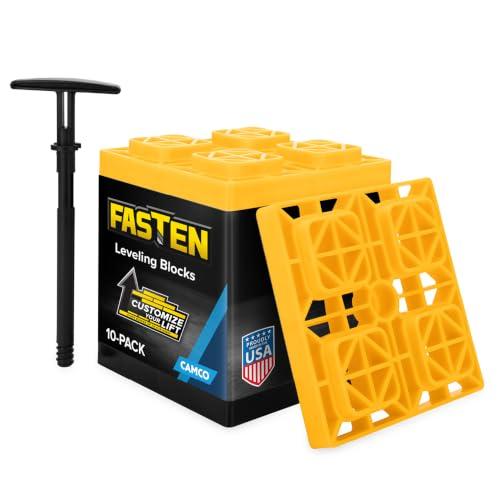
Best for Most first trailers
Camco FasTen Leveling Blocks (10-pack)
The default first purchase for a travel trailer: interlocking blocks you stack into a ramp, cheap enough to buy two sets.
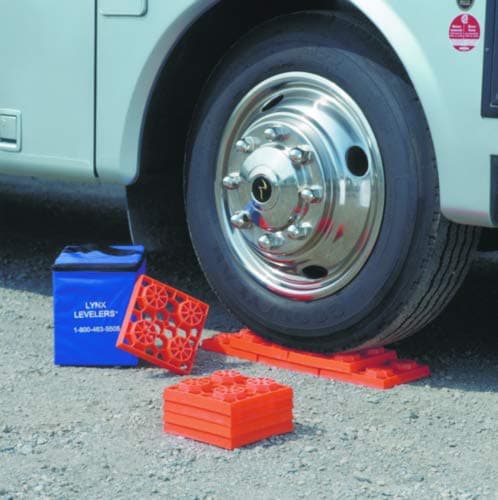
Best for Heavier rigs and soft ground
Tri-Lynx Lynx Levelers (10-pack)
The upgrade you make after your first soft-ground site: the same stacking idea with a structure that spreads weight instead of concentrating it.
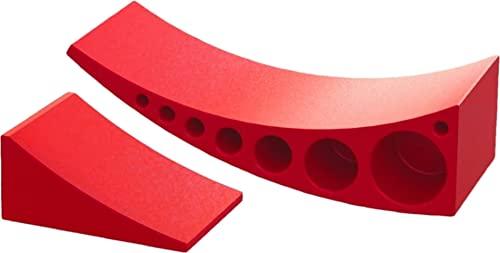
Best for Leveling in one attempt
Andersen Hitches Camper Leveler
The one that removes the trial and error: a curved ramp you drive up until level, then stop, with a chock that drops in behind.
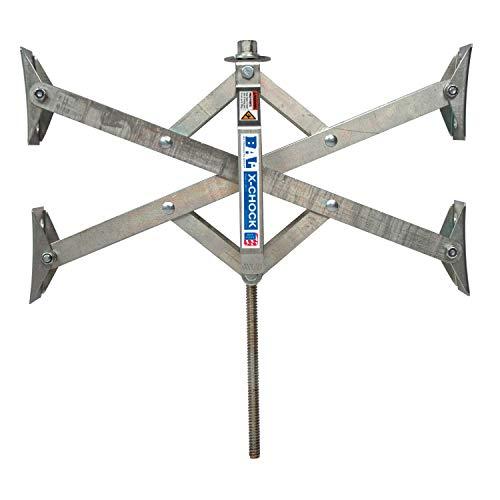
Best for Tandem-axle rigs that rock
BAL X-Chock Tire Locking Chock
The standard answer to a trailer that rocks when you walk across it, and only useful if you have two axles per side.
The steps, in order
The ordered sequence above is the short version. Three of the steps are worth expanding, because they are the ones that go wrong.
Chock before unhitching, every time, and especially here. While the trailer is on the ball it cannot get away from you. The instant it comes off, a sloped site is a ramp. Wedges go in front of and behind a tire on each side — four chocks on a tandem trailer — and they go on the ground, never on top of a leveling block, because plastic on plastic slides.
Pad the stabilizer jacks, especially the downhill pair. On a slope the downhill jacks come down further and meet the ground at a worse angle, which concentrates load into a small foot. A pad spreads it. A jack foot is roughly seven square inches; a pad several times that area turns a pressure problem into a non-problem, which is the whole argument of the jack pads roundup.
Do not lift the trailer on its stabilizer jacks. They are rated to steady a level trailer, not to carry or to level it. Using them to take out the last inch of slope is the most common way people bend them, and it does not make the trailer more stable — it makes it stand on four thin legs instead of its wheels.
Once you are level
Re-check in the morning. A stack that was fine at dusk can be a quarter of an inch into wet ground by breakfast, and on a slope that quarter inch is the difference between the door staying where you leave it and not. If it has moved, the fix is footprint rather than height: more area under the stack, laid wider.
If the trailer is level but still moves when someone walks across it, that is rocking rather than leveling and it has its own sequence — see how to keep a travel trailer from rocking. And if the cross-slope on your regular sites is what keeps beating you, Camco FasTen vs Lynx Levelers is the decision about which block set handles it better.
Questions people actually ask
Which way should I park a camper on a slope?
Along the slope rather than across it, where the site allows a choice. That puts the dominant error on the front-to-back axis, which the tongue jack corrects without the trailer moving at all, and leaves only the smaller cross-slope to fix with blocks.
How high can you stack RV leveling blocks?
No universal figure is published, so judge it by shape rather than by a number: a stack should be wider than it is tall, fully interlocked layer to layer, with the tire sitting completely on the top block. A stack taller than it is wide, leaning, or with the tire overhanging has become a hazard.
When should I chock the wheels on a sloped site?
Before unhitching, while the trailer is still on the ball and cannot move. Use opposing pairs - one chock in front of and one behind a tire on each side - and place them on the ground, never on top of a leveling block.
Can I use the stabilizer jacks to level a camper on a hill?
No. Stabilizer jacks are rated to steady a trailer that is already level, not to carry or lift it. Using them to take out slope bends them and leaves the trailer standing on four thin legs instead of its wheels.
What if the site is too steep to level?
Ask for a different pitch. The practical signs you have passed the limit are a block stack taller than it is wide, downhill stabilizer jacks reaching full extension before they carry weight, or an entry door that swings open or shut on its own once you are level.
Sources
Read next
Leveling & Chocks
How to Level a Travel Trailer (Step by Step for Beginners)
The full arrival sequence for leveling a towed trailer, in the order that means you only do it once.
Leveling & Chocks
How Many Leveling Blocks Do I Need?
Block counts by axle setup, how to estimate lift from a bubble reading, and when more blocks is the wrong answer.
Leveling & Chocks
Best Wheel Chocks for a Tandem-Axle Trailer
Wedge chocks and tire-locking chocks for a two-axle travel trailer, with the count you actually need on each side.
Leveling & Chocks
Best RV Jack Pads for a Travel Trailer
Jack pads and jack blocks compared on the one number that matters: how much ground they spread the load across.
Reviewed October 17, 2026. Spot something out of date? Tell us and we will fix it.