Best RV Sewer Hose for Long Term Use
A weekend hose is used twenty times a year. A seasonal hose lies on the ground for four months in the sun. Those are different jobs, and the second one breaks fittings, not hose.
Heads up: this page contains affiliate links. If you buy through one, Camp & Chock may earn a commission at no extra cost to you. It never changes which product we put first — how this site is funded.
The short answer
For a hose that stays connected for weeks or a whole season, buy the heavy-wall kit — this is the one case where the thicker wall genuinely earns its price, because the hose is lying on the ground in sunlight rather than living in a compartment. Pair it with a fixed-slope support, which matters more than the hose does: a seasonal hose that does not drain is a seasonal hose full of standing waste. And leave the rig-side valve closed between dumps rather than running an open hose.
Part of our sewer and water guide. Our main sewer hose roundup answers which hose to own for normal weekend use, where the answer is the standard kit. This page answers a narrower question with a different answer, because leaving a hose connected changes which property of it matters.
Our picks at a glance
Tap any row to jump to the full write-up.
| # | Product | Best for | Beginner fit | Price |
|---|---|---|---|---|
| 1 | 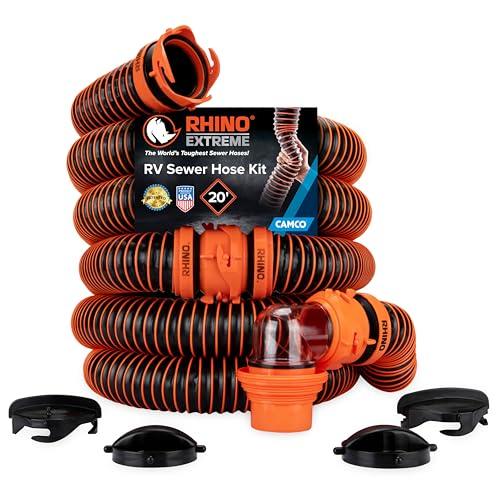 Camco RhinoEXTREME 20-Ft Sewer Hose KitThe same kit with a heavier wall. Worth the upgrade if your hose gets dragged across gravel rather than laid on grass. | Full-season and rougher sites | Strong | |
| 2 | 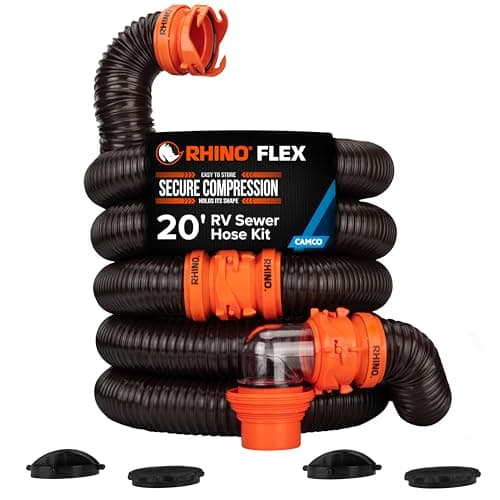 Camco RhinoFLEX 20-Ft Sewer Hose KitThe complete first kit: 20 ft in two sections, both fittings, and a clear elbow so you can see when the tank is actually done. | The first sewer hose to own | Strong | |
| 3 | 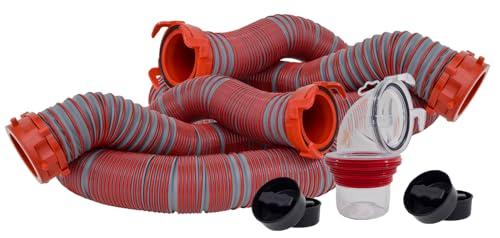 Valterra Viper 20-Ft Sewer Hose KitThe alternative worth knowing: the hose is comparable and the fitting is built where these kits usually fail first. | A stronger fitting | Good | |
| 4 | 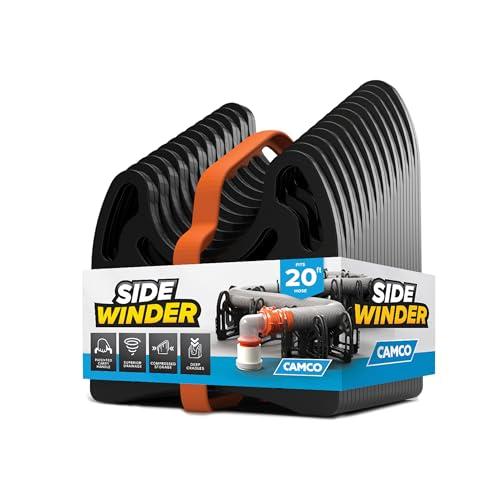 Camco Sidewinder RV Sewer Hose Support (20 ft)The item first-timers most often arrive without: a fixed-slope cradle that makes the tank actually drain instead of sit. | The support most people should buy | Strong |
Prices come from Amazon and were last checked November 12, 2026. They change constantly, so a price older than 48 hours is withdrawn rather than shown stale — those rows read “Check price on Amazon” instead and go straight to the current listing. #ad — these are affiliate links.
What actually fails on a long-term hose
A weekend hose fails from handling: it gets coiled, dragged, stood on and jammed into a bumper tube, and eventually a fold becomes a split. A hose left connected for a season barely gets handled at all, so it fails from three completely different things.
Ultraviolet exposure, which is the slow one
Sunlight degrades the polymer wall. A hose stowed in a compartment for fifty weeks of the year sees almost none; a hose lying across a grass site from May to September sees it continuously. This is the single biggest reason a seasonal hose does not last as long as the same hose used for weekends, and it is also the reason the heavier wall is worth paying for here: there is simply more material to lose.
The fittings, which is the fast one
The bayonet collar and the sewer-end adapter are the parts that actually break on long-term installations, not the hose. They are holding the hose in place against months of thermal cycling, the occasional kick, and whatever the ground does when it rains. A hose that has gone soft in the sun pulls on its fitting; a fitting that has been under load all summer cracks at the collar. If you have had a seasonal hose fail, it was almost certainly here.
This is why the kit with a reinforced fitting design is genuinely worth considering for this use even though it is a less common choice for weekend use. See Camco versus Valterra for the brand comparison.
Standing waste, which is the one you cause
The third failure is procedural and it is the one that ruins hoses fastest. If the hose does not have continuous fall from the rig to the sewer inlet, waste sits in the low spot. Over weeks, that solidifies. It also means the hose is heavy at one point, which drags on the fittings, which brings us back to the paragraph above. A support that holds slope by itself is not an accessory on a long-term hookup; it is part of the installation.
The picks
1. Best for Full-season and rougher sites
Camco RhinoEXTREME 20-Ft Sewer Hose Kit
The same kit with a heavier wall. Worth the upgrade if your hose gets dragged across gravel rather than laid on grass.
- Specification
- 20 ft as two 10 ft sections
- Specification
- Heavier wall than the standard kit
- Specification
- Same swivel fittings and clear elbow
What it does well
- A noticeably tougher wall, which matters if the hose gets dragged over gravel rather than laid on grass
- Same fittings as the standard kit, so sections interchange with what you already own
The real tradeoff
- Heavier and stiffer to coil, especially in the cold
- Costs more for a difference you may never need if you camp on grass
How it measures up
These are judgments from published specifications and what we see at the lodge, not laboratory results. How we choose.
- Beginner fit
- Strong — Identical to use.
- Durability
- Strong — The reason to buy it.
- Storage
- Adequate — Slightly bulkier than the standard hose.
- Value
- Good — Pays back over a full season, not a weekend.
Specifications from Camco.
2. Best for The first sewer hose to own
Camco RhinoFLEX 20-Ft Sewer Hose Kit
The complete first kit: 20 ft in two sections, both fittings, and a clear elbow so you can see when the tank is actually done.
- Specification
- 20 ft supplied as two 10 ft sections
- Specification
- Swivel bayonet fitting at the rig end
- Specification
- Clear 45-degree adapter included in the kit
What it does well
- The kit arrives complete: hose, both fittings and the clear elbow, so nothing is missing at the first dump station
- Two 10 ft sections means you use 10 ft at most sites and 20 ft when you need it, instead of coiling slack
- The clear elbow lets you see when the tank has actually finished, which is the entire job
The real tradeoff
- Bulkier collapsed than a thin-wall hose, and a 4-inch bumper will not take 20 ft of it
- The bayonet fittings need a firm quarter-turn. A lazy connection is how people end up with a mess
How it measures up
These are judgments from published specifications and what we see at the lodge, not laboratory results. How we choose.
- Beginner fit
- Strong — Nothing to buy separately, nothing to work out.
- Durability
- Good — Thicker than the hose bundled with a used trailer.
- Storage
- Adequate — Twenty feet will not fit a 4-inch bumper. Plan for that.
- Value
- Strong — The category default, and deservedly.
Specifications from Camco.
3. Best for A stronger fitting
Valterra Viper 20-Ft Sewer Hose Kit
The alternative worth knowing: the hose is comparable and the fitting is built where these kits usually fail first.
- Specification
- 20 ft kit
- Specification
- Reinforced fitting design
- Specification
- Standard bayonet connection
What it does well
- The fitting design is the part people praise, and the collar is usually what fails first, not the hose
- Directly interchangeable with the common bayonet standard
The real tradeoff
- Less widely stocked, so a mid-trip replacement section is harder to find
- Kit contents vary by listing
How it measures up
These are judgments from published specifications and what we see at the lodge, not laboratory results. How we choose.
- Beginner fit
- Good — Same connection method as everything else.
- Durability
- Strong — Fittings are the strong point.
- Storage
- Adequate — Same bulk problem as any 20 ft hose.
- Value
- Good — Competitive, if you can find it stocked.
Specifications from Valterra.
4. Best for The support most people should buy
Camco Sidewinder RV Sewer Hose Support (20 ft)
The item first-timers most often arrive without: a fixed-slope cradle that makes the tank actually drain instead of sit.
- Specification
- 20 ft folding support
- Specification
- Fixed slope molded in
- Specification
- Folds flat, accordion style
What it does well
- Holds the slope by itself. No adjusting, and no collapsing halfway through a dump
- Folds flat rather than telescoping, so it does not jam with grit
- This is the single most common thing first-timers arrive without
The real tradeoff
- Long when folded, and it needs a full-length storage space
- A fixed slope means a badly placed sewer connection still fights you
How it measures up
These are judgments from published specifications and what we see at the lodge, not laboratory results. How we choose.
- Beginner fit
- Strong — Unfold it, lay the hose in, done.
- Durability
- Good — Folding beats telescoping over a season of grit.
- Storage
- Adequate — Flat, but long.
- Value
- Strong — Cheap, and it fixes the slow-drain complaint outright.
Specifications from Camco.
Weekend hose against seasonal hose
Why the answer changes
| Factor | Weekend use | Long-term hookup |
|---|---|---|
| What kills the hose | Handling - folding, dragging, forcing a coil | Sunlight on the wall and load on the fittings |
| Wall thickness | Standard is easier to coil and stow | Heavy wall, because there is more material to lose to UV |
| Support | Useful - the tank drains faster | Essential - without slope, waste stands in the hose for weeks |
| Fittings | Rarely the failure point | Usually the failure point. Buy the reinforced design |
| Valve discipline | Open at the dump, closed after | Black closed until it is full. Gray can run, with a trap seal |
The installation, not just the hose
A long-term hookup is worth doing deliberately, because you will not be touching it again for weeks.
Use the shortest run that reaches. Resist the temptation to lay all twenty feet out because you have it. Excess hose is excess low spots, excess UV exposure and excess weight on the fittings. Use ten feet if ten feet reaches, and keep the second section in the compartment as your spare.
Set the slope properly, then check it with water. Lay the support, lay the hose in it, and run the gray tank briefly. You should see the flow move through continuously and the hose go flat behind it. If anything pools, the slope is wrong, and now is the time to find out rather than in six weeks.
Seal into the park inlet. Many parks require it and most long-term sites expect it. A rubber donut seal costs almost nothing and it also stops the elbow working loose over a season. See RV sewer connections explained for the full fitting order.
Keep the clear elbow in the chain. On a long stay the clear elbow is the only way you will know whether a black tank dump actually finished, and it is the first thing that tells you a rinse is needed.
The two-item answer
Heavy-wall kit plus a fixed-slope support. On a seasonal hookup the support is not optional - it is the part that stops the hose holding standing waste.
Best for Full-season and rougher sites
Camco RhinoEXTREME 20-Ft Sewer Hose Kit
The same kit with a heavier wall. Worth the upgrade if your hose gets dragged across gravel rather than laid on grass.
Best for The support most people should buy
Camco Sidewinder RV Sewer Hose Support (20 ft)
The item first-timers most often arrive without: a fixed-slope cradle that makes the tank actually drain instead of sit.
How long will a seasonal hose last?
We are not going to publish a number we have not measured. What we can say honestly is what determines it: how much sun the hose sees, whether it holds standing waste, and whether the fittings are carrying load. All three are things you control, and a hose that is shaded, sloped and supported will outlast one that is not by a wide margin regardless of which kit you bought.
The practical advice for a seasonal site is to treat the hose as a consumable and keep a spare ten-foot section in the compartment. Replacing a section mid-season is a five-minute job if you have one and an unpleasant afternoon if you do not. The same logic is why we recommend buying the kit with interchangeable standard bayonet fittings: a section from any brand will mate with it.
Cold weather is a separate question
If your long stay runs into freezing weather, the heavy-wall recommendation on this page reverses, because a thicker wall is stiffer to handle in the cold and more likely to be forced and cracked. That case has its own page: best RV sewer hose for cold weather.
Questions people actually ask
What is the best RV sewer hose for long term use?
The heavy-wall kit, paired with a fixed-slope support. On a long hookup the hose lies in sunlight for months rather than living in a compartment, so there is more value in a thicker wall than there is for weekend use.
Can I leave my RV sewer hose connected all season?
Yes, with two conditions: the hose needs continuous fall into the sewer inlet so nothing stands in it, and the black tank valve must stay closed between dumps. An open black valve lets liquid out and leaves solids behind.
Why do long-term sewer hoses fail at the fittings?
Because the fittings carry the load. Months of thermal cycling, a hose softened by sunlight pulling on the collar, and weight from any standing waste all act on the bayonet connection rather than on the hose wall.
Should I lay out all 20 feet of hose on a long stay?
No. Use the shortest run that reaches. Excess hose means more low spots to hold waste, more surface exposed to sunlight and more weight on the fittings. Keep the spare section in the compartment.
Sources
Read next
Sewer & Water
Best RV Sewer Hose for a First Travel Trailer
Complete sewer hose kits compared on length, wall thickness, fittings and storage, for someone doing this for the first time.
Sewer & Water
Best RV Sewer Hose for Cold Weather
Which hose to run when it is cold, why the heaviest wall is the wrong pick, and the drain routine that prevents the failure no hose can.
Sewer & Water
How to Clean an RV Sewer Hose
The rinse-and-drain routine at the dump station, the dedicated-hose rule, and how to store a hose that does not smell.
Sewer & Water
Best RV Sewer Hose Support
Folding and compressing hose supports compared, plus why the homemade versions usually disappoint.
Reviewed October 11, 2026. Spot something out of date? Tell us and we will fix it.