Camco Sidewinder vs Slunky: Which Sewer Hose Support?
Both hold the hose at a drain-able slope. They differ in exactly one way that matters, and it is not performance at the dump station: it is where the thing lives afterwards.
Heads up: this page contains affiliate links. If you buy through one, Camp & Chock may earn a commission at no extra cost to you. It never changes which product we put first — how this site is funded.
The verdict
Buy the rigid folding support if you have a full-length place to put it — a pass-through bay, a bumper tube or a basement locker. Its cradles are molded to a fixed slope, so it holds the drop by itself and nothing sags halfway through a dump. Buy the flexible one if storage is your constraint: it compresses to a fraction of its length, which is the entire reason it exists.
Both of these are picks in our sewer hose support roundup, and both work. This page exists because they are the two products anyone shopping this category ends up comparing, and the listings do a poor job of explaining the actual difference. Part of our sewer and water guide.
Why you need one at all
Skip this section if you are already convinced. If you are not: a sewer hose laid on the ground does not drain, it puddles. Campsite pads are rarely sloped the way you would like, and a 20-foot hose lying flat holds standing waste in every low spot, which is both slower and considerably worse to coil up afterwards.
A support is a cradle that holds the hose at a continuous downhill angle from the trailer to the sewer inlet. Gravity does the rest. The complaint that sends most first-timers looking for one — “my black tank drains slowly” — is usually not the tank, the valve or the hose. It is the slope. We cover the whole connection sequence in how to hook up an RV sewer hose.
Side by side
Published specifications for the 20-foot versions
| Rigid folding support | Flexible compressing support | |
|---|---|---|
| Structure | Molded plastic cradles on snap-fit hinges | Flexible, stretches and compresses lengthwise |
| Published height, trailer end | 7.25 in. at its highest point | 7.25 in. at the RV end |
| Published height, sewer end | 4 in. at its lowest point | 4.5 in. at the sewer end |
| How the slope is set | Built in - each cradle is lower than the last | Built in, but softer under load |
| Hose size | Fits all 3 in. diameter hoses, up to a 20 ft hose | Takes a standard 3 in. hose |
| Straps needed | No - deep cradles hold the hose | No |
| Published weight | 6.17 lb. | Not published |
| Storage | Collapses lengthwise, still long | Compresses to a fraction of its length |
| Adapts to length needed | Unfold as much as the site needs | Stretch to what the site needs |
Read that table carefully and the headline is how similar they are. Both start around 7.25 inches under the trailer and finish at 4 to 4.5 inches at the inlet, which is the same fall over the same run. Neither needs straps. Both are sold in the 20-foot length that matches the 20-foot hose kit we recommend.
So the choice is not about which drains better at the dump station. It is about structure — rigid or flexible — and everything that follows from it.
Where the rigid one wins
It holds its shape under a full hose. A black tank dumping 40 gallons puts real weight in the hose, and a rigid cradle does not care. The slope you unfolded is the slope you still have at the end.
Uneven ground. Campsite sewer connections sit in dirt, gravel, grass that has not been cut since spring, and sometimes a dip exactly where you need height. A rigid frame spans a small depression. A flexible one follows the ground into it.
Nothing to misjudge. You unfold it, lay the hose in the cradles, and the geometry is already correct. That is a genuine advantage on your first few dumps, when you do not yet have a feel for what “enough slope” looks like.
Grit. Snap-fit hinges that fold flat have very little for sand and dirt to seize. The folding action is also the thing that survives a season of being dragged out of a bay and thrown back in.
Where the flexible one wins
Storage, which is the whole argument. A folding support is flat but long — it needs a pass-through bay or a bumper tube with real length. The flexible one compresses hard: the manufacturer publishes a 15-inch collapsed length for its 25-foot version. If you have a small trailer, a packed bay, or a bumper already occupied by the hose itself, this is not a minor convenience. It is the difference between owning a support and leaving it at home.
Awkward connection distances. It stretches to whatever length the site needs and compresses where it does not, which means the support matches the run instead of you folding up a section you cannot use.
Working around obstacles. Picnic table leg, a tree, a utility post planted exactly between your outlet and the sewer: a flexible support curves around it. A rigid one wants a straight line.
The two products
1. Best for The support most people should buy
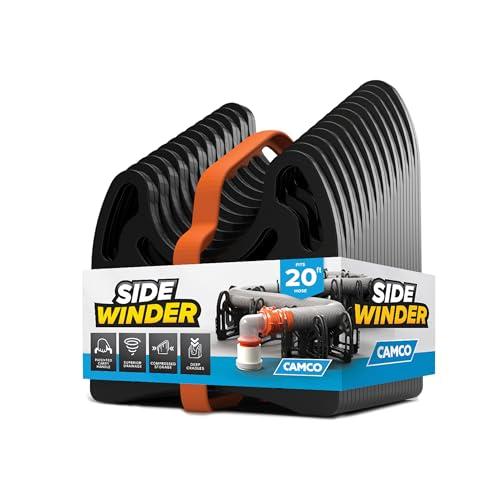
Camco Sidewinder RV Sewer Hose Support (20 ft)
The item first-timers most often arrive without: a fixed-slope cradle that makes the tank actually drain instead of sit.
- Specification
- 20 ft folding support
- Specification
- Fixed slope molded in
- Specification
- Folds flat, accordion style
What it does well
- Holds the slope by itself. No adjusting, and no collapsing halfway through a dump
- Folds flat rather than telescoping, so it does not jam with grit
- This is the single most common thing first-timers arrive without
The real tradeoff
- Long when folded, and it needs a full-length storage space
- A fixed slope means a badly placed sewer connection still fights you
How it measures up
These are judgments from published specifications and what we see at the lodge, not laboratory results. How we choose.
- Beginner fit
- Strong — Unfold it, lay the hose in, done.
- Durability
- Good — Folding beats telescoping over a season of grit.
- Storage
- Adequate — Flat, but long.
- Value
- Strong — Cheap, and it fixes the slow-drain complaint outright.
Specifications from Camco.
2. Best for Tight storage
Slunky RV Sewer Hose Support (20 ft)
The one that stores small: it compresses down hard, stretches to the length the site needs, and holds enough slope to drain.
- Specification
- 20 ft flexible support
- Specification
- Compresses to a fraction of its length
- Specification
- Self-supporting slope
What it does well
- Compresses far smaller than a folding support, which is the whole reason to choose it
- Stretches to whatever length the site actually needs
The real tradeoff
- A softer structure than a rigid folding support on very uneven ground
- The compressed form still wants its own bag
How it measures up
These are judgments from published specifications and what we see at the lodge, not laboratory results. How we choose.
- Beginner fit
- Strong — Stretch it out, lay the hose in.
- Durability
- Good — Nothing to jam or snap.
- Storage
- Strong — The reason people pick it.
- Value
- Good — A slight premium for the storage win.
How to decide in one question
Go and look at the space you intend to keep it in, and measure the longest dimension of that space.
If it will take something roughly the length of a folded 20-foot accordion support — a long pass-through bay, a 4-inch square bumper tube with the hose elsewhere, a truck bed — buy the rigid one. It is the more forgiving product at the dump station and it is usually the cheaper of the two.
If the honest answer is “a milk crate in the back of the truck,” buy the flexible one and do not feel like you settled for less. A support that is actually with you beats a slightly better support that lives in the garage, and the 2 to 3 inches of fall it holds is enough to drain a tank.
Pick by your situation
| Your situation | Buy |
|---|---|
| Full-length pass-through bay or bumper tube free | The rigid folding support |
| Short trailer, packed bay, hose already in the bumper | The flexible compressing support |
| Sites with lumpy, dipping ground | The rigid folding support |
| Sewer inlet often off to one side, or an obstacle in the way | The flexible compressing support |
| First season, want the least to think about | The rigid folding support |
What people get wrong about both
Buying a support shorter than the hose. A 20-foot hose on a 10-foot support has 10 feet lying in the dirt, which defeats the purpose at exactly the end where waste collects. Match the support to the hose length, and if you are unsure what hose length you need, what size RV sewer hose do I need answers it.
Setting it up after connecting the hose. Lay the support out first, from the trailer outlet to the inlet, then lay the hose into it, then connect both ends. Threading a connected hose into cradles is a two-person job you can avoid entirely.
Expecting either to keep the hose clean. They hold the slope; they do not rinse anything. That is a separate habit, covered in how to clean an RV sewer hose.
Skipping the clear elbow. Neither support tells you when the tank has finished draining. A clear 45-degree elbow does, and it is the cheapest useful thing in this whole category.
What this page points to
The rigid support if you have the length to store it, the flexible one if you do not, and the clear elbow either way - it is how you know the black tank is actually empty.
Best for The support most people should buy
Camco Sidewinder RV Sewer Hose Support (20 ft)
The item first-timers most often arrive without: a fixed-slope cradle that makes the tank actually drain instead of sit.
Best for Tight storage
Slunky RV Sewer Hose Support (20 ft)
The one that stores small: it compresses down hard, stretches to the length the site needs, and holds enough slope to drain.
Best for Seeing when the tank is done
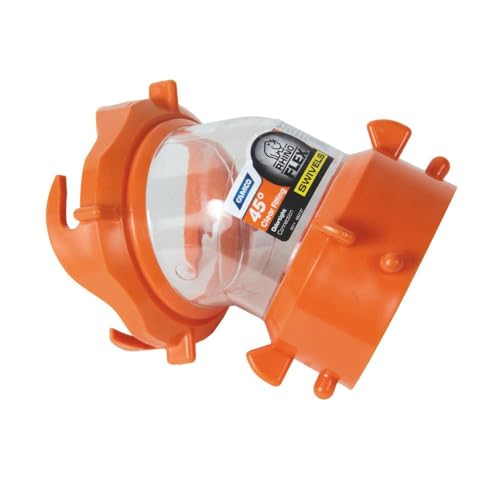
Camco RhinoFLEX Clear 45-Degree Sewer Adapter
The clear elbow: the cheapest way to know a black tank is genuinely empty rather than probably empty.
Where this sits in the rest of the setup
A support is one of four items that make the sewer side of a first season uneventful: the hose kit, the support, a clear elbow and a pair of disposable gloves. The support roundup covers the wider category including shorter lengths, and sewer hose storage ideas deals with the question this comparison keeps running into: where all of it lives when you are driving.
Questions people actually ask
Do I really need an RV sewer hose support?
If you want the tank to drain rather than puddle, yes. A hose lying flat on a campsite pad holds standing waste in every low spot. A support holds a continuous downhill angle so gravity empties the hose, and slow draining is usually a slope problem rather than a tank problem.
What is the difference between the Sidewinder and the Slunky?
Structure. One is rigid molded plastic cradles on snap-fit hinges that fold flat; the other is flexible and compresses lengthwise. Their published heights are nearly identical - about 7.25 inches at the trailer end falling to 4 to 4.5 inches at the sewer end - so the real difference is storage space and behavior on uneven ground.
Which one stores smaller?
The flexible support, by a wide margin. The manufacturer publishes a 15-inch collapsed length for its 25-foot version. The rigid support folds flat but stays close to full length, so it needs a pass-through bay, a bumper tube or a truck bed.
Can I use a 10-foot support with a 20-foot hose?
You can, but 10 feet of hose will be lying on the ground, which is where waste collects. Match the support length to the hose length you actually run. Both products are sold in a 20-foot version for exactly this reason.
Do these supports need straps to hold the hose?
No. Both hold the hose in deep cradles or a channel, which is one reason they are easier than improvising with boards or pool noodles. What neither does is tell you when the tank is empty - that is the job of a clear elbow.
Sources
Read next
Sewer & Water
Best RV Sewer Hose Support
Folding and compressing hose supports compared, plus why the homemade versions usually disappoint.
Sewer & Water
Best RV Sewer Hose for a First Travel Trailer
Complete sewer hose kits compared on length, wall thickness, fittings and storage, for someone doing this for the first time.
Sewer & Water
RV Sewer Hose Storage Ideas
Where to actually store a sewer hose, why the bumper usually will not work, and the separation rule that matters.
Sewer & Water
How to Hook Up an RV Sewer Hose (Step by Step)
The full sewer connection and dumping sequence, in order, with the two checks that prevent the story you tell for years.
Reviewed October 12, 2026. Spot something out of date? Tell us and we will fix it.