Best RV Dehumidifier for Winter Storage
The best dehumidifier for a stored trailer is usually not a dehumidifier. Cold stops a compressor working and storage has no power, which rules out the obvious answer.
Heads up: this page contains affiliate links. If you buy through one, Camp & Chock may earn a commission at no extra cost to you. It never changes which product we put first — how this site is funded.

The short answer
For a travel trailer in unpowered winter storage, buy two or three disposable hanging moisture absorbers and hang them through the trailer in October. They need no power, they work untouched for months, and they cost very little. Add a renewable desiccant brick in the wardrobe if you want something you can reuse year after year. An electric dehumidifier is the right machine for a damp trailer on shore power and the wrong one for storage.
Part of our first-season starter kit guide, and the narrow version of a question our RV dehumidifier roundup answers generally. This one has a different answer, because winter storage removes the two things an electric dehumidifier needs: warmth and a plug.
Our picks at a glance
Tap any row to jump to the full write-up.
| # | Product | Best for | Beginner fit | Price |
|---|---|---|---|---|
| 1 | DampRid Hanging Moisture AbsorberThe cheapest storage insurance there is: hang two or three through the trailer in October and forget about them. | Cheap winter storage insurance | Strong | |
| 2 | 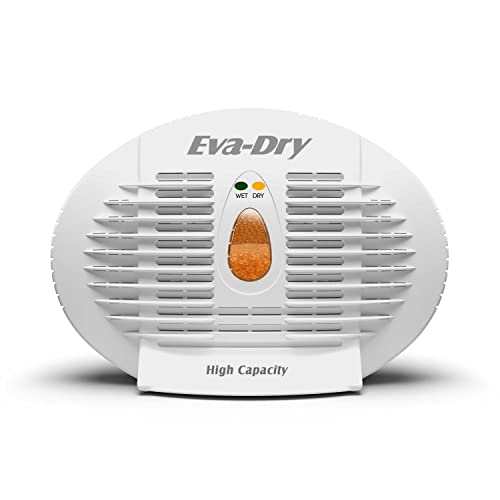 Eva-Dry E-500 Renewable Mini DehumidifierA desiccant brick that needs no power while it works. Right for a wardrobe or a stored trailer, not for a whole damp rig. | Closets and unpowered storage | Strong | |
| 3 | 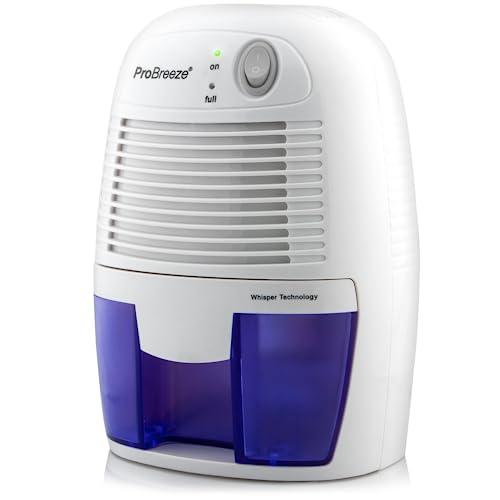 Pro Breeze Electric Mini DehumidifierThe powered option: it removes real water and it needs shore power, which rules it out for the storage months. | A powered site with a damp trailer | Strong |
Prices come from Amazon and were last checked November 12, 2026. They change constantly, so a price older than 48 hours is withdrawn rather than shown stale — those rows read “Check price on Amazon” instead and go straight to the current listing. #ad — these are affiliate links.
Why the obvious answer is the wrong answer
There are two independent reasons a compressor dehumidifier is a poor fit for a stored trailer, and either one on its own would be enough.
It needs power, and storage usually has none
Most travel trailers spend the winter on a driveway, in a field, or in a storage lot. None of those come with a reliable outlet. A machine that stops the moment the power does is not controlling damp through a winter; it is controlling damp until the first time something trips. And the storage months are precisely when nobody is there to notice.
Cold stops a compressor working properly
A compressor dehumidifier works by chilling a coil below the dew point so water condenses onto it. As the room temperature falls toward freezing, the coil has to go below freezing to do that, and what forms on it is frost rather than water. The unit then spends its time defrosting instead of drying. This is a physical limit, not a quality difference between brands, and it is why dehumidifier listings carry a minimum operating temperature at all.
Desiccant absorbers have no such limit. They work by chemical attraction rather than by refrigeration, so a cold trailer does not stop them. They remove far less water per day, which matters much less over four months of no-one-is-there than it does over an afternoon.
The picks
1. Best for Cheap winter storage insurance
DampRid Hanging Moisture Absorber
The cheapest storage insurance there is: hang two or three through the trailer in October and forget about them.
- Specification
- Disposable hanging absorber
- Specification
- No power required
- Specification
- Hangs in a wardrobe or over a rail
What it does well
- Costs very little and works for months untouched, which suits winter storage exactly
- Hang two or three through the trailer rather than relying on one device
The real tradeoff
- Disposable, so it is a repeat purchase
- The collected liquid will damage surfaces if the bag is knocked over
How it measures up
These are judgments from published specifications and what we see at the lodge, not laboratory results. How we choose.
- Beginner fit
- Strong — Hang it up.
- Capacity
- Adequate — Buy several rather than one.
- Running cost
- Good — Disposable, but cheap.
- Value
- Strong — Pennies against a mold problem.
2. Best for Closets and unpowered storage
Eva-Dry E-500 Renewable Mini Dehumidifier
A desiccant brick that needs no power while it works. Right for a wardrobe or a stored trailer, not for a whole damp rig.
- Specification
- Renewable desiccant, no power while working
- Specification
- Plugs in to dry out and reset
- Specification
- Sized for a small enclosed space
What it does well
- Needs no power while it is working, which is the entire point in a stored trailer
- Renewable rather than disposable. Plug it in, dry it out, use it again
- Small enough to live in a wardrobe permanently
The real tradeoff
- Handles a closet, not a whole trailer
- You have to remember to recharge it, and in storage nobody does
How it measures up
These are judgments from published specifications and what we see at the lodge, not laboratory results. How we choose.
- Beginner fit
- Strong — Put it in the cupboard.
- Capacity
- Adequate — A closet, not a trailer.
- Running cost
- Strong — None while in use.
- Value
- Strong — Cheap, and reusable for years.
3. Best for A powered site with a damp trailer
Pro Breeze Electric Mini Dehumidifier
The powered option: it removes real water and it needs shore power, which rules it out for the storage months.
- Specification
- Electric dehumidifier
- Specification
- Small removable tank
- Specification
- Auto shut-off when the tank fills
What it does well
- Actually removes measurable water, which a desiccant brick does not at trailer scale
- Auto shut-off means you can leave it running while you are out
The real tradeoff
- Needs shore power, which rules it out for unpowered storage, and storage is where damp does its worst
- A small tank. In a genuinely damp rig you will empty it daily
How it measures up
These are judgments from published specifications and what we see at the lodge, not laboratory results. How we choose.
- Beginner fit
- Strong — Plug in, empty the tank.
- Capacity
- Good — Handles a small trailer while plugged in.
- Running cost
- Good — Modest, but it needs power.
- Value
- Good — Right tool, wrong months.
Which to use, by situation
Matching the device to the months
| Situation | What to use | Why |
|---|---|---|
| Unpowered winter storage, 3-5 months | Two or three disposable hanging absorbers | No power needed, works untouched for months, trivial cost |
| Unpowered storage, want it reusable | A renewable desiccant brick per closed space | Plug it in to dry out and reset, then use it again next year |
| Stored on shore power, trailer feels damp | An electric dehumidifier, plus absorbers in the closets | The machine removes real water; the absorbers cover the enclosed spaces it cannot reach |
| In use on a wet week at a powered site | An electric dehumidifier | This is the job it is genuinely good at |
Why two or three absorbers rather than one
Because moisture does not travel well through a trailer full of closed doors. One absorber in the middle of the living area is doing nothing for the wardrobe, the under-bed storage or the bathroom, and the wardrobe is where the problem starts because it is the enclosed space against an outside wall. Hang one in the wardrobe, one in the main living area and one in the bathroom, and the coverage problem goes away for a few dollars.
The one thing to watch with disposable absorbers
The liquid they collect will mark or damage surfaces if the bag is knocked over, and a trailer being towed in spring is a thing that gets knocked over. Take them out before you move the trailer, not after. That is also the right moment to replace them, so it is one job rather than two.
Humidity versus wetness, which is the diagnosis that matters
Before you buy anything, work out which problem you have, because they look similar in October and are not the same at all.
Humidity is moisture that was already inside the trailer when you closed it up, held in cushions, mattresses, carpet and the air itself. It condenses on whatever surface is coldest, which is generally the inside face of an outside wall. It shows up as a general mustiness, slightly damp fabric, and condensation on windows in the morning. This is the problem absorbers solve.
Wetness is water coming in from outside, through a roof seam, a vent flange, a window frame or a sealant joint that has gone hard. It shows up as a stain, a soft patch in a wall or ceiling, or damp concentrated in one corner rather than spread through the trailer. No desiccant fixes this, and running absorbers in a leaking trailer simply hides the symptom for a season while the damage continues.
The test is where the damp is. General and even means humidity. Local and worse near the roofline, a window or a corner means a leak, and the thing to buy is sealant and an afternoon, not a dehumidifier — the roof sealant roundup is which tube for which surface.
The two that work without power
Disposable absorbers for the winter itself, a renewable brick for the wardrobe you want covered every year. Neither needs a plug.
Best for Cheap winter storage insurance
DampRid Hanging Moisture Absorber
The cheapest storage insurance there is: hang two or three through the trailer in October and forget about them.
Best for Closets and unpowered storage
Eva-Dry E-500 Renewable Mini Dehumidifier
A desiccant brick that needs no power while it works. Right for a wardrobe or a stored trailer, not for a whole damp rig.
What else matters more than the dehumidifier
Damp control in storage is mostly procedural, and the device is the last ten percent. Two things matter more.
Drain the water system completely. Water left in the lines is both a freeze risk and a moisture source. The full sequence is in how to winterize a travel trailer for storage.
Find and fix the leak, if there is one. A trailer that is genuinely wet rather than merely humid has water coming in from outside, usually at a roof seam, a vent flange or a window frame. No amount of desiccant fixes that, and running absorbers on a leaking trailer just hides the symptom for a season. If the damp is localized to one corner or one wall, it is a leak, not condensation.
Covers and seals are the other half of a stored trailer. Tires are the component most damaged by standing still — see tire covers versus wheel covers for that side of the job.
And if the question you arrived with was simply whether a bag of cheap hanging absorbers does the same job as a powered unit, the head-to-head is in DampRid vs a dehumidifier for RV storage.
Questions people actually ask
What is the best dehumidifier for an RV in winter storage?
Usually not a dehumidifier at all. Disposable hanging moisture absorbers need no power and keep working in the cold, which is exactly what unpowered winter storage requires. Hang two or three through the trailer rather than relying on one.
Do electric dehumidifiers work in a cold RV?
Poorly. A compressor dehumidifier chills a coil to condense water out of the air, and as the temperature approaches freezing the coil frosts instead, so the unit spends its time defrosting. That is a physical limit, not a brand difference.
How many moisture absorbers does a travel trailer need?
Two or three. Moisture does not move well through a trailer full of closed doors, so one unit in the living area does nothing for the wardrobe or the bathroom. Hang one in each enclosed space that sits against an outside wall.
Should I leave cupboards open when storing my camper?
Yes. Ventilation does more for damp than any device. Leave interior and cupboard doors open, pull drawers out slightly, and lift the mattress off its base so air can move underneath.
Sources
Read next
First-Season Starter Kit
Best RV Roof Sealant for a Travel Trailer
RV roof and seam sealant explained by what it goes on: self-leveling, non-sag, tape, and the clear tube to keep off a rubber roof.
Sewer & Water
Best RV Antifreeze for a Travel Trailer
RV plumbing antifreeze for a first winter: how many gallons, what -50 F really means, and the two tools worth ordering online.
First-Season Starter Kit
How to Winterize a Travel Trailer for Storage
The winter storage routine in order, from draining the water system to the moisture and tire protection that prevents a spring surprise.
First-Season Starter Kit
Best RV Dehumidifier for Damp Trailers and Winter Storage
Desiccant absorbers versus powered dehumidifiers, matched to camping use and to unpowered winter storage.
Reviewed October 11, 2026. Spot something out of date? Tell us and we will fix it.