Best RV Roof Sealant for a Travel Trailer
Two tubes and a roll of tape cover almost every sealing job on a travel trailer. Buying the wrong one of the two tubes gives you a streak; buying the wrong product entirely can damage the roof membrane it is sitting on.
Heads up: this page contains affiliate links. If you buy through one, Camp & Chock may earn a commission at no extra cost to you. It never changes which product we put first — how this site is funded.

The short answer
Buy one tube of self-leveling lap sealant for horizontal surfaces and one tube of non-sag for vertical ones, in white, from the same brand — on most trailers that is Dicor, which publishes compatibility with EPDM, TPO and PVC membranes. Those two tubes handle vent flanges, screw heads, roof edges, the front cap seam and window frames, which is almost everything. Add a roll of EternaBond RoofSeal tape only if you have an actual open seam or a tear, because tape bridges a gap and sealant only fills a joint. And the one thing to get right before you spend anything: do not put a clear general-purpose RV sealant on a rubber roof. Geocel publishes a direct warning against using Pro Flex on TPO or EPDM, and those two membranes are what most travel trailer roofs are made of.
Part of our first-season starter kit. Our first-time owner tips call a roof inspection twice a season the best-value maintenance on a travel trailer, and this is the page that tells you what to carry up there with you. If you are chasing damp rather than a leak, the dehumidifier roundup is a different problem with a different fix.
Our picks at a glance
Tap any row to jump to the full write-up.
| # | Product | Best for | Beginner fit | Price |
|---|---|---|---|---|
| 1 | 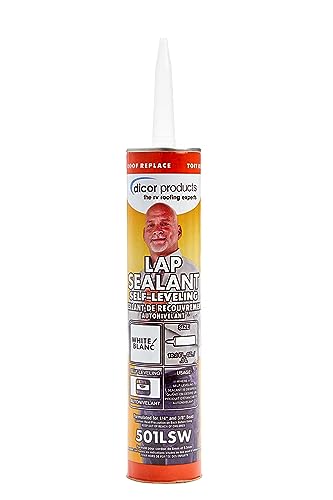 Dicor Self-Leveling Lap Sealant, White (501LSW-1, 10.3 oz)The tube to own before you need it. One of these in a storage bay is the cheapest insurance on the trailer, and it is what the roof was sealed with in the first place. | Every horizontal seam on a rubber roof | Strong | |
| 2 | 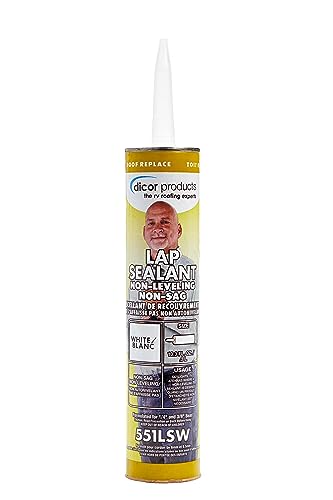 Dicor Non-Leveling Lap Sealant, White (551LSW-1, non-sag, 10.3 oz)Buy it with the self-leveling tube, not instead of it. Horizontal gets 501, vertical gets 551, and knowing which is which is most of this category. | Vertical seams, roof edges and screw heads | Good | |
| 3 | 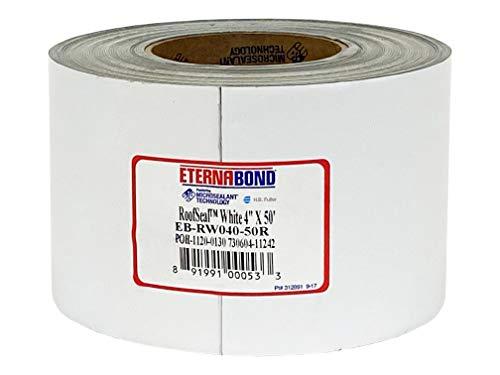 EternaBond RoofSeal White Repair Tape (4 in x 50 ft)The repair for an open seam or a tear, rather than for routine maintenance. Keep the roll flat and warm, and only unroll it when the surface is clean and dry. | A seam or a tear that sealant alone will not hold | Good | |
| 4 | 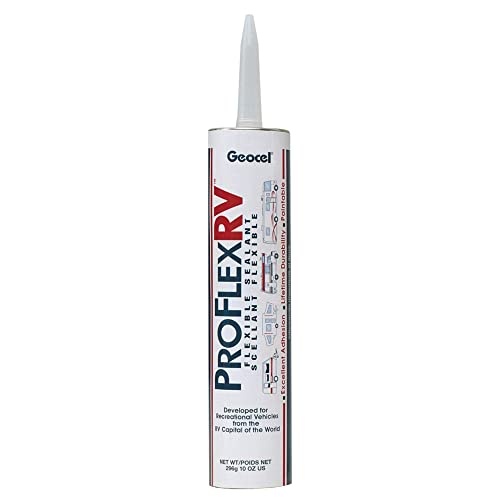 Geocel Pro Flex RV Flexible Sealant, Clear (10 oz)The sidewall and window tube, bought alongside the roof sealant and never used instead of it. Read the EPDM and TPO warning before it goes anywhere near the roof. | Windows, trim and bodywork - not the roof | Good | |
| 5 | 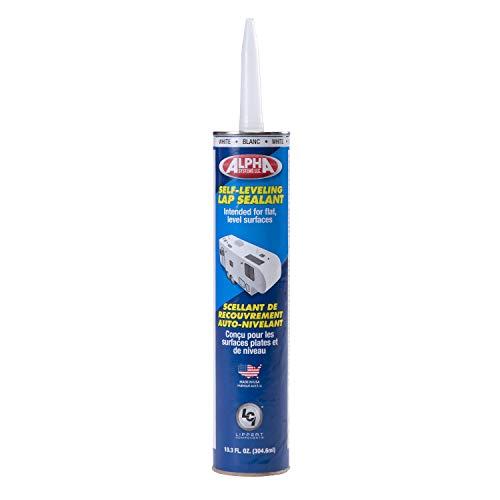 Alpha Systems 1021 Low VOC Self-Leveling Lap Sealant (10.3 oz)The right tube if your roof came from Alpha Systems and you want to match it exactly. Otherwise the Dicor 501 does the same work for less. | Matching a trailer that was not sealed with Dicor | Strong | |
| 6 | 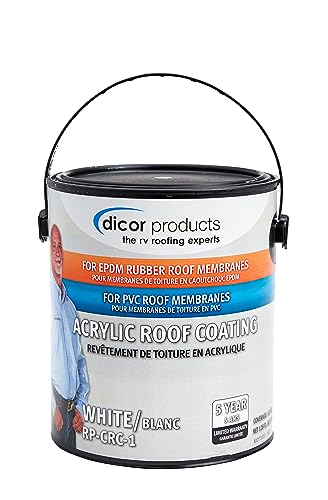 Dicor RP-CRC-1 EPDM Rubber Roof Acrylic Coating, White (1 gal)The whole-roof option, listed here so you can rule it out. A first-season owner with a leak wants a tube or a roll of tape, not two coats of this. | Re-coating a tired but sound roof, not fixing a leak | Adequate |
Prices come from Amazon and were last checked November 12, 2026. They change constantly, so a price older than 48 hours is withdrawn rather than shown stale — those rows read “Check price on Amazon” instead and go straight to the current listing. #ad — these are affiliate links.
First: what is your roof made of?
This decides which products are safe to use, and most owners do not know the answer. It takes two minutes to find out.
EPDM rubber is the most common membrane on travel trailers. It is a thin black rubber sheet with a white or gray coating on the top side, it feels slightly chalky when it is a few years old, and the underside of an offcut is black. If you rub a damp white cloth on it and the cloth comes back gray, that is an aging EPDM coating doing exactly what it is supposed to do.
TPO is the other common one, increasingly so on newer trailers. It is a white plastic-feeling membrane, it does not chalk the way EPDM does, and it is usually slightly shinier. If you cannot tell EPDM from TPO by feel, you are not alone, and the good news is that the lap sealants recommended here are published as compatible with both.
Fiberglass is a hard, smooth, gel-coated shell, most often on higher-end trailers and fifth wheels. It is unmistakable because you can tap it and it sounds solid.
Aluminum turns up on older and vintage trailers, and on a few current ones. Also unmistakable.
Why it matters. A lap sealant published for EPDM, TPO and PVC is safe on all four of those surfaces. A general-purpose RV sealant that the maker warns against using on TPO or EPDM is safe on fiberglass, aluminum, glass and trim — and not on the two membranes most roofs are made of. The difference between a repair and a problem here is reading one line on a cartridge.
Sealant, tape, or coating?
Three different products for three genuinely different situations, and the search results treat them as interchangeable.
Lap sealant fills a joint. A vent flange that meets the membrane, a screw head, the bead around a skylight, the roof-to-sidewall seam. Sealant is a consumable: it is applied over the factory bead, cracks with UV and movement over several years, and gets topped up. This is the routine maintenance product and it is 90 percent of what you will ever buy.
Tape bridges a gap. A seam that has opened up, a tear, a puncture, a slide-out seam that keeps failing. Sealant squeezed into a moving gap will crack again at the same place; a 35 mil membrane tape laid across it does not care whether the gap stays the same size. Tape is a repair, not maintenance.
Coating renews a whole surface. A membrane that has gone thin and chalky over its whole area, with no single breach to fix. A two-part coating system restores a reflective protective layer. It is also several gallons, two coats and most of a weekend, and it is the wrong answer to a leak — it just paints over it.
Which means the order is: find the problem, then pick the product. A wet ceiling stain is almost always a specific penetration, not a worn-out roof. Get up there, find the cracked bead around a vent or an antenna base, and a ten-dollar tube fixes it.
How we choose
What the maker publishes about compatibility. This is the first and heaviest criterion on this page, because getting it wrong damages the roof. Dicor states EPDM, TPO and PVC compatibility for its lap sealants and also lists aluminum, wood, vinyl, galvanized metal, fiberglass, concrete and mortar. Geocel states the opposite for Pro Flex: do not use on extruded polystyrene insulation sheathing, TPO, or EPDM. We quote both rather than summarizing either.
Whether it is self-leveling or non-sag, stated plainly. Half the bad outcomes in this category are the right chemistry on the wrong plane. Every pick here says which it is in its first line.
Whether a first-season owner can apply it correctly. Self-leveling sealant forgives a shaky bead; tape does not forgive a crooked first inch, and a coating does not forgive skipping the activator. We rank the forgiving products higher for the reader this site is written for, and we say what the unforgiving ones demand.
Cure and application conditions. Dicor publishes skins over in 5 minutes, waterproof in 4 hours, 80 percent cure in 48 hours and full cure in 30 days at 50–70 F. H.B. Fuller’s data sheet puts EternaBond’s application range at roughly 40–150 F and recommends a primer below that. Those numbers decide whether your weekend is long enough, so they are in the picks rather than buried.
What we will not claim. We do not test products and say so on how we choose. No sealant on this page was put on a roof by us and then watched for five years, no service life is asserted, and no adhesion figure here is a measurement we took. Every specification is the maker’s own, attributed. Sources are linked at the end.
The picks
1. Best for Every horizontal seam on a rubber roof
Dicor Self-Leveling Lap Sealant, White (501LSW-1, 10.3 oz)
The tube to own before you need it. One of these in a storage bay is the cheapest insurance on the trailer, and it is what the roof was sealed with in the first place.
- Specification
- Dicor publishes compatibility with EPDM, TPO and PVC membranes
- Specification
- Dicor also lists adhesion to aluminum, wood, vinyl, galvanized metal, fiberglass, concrete and mortar
- Specification
- Self-leveling, which Dicor specifies for horizontal surfaces
- Specification
- Dicor's cure times at 50-70 F: skins over in 5 minutes, waterproof in 4 hours, 80 percent cured in 48 hours, fully cured in 30 days
- Specification
- HAPS-free formula, 10.3 oz tube
What it does well
- Self-leveling does the hard part for you: squeeze a bead around a vent flange and it flows out flat and seals the edge without tooling, which is the difference between a tidy repair and a smeared one
- It is the sealant most trailers left the factory with, so you are matching the existing chemistry rather than gambling that two products get along
- Waterproof in about four hours on Dicor's figures, so a Saturday morning repair survives a Saturday afternoon storm
The real tradeoff
- Horizontal only. On a vertical surface - a sidewall seam, a window frame, the front cap - it will run and leave you with a drip mark and a thin spot, which is what the non-sag version exists for
- It is not a structural fix. Sealant over a seam that has opened up because a screw has pulled out of soft wood will fail again, and so will sealant over a crack in a skylight
- White stays white but a weathered roof does not, so a fresh bead on an eight-year-old roof looks exactly like a fresh bead on an eight-year-old roof
How it measures up
These are judgments from published specifications and what we see at the lodge, not laboratory results. How we choose.
- Beginner fit
- Strong — Self-leveling means no tooling skill needed.
- Published compatibility
- Strong — EPDM, TPO and PVC, stated by Dicor.
- Where it works
- Adequate — Horizontal surfaces only.
- Value
- Strong — The least money for the most used repair.
Specifications from Dicor.
2. Best for Vertical seams, roof edges and screw heads
Dicor Non-Leveling Lap Sealant, White (551LSW-1, non-sag, 10.3 oz)
Buy it with the self-leveling tube, not instead of it. Horizontal gets 501, vertical gets 551, and knowing which is which is most of this category.
- Specification
- Non-leveling, so it stays where you put it on a vertical surface
- Specification
- Dicor lists it as a secondary seal for roof edges, vents and screw heads
- Specification
- HAPS-free formula, 10.3 oz tube
What it does well
- The other half of the pair, and the one people do not buy until they have watched self-leveling sealant run down a sidewall and dry in a streak
- Stays put on an edge, which makes it the right product for the roof-to-sidewall joint, the front cap seam, a window frame and anywhere a screw head sits on something that is not flat
- Same family and same chemistry as the self-leveling tube, so the two are designed to live next to each other on the same roof
The real tradeoff
- You have to tool it. It will not flow out flat on its own, so a neat job takes a gloved finger, a plastic spreader and a little patience
- Costs more than the self-leveling version for less convenience, which is why it feels like the wrong tube to buy first. It is the second tube, not the first
- Also not a structural fix. Sealant does not hold a loose part on
How it measures up
These are judgments from published specifications and what we see at the lodge, not laboratory results. How we choose.
- Beginner fit
- Good — Needs tooling, which is a learnable skill.
- Published compatibility
- Strong — Same Dicor lap sealant family.
- Where it works
- Strong — Vertical and detail work the 501 cannot do.
- Value
- Good — Cheap, but the second tube you need.
Specifications from Dicor.
3. Best for A seam or a tear that sealant alone will not hold
EternaBond RoofSeal White Repair Tape (4 in x 50 ft)
The repair for an open seam or a tear, rather than for routine maintenance. Keep the roll flat and warm, and only unroll it when the surface is clean and dry.
- Specification
- 35 mil total thickness, part number EB-RW040-50R
- Specification
- 4 in wide by 50 ft long
- Specification
- H.B. Fuller's data sheet gives an application temperature of about 4-65 C (roughly 40-150 F) and recommends EternaPrime primer below that
- Specification
- Surfaces must be clean and dry before application
What it does well
- A single-step repair that bridges an actual gap. Where sealant fills a joint, this covers a seam or a tear with a continuous waterproof membrane that is not relying on the crack staying the same size
- Once it is down and rolled, it is down. This is the product people use for the repair they do not want to think about again, and it is the standard answer on a torn roof seam
- One 50 ft roll covers every seam on a typical travel trailer with plenty spare, which is the point: you buy it once and it sits in the bay for the next repair
The real tradeoff
- Unforgiving. It bonds on contact, so a crooked first inch is a crooked repair, and getting it off again takes effort and usually leaves residue
- It needs clean, dry and warm. On the manufacturer's data sheet that means roughly 40 F and up, with a primer below that - so a December roof leak is a tarp-and-wait situation, not a tape situation
- It does not look like a factory roof. This is a visible white stripe across the roof, which nobody sees and which some owners mind anyway. A 25 ft roll of the same tape also exists for less money if one repair is all you need
How it measures up
These are judgments from published specifications and what we see at the lodge, not laboratory results. How we choose.
- Beginner fit
- Good — Simple, but there is no second attempt.
- Published data
- Good — 35 mil, with a stated application range.
- Where it works
- Strong — Bridges gaps that sealant cannot fill.
- Value
- Good — More per repair than a tube, far less than a roof.
Specifications from EternaBond (H.B. Fuller).
4. Best for Windows, trim and bodywork - not the roof
Geocel Pro Flex RV Flexible Sealant, Clear (10 oz)
The sidewall and window tube, bought alongside the roof sealant and never used instead of it. Read the EPDM and TPO warning before it goes anywhere near the roof.
- Specification
- Geocel states excellent adhesion to many surfaces even when damp, slightly oily or frozen
- Specification
- Paintable and UV resistant, per Geocel
- Specification
- Geocel lists aluminum, glass, coated steel (Kynar 500 finishes), steel, wood, fiberglass and vinyl
- Specification
- Geocel's own warning: do not use on extruded polystyrene insulation sheathing, TPO, or EPDM
- Specification
- Clear, 10 oz cartridge, Geocel part number 28128
What it does well
- It sticks to a damp surface, which no other sealant here claims. For the leak you found in the rain, on the day you found it, that is the product
- Clear and paintable, so it is the right choice around a window frame, a marker light or a trim strip where a white bead would be the thing you notice about your trailer
- The cartridge behaves well in a standard caulk gun and tools cleanly, which matters for the detail work it is for
The real tradeoff
- Do NOT put it on a rubber roof. Geocel publishes a direct warning against TPO and EPDM, which is the membrane on most travel trailer roofs, and this is the single most expensive mistake available in this category
- Geocel also warns against acrylic skylight glazing and traffic-bearing surfaces, which rules out two more places people reach for a clear tube
- Clear means you cannot see coverage as easily as with white, so a thin spot is harder to spot before it is a leak
How it measures up
These are judgments from published specifications and what we see at the lodge, not laboratory results. How we choose.
- Beginner fit
- Good — Easy to use; easy to use in the wrong place.
- Published compatibility
- Adequate — Explicitly NOT for TPO or EPDM.
- Where it works
- Good — Windows, trim, metal and fiberglass.
- Value
- Good — Cheap, and it does something nothing else here does.
Specifications from Geocel.
5. Best for Matching a trailer that was not sealed with Dicor
Alpha Systems 1021 Low VOC Self-Leveling Lap Sealant (10.3 oz)
The right tube if your roof came from Alpha Systems and you want to match it exactly. Otherwise the Dicor 501 does the same work for less.
- Specification
- Self-leveling, 10.3 oz tube, part number N102101TLCI
- Specification
- Listing states a 1/4 in bead covers 30 ft
- Specification
- Low VOC formula
- Specification
- Sold for RV roofs, vents, antennas and skylights
What it does well
- Alpha Systems supplies roofing membrane to a large share of the RV industry, so on a lot of trailers this is the sealant that matches what is already up there rather than the one that merely gets along with it
- A published coverage figure - a 1/4 in bead for 30 ft - which is rare in this category and genuinely useful when you are working out how many tubes a roof needs
- Low VOC matters when you are working on a roof with your face about two feet from the bead for an hour
The real tradeoff
- Costs about twice the equivalent Dicor tube for a product that does the same job, and on a trailer already sealed with Dicor there is no reason to pay it
- Harder to find in a store, so it is more likely to be a planned order than a Saturday-morning fix
- Self-leveling, so like the Dicor 501 it is for horizontal surfaces only
How it measures up
These are judgments from published specifications and what we see at the lodge, not laboratory results. How we choose.
- Beginner fit
- Strong — Self-leveling, same technique as the 501.
- Published compatibility
- Good — Sold for RV roofs; coverage figure stated.
- Where it works
- Adequate — Horizontal surfaces only.
- Value
- Adequate — A premium over Dicor for a matching brand.
Specifications from Alpha Systems.
6. Best for Re-coating a tired but sound roof, not fixing a leak
Dicor RP-CRC-1 EPDM Rubber Roof Acrylic Coating, White (1 gal)
The whole-roof option, listed here so you can rule it out. A first-season owner with a leak wants a tube or a roll of tape, not two coats of this.
- Specification
- Listing states coverage of 125 sq ft per gallon per coat
- Specification
- Part 2 of Dicor's two-part rubber roof coating system
- Specification
- Part 1 is the separate RP-CRP-Q cleaner and activator, sold on its own
- Specification
- Sold for EPDM and PVC roofs; two coats is the normal application
What it does well
- The right product for a roof whose membrane has gone chalky and thin all over but has no actual breach - it restores a protective, reflective layer instead of patching a hole that is not there
- A white reflective coat measurably changes how hot a trailer gets in summer, which is a comfort and an air conditioning cost, not just a maintenance item
- A proper system with published coverage, which lets you buy the right number of gallons rather than guessing
The real tradeoff
- Part 2 only. The cleaner and activator is a separate purchase and the coating is not designed to go on without it, so the real cost and the real time are both higher than the gallon price suggests
- It is not a leak fix, and using it as one hides the problem under a fresh white layer. Find the breach, seal it with lap sealant or tape, and only then consider coating
- At 125 sq ft per gallon per coat and two coats, a typical travel trailer roof is several gallons and most of a weekend. This is a project, not a repair
How it measures up
These are judgments from published specifications and what we see at the lodge, not laboratory results. How we choose.
- Beginner fit
- Adequate — A multi-step, two-product, whole-weekend job.
- Published compatibility
- Good — Sold for EPDM and PVC; coverage stated.
- Where it works
- Adequate — Sound but weathered roofs only.
- Value
- Adequate — Cheap per square foot, expensive per weekend.
Specifications from Dicor.
Where each product goes, on the makers' published guidance
| Pick | Type | Published compatibility | Surface |
|---|---|---|---|
| Dicor 501LSW self-leveling | Lap sealant, white | EPDM, TPO, PVC; also aluminum, fiberglass, wood, vinyl (Dicor) | Horizontal only |
| Dicor 551LSW non-sag | Lap sealant, white | Same Dicor lap sealant family | Vertical, edges, screw heads |
| EternaBond RoofSeal tape | 35 mil membrane tape | Apply roughly 40-150 F, primer below that (H.B. Fuller) | Over a seam or tear, any plane |
| Geocel Pro Flex, clear | Flexible sealant | NOT for TPO or EPDM (Geocel's own warning) | Windows, trim, metal, fiberglass |
| Alpha Systems 1021 | Lap sealant, self-leveling | Sold for RV roofs; 1/4 in bead covers 30 ft (listing) | Horizontal only |
| Dicor RP-CRC-1 coating | Acrylic coating, Part 2 of 2 | EPDM and PVC; 125 sq ft per gallon per coat (listing) | Whole roof, two coats |
The fourth row is the one to read twice. Pro Flex is a good product and it is on this page for the window frames and trim work it is genuinely best at — it is the only sealant here whose maker claims adhesion to a damp surface. It is also the tube most likely to be bought by mistake for a roof job, which is why its warning is quoted rather than paraphrased.
If you only buy one
Buy two: the self-leveling tube for flat surfaces and the non-sag tube for vertical ones. That pair is the whole maintenance kit. Add the tape only when you have found an actual open seam or a tear, because that is the job sealant cannot do.
Best for Every horizontal seam on a rubber roof
Dicor Self-Leveling Lap Sealant, White (501LSW-1, 10.3 oz)
The tube to own before you need it. One of these in a storage bay is the cheapest insurance on the trailer, and it is what the roof was sealed with in the first place.
Best for Vertical seams, roof edges and screw heads
Dicor Non-Leveling Lap Sealant, White (551LSW-1, non-sag, 10.3 oz)
Buy it with the self-leveling tube, not instead of it. Horizontal gets 501, vertical gets 551, and knowing which is which is most of this category.
Best for A seam or a tear that sealant alone will not hold
EternaBond RoofSeal White Repair Tape (4 in x 50 ft)
The repair for an open seam or a tear, rather than for routine maintenance. Keep the roll flat and warm, and only unroll it when the surface is clean and dry.
The twice-a-season roof check, and what you will find
This is the maintenance habit the products above exist to serve, and it takes under an hour.
Go up only if the roof is walkable. Many travel trailer roofs are, and the owner’s manual says so; some are not, and on those you work from a ladder at each corner, or from a stepladder with a phone on a pole. A roof you have put a foot through is a far worse problem than the one you went up to find.
Work the penetrations, not the middle. Leaks come in where something passes through the membrane: roof vents, the bathroom fan, the air conditioner gasket, the refrigerator vent, the antenna base, the solar gland, any screw holding a piece of trim. The flat middle of a roof almost never leaks.
Look for cracks, lifted edges and missing bead. Old sealant goes hard, then crazes into a crackle pattern, then lifts at one edge. Any of those means water has a path. Press a fingernail along the bead — if it is still rubbery you are fine for another season.
Clean before you seal. Every product here needs a clean, dry surface, and sealant over road grime is sealant that comes off in a year. A rag, mild soap and water, then let it dry properly. Do not use a petroleum solvent on EPDM.
Top up, do not strip. Fresh lap sealant goes over the old bead. You remove old sealant only when it is lifting off in pieces, and then with a plastic scraper and patience rather than a blade, because a blade on a membrane roof is how a maintenance job becomes a tape job.
And check the seams on the way down. The roof-to-sidewall joint, the front and rear caps, the window frames and the slide-out seals are all the same inspection with the non-sag tube instead of the self-leveling one. Our winterizing walkthrough puts this check right before the trailer goes into storage, which is the right time: a crack that lets water in all winter is the one that costs real money.
Mistakes that turn a ten-dollar fix into a wall repair
Silicone. Any silicone, anywhere. Bathroom caulk and general-purpose silicone do not bond reliably to EPDM, they fail at the edges, and worst of all nothing will stick to the residue afterward — so the correct product cannot be applied until the silicone is mechanically removed. Tape makers warn against silicone surfaces for exactly this reason. It is the single worst thing you can put on an RV roof.
A clear general-purpose sealant on a rubber roof. Covered above, and worth repeating because the tube says “RV” on it. Read the maker’s own warning line before it touches a membrane.
Self-leveling on a vertical seam. It runs. You get a streak down the sidewall and a thin spot at the joint, which is the failure you were trying to prevent.
Sealing over a loose part. If a vent flange moves when you push it, the screws have lost their grip in the roof decking. Sealant will not hold it down, and the bead will crack again at the next highway speed. Re-fasten first, then seal.
Sealing in the cold or the wet. Both the lap sealant cure figures and the tape’s application range assume a warm, dry surface. A January roof repair in the rain is a tarp and a ratchet strap until the weather turns, and that is a legitimate answer.
Coating a roof instead of finding the leak. A fresh white coat over an unfixed penetration is a leak you can no longer see. Fix, then coat, in that order, or do not coat.
Where this sits in a first season
Water damage is the thing that quietly destroys travel trailers, and it almost never announces itself. By the time there is a stain on a ceiling panel the water has usually been in the wall for a season. That is the whole argument for keeping two tubes of sealant in a storage bay and spending an hour on the roof twice a year: it is the cheapest intervention available against the most expensive failure.
It also comes up the first time you install anything on the outside of the trailer. Mounting a backup camera means drilling through the rear wall, and every fastener you put through the shell needs sealing properly — which until now this site has told you to do without telling you what to buy. For a roof penetration that is the self-leveling tube; for a vertical rear wall it is the non-sag one. And once the roof is sound, the rest of the weather-protection list is short: tire covers for UV on the sidewalls, and antifreeze for the plumbing if the trailer is going to sit through a freeze.
Questions people actually ask
What is the difference between self-leveling and non-sag lap sealant?
Self-leveling sealant flows out flat on its own and Dicor specifies it for horizontal surfaces, which makes it the right product for vent flanges, screw heads and anything on the roof deck. Non-sag stays where you put it and is tooled with a gloved finger, which makes it the right product for vertical surfaces: the roof-to-sidewall seam, the front cap, window frames and trim. Using self-leveling on a vertical surface leaves a drip streak and a thin spot at the joint.
Can I use silicone caulk on an RV roof?
No, and it is the worst mistake in this category. Silicone does not bond reliably to EPDM, it fails at the edges, and the residue it leaves behind stops the correct sealant from sticking afterward - so the repair becomes a removal job before it becomes a repair. Use a lap sealant published as compatible with your membrane instead.
How do I know whether my RV roof is EPDM or TPO?
EPDM is a thin rubber membrane with a white or gray top coating that chalks as it ages - rub it with a damp white cloth and the cloth comes back gray. TPO is a white plastic-feeling membrane that does not chalk and usually looks slightly shinier. If you still cannot tell, the lap sealants recommended here are published by Dicor as compatible with EPDM, TPO and PVC, so that choice does not depend on identifying it.
Is EternaBond tape better than lap sealant?
They do different jobs. Lap sealant fills a joint and is a consumable you top up every few years; tape lays a continuous 35 mil membrane across a gap that sealant cannot bridge, such as an open seam, a tear or a puncture. Buy sealant for maintenance and tape for a specific repair. H.B. Fuller's data sheet puts the tape's application range at roughly 40 to 150 F, with a primer recommended below that, so it is a warm, dry-day product.
How often should I reseal an RV roof?
Inspect twice a season and top up whatever has cracked, rather than resealing on a schedule. Press a fingernail along the existing beads around every roof penetration: still rubbery is fine, hard and crazed means water has a path. Most trailers need a tube or two of attention a year, concentrated entirely around vents, fans, the air conditioner, the antenna base and trim screws.
Can I use Geocel Pro Flex on my RV roof?
Not if your roof is TPO or EPDM, which covers most travel trailers. Geocel's own product warning reads: do not use on extruded polystyrene insulation sheathing (Styrofoam, etc.), TPO, or EPDM. It is an excellent sealant for windows, trim, metal and fiberglass - it is the only one here whose maker claims adhesion to damp surfaces - but it belongs on the sides of the trailer rather than on a rubber roof.
Should I coat my whole RV roof or just seal the leak?
Seal the leak. Leaks come in at penetrations - vents, fans, the air conditioner gasket, the antenna base, trim screws - and a tube of lap sealant fixes that for about ten dollars. A full coating is for a membrane that has gone thin and chalky across its whole area with no single breach, it is a two-part system with a separate cleaner and activator, and at the published 125 square feet per gallon per coat it is several gallons and two coats. Coating over an unfixed leak just hides it.
How long does RV lap sealant take to dry?
Dicor publishes, for 50 to 70 F weather, that its self-leveling lap sealant skins over in about 5 minutes, is waterproof in about 4 hours, reaches 80 percent cure in 48 hours and fully cures in 30 days. In practice that means a morning repair is rain-safe by the afternoon, but do not wash the trailer or stress the joint for a couple of days.
Sources
Read next
First-Season Starter Kit
First-Time Travel Trailer Owner Tips
The habits first-season owners learn the hard way, from a lodge that watches new rigs set up every weekend.
First-Season Starter Kit
How to Winterize a Travel Trailer for Storage
The winter storage routine in order, from draining the water system to the moisture and tire protection that prevents a spring surprise.
Towing & Security
How to Install a Wireless RV Backup Camera
Mounting and powering a wireless trailer camera, including the factory plate route and the marker light tap.
First-Season Starter Kit
Best RV Tire Covers for a Travel Trailer
Vinyl, cloth and single-panel tandem covers compared, plus how to measure your tire diameter before you order.
Reviewed November 9, 2026. Spot something out of date? Tell us and we will fix it.