Best RV Roof Sealant Under $25
This is the rare price cap that excludes nothing you need. Every sealant tube made for an RV roof costs under $25, and what sits above it does a different job - but one of the cheap tubes must never touch a rubber roof.
Heads up: this page contains affiliate links. If you buy through one, Camp & Chock may earn a commission at no extra cost to you. It never changes which product we put first — how this site is funded.

The short answer
Buy Dicor 501LSW self-leveling lap sealant, which is both the best answer here and the cheapest thing on the page. Dicor publishes compatibility with EPDM, TPO and PVC membranes — the three roofs travel trailers actually have — and it is almost certainly what your roof was sealed with at the factory. Add a tube of Dicor 551LSW non-sag for anything vertical, because self-leveling sealant on a vertical surface runs. And read the warning below before you reach for the clear tube: the Geocel Pro Flex also costs under $25, and Geocel’s own warning says to keep it off TPO and EPDM. The useful thing to know about this price cap is that it is not a compromise — it excludes no sealant at all, only the tape and the coating, which are different products for different jobs.
Part of our first-season starter kit. If you want the category sorted by what each product goes ON rather than by price, the full RV roof sealant roundup is that page. If your roof is chalky and tired across its whole surface rather than leaking at a seam, you want RV roof coating instead, and that is the product this page’s cap excludes.
Our picks at a glance
Tap any row to jump to the full write-up.
| # | Product | Best for | Beginner fit | Price |
|---|---|---|---|---|
| 1 | 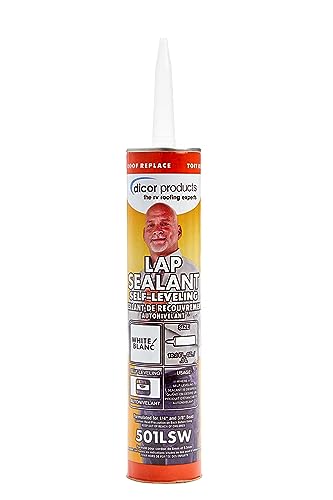 Dicor Self-Leveling Lap Sealant, White (501LSW-1, 10.3 oz)The tube to own before you need it. One of these in a storage bay is the cheapest insurance on the trailer, and it is what the roof was sealed with in the first place. | Every horizontal seam on a rubber roof | Strong | |
| 2 | 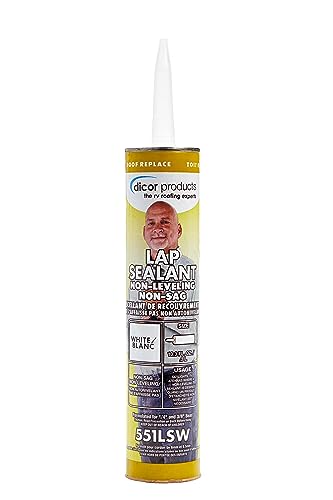 Dicor Non-Leveling Lap Sealant, White (551LSW-1, non-sag, 10.3 oz)Buy it with the self-leveling tube, not instead of it. Horizontal gets 501, vertical gets 551, and knowing which is which is most of this category. | Vertical seams, roof edges and screw heads | Good | |
| 3 | 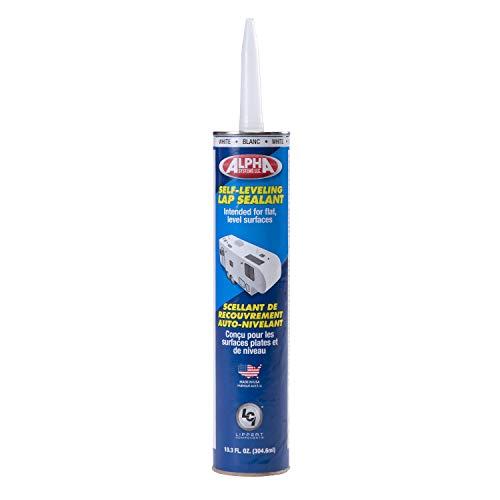 Alpha Systems 1021 Low VOC Self-Leveling Lap Sealant (10.3 oz)The right tube if your roof came from Alpha Systems and you want to match it exactly. Otherwise the Dicor 501 does the same work for less. | Matching a trailer that was not sealed with Dicor | Strong | |
| 4 | 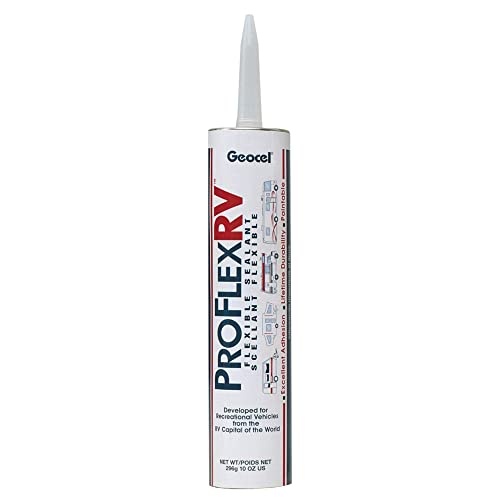 Geocel Pro Flex RV Flexible Sealant, Clear (10 oz)The sidewall and window tube, bought alongside the roof sealant and never used instead of it. Read the EPDM and TPO warning before it goes anywhere near the roof. | Windows, trim and bodywork - not the roof | Good |
Prices come from Amazon and were last checked November 27, 2026. They change constantly, so a price older than 48 hours is withdrawn rather than shown stale — those rows read “Check price on Amazon” instead and go straight to the current listing. #ad — these are affiliate links.
Why $25, and why the cap costs you nothing
We normally have to apologize for a price cap. A budget ceiling in most categories means giving something up: a cheaper surge protector drops from an electrical management system to a surge suppressor, a cheaper backup camera drops a screen. So it is worth stating plainly what makes this category different.
Every cartridge sealant made for an RV roof is a sub-$25 product. Not the budget ones — all of them. A 10.3 oz tube of the sealant the factory used is in the ten-to-twenty-dollar range, and there is no premium tier of roof sealant sitting above it waiting to perform better. The $25 cap on this page excludes precisely two things from our registry, and neither is a sealant:
Roof tape, at roughly double the cap. A tape is a mechanical repair: you clean, you roll it down, and it bridges a split or a tear rather than filling a joint. It is excellent at that and it cannot do what a flowing bead does around a vent flange.
Whole-roof coating, at roughly three times the cap. A gallon of coating refreshes an entire tired membrane. It is sold by the gallon because it covers a roof, not a seam, and using it on a leak is a documented way to turn a small repair into a large one — which is why we built a separate page about it.
So: if the job in front of you is a seam, a vent flange, a screw head or a lap joint, the cap is irrelevant and you are shopping the whole category. If the job is a torn membrane or a whole roof past its life, the cap is the wrong filter and you should ignore this page.
How we choose
We have not weathered a sealant for five years and we are not going to claim a durability ranking we did not earn. Inside a price band, these are the four things that decide the order:
Published membrane compatibility, first and above all. A sealant that the maker says not to use on your roof is not a cheaper option; it is the wrong product. This criterion alone moves one of the four tubes here from a recommendation to a warning.
Self-leveling or non-sag, matched to the surface. Self-leveling sealant flows out flat, which is what you want on a horizontal lap joint and exactly what you do not want on a vertical edge, where it will run and leave you a streak down the side of the trailer. Dicor specifies 501LSW for horizontal surfaces and lists 551LSW for roof edges, vents and screw heads.
Published cure behavior. Dicor publishes real figures for 501LSW at 50-70 F: skins over in 5 minutes, waterproof in 4 hours, 80 percent cured in 48 hours and fully cured in 30 days. Those numbers decide whether you can seal a roof the afternoon before rain, which is the question people actually have.
Whether it matches what is already up there. Sealant goes on top of old sealant. Matching the family your roof was built with is worth more than a marginal spec difference, which is the entire case for the Alpha Systems tube below.
The picks, all under $25
1. Best for Every horizontal seam on a rubber roof
Dicor Self-Leveling Lap Sealant, White (501LSW-1, 10.3 oz)
The tube to own before you need it. One of these in a storage bay is the cheapest insurance on the trailer, and it is what the roof was sealed with in the first place.
- Specification
- Dicor publishes compatibility with EPDM, TPO and PVC membranes
- Specification
- Dicor also lists adhesion to aluminum, wood, vinyl, galvanized metal, fiberglass, concrete and mortar
- Specification
- Self-leveling, which Dicor specifies for horizontal surfaces
- Specification
- Dicor's cure times at 50-70 F: skins over in 5 minutes, waterproof in 4 hours, 80 percent cured in 48 hours, fully cured in 30 days
- Specification
- HAPS-free formula, 10.3 oz tube
What it does well
- Self-leveling does the hard part for you: squeeze a bead around a vent flange and it flows out flat and seals the edge without tooling, which is the difference between a tidy repair and a smeared one
- It is the sealant most trailers left the factory with, so you are matching the existing chemistry rather than gambling that two products get along
- Waterproof in about four hours on Dicor's figures, so a Saturday morning repair survives a Saturday afternoon storm
The real tradeoff
- Horizontal only. On a vertical surface - a sidewall seam, a window frame, the front cap - it will run and leave you with a drip mark and a thin spot, which is what the non-sag version exists for
- It is not a structural fix. Sealant over a seam that has opened up because a screw has pulled out of soft wood will fail again, and so will sealant over a crack in a skylight
- White stays white but a weathered roof does not, so a fresh bead on an eight-year-old roof looks exactly like a fresh bead on an eight-year-old roof
How it measures up
These are judgments from published specifications and what we see at the lodge, not laboratory results. How we choose.
- Beginner fit
- Strong — Self-leveling means no tooling skill needed.
- Published compatibility
- Strong — EPDM, TPO and PVC, stated by Dicor.
- Where it works
- Adequate — Horizontal surfaces only.
- Value
- Strong — The least money for the most used repair.
Specifications from Dicor.
2. Best for Vertical seams, roof edges and screw heads
Dicor Non-Leveling Lap Sealant, White (551LSW-1, non-sag, 10.3 oz)
Buy it with the self-leveling tube, not instead of it. Horizontal gets 501, vertical gets 551, and knowing which is which is most of this category.
- Specification
- Non-leveling, so it stays where you put it on a vertical surface
- Specification
- Dicor lists it as a secondary seal for roof edges, vents and screw heads
- Specification
- HAPS-free formula, 10.3 oz tube
What it does well
- The other half of the pair, and the one people do not buy until they have watched self-leveling sealant run down a sidewall and dry in a streak
- Stays put on an edge, which makes it the right product for the roof-to-sidewall joint, the front cap seam, a window frame and anywhere a screw head sits on something that is not flat
- Same family and same chemistry as the self-leveling tube, so the two are designed to live next to each other on the same roof
The real tradeoff
- You have to tool it. It will not flow out flat on its own, so a neat job takes a gloved finger, a plastic spreader and a little patience
- Costs more than the self-leveling version for less convenience, which is why it feels like the wrong tube to buy first. It is the second tube, not the first
- Also not a structural fix. Sealant does not hold a loose part on
How it measures up
These are judgments from published specifications and what we see at the lodge, not laboratory results. How we choose.
- Beginner fit
- Good — Needs tooling, which is a learnable skill.
- Published compatibility
- Strong — Same Dicor lap sealant family.
- Where it works
- Strong — Vertical and detail work the 501 cannot do.
- Value
- Good — Cheap, but the second tube you need.
Specifications from Dicor.
3. Best for Matching a trailer that was not sealed with Dicor
Alpha Systems 1021 Low VOC Self-Leveling Lap Sealant (10.3 oz)
The right tube if your roof came from Alpha Systems and you want to match it exactly. Otherwise the Dicor 501 does the same work for less.
- Specification
- Self-leveling, 10.3 oz tube, part number N102101TLCI
- Specification
- Listing states a 1/4 in bead covers 30 ft
- Specification
- Low VOC formula
- Specification
- Sold for RV roofs, vents, antennas and skylights
What it does well
- Alpha Systems supplies roofing membrane to a large share of the RV industry, so on a lot of trailers this is the sealant that matches what is already up there rather than the one that merely gets along with it
- A published coverage figure - a 1/4 in bead for 30 ft - which is rare in this category and genuinely useful when you are working out how many tubes a roof needs
- Low VOC matters when you are working on a roof with your face about two feet from the bead for an hour
The real tradeoff
- Costs about twice the equivalent Dicor tube for a product that does the same job, and on a trailer already sealed with Dicor there is no reason to pay it
- Harder to find in a store, so it is more likely to be a planned order than a Saturday-morning fix
- Self-leveling, so like the Dicor 501 it is for horizontal surfaces only
How it measures up
These are judgments from published specifications and what we see at the lodge, not laboratory results. How we choose.
- Beginner fit
- Strong — Self-leveling, same technique as the 501.
- Published compatibility
- Good — Sold for RV roofs; coverage figure stated.
- Where it works
- Adequate — Horizontal surfaces only.
- Value
- Adequate — A premium over Dicor for a matching brand.
Specifications from Alpha Systems.
4. Best for Windows, trim and bodywork - not the roof
Geocel Pro Flex RV Flexible Sealant, Clear (10 oz)
The sidewall and window tube, bought alongside the roof sealant and never used instead of it. Read the EPDM and TPO warning before it goes anywhere near the roof.
- Specification
- Geocel states excellent adhesion to many surfaces even when damp, slightly oily or frozen
- Specification
- Paintable and UV resistant, per Geocel
- Specification
- Geocel lists aluminum, glass, coated steel (Kynar 500 finishes), steel, wood, fiberglass and vinyl
- Specification
- Geocel's own warning: do not use on extruded polystyrene insulation sheathing, TPO, or EPDM
- Specification
- Clear, 10 oz cartridge, Geocel part number 28128
What it does well
- It sticks to a damp surface, which no other sealant here claims. For the leak you found in the rain, on the day you found it, that is the product
- Clear and paintable, so it is the right choice around a window frame, a marker light or a trim strip where a white bead would be the thing you notice about your trailer
- The cartridge behaves well in a standard caulk gun and tools cleanly, which matters for the detail work it is for
The real tradeoff
- Do NOT put it on a rubber roof. Geocel publishes a direct warning against TPO and EPDM, which is the membrane on most travel trailer roofs, and this is the single most expensive mistake available in this category
- Geocel also warns against acrylic skylight glazing and traffic-bearing surfaces, which rules out two more places people reach for a clear tube
- Clear means you cannot see coverage as easily as with white, so a thin spot is harder to spot before it is a leak
How it measures up
These are judgments from published specifications and what we see at the lodge, not laboratory results. How we choose.
- Beginner fit
- Good — Easy to use; easy to use in the wrong place.
- Published compatibility
- Adequate — Explicitly NOT for TPO or EPDM.
- Where it works
- Good — Windows, trim, metal and fiberglass.
- Value
- Good — Cheap, and it does something nothing else here does.
Specifications from Geocel.
What each tube is for, as the maker publishes it
| Tube | Flows or stays | Published for | Use it on |
|---|---|---|---|
| Dicor 501LSW, white | Self-leveling | EPDM, TPO and PVC (Dicor) | Horizontal roof seams, vent flanges, lap joints |
| Dicor 551LSW, white | Non-sag | Roof edges, vents and screw heads (Dicor) | Anything vertical or sloped |
| Alpha Systems 1021 | Self-leveling | RV roofs, vents, antennas, skylights (listing) | Horizontal seams on an Alpha Systems roof |
| Geocel Pro Flex, clear | Non-sag | NOT for TPO or EPDM (Geocel's own warning) | Windows, trim, metal, fiberglass - never a rubber roof |
What to actually buy, and how many tubes
If you are buying one tube: Dicor 501LSW, white. It is the cheapest product on this page and the top pick, which almost never happens and is worth saying out loud. It is published for all three membrane types, it is what most roofs were sealed with originally, and a tube in a storage bay before you need it is the cheapest insurance on the trailer.
If you are buying two: add the 551LSW non-sag. The two tubes are not alternatives and buying one instead of the other is the most common error in this category. Horizontal gets the self-leveling tube; vertical gets the non-sag. Both together still come to well under $30, which tells you something about how little the correct answer costs here.
If your roof is an Alpha Systems roof: the 1021 tube, to match. Its listing states that a 1/4 in bead covers 30 ft, which is the only published coverage figure among these cartridges and a useful one for estimating a whole-roof reseal. If your roof is not Alpha Systems, the Dicor does the same work for less.
For your windows and trim: the Geocel, bought alongside the roof tube and never used instead of it. It is the one product here that sticks to a damp surface, which makes it the tube for the leak you found in the rain — on the sidewall. Not on the roof.
How many tubes for a full reseal? More than you think. Resealing every seam, vent, skylight and antenna base on a travel trailer is a multi-tube job, and running out halfway up a roof with a half-done bead and weather coming is miserable. The saved money in this category does not belong in a pricier sealant, because there is not one — it belongs in a second and third tube, and in a decent caulk gun that does not dribble.
The cheap tube that is not on this list
There is something cheaper than every product here, it is on the shelf of every hardware store, and it is the reason some roofs need a coating years before they should: household silicone caulk.
It is worth being specific about why it fails rather than just telling you not to use it. Silicone does not bond reliably to a rubber membrane, it is not formulated for the constant flex a roof takes on the road, and it sheds dirt poorly so the bead goes gray and hard. The worse problem is what it does to the next repair: almost nothing sticks to cured silicone, including the lap sealant you should have used, so you cannot simply seal over it. You have to get it off first, off a membrane you must not gouge, which is a genuinely unpleasant afternoon. A ten-dollar tube of the correct sealant is cheaper than that afternoon by any measure.
The same logic rules out roofing tar, driveway sealer and general-purpose exterior caulk. Everything in this category is cheap enough that there is no money to be saved by substituting, which is the most useful thing about a price band this low.
Applying it so the cheap tube lasts
A sealant this inexpensive lives or dies on preparation, and this is where the money you did not spend on a premium product actually gets repaid.
Clean first, and more than you think. New sealant bonds to what it touches. If that is a film of road grime and chalked membrane, the bead is sitting on dirt and will lift at the edges within a season. Scrub the area, let it dry fully, and wipe it with a solvent the membrane maker allows — not whatever is under the sink, because the wrong solvent attacks EPDM.
Remove what is loose, keep what is sound. You do not have to strip old sealant to bare metal. Pull off anything cracked, lifting or crumbling, and leave the well-bonded old bead in place: fresh lap sealant goes over cured lap sealant happily. Chasing a sound bead off the roof with a scraper risks the membrane and buys nothing.
Bead generously, then leave it alone. With the self-leveling tube the temptation is to tool the bead smooth like bathroom caulk. Do not — it is designed to flow out on its own, and working it only thins the middle. Lay a full bead over the joint and walk away. The non-sag tube is the opposite: it stays where you put it, so put it where you want it.
Watch the weather against the published cure. Dicor publishes 501LSW as waterproof in 4 hours at 50-70 F. That is your planning number: four dry hours, in reasonable temperatures, before rain. Cold or damp conditions stretch all of it, and sealing ahead of a storm because you noticed a crack is how a repair ends up needing to be done twice.
Where this sits in a first season
Roof sealant is not a first-trip purchase and nothing here will stop you camping this weekend. It belongs on the list of things a new trailer owner should own before needing them, alongside the gear in first-time RV owner tips and the outdoor items in RV accessories for outside. Water getting into a roof seam is the one failure mode that quietly destroys a trailer rather than inconveniencing you, and it is the cheapest one to prevent.
The habit worth building is seasonal rather than reactive: walk the roof twice a year if it is rated to be walked on, look at every seam and every screw head, and put a bead on anything cracked or pulling away before it leaks rather than after. If you are storing the trailer for winter, do it as part of winterizing for storage — that is the moment the roof gets a long look anyway, and a $10 tube is the cheapest item in the whole routine.
Questions people actually ask
Is a cheap RV roof sealant worse than an expensive one?
In this category the question barely applies, because there is no expensive tier. Every cartridge sealant made for an RV roof costs under $25, including the Dicor product most roofs were sealed with at the factory. What costs more is not better sealant but different products: roof tape at roughly double, and whole-roof coating at roughly three times, both of which do jobs a bead of sealant cannot. Price is not the variable to optimize here - published membrane compatibility is.
What is the best RV roof sealant under $25?
Dicor 501LSW self-leveling lap sealant, which is also the cheapest product in the band. Dicor publishes compatibility with EPDM, TPO and PVC membranes, it is what the majority of travel trailer roofs were sealed with originally, and it is self-leveling, which is what you want on a horizontal seam. Add the 551LSW non-sag tube for vertical surfaces, because self-leveling sealant runs when it is not on the flat.
What is the difference between self-leveling and non-sag roof sealant?
Whether it flows. Self-leveling sealant spreads out flat after you apply it, which seals a horizontal lap joint or a vent flange neatly, and runs down a vertical surface leaving a streak. Non-sag stays where you put it, which is what you need on a roof edge, a sidewall or around screw heads. Dicor specifies 501LSW for horizontal surfaces and lists 551LSW for roof edges, vents and screw heads. Buying one instead of the other is the most common mistake in this category.
Can I use Geocel Pro Flex on my RV roof if it is the cheapest option?
No, not if your roof is TPO or EPDM, which covers most travel trailers - and its price is irrelevant to that. Geocel's own product warning says not to use it on extruded polystyrene insulation sheathing, TPO or EPDM. It is a very good sealant for windows, trim, metal and fiberglass, and it is the only one here whose maker claims adhesion to a damp surface. It just belongs on the sides of the trailer, never on a rubber roof.
How long does RV roof sealant take to dry?
Dicor publishes figures for 501LSW at 50 to 70 F: it skins over in about 5 minutes, is waterproof in 4 hours, reaches 80 percent cure in 48 hours and is fully cured in 30 days. The practical reading is that you can seal a roof the afternoon before rain as long as you have four hours of dry weather, but you should not expect the bead to be at full strength for weeks. Cold or damp conditions slow all of it down.
How many tubes of sealant do I need to reseal an RV roof?
More than one, and probably more than two for a full reseal of every seam, vent, skylight and antenna base on a travel trailer. The Alpha Systems listing is the only one here that publishes a coverage figure - a 1/4 inch bead covering 30 feet - which gives you something to estimate from. Since no sealant in this category costs much, buy a spare: running out mid-roof with weather coming is far more expensive than an extra tube.
Do I need roof tape or coating instead of sealant?
It depends on what has failed, and the two are not upgrades of sealant. If a seam, vent flange or screw head is cracked or pulling away, you want a bead of sealant and nothing more. If the membrane itself is split or torn, a mechanical tape repair bridges it in a way sealant cannot. If the whole roof is chalky and tired but not leaking, a whole-roof coating refreshes it - and coating over an actual leak rather than repairing it first is the most expensive mistake in RV roof care.
Sources
Read next
First-Season Starter Kit
Best RV Roof Sealant for a Travel Trailer
RV roof and seam sealant explained by what it goes on: self-leveling, non-sag, tape, and the clear tube to keep off a rubber roof.
First-Season Starter Kit
Best RV Roof Coating for a Travel Trailer
Whole-roof coating versus seam sealant versus tape: what each one fixes, with published coverage figures.
First-Season Starter Kit
RV Accessories for Outside Your Camper
The five outside items a first trip actually needs, sequenced by the order you use them at the site.
First-Season Starter Kit
How to Winterize a Travel Trailer for Storage
The winter storage routine in order, from draining the water system to the moisture and tire protection that prevents a spring surprise.
Reviewed November 24, 2026. Spot something out of date? Tell us and we will fix it.