Dicor Lap Sealant Alternatives
Dicor is the default for a reason. But if it is out of stock, if your roof was not sealed with it, or if the seam you are looking at is vertical, these are the four honest alternatives.
Heads up: this page contains affiliate links. If you buy through one, Camp & Chock may earn a commission at no extra cost to you. It never changes which product we put first — how this site is funded.

The short answer
The closest like-for-like alternative is Alpha Systems 1021 low-VOC self-levelling lap sealant: the same product category, the same application, and the sealant to use if your trailer was built by a manufacturer that used Alpha Systems rather than Dicor. If the seam has an actual gap in it, EternaBond RoofSeal tape is a better answer than any sealant — it bridges rather than fills, with no cure time. For a vertical seam, a self-levelling product is the wrong tool entirely: use a non-sag sealant, and Dicor’s own 551LSW is the obvious one. The budget pick is Geocel Pro Flex, which is cheaper than any of them — with the clear caveat that it is for windows, trim and bodywork rather than the roof membrane.
Part of our first-season starter kit guide. The full ranking, Dicor included, is best RV roof sealant; if what you actually want is a whole-roof refresh rather than a seam repair, that is best RV roof coating.
Our picks at a glance
Tap any row to jump to the full write-up.
| # | Product | Best for | Beginner fit | Price |
|---|---|---|---|---|
| 1 | 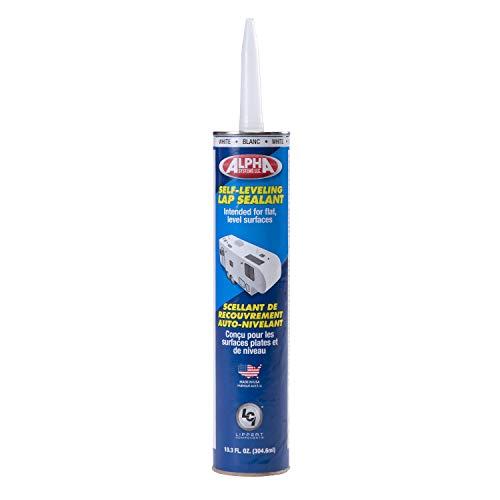 Alpha Systems 1021 Low VOC Self-Leveling Lap Sealant (10.3 oz)The right tube if your roof came from Alpha Systems and you want to match it exactly. Otherwise the Dicor 501 does the same work for less. | Matching a trailer that was not sealed with Dicor | Strong | |
| 2 | 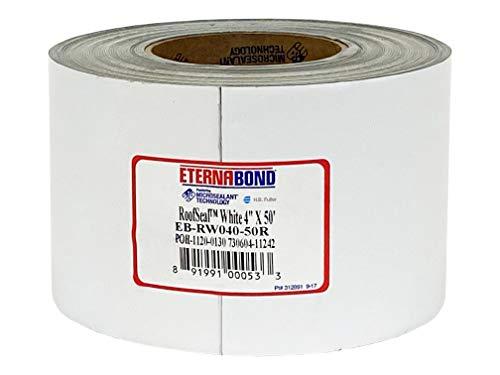 EternaBond RoofSeal White Repair Tape (4 in x 50 ft)The repair for an open seam or a tear, rather than for routine maintenance. Keep the roll flat and warm, and only unroll it when the surface is clean and dry. | A seam or a tear that sealant alone will not hold | Good | |
| 3 | 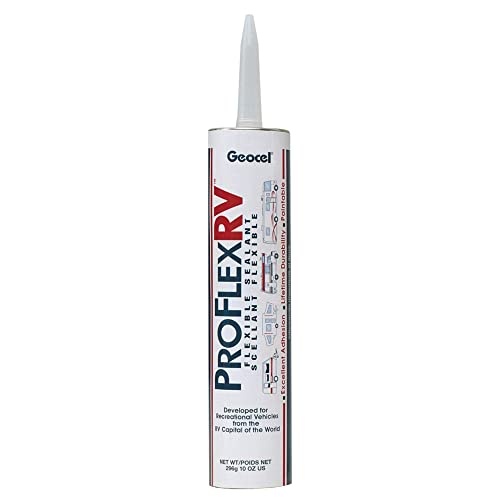 Geocel Pro Flex RV Flexible Sealant, Clear (10 oz)The sidewall and window tube, bought alongside the roof sealant and never used instead of it. Read the EPDM and TPO warning before it goes anywhere near the roof. | Windows, trim and bodywork - not the roof | Good | |
| 4 | 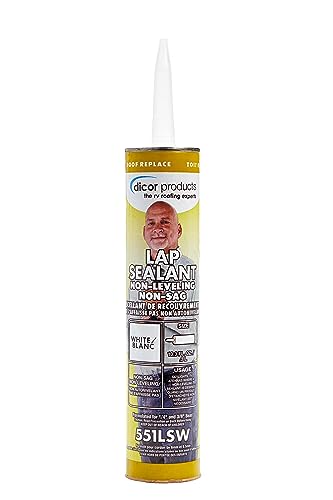 Dicor Non-Leveling Lap Sealant, White (551LSW-1, non-sag, 10.3 oz)Buy it with the self-leveling tube, not instead of it. Horizontal gets 501, vertical gets 551, and knowing which is which is most of this category. | Vertical seams, roof edges and screw heads | Good | |
| 5 | 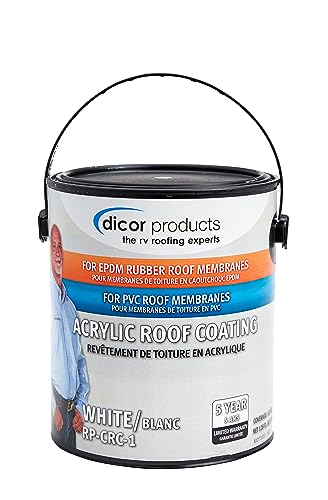 Dicor RP-CRC-1 EPDM Rubber Roof Acrylic Coating, White (1 gal)The whole-roof option, listed here so you can rule it out. A first-season owner with a leak wants a tube or a roll of tape, not two coats of this. | Re-coating a tired but sound roof, not fixing a leak | Adequate |
Prices come from Amazon and were last checked November 27, 2026. They change constantly, so a price older than 48 hours is withdrawn rather than shown stale — those rows read “Check price on Amazon” instead and go straight to the current listing. #ad — these are affiliate links.
What Dicor is known for, so you know what to match
It is the self-levelling lap sealant most RV roofs were sealed with. Dicor 501LSW is the industry default for horizontal seams on an EPDM rubber roof: it flows out flat rather than holding a bead, so it self-seals around vent flanges and screw heads without tooling. Dicor publishes it for EPDM and TPO roofs. If you walk into any RV dealer and ask for roof sealant, this is what you are handed.
It is widely stocked and widely documented. Part numbers are stable, the colour range matches common roof trims, and there is a published non-sag companion product (551LSW) for the vertical surfaces where a self-levelling sealant would run.
So an alternative has to match one of three things: the self-levelling chemistry, the compatibility with your particular membrane, or the price. We are not going to tell you Dicor is a bad product — it is the benchmark, and the reason people search for alternatives is almost always availability, a different factory sealant, or the wrong seam orientation.
The four alternatives, and when each one is right
Alpha Systems 1021, for a trailer not sealed with Dicor. A low-VOC self-levelling lap sealant doing the same job in the same way. Several RV manufacturers use Alpha Systems products from the factory, and matching what is already on the roof is better practice than layering two chemistries. This is the like-for-like swap.
EternaBond RoofSeal tape, for a gap rather than a joint. Sealant fills and bonds; tape spans. If the seam has lifted, if there is a tear, or if you are standing on a campground roof in the rain with water getting in, the tape is the better product and it does not need a dry cure window. Many owners use both: tape across the breach, sealant over its edges.
Dicor 551LSW non-sag, for anything vertical. Worth saying plainly because it is the most common error in this category: a self-levelling sealant on a vertical surface runs down the side of the trailer. The non-sag version is the same job with the opposite rheology. We have kept it on an alternatives page deliberately, because for a reader whose seam is vertical the honest alternative to self-levelling Dicor is non-sag Dicor.
Geocel Pro Flex, for windows, trim and bodywork. Cheaper than everything above, and not a roof membrane product. If what is leaking is a window frame, a marker light or a trim strip on the side of the trailer, this is the right tube and the self-levelling roof sealant is the wrong one.
How we chose
Published compatibility. The only specification that decides a roof repair. Products that state which membranes they are for rank above products that do not.
Matches a stated strength of the original, or a lower price. Alpha Systems matches the chemistry. EternaBond matches on a job Dicor cannot do. 551LSW matches on orientation. Geocel matches on price with its scope clearly limited. We are not claiming any of them is better than Dicor overall.
Availability, honestly. Part of why anyone reads this page is that the shelf was empty. All four of these are commonly stocked.
No disparagement, and no invented testing. The facts stated about Dicor above are what Dicor publishes about its own products. We have not compared adhesion, longevity or UV resistance between any two of these, because we did not measure them.
We do not test products and say so on how we choose.
The picks
1. Best for Matching a trailer that was not sealed with Dicor
Alpha Systems 1021 Low VOC Self-Leveling Lap Sealant (10.3 oz)
The right tube if your roof came from Alpha Systems and you want to match it exactly. Otherwise the Dicor 501 does the same work for less.
- Specification
- Self-leveling, 10.3 oz tube, part number N102101TLCI
- Specification
- Listing states a 1/4 in bead covers 30 ft
- Specification
- Low VOC formula
- Specification
- Sold for RV roofs, vents, antennas and skylights
What it does well
- Alpha Systems supplies roofing membrane to a large share of the RV industry, so on a lot of trailers this is the sealant that matches what is already up there rather than the one that merely gets along with it
- A published coverage figure - a 1/4 in bead for 30 ft - which is rare in this category and genuinely useful when you are working out how many tubes a roof needs
- Low VOC matters when you are working on a roof with your face about two feet from the bead for an hour
The real tradeoff
- Costs about twice the equivalent Dicor tube for a product that does the same job, and on a trailer already sealed with Dicor there is no reason to pay it
- Harder to find in a store, so it is more likely to be a planned order than a Saturday-morning fix
- Self-leveling, so like the Dicor 501 it is for horizontal surfaces only
How it measures up
These are judgments from published specifications and what we see at the lodge, not laboratory results. How we choose.
- Beginner fit
- Strong — Self-leveling, same technique as the 501.
- Published compatibility
- Good — Sold for RV roofs; coverage figure stated.
- Where it works
- Adequate — Horizontal surfaces only.
- Value
- Adequate — A premium over Dicor for a matching brand.
Specifications from Alpha Systems.
2. Best for A seam or a tear that sealant alone will not hold
EternaBond RoofSeal White Repair Tape (4 in x 50 ft)
The repair for an open seam or a tear, rather than for routine maintenance. Keep the roll flat and warm, and only unroll it when the surface is clean and dry.
- Specification
- 35 mil total thickness, part number EB-RW040-50R
- Specification
- 4 in wide by 50 ft long
- Specification
- H.B. Fuller's data sheet gives an application temperature of about 4-65 C (roughly 40-150 F) and recommends EternaPrime primer below that
- Specification
- Surfaces must be clean and dry before application
What it does well
- A single-step repair that bridges an actual gap. Where sealant fills a joint, this covers a seam or a tear with a continuous waterproof membrane that is not relying on the crack staying the same size
- Once it is down and rolled, it is down. This is the product people use for the repair they do not want to think about again, and it is the standard answer on a torn roof seam
- One 50 ft roll covers every seam on a typical travel trailer with plenty spare, which is the point: you buy it once and it sits in the bay for the next repair
The real tradeoff
- Unforgiving. It bonds on contact, so a crooked first inch is a crooked repair, and getting it off again takes effort and usually leaves residue
- It needs clean, dry and warm. On the manufacturer's data sheet that means roughly 40 F and up, with a primer below that - so a December roof leak is a tarp-and-wait situation, not a tape situation
- It does not look like a factory roof. This is a visible white stripe across the roof, which nobody sees and which some owners mind anyway. A 25 ft roll of the same tape also exists for less money if one repair is all you need
How it measures up
These are judgments from published specifications and what we see at the lodge, not laboratory results. How we choose.
- Beginner fit
- Good — Simple, but there is no second attempt.
- Published data
- Good — 35 mil, with a stated application range.
- Where it works
- Strong — Bridges gaps that sealant cannot fill.
- Value
- Good — More per repair than a tube, far less than a roof.
Specifications from EternaBond (H.B. Fuller).
3. Best for Windows, trim and bodywork - not the roof
Geocel Pro Flex RV Flexible Sealant, Clear (10 oz)
The sidewall and window tube, bought alongside the roof sealant and never used instead of it. Read the EPDM and TPO warning before it goes anywhere near the roof.
- Specification
- Geocel states excellent adhesion to many surfaces even when damp, slightly oily or frozen
- Specification
- Paintable and UV resistant, per Geocel
- Specification
- Geocel lists aluminum, glass, coated steel (Kynar 500 finishes), steel, wood, fiberglass and vinyl
- Specification
- Geocel's own warning: do not use on extruded polystyrene insulation sheathing, TPO, or EPDM
- Specification
- Clear, 10 oz cartridge, Geocel part number 28128
What it does well
- It sticks to a damp surface, which no other sealant here claims. For the leak you found in the rain, on the day you found it, that is the product
- Clear and paintable, so it is the right choice around a window frame, a marker light or a trim strip where a white bead would be the thing you notice about your trailer
- The cartridge behaves well in a standard caulk gun and tools cleanly, which matters for the detail work it is for
The real tradeoff
- Do NOT put it on a rubber roof. Geocel publishes a direct warning against TPO and EPDM, which is the membrane on most travel trailer roofs, and this is the single most expensive mistake available in this category
- Geocel also warns against acrylic skylight glazing and traffic-bearing surfaces, which rules out two more places people reach for a clear tube
- Clear means you cannot see coverage as easily as with white, so a thin spot is harder to spot before it is a leak
How it measures up
These are judgments from published specifications and what we see at the lodge, not laboratory results. How we choose.
- Beginner fit
- Good — Easy to use; easy to use in the wrong place.
- Published compatibility
- Adequate — Explicitly NOT for TPO or EPDM.
- Where it works
- Good — Windows, trim, metal and fiberglass.
- Value
- Good — Cheap, and it does something nothing else here does.
Specifications from Geocel.
4. Best for Vertical seams, roof edges and screw heads
Dicor Non-Leveling Lap Sealant, White (551LSW-1, non-sag, 10.3 oz)
Buy it with the self-leveling tube, not instead of it. Horizontal gets 501, vertical gets 551, and knowing which is which is most of this category.
- Specification
- Non-leveling, so it stays where you put it on a vertical surface
- Specification
- Dicor lists it as a secondary seal for roof edges, vents and screw heads
- Specification
- HAPS-free formula, 10.3 oz tube
What it does well
- The other half of the pair, and the one people do not buy until they have watched self-leveling sealant run down a sidewall and dry in a streak
- Stays put on an edge, which makes it the right product for the roof-to-sidewall joint, the front cap seam, a window frame and anywhere a screw head sits on something that is not flat
- Same family and same chemistry as the self-leveling tube, so the two are designed to live next to each other on the same roof
The real tradeoff
- You have to tool it. It will not flow out flat on its own, so a neat job takes a gloved finger, a plastic spreader and a little patience
- Costs more than the self-leveling version for less convenience, which is why it feels like the wrong tube to buy first. It is the second tube, not the first
- Also not a structural fix. Sealant does not hold a loose part on
How it measures up
These are judgments from published specifications and what we see at the lodge, not laboratory results. How we choose.
- Beginner fit
- Good — Needs tooling, which is a learnable skill.
- Published compatibility
- Strong — Same Dicor lap sealant family.
- Where it works
- Strong — Vertical and detail work the 501 cannot do.
- Value
- Good — Cheap, but the second tube you need.
Specifications from Dicor.
5. Best for Re-coating a tired but sound roof, not fixing a leak
Dicor RP-CRC-1 EPDM Rubber Roof Acrylic Coating, White (1 gal)
The whole-roof option, listed here so you can rule it out. A first-season owner with a leak wants a tube or a roll of tape, not two coats of this.
- Specification
- Listing states coverage of 125 sq ft per gallon per coat
- Specification
- Part 2 of Dicor's two-part rubber roof coating system
- Specification
- Part 1 is the separate RP-CRP-Q cleaner and activator, sold on its own
- Specification
- Sold for EPDM and PVC roofs; two coats is the normal application
What it does well
- The right product for a roof whose membrane has gone chalky and thin all over but has no actual breach - it restores a protective, reflective layer instead of patching a hole that is not there
- A white reflective coat measurably changes how hot a trailer gets in summer, which is a comfort and an air conditioning cost, not just a maintenance item
- A proper system with published coverage, which lets you buy the right number of gallons rather than guessing
The real tradeoff
- Part 2 only. The cleaner and activator is a separate purchase and the coating is not designed to go on without it, so the real cost and the real time are both higher than the gallon price suggests
- It is not a leak fix, and using it as one hides the problem under a fresh white layer. Find the breach, seal it with lap sealant or tape, and only then consider coating
- At 125 sq ft per gallon per coat and two coats, a typical travel trailer roof is several gallons and most of a weekend. This is a project, not a repair
How it measures up
These are judgments from published specifications and what we see at the lodge, not laboratory results. How we choose.
- Beginner fit
- Adequate — A multi-step, two-product, whole-weekend job.
- Published compatibility
- Good — Sold for EPDM and PVC; coverage stated.
- Where it works
- Adequate — Sound but weathered roofs only.
- Value
- Adequate — Cheap per square foot, expensive per weekend.
Specifications from Dicor.
Matching the alternative to the job
| If the job is... | The alternative | Matches Dicor on | Not for |
|---|---|---|---|
| A horizontal roof seam, non-Dicor roof | Alpha Systems 1021 | Self-levelling chemistry, low VOC | Vertical surfaces |
| A tear or a lifted seam with a gap | EternaBond RoofSeal tape | A job sealant cannot do - bridging | Sealing around a complex vent flange |
| A window, marker light or trim seam | Geocel Pro Flex | A substantially lower price | The roof membrane itself |
| A vertical seam or a roof edge | Dicor 551LSW non-sag | Same maker, opposite rheology | Horizontal seams, where it holds a bead |
| A whole roof that has gone chalky | Dicor EPDM acrylic coating | Nothing - it is a different product class | Any active leak |
The practical answer
One self-levelling sealant matched to your membrane, one roll of tape for anything with a gap, and one tube of non-sag for the vertical seams. Those three cover every roof repair a first-season owner will meet.
Best for Matching a trailer that was not sealed with Dicor
Alpha Systems 1021 Low VOC Self-Leveling Lap Sealant (10.3 oz)
The right tube if your roof came from Alpha Systems and you want to match it exactly. Otherwise the Dicor 501 does the same work for less.
Best for A seam or a tear that sealant alone will not hold
EternaBond RoofSeal White Repair Tape (4 in x 50 ft)
The repair for an open seam or a tear, rather than for routine maintenance. Keep the roll flat and warm, and only unroll it when the surface is clean and dry.
Best for Vertical seams, roof edges and screw heads
Dicor Non-Leveling Lap Sealant, White (551LSW-1, non-sag, 10.3 oz)
Buy it with the self-leveling tube, not instead of it. Horizontal gets 501, vertical gets 551, and knowing which is which is most of this category.
Applying any of these properly
Clean first, and clean properly. An ageing EPDM roof has a chalky sacrificial surface, and that surface is exactly what sealant cannot bond to. Scrub it back to the membrane in the area you are sealing.
Remove what is loose, keep what is sound. You are not stripping the old sealant off the whole roof. Pick away what has cracked or lifted and leave the rest.
Self-levelling goes on horizontals only. Said three times on this page on purpose.
Mind the temperature and the forecast. Sealants have a cure window and a minimum application temperature. Tape does not, which is why it is the emergency product.
Check whether your roof is walkable. Not all travel trailer roofs are. Your manual says; guessing does not.
Mistakes when switching products
Layering an unknown chemistry over an existing sealant. Match what is there where you can. Where you cannot, remove the old material in the repair area rather than covering it.
Using household silicone because it was in the cupboard. It will not bond reliably to EPDM, nothing will bond over it afterwards, and removing it is worse than the original repair.
Using a sidewall sealant on the roof membrane. The Geocel on this page is a genuinely useful product in the wrong place.
Sealing over a leak you have not found. Water tracks. The wet spot inside is often nowhere near the breach outside, and the full inspection routine is on the roof sealant roundup.
Questions people actually ask
What can I use instead of Dicor lap sealant?
Alpha Systems 1021 low-VOC self-levelling lap sealant is the closest like-for-like alternative - the same product category applied the same way, and the right choice if your trailer was sealed at the factory with Alpha Systems rather than Dicor. For a seam with an actual gap in it, EternaBond RoofSeal tape is a better answer than any sealant because it bridges rather than fills. For vertical seams you want a non-sag product rather than a self-levelling one.
Is Dicor the only self-levelling RV roof sealant?
No. Dicor 501LSW is the industry default and the one most RV dealers hand you, but Alpha Systems makes a low-VOC self-levelling lap sealant that does the same job, and several RV manufacturers use it from the factory. The decision should be driven by what membrane your roof is and what it was originally sealed with, rather than by brand preference.
Can I use EternaBond tape instead of lap sealant?
For some jobs it is better. Tape spans a gap - a tear, a lifted seam - without a cure time and it will go on in the rain, which is why it is the product to have on board for a roof problem found at a campground. Sealant is better around complex shapes like vent flanges and screw heads, where a flowing self-levelling product seals into places tape cannot follow. Many owners use both: tape across the breach, sealant over its edges.
What is the difference between self-levelling and non-sag lap sealant?
Rheology - how the material behaves after it leaves the tube. Self-levelling flows out flat, which is exactly what you want on a horizontal roof seam and exactly wrong on a vertical one, where it will run down the side of the trailer. Non-sag holds its shape, so it is the product for vertical seams, roof edges and anywhere the surface is not flat.
Can I use a cheaper sealant on my RV roof?
Only if it is published for your roof membrane. The genuinely cheaper option on this page, Geocel Pro Flex, is a good product for windows, trim and bodywork and is not for the roof membrane - using it there is not a saving. The sealant we would never use at any price is household silicone, which does not bond reliably to EPDM and makes any future repair harder.
Will a different brand of sealant stick over old Dicor?
Match what is already there where you can, and where you cannot, remove the old material in the repair area rather than layering an unknown chemistry over it. The bigger adhesion problem on an older roof is not the brand at all - it is the chalky sacrificial surface on ageing EPDM, which has to be scrubbed back to the membrane before anything will bond.
Sources
Read next
First-Season Starter Kit
Best RV Roof Sealant for a Travel Trailer
RV roof and seam sealant explained by what it goes on: self-leveling, non-sag, tape, and the clear tube to keep off a rubber roof.
First-Season Starter Kit
Best RV Roof Coating for a Travel Trailer
Whole-roof coating versus seam sealant versus tape: what each one fixes, with published coverage figures.
First-Season Starter Kit
How to Winterize a Travel Trailer for Storage
The winter storage routine in order, from draining the water system to the moisture and tire protection that prevents a spring surprise.
First-Season Starter Kit
Best RV Cover for a Travel Trailer
Travel trailer storage covers: breathable tops versus waterproof tarps, how to size the length band, and how to fit one without damaging the trailer.
Reviewed November 22, 2026. Spot something out of date? Tell us and we will fix it.