Best RV Rear View Camera
On a motorhome a backup camera taps the reverse signal. On a towed trailer there is no reverse signal to tap, so the camera is always on - which makes it a driving tool, not a parking one.
Heads up: this page contains affiliate links. If you buy through one, Camp & Chock may earn a commission at no extra cost to you. It never changes which product we put first — how this site is funded.
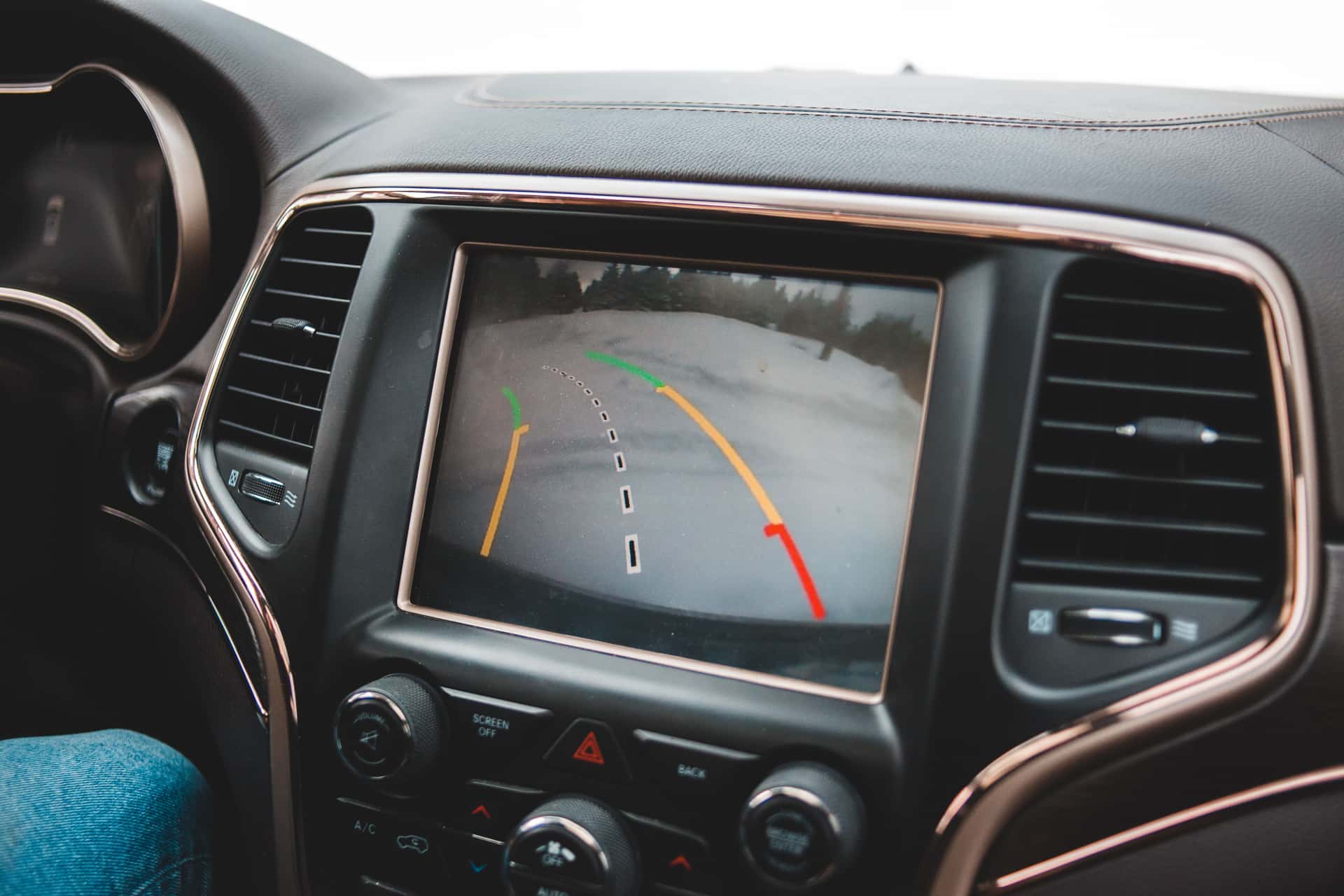
On a travel trailer, buy whichever camera your trailer supports and then use it as a rear view mirror rather than a parking aid — because on a towed trailer there is no reverse signal to switch it on, so it runs the whole time you drive. With a factory plate, the matching plate camera. Without one, the self-contained wireless kit with the larger monitor, which is easier to read at a glance at speed. The difference between the two product categories matters less than understanding what you are buying it for.
Part of our towing and security guide. Our backup camera roundup ranks the products. This page exists because “rear view camera” and “backup camera” are genuinely different things in the automotive world, and on a trailer the distinction collapses in a way nobody explains.
Rear view against backup: the real difference
In a car, these are two separate features. A backup camera is wired to the reverse lamp circuit. Put the car in reverse, the camera powers up, the screen switches to it, and you get guide lines overlaid for parking. Come out of reverse and it disappears. A rear view camera, by contrast, replaces or supplements the mirror: it runs continuously while you drive, usually without guide lines, and shows a wider view at a distance rather than a close view of a bumper.
On a towed travel trailer, you cannot have the first kind. There is no electrical path from the trailer’s rear to the tow vehicle’s reverse circuit; the seven-pin connector carries running lights, brakes, turn signals and a charge line, not a camera trigger. So a trailer camera is powered independently and is simply on.
That is not a limitation. It is better. A camera that is on while you drive is showing you the lane behind the trailer the entire journey, which is worth considerably more than a parking aid you use for ninety seconds a day.
What each one is built to do
| Backup camera (motorhome / car) | Rear view camera (trailer reality) | |
|---|---|---|
| When it runs | Only in reverse, triggered by the lamp circuit | Continuously, because nothing can trigger it |
| What it shows | Close view of the bumper, with guide lines | Wider view down the lane behind you |
| What matters most | Guide line accuracy and close-range clarity | Low latency, daylight readability, stable signal at speed |
| Power source | The reverse lamp feed | A marker light tap or a pre-wired factory plate |
What to judge a rear view camera on
Because it is a driving tool, the specifications that matter are not the ones a parking camera is sold on.
Latency, which almost nobody publishes
A wireless link introduces delay between the camera and the screen. At parking speeds a third of a second is invisible. At 60 mph it means the image is showing you where the car behind was about thirty feet ago, which matters when you are deciding whether to change lanes. Nobody publishes a latency figure, so the practical test is your own: once fitted, have someone wave behind the trailer and watch the screen. If the lag is obvious to the eye, treat the camera as advisory and use your mirrors for the decision.
Daylight readability, which is mostly monitor size
The screen sits on a dash in direct sun. A larger monitor is easier to read at a glance than a small one with the same resolution, and a glance is all you get while driving. This is the single most practical reason the seven-inch option wins for this use case over the smaller screens bundled with plate cameras.
Signal stability at speed, which is about mounting
Dropouts at highway speed are usually distance and obstruction rather than vibration. The camera is at the back of a metal box and the monitor is in a metal cab; everything in between attenuates the signal. Mount the camera as high as the trailer allows and keep the monitor toward the windshield rather than down in a footwell.
The picks
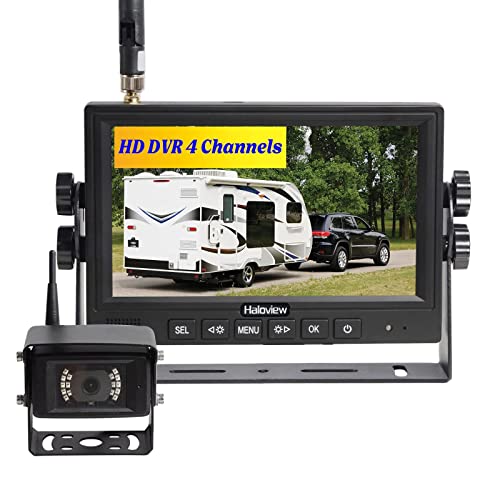
1. Best for Trailers with no factory mount
Haloview MC7108 Wireless Backup Camera System
The answer when your trailer has no factory camera plate: it works on anything, at the cost of mounting and powering it yourself.
- Specification
- Wireless system with a 7-inch monitor
- Specification
- Expandable to additional cameras
- Specification
- Independent of any factory plate
What it does well
- Works on any trailer, because it does not depend on a manufacturer's mounting plate
- A bigger monitor than most bundled systems, which matters when it sits on the dash in daylight
- Adding a second camera later is supported rather than a hack
The real tradeoff
- You are mounting and powering the camera yourself, which means drilling or a marker-light tap
- More setup decisions than the plug-in option
How it measures up
These are judgments from published specifications and what we see at the lodge, not laboratory results. How we choose.
- Beginner fit
- Good — The install is the hard part, not the use.
- Install effort
- Adequate — Mounting and power are on you.
- Picture in daylight
- Strong — The larger monitor is a real advantage.
- Value
- Good — Fair for a complete, non-proprietary system.
Specifications from Haloview.
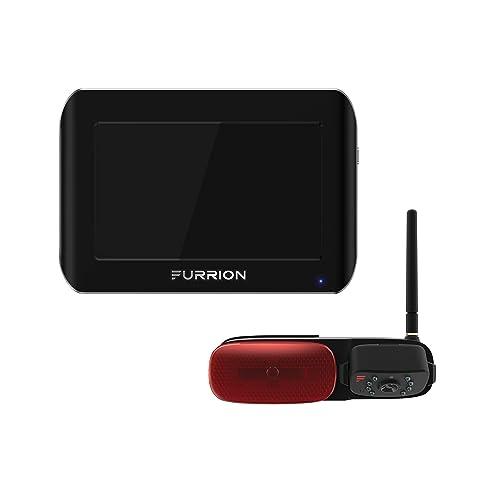
2. Best for Trailers with a factory Furrion mount
Furrion Vision S Wireless Backup Camera
If there is a black plate on the back of your trailer, this is the camera it was designed for, and fitting it is roughly a screwdriver job.
- Specification
- Wireless camera and monitor
- Specification
- Designed for the pre-wired Furrion mounting plate found on many trailers
- Specification
- Monitor mounts in the tow vehicle
What it does well
- If your trailer already has the black Furrion plate on the back, this is close to plug-and-play
- No cable to run the length of the trailer, which is the job that stops most people
- The pre-wired plate means power is already there
The real tradeoff
- Only a bargain if you have that plate. Otherwise you are paying for compatibility you cannot use
- Wireless range and interference vary. A long fifth-wheel is a harder case than a 22 ft trailer
How it measures up
These are judgments from published specifications and what we see at the lodge, not laboratory results. How we choose.
- Beginner fit
- Strong — With the plate, genuinely easy.
- Install effort
- Strong — No cable run and no drilling, if the plate is there.
- Picture in daylight
- Good — Clear enough for hitching and lane checks.
- Value
- Good — Strong with the plate, poor without it.
Specifications from Furrion.
Why the larger-monitor kit leads for this use
Not because the camera is better, but because the monitor is the part you interact with at 60 mph. A seven-inch screen on the dash is legible with a glance in daylight, and the kit is independent of any factory plate, so it fits any trailer. The cost is that you mount and power the camera yourself, which for a camera you intend to use continuously is a reasonable one-time job.
When the plate camera is still the right answer
If your trailer has the factory plate, fitting the matching camera is roughly a screwdriver job with no cable run and no power to find, and it gives you the same always-on rear view. For most people most of the time, that is the better purchase, and the smaller screen is a fair trade for not drilling anything. We review it in detail in the Furrion Vision S review.
The decision in one line
Factory plate on the back of the trailer: buy the plate camera. No plate, or you want the bigger screen for driving: buy the self-contained kit.
Best for Trailers with no factory mount
Haloview MC7108 Wireless Backup Camera System
The answer when your trailer has no factory camera plate: it works on anything, at the cost of mounting and powering it yourself.
Best for Trailers with a factory Furrion mount
Furrion Vision S Wireless Backup Camera
If there is a black plate on the back of your trailer, this is the camera it was designed for, and fitting it is roughly a screwdriver job.
Using it well, which is a habit rather than a product
A rear view camera on a trailer earns its money in three specific moments, and it is worth knowing them so you actually look.
Merging and lane changes. A long trailer hides the lane beside and behind it from your mirrors. The camera does not fix the side blind spot, but it does tell you whether the lane behind you is clear before you start moving over.
Being followed too closely. You cannot see a tailgater in a tow mirror once they are inside a certain distance. The camera shows them, which changes how you brake.
Backing into a site. This is the parking use, and it is genuinely useful even without guide lines, because the camera sees the one thing you cannot: whatever is directly behind the trailer at ground level. It does not replace a spotter and it does catch the things a spotter misses while walking around.
If you want more than the rear view
A side camera at the rear quarter addresses the blind spot a rear camera cannot, and that needs a monitor with more than one channel. Whether that is worth it, and what it costs beyond the box, is covered in best RV camera system. The wiring reality on a towed trailer — why there is no cable and no reverse signal in the first place — is in travel trailer backup cameras.
Questions people actually ask
What is the difference between a rear view camera and a backup camera?
A backup camera is wired to the reverse lamp circuit and only runs in reverse, with guide lines for parking. A rear view camera runs continuously while you drive and shows a wider view down the lane behind you.
Does an RV rear view camera run all the time?
On a towed travel trailer, yes. There is no electrical path from the trailer's rear to the tow vehicle's reverse circuit, so the camera is powered independently and is simply on whenever you want it.
Can a camera replace towing mirrors?
No. Towing mirror requirements are set by state law and a screen in the cab does not satisfy them. Fit extended mirrors for the legal requirement and use the camera for the lane directly behind the trailer, which mirrors cannot show.
Does camera lag matter at highway speed?
Yes. A wireless link adds delay that is invisible at parking speed and meaningful at 60 mph. Nobody publishes a latency figure, so test it once fitted and treat an obviously laggy picture as advisory rather than decisive.
Sources
Read next
Towing & Security
Best RV Camera System
What makes a camera setup a system, how many channels a travel trailer actually needs, and which option expands.
Towing & Security
Best Wireless RV Backup Camera
Wireless camera systems that work on any trailer, with range guidance by rig length.
Towing & Security
Furrion Vision S Review: Check for the Plate First
The plate-matched wireless camera reviewed, with the compatibility check that decides whether it is the right buy.
Towing & Security
Travel Trailer Backup Cameras: What Actually Works
Why a trailer camera is a different problem from a motorhome one, the factory plate check, and the two routes that work.
Reviewed October 11, 2026. Spot something out of date? Tell us and we will fix it.