Do I Need a Weight Distribution Hitch?
The answer is in two numbers you already have access to, and in most travel trailer cases it comes out the same way.
Heads up: this page contains affiliate links. If you buy through one, Camp & Chock may earn a commission at no extra cost to you. It never changes which product we put first — how this site is funded.
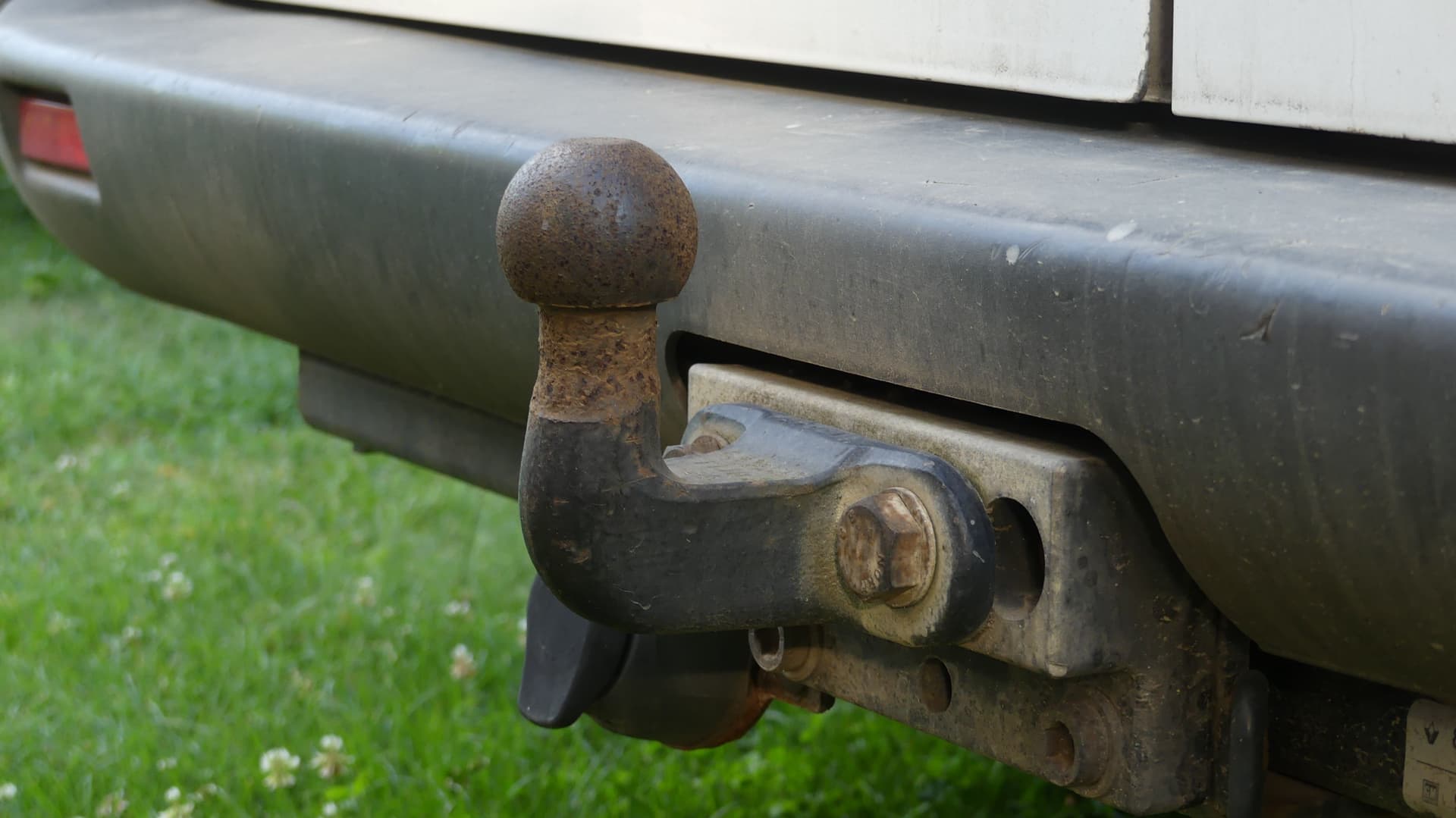
You need a weight distribution hitch if your loaded tongue weight exceeds the weight-carrying rating of your hitch or vehicle, and most travel trailers over about 5,000 pounds loaded do. Two numbers decide it: the tongue weight of your trailer with your gear in it, and the weight-carrying versus weight-distributing ratings printed on your receiver and in your owner's manual. If the first number is above the weight-carrying limit, the hitch is not optional — it is what makes the tow legal and the handling correct.
This is part of our towing and security guide, and it is the question that comes before every other hitch question.
The two ratings nobody reads
Look at the sticker or stamping on your receiver hitch. It will give two sets of figures. One is the weight-carrying rating: how much tongue weight the hitch can take with a plain ball mount. The other is the weight-distributing rating, which is higher, and applies only when a weight distribution system is fitted.
Your owner's manual gives the vehicle side of the same pair. When a manufacturer says a truck can tow a certain weight, that figure frequently assumes weight distribution above a stated tongue weight. The higher number is conditional, and the condition is the hitch.
Working out whether you need one
| Step | What you do | What it tells you |
|---|---|---|
| 1 | Find loaded trailer weight on a scale, not the brochure | Dry weight is not your weight |
| 2 | Work out tongue weight - commonly 10 to 15 percent of loaded weight | The number both ratings are about |
| 3 | Read the weight-carrying rating on your receiver | The ceiling without a WD hitch |
| 4 | Compare | Over the carrying rating means you need weight distribution |
| 5 | Check your manual for a stated requirement | Some makers require WD above a given weight regardless |
The symptoms, if you would rather not do arithmetic
The numbers are the real answer, but the symptoms are reliable enough to take seriously on their own. Any of these means the tongue weight is doing something your hitch is not handling.
The truck is nose-high and tail-low when hitched. This is the clearest sign. The trailer tongue is levering weight off the front axle, which is where your steering is. Headlights pointing at the trees is the same observation.
Steering feels light or vague. Follows directly from the above. Less weight on the front tires is less grip for steering.
The rig wanders, or a passing truck moves you. That is sway, and sway control is the second half of what these hitches do.
Braking takes longer than it should. Weight shifted off the front axle is braking capacity you are not using.
If the answer is yes
An integrated sway-control hitch sized to your real tongue weight, a lighter system if handling the bars is the obstacle, and a tire monitor because a weight-distribution setup loads your tires closer to their limits.
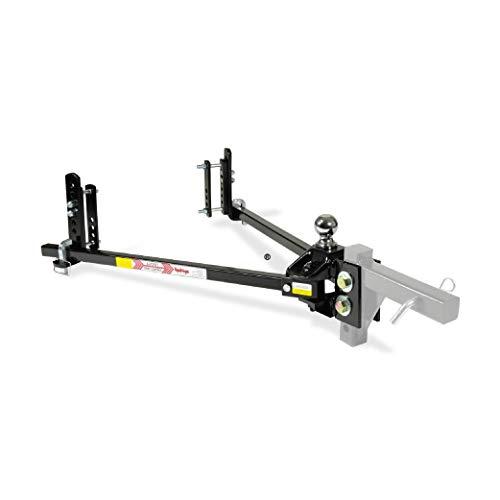
Best for Sway control built in
Equal-i-zer 4-Point Sway Control Hitch
Weight distribution with sway control built in rather than bolted on. Size it to your real tongue weight and let a shop set it up once.
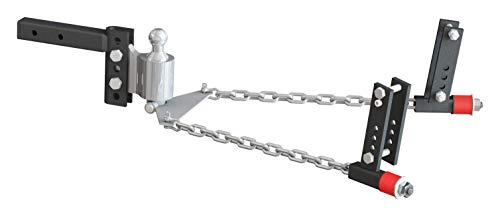
Best for Weight, and easier hitching
Andersen No-Sway Weight Distribution Hitch
The light one. Far easier to handle than steel spring bars, at the cost of being different from every hitch tutorial you will read.
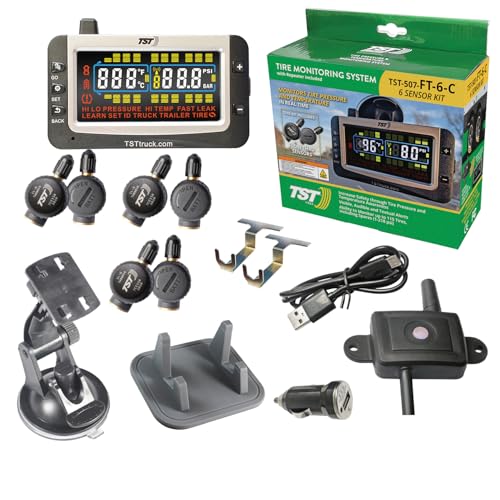
Best for Knowing before the blowout
TST 507 Tire Pressure Monitoring System
The only warning you get before a trailer tire fails, because a trailer gives you no feedback through the steering wheel.
The half-ton truck question
It comes up constantly: does a big truck mean you can skip it? No, and the reason is that the two questions are unrelated. Weight distribution is about where the tongue weight sits, not about whether the truck is strong enough to pull. A heavy-duty truck with a plain ball mount still takes the full tongue weight behind its rear axle, and still levers weight off the front.
What a bigger truck changes is how much it sags doing it. A half-ton will visibly drop; a three-quarter-ton may not look like it has noticed. But your receiver still has a weight-carrying rating, your manual still has a condition, and the trailer still sways when a semi passes. The ratings decide, not the badge.
When you genuinely do not need one
Small and light trailers are a real exception, not a loophole. A teardrop or a short single-axle trailer loaded to a modest total weight has a tongue weight well inside any standard receiver's weight-carrying rating. In that case a weight distribution hitch adds cost, weight and setup complexity to solve a problem you do not have.
The line is not a specific number we can give you, because it depends on your receiver and your vehicle. Read both ratings. If you are inside them with the trailer loaded the way you actually load it, you are finished.
What the hitch is actually doing to the load
Worth understanding, because it explains why the symptoms above appear together. A plain ball mount puts the entire tongue weight behind the rear axle of the tow vehicle, which means the rear axle acts as a fulcrum: load goes down at the back and lifts at the front. That is why the headlights point up, and it is why the steering goes light at the same moment.
A weight distribution hitch uses spring bars under tension between the hitch head and brackets on the trailer A-frame to push back against that rotation. The result is that some of the tongue weight is effectively carried by the tow vehicle's front axle and some by the trailer's own axles, instead of all of it landing at the one point behind the rear wheels. You have not removed weight — you have spread it across four axles instead of concentrating it at one.
Sway control is the second, separate job. A trailer that starts to rotate around the ball will keep going unless something resists it, and modern hitches build that resistance into the same assembly rather than adding a bar you can forget. The two jobs are why these are expensive and why they are not interchangeable with a cheaper ball mount of the same rating.
Once you know you need one, the sizing is a separate and equally specific question — see what size weight distribution hitch you need, and Equal-i-zer versus Husky Centerline TS for the two models most first-time buyers end up choosing between.
Questions people actually ask
Do I need a weight distribution hitch for my travel trailer?
If your loaded tongue weight is above the weight-carrying rating stamped on your receiver, or your vehicle manual requires weight distribution above a stated weight, then yes. Most travel trailers over roughly 5,000 pounds loaded fall into that case.
Do I need a weight distribution hitch with a half-ton truck?
Probably, and the size of the truck is not what decides it. Weight distribution is about where the tongue weight sits relative to the rear axle, not about pulling power. Read the weight-carrying rating on the receiver and the condition in your manual.
Do I need one for a 4,000 pound trailer?
Often not, but it depends on your receiver rating rather than the trailer weight alone. Work out the loaded tongue weight, compare it to the weight-carrying rating on your hitch, and if you are inside it you do not need weight distribution.
Will airbags do the same job?
No. Airbags level the tow vehicle's rear suspension but do not transfer tongue weight forward onto the front axle, and they provide no sway control. They address the symptom you can see, not the load path.
How do I find my trailer's tongue weight?
Weigh the trailer loaded the way you actually tow it, at a public scale. Tongue weight is commonly in the region of 10 to 15 percent of loaded trailer weight, but the measured figure is the one to use, because brochure dry weight is not your trailer.
Is a weight distribution hitch a legal requirement?
It is a condition on a rating rather than a standalone law. If the manufacturer's tow rating assumes weight distribution above a given tongue weight, towing beyond that without it puts you outside the rating you are relying on.
Sources
Read next
Towing & Security
What Size Weight Distribution Hitch Do I Need?
How to size spring bars from your real loaded tongue weight, including the gear everyone forgets to count.
Towing & Security
Best Weight Distribution Hitch for a Travel Trailer
Weight distribution hitches with integrated sway control, sized by tongue weight, with an honest account of setup complexity.
Towing & Security
How to Hitch a Travel Trailer (Step by Step)
The full hitching sequence with the latch and jack checks that prevent a trailer coming off the ball.
Towing & Security
RV Towing Safety Checklist
A pre-departure towing checklist covering hitch, chains, brakes, tires, loading and the rooftop items people forget.
Reviewed October 10, 2026. Spot something out of date? Tell us and we will fix it.