What Size Weight Distribution Hitch Do I Need?
Spring bars are rated by tongue weight, and tongue weight is not a number printed on your trailer. Here is how to arrive at it and which rating to then buy.
Heads up: this page contains affiliate links. If you buy through one, Camp & Chock may earn a commission at no extra cost to you. It never changes which product we put first — how this site is funded.
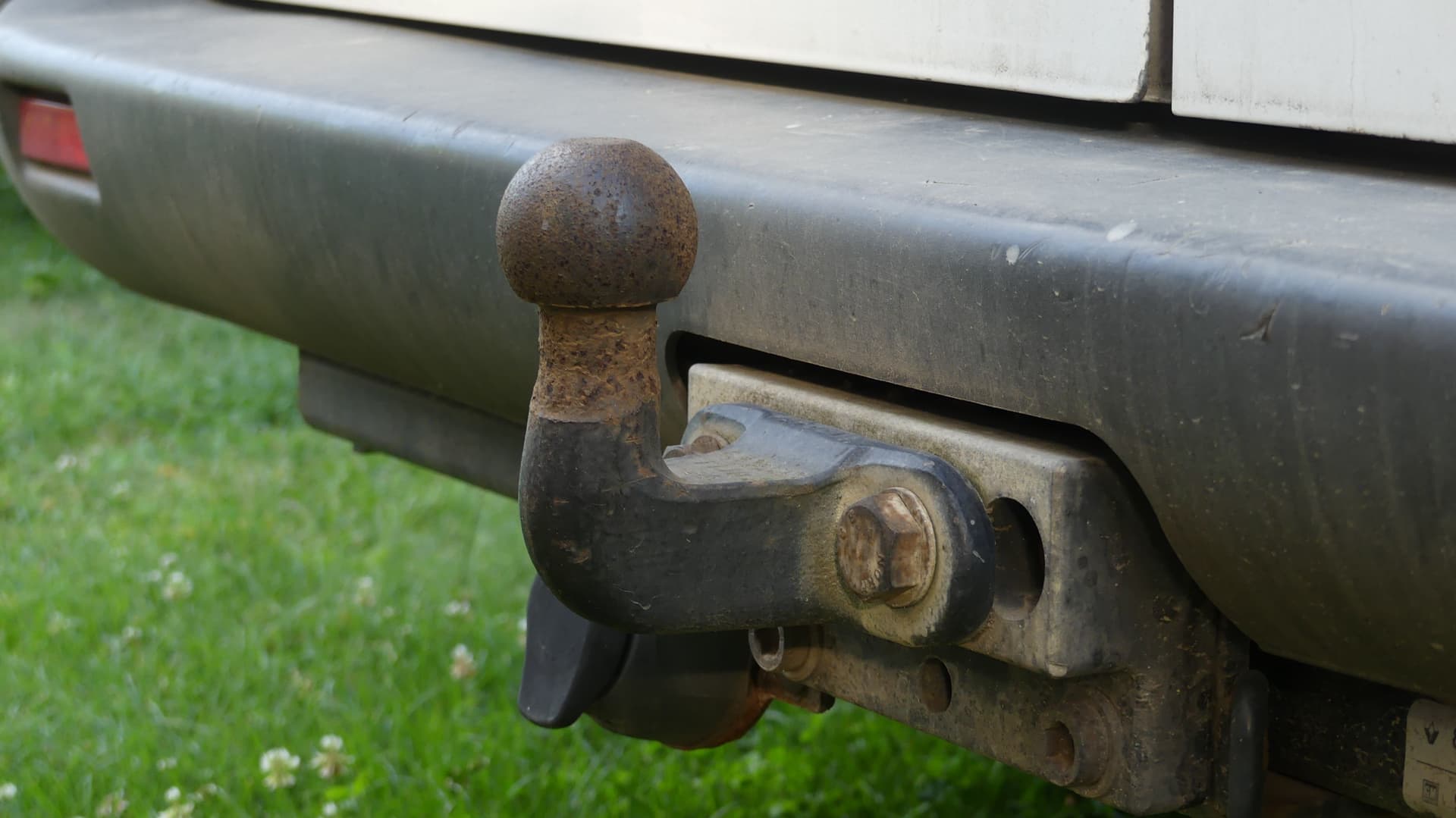
Size the hitch by your loaded tongue weight, and pick the rating band that puts your real figure comfortably inside it rather than at either edge. Tongue weight is commonly in the region of 10 to 15 percent of loaded trailer weight, so a trailer that actually weighs 7,000 pounds loaded lands somewhere around 700 to 1,050 pounds on the ball — before you add anything stored in the truck bed ahead of the axle. Bars rated far above your tongue weight tow harshly; bars rated below it do not do the job at all.
This is part of our towing and security guide, and it assumes you have already settled whether you need one.
Why bar rating is about tongue weight, not trailer weight
Spring bars work by being tensioned to a specific load. Their rating describes the tongue weight range over which that tension does what it is supposed to do. A bar rated well above your actual tongue weight is stiffer than the load it is carrying, so the trailer transmits every bump through to the truck and the ride goes hard. A bar rated below your tongue weight is being asked to distribute more than it can, and it simply does not transfer the load forward.
Trailer weight comes into it only as the way you estimate tongue weight. Two trailers of identical total weight can have meaningfully different tongue weights depending on where the axles sit and where the heavy items are.
The arithmetic, with the part people miss
Getting to a real tongue weight figure
| Step | What to include | Why it matters |
|---|---|---|
| Start from loaded trailer weight | Trailer on a scale, loaded as you tow it | Brochure dry weight excludes everything you own |
| Add fresh water | Water weighs roughly 8.3 lb per gallon | A full fresh tank is a large, forward-biased load |
| Add propane and battery | Both sit at the front, over or ahead of the tongue | Nearly all of this weight lands on the ball |
| Add front-compartment cargo | Tools, chocks, blocks, hose, generator | The pass-through is in front of the axles |
| Take 10 to 15 percent | Of the loaded total, as an estimate | Use a measured figure instead where you can |
| Add cargo in the truck bed | Anything ahead of the rear axle | Counts toward what the hitch system carries |
The forward-bias point is the one that catches people. A travel trailer's fresh water tank, propane bottles, battery and front pass-through storage are all at or ahead of the axles, which means a disproportionate share of that weight ends up on the tongue. Loading the front compartment with leveling blocks, a sewer kit and a toolbox can move tongue weight by enough to cross a rating band.
Choosing the band
Manufacturers publish bars in bands — a commonly seen set runs roughly 600, 1,000, 1,200 and 1,400 pounds, though the exact figures vary by maker and you should read the chart for the hitch you are buying. The rule is the same whoever makes it: your measured tongue weight should sit inside the band with margin at both ends, not within a few pounds of the top or bottom.
If your figure lands right on a boundary, the usual advice is to take the larger band only if you expect to load heavier in future, and the smaller one if the trailer is already loaded the way it will stay. An over-rated bar is the more common mistake and the one that produces the complaint that the hitch made the ride worse.
Hitches that publish clear sizing bands
All three are sold in several tongue-weight ratings. Read the band chart against your measured figure before ordering, not after.
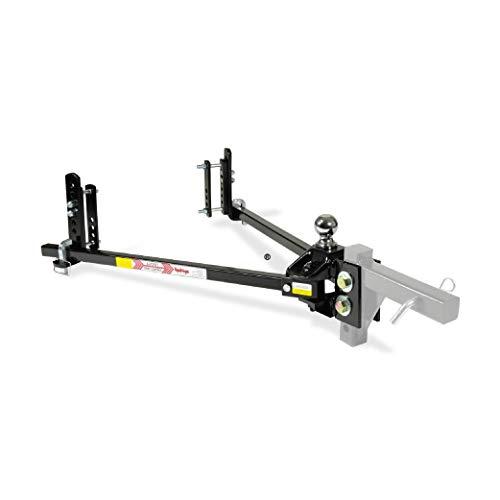
Best for Sway control built in
Equal-i-zer 4-Point Sway Control Hitch
Weight distribution with sway control built in rather than bolted on. Size it to your real tongue weight and let a shop set it up once.
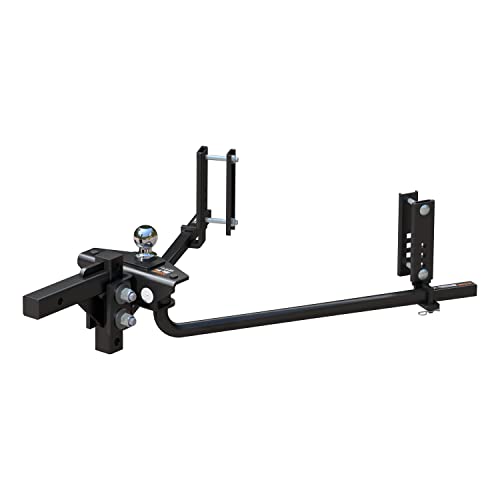
Best for Availability and parts support
CURT TruTrack Weight Distribution Hitch
The widely stocked option: integrated sway control, several weight ratings, and parts you can actually source mid-trip.
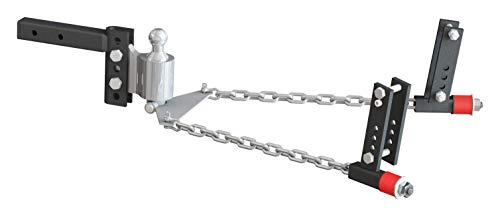
Best for Weight, and easier hitching
Andersen No-Sway Weight Distribution Hitch
The light one. Far easier to handle than steel spring bars, at the cost of being different from every hitch tutorial you will read.
Getting the number without guessing
There are three ways to arrive at a tongue weight, in descending order of how much you should trust them.
A public scale, in two weighings. Weigh the whole rig with the trailer hitched, then unhitch and weigh the tow vehicle alone. The difference is close to the tongue weight. This is the method to use if you are anywhere near a rating boundary, and truck stops and grain scales both do it for a small fee.
A dedicated tongue weight scale. A purpose-made gauge sits under the coupler and reads the weight directly. More convenient than a scale trip if you expect to re-check after changing how you load, and it measures the one number this page is about rather than deriving it.
The percentage estimate. Taking 10 to 15 percent of loaded trailer weight is a reasonable starting point and nothing more. Use it to work out which band you are probably in, then measure before you buy if the answer is close to an edge. What it cannot tell you is how your particular trailer distributes its load, which is exactly the variable that matters.
Whichever route you take, weigh or estimate the trailer loaded the way you tow it. A trailer weighed empty gives you a number that is correct about a trailer you do not own.
Three things that change the answer
How you load the trailer
Moving heavy items behind the axles reduces tongue weight — and taken too far it causes sway, which is far worse than a slightly high tongue weight. Do not load to hit a hitch rating. Load for stability, measure the result, and buy the bars that match.
Whether you tow with full water
A full fresh tank is a significant load, and whether it is aboard changes your tongue weight noticeably. If you sometimes tow full and sometimes empty, size for the full case — that is the condition the hitch has to handle.
The receiver, which has its own limit
A hitch rated for more tongue weight than your receiver can carry is not an upgrade. The weakest published rating in the chain is your real limit, and it may be the receiver, the ball mount, the ball, or the vehicle. Check all four.
For which hitch to buy once you know the band, see best weight distribution hitch and the head-to-head in Equal-i-zer versus Husky Centerline TS. The same tongue weight arithmetic has a second use on a half-ton truck, where the hitch’s own weight comes off your payload alongside it — see best weight distribution hitch for a half-ton truck.
Questions people actually ask
What size weight distribution hitch do I need?
One whose spring bar rating brackets your loaded tongue weight with margin at both ends. Tongue weight is commonly 10 to 15 percent of loaded trailer weight, so measure the loaded trailer rather than using brochure dry weight.
Is a weight distribution hitch sized by trailer weight or tongue weight?
Tongue weight. Trailer weight is only a way of estimating it. Two trailers of the same total weight can have different tongue weights depending on axle position and where the heavy items sit.
What happens if the spring bars are too heavy for my trailer?
The ride goes hard. Bars stiffer than the load they carry transmit bumps straight through to the tow vehicle, and this is the most common reason someone concludes a weight distribution hitch made things worse.
Does cargo in the truck bed count?
Anything ahead of the rear axle effectively adds to what the hitch system is managing, so include it when you are close to a rating boundary. Weight behind the rear axle works against you in a different way.
Should I size for a full or empty fresh water tank?
Full, if you ever tow that way. Water is roughly 8.3 pounds per gallon and the fresh tank usually sits forward, so a full tank raises tongue weight noticeably. Size for the heaviest condition you actually tow in.
Can I use a hitch rated higher than my receiver?
No benefit, and it is not an upgrade. Your real limit is the lowest published rating in the chain of receiver, ball mount, ball and vehicle, whichever that turns out to be.
Sources
Read next
Towing & Security
Do I Need a Weight Distribution Hitch?
The tongue-weight test that decides whether you need weight distribution, and why a big truck does not exempt you.
Towing & Security
Best Weight Distribution Hitch for a Travel Trailer
Weight distribution hitches with integrated sway control, sized by tongue weight, with an honest account of setup complexity.
Towing & Security
Equal-i-zer vs Husky Centerline TS
Two integrated sway-control hitches compared on mechanism, noise, setup and parts support.
Towing & Security
How to Hitch a Travel Trailer (Step by Step)
The full hitching sequence with the latch and jack checks that prevent a trailer coming off the ball.
Reviewed October 10, 2026. Spot something out of date? Tell us and we will fix it.