Best RV Water Filter for Hard Water
Start with the uncomfortable part: a filter does not soften water. Hardness is dissolved mineral, and a carbon cartridge does not remove dissolved mineral. Here is what it does remove.
Heads up: this page contains affiliate links. If you buy through one, Camp & Chock may earn a commission at no extra cost to you. It never changes which product we put first — how this site is funded.
The short answer
Buy the canister filter with a replaceable cartridge, and buy it for the right reason: it handles sediment and taste far better than a throwaway inline unit, and sediment is what actually clogs your faucet screens and shower head. It will not soften hard water, because no inline RV filter softens hard water — that needs ion exchange, which is a different machine. Add a pressure regulator whatever you decide about filtration, because that is the item that prevents actual damage.
Part of our sewer and water guide, and the qualifier version of our RV water filter roundup. “For hard water” is the most common thing people add to that search, and it deserves a straight answer rather than a page that quietly sells a carbon filter to someone with a limescale problem.
Our picks at a glance
Tap any row to jump to the full write-up.
| # | Product | Best for | Beginner fit | Price |
|---|---|---|---|---|
| 1 | Camco EVO Premium RV Water FilterA proper canister with a replaceable cartridge: better on sediment than the throwaway inline filters, and cheaper after season one. | Filtering that earns its housing | Good | |
| 2 | 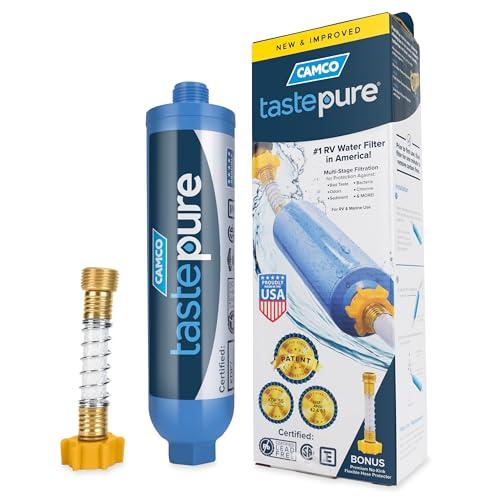 Camco TastePURE Inline RV Water FilterThe one most people start with: screws on, improves the taste, keeps grit out, and gets thrown away at the end of the season. | The simple first filter | Strong | |
| 3 | 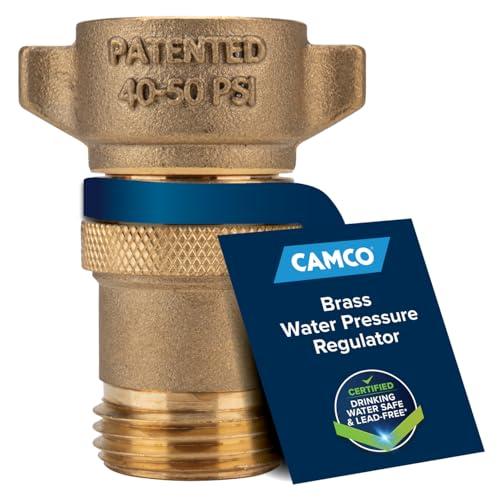 Camco Brass Water Pressure RegulatorThe cheapest single item that prevents the most expensive damage. Fixed preset, brass body, screws on in four seconds. | The cheapest thing that prevents the worst damage | Strong |
Prices come from Amazon and were last checked November 12, 2026. They change constantly, so a price older than 48 hours is withdrawn rather than shown stale — those rows read “Check price on Amazon” instead and go straight to the current listing. #ad — these are affiliate links.
What “hard water” actually is, and why a filter misses it
Hardness is dissolved calcium and magnesium. The word “dissolved” is the whole problem: those minerals are in solution, at the molecular level, not suspended as particles. A sediment filter works by physical size exclusion — it catches things bigger than its pore rating. Dissolved mineral is not bigger than the pore rating of anything you would want to push drinking water through.
Activated carbon, which is the other half of most RV filters, works by adsorption and is genuinely good at chlorine, chlorine byproducts, and the compounds that make water taste and smell of the campground. It is not a mineral removal technology either.
Removing hardness takes ion exchange, which swaps calcium and magnesium for sodium across a resin bed that you periodically regenerate with salt. That is a water softener. Portable RV softeners exist as a product category; they are a separate, larger, heavier device with a recharge routine, and they are not what anyone means by “RV water filter.” We do not currently recommend a specific one.
What a filter does fix, which is most of why people ask
In our experience the person searching for a hard water filter usually has one of four complaints, and three of them are not hardness.
The complaint, and what actually solves it
| What you noticed | Cause | What fixes it |
|---|---|---|
| Water tastes or smells of chemicals | Chlorine and its byproducts | Any carbon filter. This is the easy win |
| Grit in the faucet screen, weak shower | Sediment from park plumbing | A canister filter with a sediment cartridge |
| White crust on the faucet and shower head | Genuine hardness - dissolved mineral | Nothing a filter does. Descale periodically, or run a softener |
| Sulfur or rotten-egg smell | Usually hydrogen sulfide in well water | Carbon helps with mild cases; strong cases need specific media |
If your complaint is row one or row two, a filter is exactly the right purchase and the canister is the better of the two options. If it is row three, a filter is the wrong purchase and we would rather tell you that than take the commission.
The picks
1. Best for Filtering that earns its housing
Camco EVO Premium RV Water Filter
A proper canister with a replaceable cartridge: better on sediment than the throwaway inline filters, and cheaper after season one.
- Specification
- Inline canister with replaceable cartridge
- Specification
- Sediment and taste filtration
- Specification
- Standard hose thread
What it does well
- A replaceable cartridge instead of a disposable unit, so the running cost falls after the first season
- Handles sediment better than the small inline filters, and sediment is what clogs faucet screens
The real tradeoff
- Bulkier at the spigot, and it wants support so it is not hanging on the fitting
- Higher up-front cost
How it measures up
These are judgments from published specifications and what we see at the lodge, not laboratory results. How we choose.
- Beginner fit
- Good — One cartridge change to learn.
- Control
- Good — You choose the cartridge.
- Flow
- Good — Better than the small inline filters.
- Value
- Good — Wins over a season, loses on the first purchase.
Specifications from Camco.
2. Best for The simple first filter
Camco TastePURE Inline RV Water Filter
The one most people start with: screws on, improves the taste, keeps grit out, and gets thrown away at the end of the season.
- Specification
- Disposable inline filter
- Specification
- Screws between spigot and hose
- Specification
- Typically replaced each season
What it does well
- The cheapest way to stop tasting the campground and to keep grit out of your faucets
- No housing, no cartridge, nothing to assemble
The real tradeoff
- Disposable, so the cost repeats
- Clogs faster on genuinely sedimented water than a canister filter
How it measures up
These are judgments from published specifications and what we see at the lodge, not laboratory results. How we choose.
- Beginner fit
- Strong — Screw it on.
- Control
- Adequate — None.
- Flow
- Adequate — Restricts a little, and more as it clogs.
- Value
- Strong — Low entry cost. Buy the canister later.
Specifications from Camco.
3. Best for The cheapest thing that prevents the worst damage
Camco Brass Water Pressure Regulator
The cheapest single item that prevents the most expensive damage. Fixed preset, brass body, screws on in four seconds.
- Specification
- Brass inline regulator
- Specification
- Fixed preset pressure
- Specification
- Standard hose thread at both ends
What it does well
- Fits between the spigot and your hose in about four seconds and then protects the whole plumbing system
- Brass rather than plastic, so it survives being over-tightened and left on all season
- A fixed preset means there is nothing to get wrong
The real tradeoff
- You cannot adjust it and you cannot see what it is doing
- Fixed regulators restrict flow more than an adjustable one set higher
How it measures up
These are judgments from published specifications and what we see at the lodge, not laboratory results. How we choose.
- Beginner fit
- Strong — Screw it onto the spigot. There is no step two.
- Control
- Adequate — No adjustment and no gauge.
- Flow
- Adequate — Noticeably more restrictive than an adjustable unit.
- Value
- Strong — The best money-to-risk ratio on the whole site.
Specifications from Camco.
Why the canister rather than the inline unit
For a hard-water area specifically, the canister wins for a reason that is not about hardness at all: hard water areas are frequently also sediment-heavy areas, because both tend to come from groundwater rather than treated surface supply. A small disposable inline filter clogs quickly on sedimented water, and a clogged filter is a flow restriction that feels exactly like low pressure. A canister with a replaceable cartridge has more media, handles sediment better, and the running cost falls after the first season because you replace a cartridge rather than the whole unit.
The inline filter is still the right first purchase for someone who wants the taste fixed and does not want to think about it. It is the one most people start with and there is no shame in it.
Why the regulator is on this list at all
Because it is the item in this category that prevents actual damage, and a lot of people buy a filter and skip it. Campground water pressure is unknown and occasionally far higher than your trailer’s plumbing is rated for, and a burst fitting inside a wall is a bad week. A filter improves your water; a regulator protects your trailer. If you are buying one thing, buy the regulator. The order the two go in is covered in water filter and pressure regulator: which order.
The pair we would actually buy
Canister filter for sediment and taste, brass regulator for the plumbing. Neither one softens water, and the second one is the one that prevents damage.
Best for Filtering that earns its housing
Camco EVO Premium RV Water Filter
A proper canister with a replaceable cartridge: better on sediment than the throwaway inline filters, and cheaper after season one.
Best for The cheapest thing that prevents the worst damage
Camco Brass Water Pressure Regulator
The cheapest single item that prevents the most expensive damage. Fixed preset, brass body, screws on in four seconds.
Living with hard water in a trailer, without a softener
If you camp in a hard-water region and a portable softener is more machine than you want to carry, three habits do most of the work.
Descale the faucet aerators and shower head. They are where scale shows up first and they unscrew. White vinegar in a bag, tied around the fixture for an hour, handles it.
Do not let the water heater sit full all winter. Scale deposits in a water heater are what shorten its life, and a tank drained for storage cannot deposit anything. That is already part of winterizing — see how to winterize a travel trailer for storage.
Use the fresh water tank as a buffer on bad supplies. If you arrive somewhere with visibly poor water, filling your own tank through a filter and running off the pump means you control what you are drinking rather than the park doing it. Sanitizing that tank periodically matters if you do this — the method is in how to sanitize an RV fresh water tank.
Hard water is the specific case. The general one — whether a first-season owner needs a filter at all, and what the standard ones are actually certified to remove — is in do I need an RV water filter.
Questions people actually ask
Will an RV water filter soften hard water?
No. Hardness is dissolved calcium and magnesium, and sediment filters work by physical size exclusion while carbon works by adsorption. Removing hardness requires ion exchange, which is a water softener rather than a filter.
What is the best RV water filter for hard water areas?
A canister filter with a replaceable cartridge, chosen for sediment capacity rather than for hardness. Hard-water regions are frequently sediment-heavy too, and a small disposable inline filter clogs quickly on that water.
What does an anti-scale filter actually do?
It alters how mineral crystallizes so it is less likely to stick to surfaces. The mineral is still in the water and the hardness number is unchanged, so it is not softening even though the two words often appear together in listings.
Do I need a water pressure regulator as well as a filter?
Yes, and if you only buy one, buy the regulator. A filter improves your water; a regulator protects your plumbing from campground pressure that can be far above what the trailer is rated for.
Sources
Read next
Sewer & Water
Best RV Water Filter
Inline and canister water filters compared, with an honest account of what filtration at this level achieves.
Sewer & Water
RV Water Filter and Pressure Regulator: Which Goes First
The order of the regulator and filter on a city water line, why it matters, and which of the two you actually need.
Sewer & Water
How to Use an RV Water Pressure Regulator
Where it goes, which way round, what to set an adjustable one to, and why the common placement leaves the hose exposed.
Sewer & Water
How to Sanitize an RV Fresh Water Tank
The full tank sanitizing procedure with dilution guidance from an authority, plus the non-bleach alternatives.
Reviewed October 11, 2026. Spot something out of date? Tell us and we will fix it.