Do I Need an RV Water Filter?
Almost certainly yes, and for less dramatic reasons than the internet suggests. It is not there to make dangerous water safe. It is there so your water does not taste like a hose and your faucets do not fill with grit.
Heads up: this page contains affiliate links. If you buy through one, Camp & Chock may earn a commission at no extra cost to you. It never changes which product we put first — how this site is funded.
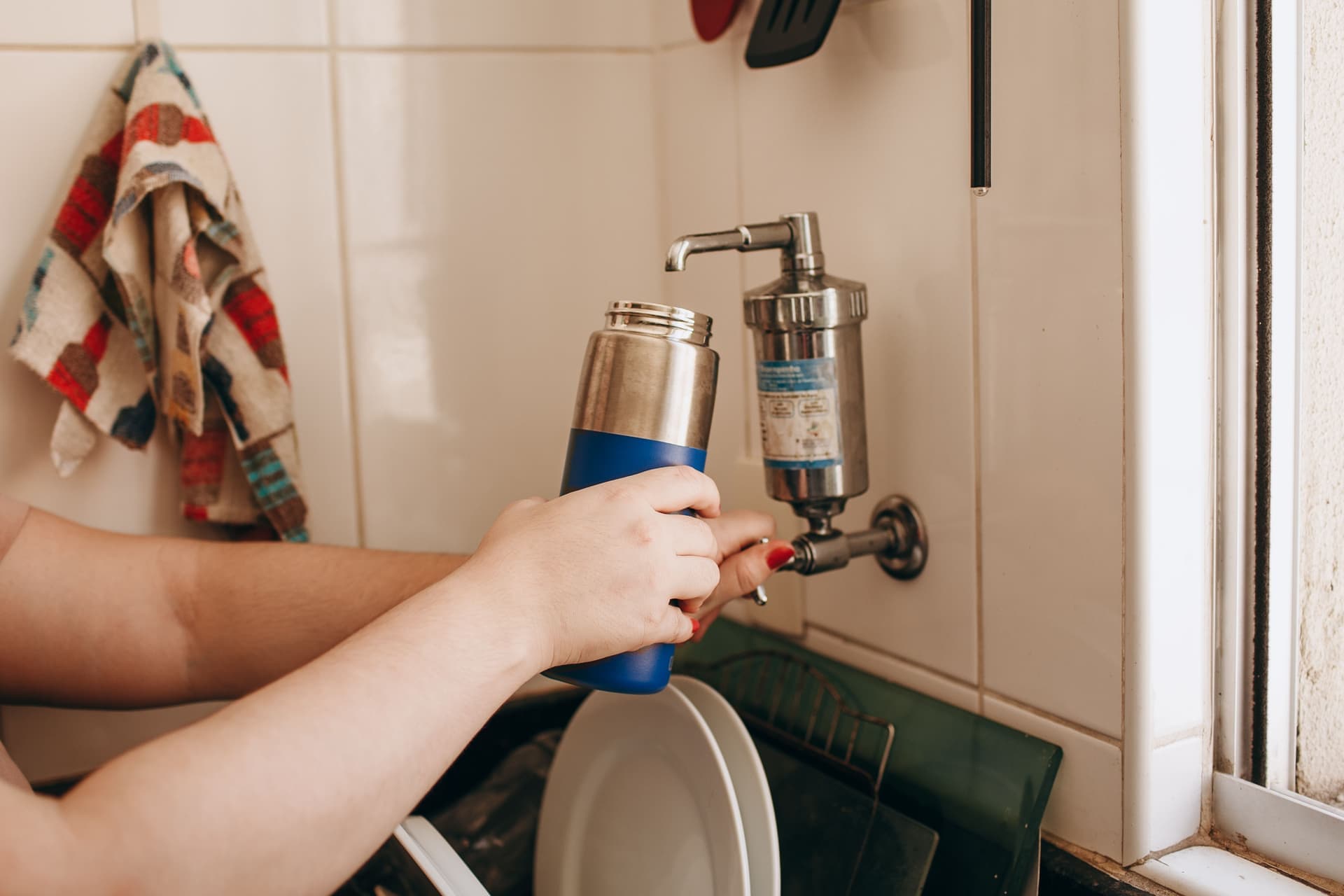
Yes, buy one — but buy it for the right reasons. An RV water filter is sold and certified to reduce taste, odor, chlorine and sediment. It is not a purifier, and it is not what makes questionable water safe to drink. The honest case for it is smaller and more practical than the one you will read in forum threads: campground water genuinely does taste of chlorine and warm hose, grit genuinely does clog faucet screens and toilet valves, and a filter is the cheapest thing on this site that improves every single day of a trip. At the price of a few coffees, it is close to a free decision.
Part of our sewer and water guide. Once you have decided yes, which one to buy is in the RV water filter roundup, and if your water leaves white crust on everything, the specific case is in the hard water version.
What the filter is actually removing
The standard RV filter is a sediment stage plus granular activated carbon. Camco’s TastePURE line, which is the one most first-season owners end up with, is described in its listings as a 20-micron sediment filter combined with granular activated carbon, reducing bad taste, odor, chlorine and sediment, and it is listed as independently tested to NSF/ANSI standards 42 and 53. The KDF media in some versions is there to limit bacteria growth inside the filter while it sits unused, which is a different claim from treating the water as it passes through.
Read that list again, because it is the whole answer. Taste. Odor. Chlorine. Sediment. Those four things are what you are buying, and all four are real problems at a real campground.
The three reasons it earns its money
Taste, which you will notice on day one. Municipal water that is perfectly pleasant at home arrives at a campsite after a long run through a buried pipe, a frost-free spigot and whatever hose you attached, in July. Chlorine concentrates in the smell. Coffee is the first casualty and the first thing people comment on.
Grit, which you will notice in month three. Sediment from an old campground supply line does not leave. It collects in your faucet aerators, in the toilet valve, in the water pump screen and at the bottom of the water heater. A faucet that trickles after a season of camping is usually a screen full of sand, not a plumbing problem, and twenty microns of sediment filtration is what stops it arriving at all.
The fresh tank, which you will notice next spring. Whatever goes into the tank stays there between trips. Filtering before the hose means less sediment settling in the tank, which means the annual tank sanitizing routine starts from a cleaner place.
What a filter does not do, and what each job actually needs
This is the part that matters most for a first season, because three separate products get confused with each other and only one of them is the filter.
Three different jobs, three different products
| The problem | The product that fixes it | What the filter does about it |
|---|---|---|
| Water tastes and smells like chlorine or hose | Carbon water filter | This is its actual job |
| Grit in faucets, valves and the pump screen | Sediment stage of the filter | This is its other actual job |
| Campground pressure high enough to split a fitting | Water pressure regulator | Nothing. A filter is not a regulator |
| White scale on the shower and fixtures | Hard water is a mineral problem, treated separately | A standard carbon filter does not soften water |
| Water you have been told is not safe to drink | Bottled water, or a purpose-built purification system | Nothing you should rely on |
The regulator confusion is the expensive one. A filter has a hose thread on each end and screws on at the spigot; so does a regulator; they look like relatives and they do completely unrelated jobs. Pressure is what splits a fitting at two in the morning, and no filter protects against it — the filter and regulator page covers using both together, and the regulator roundup is where to buy the one you are missing.
When you can honestly skip it
You only ever fill from your own house tap. If the trailer lives at home, you fill the fresh tank from a spigot you already drink from, and you never hook up at a campground, the taste argument mostly disappears. Many people in this position still run one, because the hose is the other half of the taste problem.
You already have a whole-trailer filtration setup. Some rigs come with an under-sink or whole-coach filter. A second inline filter at the spigot is not wrong, but it is not the urgent purchase it is for everyone else.
You are dry camping with a tank you filled at home. No hookup, no filter needed for that trip. Pack it anyway, because the spigot you find on the way is the reason you own it.
That is the honest list, and it is short. For a first-season owner hooking up at campgrounds, there is no version of this where the answer is no.
What this points to
Starting out, or buying one thing: the disposable inline filter. Camping enough that a season of disposables adds up, or dealing with visible sediment: the canister with a replaceable cartridge. And if you do not already own a pressure regulator, that is the more urgent purchase of the two.
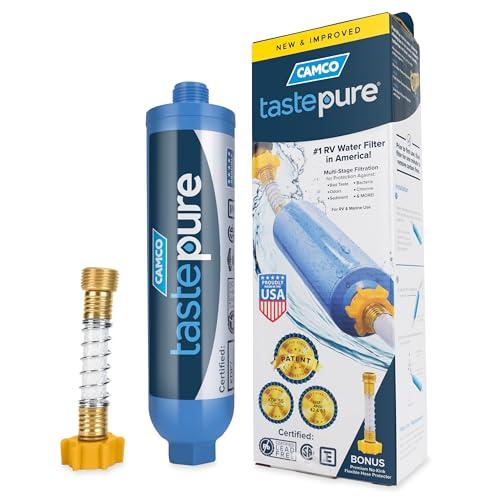
Best for The simple first filter
Camco TastePURE Inline RV Water Filter
The one most people start with: screws on, improves the taste, keeps grit out, and gets thrown away at the end of the season.
Best for Filtering that earns its housing
Camco EVO Premium RV Water Filter
A proper canister with a replaceable cartridge: better on sediment than the throwaway inline filters, and cheaper after season one.
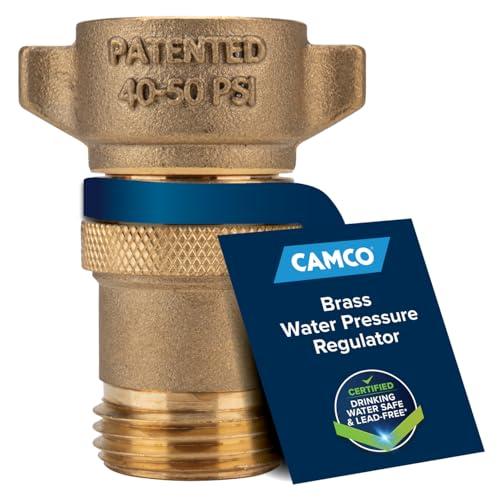
Best for The cheapest thing that prevents the worst damage
Camco Brass Water Pressure Regulator
The cheapest single item that prevents the most expensive damage. Fixed preset, brass body, screws on in four seconds.
Disposable or canister, for a first season
The disposable inline filter is a sealed cylinder that screws between the spigot and the hose and gets thrown away at the end of the season. Nothing to assemble, nothing to learn, and it is the right first filter for almost everybody.
The canister filter is a housing with a replaceable cartridge. It costs more up front, handles sediment better, and gets cheaper from season two onward because you replace a cartridge instead of a unit. It is also bulkier at the spigot and wants supporting so it is not hanging off the fitting.
If you are reading this before a first trip, buy the disposable one. The canister is a sensible upgrade once you know how much you camp and what your water is actually like, and that is information you do not have yet.
Four things that waste a filter
Fitting it after the hose rather than before it. The filter goes on at the spigot end, so the hose carries filtered water. Put it at the trailer end and the inside of the hose is still part of the taste.
Leaving it on the spigot all season. A filter sitting wet and warm between trips is the thing the KDF media exists to slow down, not prevent. Take it off, let it drain, store it dry, and replace it on the schedule rather than when it tastes wrong.
Expecting one to fix flow that was always slow. A filter restricts flow slightly when new and more as it clogs. If a shower is weak from the first trip, the filter is not the cause and a second one will not help.
Running it with a garden hose. Filtering water and then passing it through a hose not made for drinking water undoes the point of the exercise — can you use a regular hose for RV water is the longer version, and the drinking water hose roundup is the fix.
The two-stage setup, and whether you need one
Spend any time reading RV forums and you will find people running two housings in series: a dedicated sediment filter first, then a carbon stage. It is a real setup and it is genuinely better on bad water, because sediment is what shortens a carbon filter’s life, and taking the grit out first means the expensive cartridge lasts.
It is also two housings, two cartridge schedules, a bracket, extra fittings and more places to leak, all sitting on the ground at a spigot you move every weekend. For a first season that is a solution to a problem you have not met yet. Run one filter, see what your water actually does to it, and build the two-stage rig in year two if the first cartridge comes out brown.
Two things worth knowing about your own water
Your home water is a useful baseline. If your house water tastes fine and leaves no scale, then most of what you will notice on the road is campground supply and hose, which is exactly what a basic filter addresses. If your house water already leaves white crust on the kettle, you are starting from hard water and the filter will not change that.
Standards tell you what was tested, not what is in the water. A filter listed to NSF/ANSI 42 and 53 has been tested against a defined set of contaminant-reduction claims; it does not tell you which of those contaminants your campground has. That is why the sensible first filter is the cheap one: it fixes the two problems every campground shares, and anything beyond that is a question about a specific water supply rather than a specific product.
The same question in a different aisle
Nearly every first-season purchase has a version of this question attached to it: is the RV-specific product real, or is it the same thing with a premium? The water filter is one where the answer is a clear yes. The one where the answer is mostly no is RV-specific toilet paper, and what not to buy for your first RV covers the rest of the aisle. If the trailer lives at the house between trips, the other question that comes up is connecting an RV to a home sewer, where the water side of this page applies unchanged.
Questions people actually ask
Do I really need an RV water filter?
For a first-season owner who hooks up at campgrounds, yes. It is the cheapest purchase that improves every day of a trip: it removes the chlorine and warm-hose taste, and its sediment stage keeps grit out of faucet screens, the toilet valve and the water heater. Buy it for those reasons rather than for safety, because that is what these filters are actually certified to do.
Does an RV water filter make unsafe water safe to drink?
No, and you should not treat it as if it does. RV carbon filters are sold and certified for taste, odor, chlorine and sediment. If a spigot is labeled non-potable, fill from a potable tap or carry drinking water instead.
Is a water filter the same as a pressure regulator?
No. They look similar, both screw on at the spigot, and they do unrelated jobs. The regulator limits incoming pressure, which is what protects your fittings and plumbing; the filter does nothing about pressure. If you can only buy one before your first trip, buy the regulator.
Where does the water filter go in the hookup?
At the spigot, before the hose. That way the hose carries filtered water instead of adding its own taste. A regulator usually goes on first, directly at the spigot, with the filter after it and the drinking water hose last.
How often do I replace an RV water filter?
Follow the manufacturer's interval rather than waiting for the taste to change - a disposable inline filter is typically treated as a one-season item, and a canister takes a new cartridge. Replacing on a schedule also avoids the real failure mode, which is a filter left wet on a spigot for months between trips.
Will a water filter help with hard water?
Not on its own. Hard water is dissolved mineral and a standard sediment-and-carbon filter does not soften it, which is why the scale keeps appearing on fixtures. That case needs its own approach and it is covered separately on our hard water page.
Sources
Read next
Sewer & Water
Best RV Water Filter
Inline and canister water filters compared, with an honest account of what filtration at this level achieves.
Sewer & Water
Best RV Water Filter for Hard Water
The honest answer on hardness, what a filter genuinely fixes, and the canister-versus-inline decision.
Sewer & Water
RV Water Filter and Pressure Regulator: Which Goes First
The order of the regulator and filter on a city water line, why it matters, and which of the two you actually need.
Sewer & Water
Best RV Water Pressure Regulator
Fixed and adjustable pressure regulators compared, with the flow tradeoff explained and a pressure to aim for.
Reviewed October 19, 2026. Spot something out of date? Tell us and we will fix it.