Best RV Water Softener for a Travel Trailer
A softener is not a filter and a filter is not a softener. This is what ion exchange actually does, how to turn a grain rating into days between salt refills, and the cheap test strip that decides whether you need any of it.
Heads up: this page contains affiliate links. If you buy through one, Camp & Chock may earn a commission at no extra cost to you. It never changes which product we put first — how this site is funded.
The short answer
Test your water first with a hardness strip, because a good share of campgrounds are not hard enough to justify any of this. If the strip comes back hard, the On The Go Double Standard is the one to buy: 16,000 grains of resin, regenerated with two boxes of grocery-store table salt, for not much more than the 8,000 grain version of the same tank. Capacity is the whole specification in this category, and it is the only one anyone publishes honestly. Skip the premium tanks unless you specifically need the flow rate, and understand what you are buying: a softener fixes scale, dishes, hair and skin. It does not filter sediment or improve taste, so it goes in the line alongside your filter rather than instead of it.
Part of our sewer and water guide. Our hard water filter page tells you plainly that no filter softens water — this is the page for what to do about that. If you have not yet sorted the two things that come before softening, a pressure regulator and a drinking-water hose are both more urgent purchases than this one.
Our picks at a glance
Tap any row to jump to the full write-up.
| # | Product | Best for | Beginner fit | Price |
|---|---|---|---|---|
| 1 | 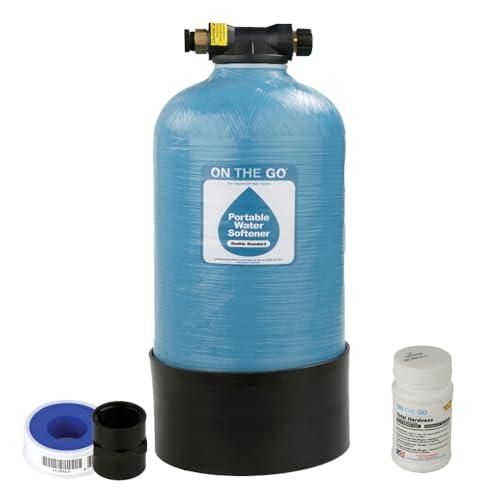 On The Go Portable Water Softener, 16,000 Grain Double StandardThe default portable softener for a travel trailer: the most resin per dollar in the category, and the only brand here that publishes enough to check. | Most travel trailers, and anyone parked in genuinely hard water | Strong | |
| 2 | 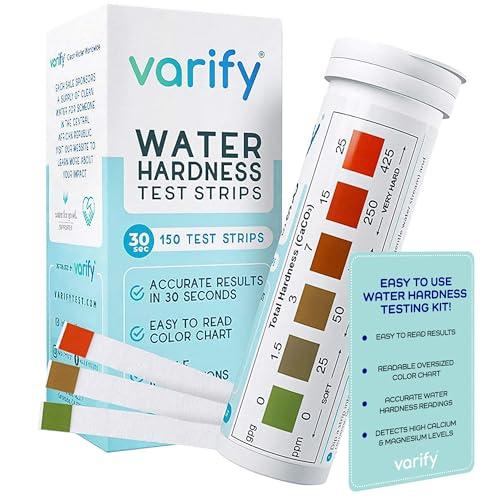 Varify Water Hardness Test Kit (150 strips)A few dollars that decide whether you need to spend anything else on this page. Buy this first, every time. | Finding out whether you need a softener at all | Strong | |
| 3 | 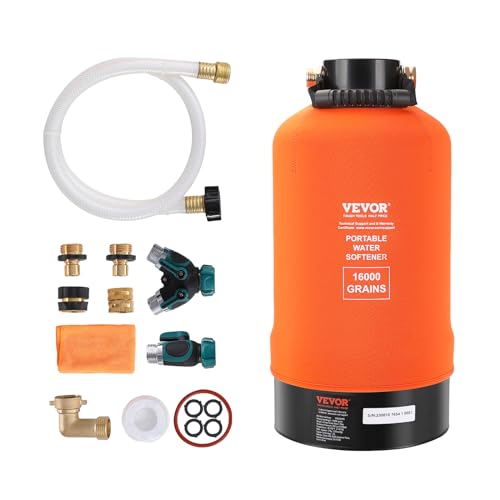 VEVOR Portable RV Water Softener (16,000 grain)The budget pick, and a defensible one: the mechanism is simple enough that a cheap version mostly works. Just know you are buying a claim rather than a specification. | The cheapest honest way into ion exchange | Good | |
| 4 | 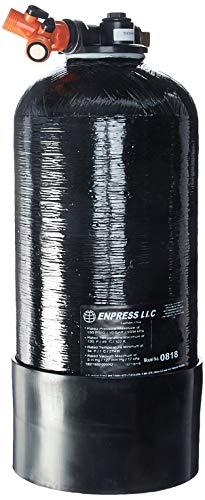 Watts RV PRO-1000 Portable Water Softener (M7002)Buy it for the flow rate and the brand behind the fittings, not for the capacity. It is the small tank at the big price. | Flow rate, and a plumbing brand behind the part | Good | |
| 5 | 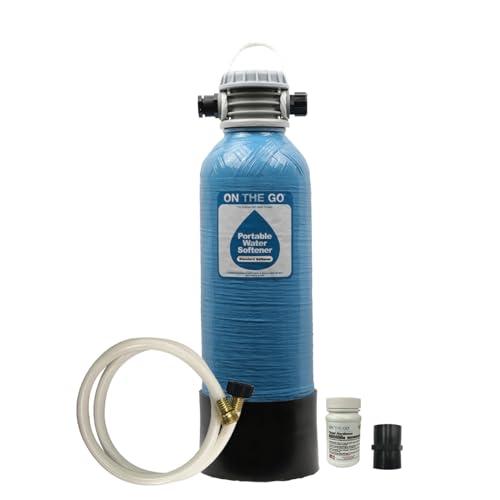 On The Go Standard Portable Water Softener (OTG4-StdSoft)Buy it only if the Double Standard will not physically fit. On price per grain it is the worse deal, and we would rather say so. | A small trailer with no room for the taller tank | Strong |
Prices come from Amazon and were last checked November 27, 2026. They change constantly, so a price older than 48 hours is withdrawn rather than shown stale — those rows read “Check price on Amazon” instead and go straight to the current listing. #ad — these are affiliate links.
What a water softener actually does, and what it cannot do
This is the part that decides whether you should be on this page at all, so it comes before the picks.
A softener is ion exchange, not filtration. Inside the tank is a bed of resin beads loaded with sodium. Hard water is water carrying dissolved calcium and magnesium; as it passes through the bed, the resin swaps its sodium for those two minerals and holds on to them. The water that comes out the other side has the same amount of dissolved material in it — it is just carrying sodium instead of calcium, and sodium does not form scale. Nothing is strained out. Nothing is removed. Two ions are traded for another.
That is why a filter cannot soften. A carbon or sediment filter catches particles and adsorbs chemicals that affect taste and smell. Dissolved calcium is neither a particle nor a smell, so it goes straight through, which is exactly what our hard water filter page says. The reverse is also true and less often mentioned: a softener does nothing for grit, rust or a campground that tastes of chlorine. They are two different jobs and you want both devices in the line.
And it has to be regenerated. The resin only holds so much calcium before it is full. At that point you flush it with a strong salt solution, the sodium pushes the hardness minerals back off the beads, the whole lot drains away, and the bed is ready again. On a portable RV unit that means pouring in a couple of boxes of table salt, waiting, and rinsing — On The Go publishes two boxes and under thirty minutes for the Double Standard. It is not difficult. It is just a chore you now own, roughly every couple of weeks in genuinely hard water, and it is the reason some owners buy one of these and then leave it in the garage.
Find out whether you even need one
Hardness is a property of the campground, not of your trailer. You can tow the same rig from water that needs nothing to water that will scale a shower head in a month.
The published scale. The USGS publishes its general classification in milligrams per liter as calcium carbonate: 0 to 60 is soft, 61 to 120 moderately hard, 121 to 180 hard, and above 180 very hard. It also records that hard water is prevalent in the east-central and western United States, which is most of the places a first-season owner is likely to be towing. Note that the USGS table does not publish grains per gallon at all — the conversion is a unit conversion, one grain per gallon being 17.1 mg/L, so the “very hard” line sits a little above 10 grains per gallon.
Test, do not guess. A strip kit costs less than a tank of fuel and reads in seconds. Dip one at the spigot when you arrive at a site and you will know within a minute whether the softener in your storage bay is worth connecting that week. This is the single most useful thing in this whole category and it is the cheapest item on the page, which is why it is ranked second rather than fifth.
What hard water looks like if you have not tested. White crust around the shower head and faucet aerators. Soap and shampoo that will not lather and then will not rinse off. Spots on everything you wash up. A film on the shower walls. If none of that is happening to you, you do not have a softening problem, and the money is better spent on a decent filter.
Turning a grain rating into days
Every unit here is sold on a grain number, and the number is less informative than it looks until you do one division.
Grains is total capacity, not a run length. A 16,000 grain softener removes 16,000 grains of hardness before it needs regenerating. How many gallons that is depends entirely on how hard your water is. Divide the capacity by your hardness in grains per gallon and you have your gallons. At 11 grains per gallon, 16,000 grains is about 1,450 gallons; at 30 grains per gallon it is about 530. Same tank, a third of the run.
Then divide by what you use. A couple in a travel trailer on full hookups, showering at the trailer and washing up at the sink, is realistically somewhere in the region of 30 to 50 gallons a day. Against roughly 1,450 gallons that is a month or so; against 530 gallons it is a week and a half. That spread is the real answer to “how often will I be doing this?” and it is why we keep pushing the test strip.
Treat the marketing gallons as marketing. Camping World’s specification page for the Double Standard publishes “1,600 gallons of soft water (up to 40 days)” and does not state the hardness that figure assumes. It is not a dishonest number, it is just an unanchored one — and a reader in 30 grain water who plans around 40 days will be disappointed in week two. Do your own division.
How we choose
Capacity per dollar, because the mechanism is a commodity. Every product on this page is a tube of standard softening resin with a head on top. There is no proprietary chemistry to pay for and no performance claim anyone can measure between two tanks of the same capacity. So we rank on grains per dollar and then on whether the maker publishes enough for the figure to mean anything.
Regeneration on ordinary salt. Anything that needs a proprietary pack, a cartridge subscription or a special salt would be disqualified here, and we are glad to report that nothing in the portable RV category currently does. Table salt from a grocery store is the running cost, and it is a couple of dollars.
What is published, not what is implied. One brand here publishes capacity, dimensions, weight and a written regeneration procedure. One publishes a flow rate. One publishes a listing bullet and nothing else. That ordering is most of our ranking, because on a part that holds pressurized water inside your trailer, a company willing to put numbers in writing is worth something.
Physical fit, which eliminates picks on its own. These tanks are 21 to 22 inches tall and nine or ten inches across, and they have to live somewhere when you are towing. A wet bay with a shallow door will decide this for you, which is the only honest reason to buy the smaller tank.
We do not test products and say so on how we choose. No softener on this page was run by us, no water was analyzed in a laboratory, and no hardness reading here is ours. Every grain capacity, dimension and flow figure below is the maker’s or the retailer’s own, reported as a claim, and the gallons arithmetic is labeled as arithmetic. What we can do is read the published numbers against each other, point out where a figure has nothing behind it, and tell you to measure your own water before you spend anything. Sources are linked at the end.
The picks
1. Best for Most travel trailers, and anyone parked in genuinely hard water
On The Go Portable Water Softener, 16,000 Grain Double Standard
The default portable softener for a travel trailer: the most resin per dollar in the category, and the only brand here that publishes enough to check.
- Specification
- 16,000 grain capacity (maker's figure)
- Specification
- Camping World publishes 1,600 gallons of soft water, up to 40 days, without stating the hardness behind it
- Specification
- Regenerates with 2 boxes of common table salt in under 30 minutes (maker)
- Specification
- 22 in tall x 9-1/2 in diameter, 34.18 lb (Camping World)
- Specification
- Standard hose connection, with a back-flush adapter and a 4 ft drinking hose in the box
- Specification
- Assembled in Indiana per the listing
What it does well
- Double the resin of the 8,000 grain model for a price difference that is usually small enough to be a rounding error, which makes it the obvious buy of the two
- Regenerates on table salt from any grocery store rather than on a proprietary cartridge, so running it costs a couple of dollars a month
- The brand actually publishes capacity, dimensions and a regeneration procedure, which most of this category does not
- Tall and narrow, so it stands in a wet bay or beside the pedestal instead of needing floor space
The real tradeoff
- Heavy to carry when wet, and it is one more 34 lb object to find room for in a trailer that is already full
- The published 1,600 gallon figure has no hardness attached to it, so treat it as marketing rather than as a number you can plan around
- Regeneration takes half an hour and a place for salty flush water to go, which is awkward at a tight site
- It softens. It does not filter sediment or improve taste, so you still want a filter in the line
How it measures up
These are judgments from published specifications and what we see at the lodge, not laboratory results. How we choose.
- Beginner fit
- Strong — Hose in, hose out, salt once in a while.
- Capacity per dollar
- Strong — 16,000 grains for close to the 8,000 price.
- Published data
- Good — Capacity, size and procedure; no hardness behind the gallons.
- Portability
- Adequate — Narrow, but 34 lb wet.
Specifications from Camping World published specifications.
2. Best for Finding out whether you need a softener at all
Varify Water Hardness Test Kit (150 strips)
A few dollars that decide whether you need to spend anything else on this page. Buy this first, every time.
- Specification
- 150 strips, reading calcium and magnesium hardness (listing)
- Specification
- Dip and compare against a printed color scale, with a result in seconds
- Specification
- Costs a small fraction of any softener on this page
What it does well
- The only item here that can save you the entire cost of the other four - plenty of campgrounds are not hard enough to need a softener
- 150 strips is enough to test every site you stay at for years, which is the point: hardness belongs to the campground, not to your trailer
- Reads the actual number you need in order to turn a grain capacity into a run length
The real tradeoff
- A color-match strip, not a laboratory titration, so read the result as a band rather than as a precise figure
- Does nothing about hard water on its own. It only tells you what you are dealing with
- Strips are time-sensitive once wet, so read them when the instructions say to
How it measures up
These are judgments from published specifications and what we see at the lodge, not laboratory results. How we choose.
- Beginner fit
- Strong — Dip, wait, compare.
- Capacity per dollar
- Strong — Not a softener, and still the best value here.
- Published data
- Adequate — Listing claims; it is a test strip.
- Portability
- Strong — A pocket vial.
3. Best for The cheapest honest way into ion exchange
VEVOR Portable RV Water Softener (16,000 grain)
The budget pick, and a defensible one: the mechanism is simple enough that a cheap version mostly works. Just know you are buying a claim rather than a specification.
- Specification
- 16,000 grain capacity claimed by the listing
- Specification
- 3/4 in brass fittings and a 42 in hose included (listing)
- Specification
- Same table-salt regeneration principle as the branded units
What it does well
- Roughly half the price of the branded 16,000 grain tanks, which is a real saving on a product that is mostly a tube of resin
- Brass fittings rather than plastic at the two connections that get cross-threaded most
- Comes with its own hose, so there is nothing else to buy on day one
The real tradeoff
- A marketplace brand with no published resin specification, no documented regeneration procedure and no service parts - if a head cracks, you are buying another one
- The 16,000 grain claim is the listing's own, with nothing behind it you can check, so we rank it below the brands that publish
- No US assembly or support story, which matters more than it sounds on a part that holds pressurized water inside your trailer
How it measures up
These are judgments from published specifications and what we see at the lodge, not laboratory results. How we choose.
- Beginner fit
- Good — Hose on, hose off; documentation is thin.
- Capacity per dollar
- Strong — The cheapest 16,000 grain claim here.
- Published data
- Weak — A listing bullet and nothing else.
- Portability
- Good — Comparable tank size to the brands.
4. Best for Flow rate, and a plumbing brand behind the part
Watts RV PRO-1000 Portable Water Softener (M7002)
Buy it for the flow rate and the brand behind the fittings, not for the capacity. It is the small tank at the big price.
- Specification
- 10,000 grain capacity (retailer listings)
- Specification
- Flow up to 4 GPM published, which is the only flow figure anyone in this category states
- Specification
- Tank dimensions published variously as 9 x 21 in and 8 x 22 in across listings, with a 3/4 in female garden hose inlet and a 3/4 in outlet
- Specification
- Regenerates with common table salt
What it does well
- Watts is a mainstream plumbing manufacturer, and the fittings and head feel like it
- A published flow rate, which matters if you have ever watched a softener turn a shower into a dribble
- Shorter tank than the On The Go units, so it fits lower bays
The real tradeoff
- The most expensive unit here by a wide margin, for the least capacity of the three larger tanks
- Published weights disagree between retailers, which is a reminder of how loosely this category is documented
- 10,000 grains in very hard water is a short run between regenerations
How it measures up
These are judgments from published specifications and what we see at the lodge, not laboratory results. How we choose.
- Beginner fit
- Good — Standard hose threads, clear instructions.
- Capacity per dollar
- Weak — Least resin, most money.
- Published data
- Good — The only published GPM in the category.
- Portability
- Strong — Shortest tank here.
Specifications from Watts.
5. Best for A small trailer with no room for the taller tank
On The Go Standard Portable Water Softener (OTG4-StdSoft)
Buy it only if the Double Standard will not physically fit. On price per grain it is the worse deal, and we would rather say so.
- Specification
- 8,000 grain capacity (maker's figure)
- Specification
- Half the resin of the Double Standard above, in a shorter tank
- Specification
- Same regeneration method: common table salt, no proprietary cartridge
- Specification
- At 11 grains per gallon of hardness, 8,000 grains is about 727 gallons - our arithmetic, not a published rating
What it does well
- Genuinely smaller and lighter, which is the entire reason to choose it over the Double Standard
- Same simple salt regeneration, and the same absence of consumables to buy
- Fits a wet bay that the taller tank will not
The real tradeoff
- On the day we checked it cost only a little less than the 16,000 grain model, so you are paying nearly the same money for half the capacity
- In hard water you will be regenerating it roughly twice as often, which is the one chore this product has
- No gallons rating is published for this model, so plan from your own hardness number
How it measures up
These are judgments from published specifications and what we see at the lodge, not laboratory results. How we choose.
- Beginner fit
- Strong — Identical to its bigger sibling.
- Capacity per dollar
- Weak — Half the resin, nearly the same price.
- Published data
- Adequate — Capacity only.
- Portability
- Strong — The reason this model exists.
Specifications from Camping World (On The Go capacity range).
Published capacity against what it costs you
| Pick | Published capacity | Who publishes it | The catch |
|---|---|---|---|
| On The Go Double Standard | 16,000 grains | Maker, plus dimensions, weight and procedure | 34 lb and 22 in tall; its gallons claim has no hardness attached |
| Varify hardness test kit | 150 strips | Listing | Tells you the problem, does nothing about it |
| VEVOR portable softener | 16,000 grains claimed | Listing only | No resin specification, no documented procedure, no parts |
| Watts Flow-Pur RV PRO-1000 | 10,000 grains, up to 4 GPM | Retailer listings | Most money, least resin; published weights disagree |
| On The Go Standard | 8,000 grains | Maker | Costs nearly what the 16,000 grain tank costs |
What the table cannot show is any measured difference in softening between two tanks of equal capacity, because there is not one to show. Resin is resin. The ordering above is about how much of it you get, how well documented it is, and whether it fits where you need to put it.
If you are working out whether this is your problem
Buy the strips first and test the next three campgrounds you stay at. If they come back hard, the Double Standard is the default and the VEVOR is the budget route into the same mechanism. If they come back soft, you have just saved the price of a softener and you should spend some of it on a filter instead.
Best for Finding out whether you need a softener at all
Varify Water Hardness Test Kit (150 strips)
A few dollars that decide whether you need to spend anything else on this page. Buy this first, every time.
Best for Most travel trailers, and anyone parked in genuinely hard water
On The Go Portable Water Softener, 16,000 Grain Double Standard
The default portable softener for a travel trailer: the most resin per dollar in the category, and the only brand here that publishes enough to check.
Best for The cheapest honest way into ion exchange
VEVOR Portable RV Water Softener (16,000 grain)
The budget pick, and a defensible one: the mechanism is simple enough that a cheap version mostly works. Just know you are buying a claim rather than a specification.
Salt, sodium and the question people actually worry about
Does softened water taste salty? Not in the way people fear. Ion exchange adds sodium in proportion to the hardness it removes, so harder water produces a slightly higher sodium figure on the other side. In most municipal water that amount is small. What people genuinely do taste is the tail end of a regeneration that was not rinsed out properly, which tastes strongly of brine and is a procedure problem rather than a property of the device. Rinse until it runs clean.
Is it a problem if you are on a sodium-restricted diet? It is a fair question and not one we are qualified to answer for you, so we will say only what is true of the mechanism: softening adds sodium, the amount scales with your incoming hardness, and the standard answer in household plumbing is to leave one drinking tap unsoftened. On a trailer, the equivalent is to use bottled or filtered water for drinking and the softened supply for everything else.
Where does the flush water go? This is the practical constraint nobody mentions. Regeneration produces several gallons of salty rinse water that has to drain somewhere that is not a lawn, a garden bed or your neighbor’s site. At a full-hookup site the sewer connection is the obvious answer. At a dry or partial site, this is the reason to regenerate before you leave home rather than on arrival.
Can you leave resin in a tank over winter? Not if the tank is going to freeze. Water in a resin bed behaves like water anywhere else, and a split head is the usual result. Drain it, store it somewhere above freezing, and treat it as part of the same job as the rest of the plumbing — the antifreeze roundup and the winterizing walkthrough cover the rest of it.
Mistakes that make a softener look like it failed
Expecting it to fix taste. It will not. Softened water tastes slightly different because the minerals have changed, but chlorine, sulfur and campground mustiness are a filter’s job. People buy a softener to fix a taste problem, get soft water that still tastes of chlorine, and conclude the unit is broken.
Running it on a site that does not need it. Soft water through a softener is soft water, but you have added two more hose joints, a pressure drop and a chore for no benefit. Test, then connect.
Skipping the regeneration until the symptoms come back. Resin does not warn you. It simply stops exchanging, and the first sign is scale and flat shampoo again. Track your gallons or count your days and regenerate on the schedule your own hardness number gives you.
Buying it before the regulator. We see this order reversed often enough to name it. Unregulated campground pressure is the failure that costs money, and a softener is one more component in that line to split. The regulator is the purchase that protects everything, including this.
Leaving it standing in the sun all season. These are plastic pressure vessels. UV is as unkind to them as it is to a hose, and shade or a bay costs nothing.
Where this sits in a first season
A softener is firmly in the second tier of fresh-water purchases, and we would rather be honest about that than sell one to everybody. The things that come first are the ones that prevent damage or protect your health: a pressure regulator so a high-pressure site does not split a line inside a wall, a drinking-water hose because a garden hose is not rated for water you will drink, and the right hose length and diameter so you can reach the spigot at all.
Softening comes after those, and it earns its place for exactly two kinds of owner: the one parked long-term in hard water, watching scale build up on the fixtures, and the one who simply cannot stand what hard water does to hair and skin on a two-week trip. If you are either of those, the Double Standard and a box of table salt is a solved problem for about the price of a night in a hotel. If you are neither, buy the strips, test for a season, and spend the rest on filtration instead.
A softener and a filter are two devices in one line rather than alternatives, and most owners need only one of them. Which one, and in what order, is on best RV water filter and softener.
Questions people actually ask
Do I really need a water softener in my RV?
Only if the water where you park is actually hard. Hardness belongs to the campground, not to the trailer, so the honest first step is a hardness test strip at the spigot rather than a purchase. The USGS classifies water above 180 mg/L as calcium carbonate as very hard and records that hard water is prevalent in the east-central and western United States, so plenty of owners do need one - but plenty do not, and a strip kit costs a tiny fraction of a softener.
What is the difference between an RV water softener and an RV water filter?
A softener is ion exchange: a resin bed trades its sodium for the dissolved calcium and magnesium that cause scale, and nothing is strained out. A filter catches particles and adsorbs chemicals that affect taste and smell, and it cannot touch dissolved hardness minerals. They solve different problems, which is why the two devices go in the line together rather than one instead of the other.
How many grains of water softener do I need for a travel trailer?
Buy the largest capacity that physically fits, because grains are capacity rather than performance and more grains simply means longer between regenerations. To size it to your own water, divide the grain rating by your hardness in grains per gallon: 16,000 grains at 11 grains per gallon is roughly 1,450 gallons, and the same tank in 30 grain water is roughly 530. Then divide by your daily use, which for a couple on hookups is commonly in the region of 30 to 50 gallons a day.
How often do you have to regenerate an RV water softener?
It depends on your hardness and your water use, not on a calendar. In moderately hard water a 16,000 grain unit can run most of a month for two people; in very hard water the same tank may need regenerating every week or two. On The Go publishes two boxes of common table salt and under thirty minutes for the Double Standard, and the process is pour, wait, rinse until the water runs clean.
What kind of salt does a portable RV water softener use?
Common table salt from any grocery store. That is one of the genuinely good things about this category: there is no proprietary cartridge, no subscription and no special softener pellet needed on the portable units, so the running cost is a couple of dollars per regeneration.
Does an RV water softener remove chlorine or improve taste?
No, and expecting it to is the most common disappointment with these units. Softening changes which minerals the water is carrying; it does not remove chlorine, sulfur smell, sediment or rust. If taste is your complaint, a carbon filter is the product you want, and if hardness is also a problem you run both in series with the filter downstream of the softener.
Where does the salty water go when you regenerate?
Several gallons of brine rinse have to drain somewhere that is not grass, a garden bed or a neighbor's site. At a full-hookup site the sewer connection is the obvious destination. At a dry or partial-hookup site, regenerate at home before you travel instead - this is the practical constraint that catches people out on arrival.
Can you leave a water softener outside over winter?
Not where it will freeze. The resin bed holds water, and water in a sealed plastic pressure vessel behaves the way it does everywhere else on a trailer. Drain it and store it above freezing as part of the same job as winterizing the rest of the plumbing.
Sources
Read next
Sewer & Water
Best RV Water Filter for Hard Water
The honest answer on hardness, what a filter genuinely fixes, and the canister-versus-inline decision.
Sewer & Water
Best RV Water Filter
Inline and canister water filters compared, with an honest account of what filtration at this level achieves.
Sewer & Water
Best RV Water Pressure Regulator
Fixed and adjustable pressure regulators compared, with the flow tradeoff explained and a pressure to aim for.
Sewer & Water
RV Water Filter and Pressure Regulator: Which Goes First
The order of the regulator and filter on a city water line, why it matters, and which of the two you actually need.
Reviewed November 16, 2026. Spot something out of date? Tell us and we will fix it.