What Size Water Hose Do I Need for an RV?
Three numbers decide this and only one of them is on the front of the packaging. Here is what 5/8 inch, 3/4 inch thread and 25 feet each mean, and which of them you are allowed to change.
Heads up: this page contains affiliate links. If you buy through one, Camp & Chock may earn a commission at no extra cost to you. It never changes which product we put first — how this site is funded.
The short answer
5/8 inch inside diameter, 3/4 inch garden hose thread, 25 feet long, white. That is the answer for essentially every travel trailer, and it is one product rather than a set of choices. The thread is standardized, so it is not really a decision. The diameter is where the money gets saved on cheap hoses and where you pay for it in the shower. The length is the only number that genuinely depends on your site, and even then 25 ft reaches almost everywhere — buy a second 25 ft hose rather than one 50 ft hose if you need reach sometimes.
Part of our sewer and water guide. For which hose to actually buy, see the fresh water hose roundup; if a garden hose is what you have in the shed, can you use a regular hose for RV water answers that first. Sewer hose sizing is a completely separate number and lives in what size RV sewer hose do I need.
The three numbers, and which one you can change
RV fresh water hose sizing at a glance
| Number | The standard | Can you change it? |
|---|---|---|
| Inside diameter | 5/8 in | You can, and you should not. Smaller throttles flow; larger buys nothing |
| Thread | 3/4 in garden hose thread (3/4-11.5 NH), the same on every RV fresh-water fitting | No. It is a standard, which is what makes regulators and filters interchangeable |
| Length | 25 ft | Yes. This is the one real decision, and it is decided by measuring |
Diameter: why 5/8 inch and not 1/2 or 3/4
Hose diameter is quoted as inside diameter — the hole the water goes through, not the outside of the jacket. An RV fresh-water hose is 5/8 in, and that figure is on the packaging or the spec line of every hose worth buying.
Half-inch hoses exist and are a false economy. They turn up most often among cheap heated hoses and compact coil hoses, at a price that looks like a bargain next to the 5/8 in version. A narrower pipe moves less water at the same pressure, and in a trailer that shows up in exactly one place: the shower, with the water heater also drawing. It is a permanent, daily compromise bought to save a few dollars once.
Three-quarter-inch hoses also exist and buy you nothing. The restriction in your fresh-water system is not the hose. It is the city-water inlet, the internal plumbing and the pump — and the campground spigot upstream of all of it. Bigger hose, same shower, heavier coil, more money, more space in the compartment.
So the diameter is not really a decision either. It is a thing to check, once, on the listing, before you buy. If a hose does not state its inside diameter anywhere, that silence is the specification.
Thread: 3/4 inch garden hose thread, and why that matters
Every fresh-water fitting on an American RV uses the same thread: 3/4 inch garden hose thread, written as GHT or as 3/4-11.5 NH, and standardized in ANSI/ASME B1.20.7. It is a straight, non-tapered thread at 11.5 threads per inch, and it is the same thread on a garden spigot, a hose end, a pressure regulator, a filter canister and your trailer’s city-water inlet.
That standard is quietly why this whole category is easy. It means any regulator threads onto any hose, any filter fits in any order, a splitter at the spigot works, and a heated hose drops straight into the setup you already own. There is no RV-specific fitting to hunt for and nothing to adapt.
Two caveats worth knowing. The first is that your trailer’s city-water inlet is usually a 3/4 in GHT female connection on the outside and a 1/2 in NPT pipe thread on the inside, where it joins the trailer plumbing — so the only part you ever thread a hose onto is the GHT side. The second is that garden hose thread is not pipe thread: do not try to thread a hose onto a tapered NPT fitting, and do not reach for thread tape to fix a leak. A GHT joint seals on a rubber washer, not on the threads. Nine leaks out of ten at this connection are a missing, flattened or grit-filled washer.
Length: the only number that is actually your decision
Twenty-five feet is the default, and it is the right default. Campground sites are laid out so hookups sit near where the trailer parks. Twenty-five feet reaches at the overwhelming majority of them, coils into a reasonable space, and holds a sensible amount of standing water.
Buy a second 25 ft hose instead of one 50 ft hose. This is the part people get backwards. Two 25 ft hoses give you 25 ft most of the time and 50 ft when you need it. One 50 ft hose gives you 50 ft of hose to coil, store and drain at every single site, plus twice the water sitting in the sun. You also get a spare, which matters the day a fitting splits.
More hose means warmer water, not less pressure. The pressure loss over an extra 25 ft of 5/8 in hose is not something you will feel. What you will feel is the first thirty seconds of hot water at the kitchen tap on a July afternoon, because the hose has been lying in the sun. That is a reason to use the shorter hose when you can, not a reason to fear a long one.
When 50 ft as one hose is genuinely right. A seasonal site you have already measured, and the heated case: a heated hose joined to an unheated hose freezes at the joint, so if the run is 35 ft in winter you want one 50 ft heated hose, not a heated 25 plus an ordinary 25. That is covered in the heated hose roundup.
Hoses in the right size
All three are 5/8 inch inside diameter with standard 3/4 inch garden hose thread. The Camco is the standard reinforced white hose and the sensible first buy; the Zero-G is the lightweight version for anyone who hates coiling; the Kohree is the same sizing in a heated hose for a cold-weather site.
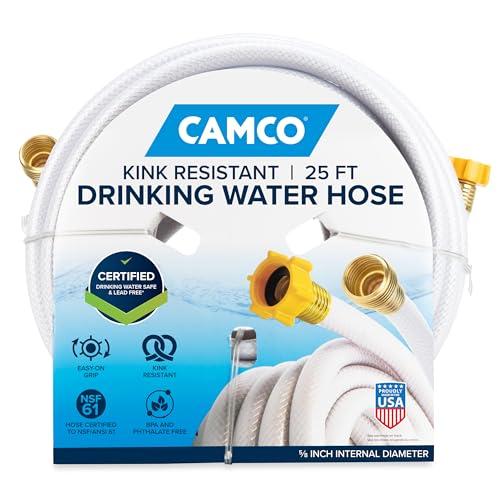
Best for The default fresh water hose
Camco TastePURE Drinking Water Hose (25 ft)
The correct part rather than an upgrade: a drinking-water-rated hose, in white so it never gets mixed up with the sewer gear.
Best for Easy coiling and small storage
Zero-G RV and Marine Drinking Water Hose
The lightweight upgrade: it coils small, stays flexible in the cold, and costs enough to be a second-season purchase.
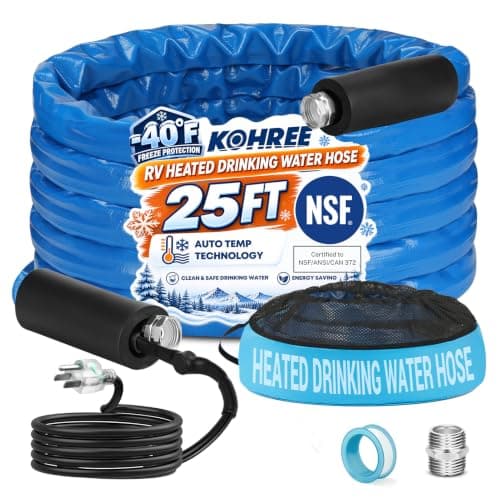
Best for A first winter on full hookups without paying resort-brand money
Kohree 25 ft Heated RV Water Hose
The heated hose to buy for a first cold-weather season: right diameter, a thermostat, and a price that does not make you question whether you needed one.
What size for the other hoses on the trailer
“RV water hose” gets used for three different hoses, and only one of them is the fresh-water line. Since the sizes are different, it is worth being explicit.
The fresh-water hose: 5/8 in, white, drinking-water rated, 25 ft. The subject of this page.
The tank-rinse hose: the same size, and a second hose. Buy an identical 25 ft hose, mark it, and keep it well away from the drinking one — this is the hose that goes near the sewer connection and into the black tank flush inlet. Color is the whole safeguard when two coiled hoses share a dark compartment, which is why the fresh one is white.
The sewer hose: 3 inch, and a different world. Nothing on this page applies to it. It sizes by length and by fitting type, and what size RV sewer hose do I need is the page for that.
Sizing mistakes that cost money or flow
Buying by outside diameter or by the fitting size. The number that matters is inside diameter. A listing with “3/4 inch” on the front of it is usually telling you the thread size — which is the same on every hose — not the bore.
Buying one 50 ft hose as the only hose. Covered above. Two 25s beat one 50 for nearly everybody.
Using a garden hose because the thread fits. It fits because the thread is standardized. That does not make the material drinking-water rated, which is the entire point of that separate question.
Chasing a leak with thread tape. A GHT connection seals on a washer. Replace the washer, hand-tighten, and stop.
Forgetting the regulator sizes nothing. A pressure regulator limits pressure, not flow rate, and it does not change what diameter hose you need. How to use one covers where in the line it goes, which is at the spigot.
Coiling a 5/8 in hose tight and hot. Not a sizing mistake exactly, but it is how a correctly sized hose becomes a kinked one. Loose coils, in the shade, drained.
The short version to take to the store
One 25 ft white drinking-water hose at 5/8 in inside diameter, and then a second identical one for tank rinsing. Standard 3/4 in garden hose thread, which you do not have to ask about because there is no alternative. A regulator at the spigot before either of them. That is the whole fresh-water sizing problem, and it is the same answer whether your trailer is 18 ft or 35 ft. If you are building the rest of the kit at the same time, the starter kit roundup puts it in order.
Questions people actually ask
What size water hose does an RV use?
A 5/8 inch inside diameter hose with standard 3/4 inch garden hose thread fittings. That is the size every RV fresh-water component is built around, from the city-water inlet to the pressure regulator to the filter.
What length water hose do I need for an RV?
Twenty-five feet covers almost every campground site. Buy a second 25 ft hose rather than a single 50 ft one: you get the reach when you need it, a shorter hose to coil the rest of the time, and a spare the day a fitting splits.
Is an RV water hose the same thread as a garden hose?
Yes. Both use 3/4 inch garden hose thread, designated 3/4-11.5 NH and standardized in ANSI/ASME B1.20.7. That is why any regulator, filter or splitter threads onto any hose. The thread being identical is also why people mistakenly use actual garden hoses, which are not drinking-water rated.
Can I use a 1/2 inch hose for my RV?
It will connect and it will work, and it will move less water than a 5/8 inch hose for as long as you own it. You notice it in the shower. Half-inch hoses show up most often among cheap heated hoses and compact coil hoses - check the inside diameter on the listing before the price convinces you.
Would a 3/4 inch hose give me better water pressure?
No. The restriction is the city-water inlet, your internal plumbing and the campground spigot, not the hose. A 3/4 inch hose is heavier, bulkier and more expensive with no change you can feel at the tap.
Why does my hose connection leak even when it is tight?
Because a garden hose thread joint seals on a rubber washer, not on the threads. Check the washer is present, flat and free of grit, replace it if it is squashed, and hand-tighten. Thread tape does not fix this connection.
Do I need two water hoses for an RV?
Yes, and they should be the same size. One white 25 ft drinking-water hose for the fresh supply, and a second identical hose kept separate for rinsing tanks and the black tank flush. The white jacket on the fresh one is the safeguard that stops you grabbing the wrong hose at dusk.
Sources
Read next
Sewer & Water
Best RV Fresh Water Hose
Drinking-water-safe hoses compared on length, flexibility and storage, plus why two hoses is the right answer.
Sewer & Water
Best Heated RV Water Hose for a Travel Trailer
Heated fresh-water hoses for freezing nights, ranked on diameter, published cold rating and what happens when the power goes off.
Sewer & Water
Can You Use a Regular Hose for RV Fresh Water?
Why a garden hose is the wrong part for an RV fresh water connection, and the three-item chain that is the right one.
Sewer & Water
Best RV Water Pressure Regulator
Fixed and adjustable pressure regulators compared, with the flow tradeoff explained and a pressure to aim for.
Reviewed November 2, 2026. Spot something out of date? Tell us and we will fix it.