Connecting an RV to a Home Sewer
Parking the trailer at the house and dumping into the home line is usually straightforward, and the fitting is often one you already own. The two things that catch people are permission and fall, and neither of them is sold in a box.
Heads up: this page contains affiliate links. If you buy through one, Camp & Chock may earn a commission at no extra cost to you. It never changes which product we put first — how this site is funded.
You connect into a sewer cleanout — the capped pipe stub that gives a plumber access to the house drain — and in most cases the 4-in-1 elbow that came with your sewer hose kit threads straight into it. The fitting is rarely the hard part. What decides whether this works is two things nobody sells you: whether your local rules and your property allow it, and whether the hose can run continuously downhill from the trailer to the cleanout with no low spot in the middle. Get those right and the rest is one afternoon.
Part of our sewer and water guide. If the fittings themselves are still a mystery, RV sewer connections explained is the catalog of what mates to what, and how to hook up an RV sewer hose is the campground version of the same job.
Where the connection goes, and where it must not
The cleanout. A house drain has at least one cleanout: a short capped pipe, usually 3 or 4 inches, sticking out of the ground near the foundation or out of a wall. It exists so a plumber can run a snake into the line, which makes it the one access point designed to be opened and closed. That is where an RV hose belongs.
Not a vent stack. The pipe coming out of the roof is a vent. It is connected to the drain system, so it looks like a shortcut. Running waste down a vent defeats the venting the whole system depends on and can leave you with drains that gurgle and traps that siphon.
Not a yard drain, a storm grate, a French drain or a sump. Those go to surface water, not to treatment. This is the mistake with the worst consequences on the list, and from ground level a storm grate and a cleanout can look similarly like somewhere a hose could go.
Not the washing machine standpipe, as a default. Some people do use a laundry or utility connection, and sometimes a plumber will tell you that is the sensible point on your particular house. It is not a thing to improvise, because a standpipe is sized and trapped for a washer and it is inside the building.
If you cannot confidently identify a cleanout in your yard, that is the moment to have a plumber point at it rather than the moment to guess. One visit also answers the slope question below, which is the other half of the job.
The fittings, honestly
This is where the internet overcomplicates things. Here is the whole picture.
What you find at the house, and what mates to it
| At the cleanout | What connects to it | Where it comes from |
|---|---|---|
| Threaded 3 in, 3-1/2 in or 4 in pipe with a screw-in plug | The 4-in-1 elbow from your sewer hose kit screws in | Already in the kit, per Camco's kit specification |
| Threaded pipe, but the threads are damaged | A flexible seal adapter that wedges into 3, 3-1/2 or 4 in | Sold separately, cheap |
| Plain glued PVC stub, no threads | A PVC female adapter glued on, then the threaded elbow | Any hardware store plumbing aisle |
| 4 in line, and you want a 3 in thread | A 4 in to 3 in PVC reducer bushing | Any hardware store plumbing aisle |
| Cleanout is further than your hose reaches | A second standard bayonet hose section | Any RV section mates to any other |
Two things follow from that table. First, nothing here is specialist RV plumbing: once you are past the bayonet fitting you are in ordinary hardware-store territory, and the parts cost a few dollars. Second, the fitting people most often buy for this job is the one already sitting in their hose kit — Camco specifies the removable 4-in-1 elbow in its RhinoFLEX kits as fitting 3 inch slip and 3 inch, 3-1/2 inch and 4 inch threaded pipe, which is the same range of sizes a residential cleanout comes in.
Two things to check before you buy anything
Whether you are allowed to. Residential drainage and what may be parked and occupied on a lot are governed by local rules, and they genuinely differ from one town to the next. Some jurisdictions are entirely relaxed about dumping a trailer into your own cleanout; some permit the connection but prohibit living in the trailer; some require a permit for a permanent connection. We cannot tell you which you live in, and anybody who tells you confidently without asking where you live is guessing. One call to your city or county building department settles it, and it is free.
Whether it is septic rather than municipal. A septic system is a biological process with a finite capacity, and a trailer adds a tank of concentrated waste at once rather than a household trickle. If the house is on septic, the volume question is real and the chemistry question matters too: avoid formaldehyde-based tank treatments, which interfere with the biology the system depends on. The formaldehyde-free options are covered in the tank treatment roundup.
Fall is the whole job
A campground dump is a short, steep run that you watch for four minutes and then pack away. A home connection is often longer, frequently has something in the way, and gets left in place. That changes what matters.
What you need is continuous fall: the hose going downhill the entire way from the trailer outlet to the cleanout, with no dip in the middle. A single low spot becomes a standing pool that never clears, and standing waste in a hose is where the smell and the eventual blockage live. If the hose has to cross a flat lawn, it needs supporting all the way, not at the ends — the sewer hose support roundup is the hardware for exactly that, and a support matters more on a permanent run than on a weekend one.
We are not going to publish a required gradient figure, because residential drainage slope is set by your local plumbing code rather than by us. The practical test needs no number: water should visibly keep moving along the whole run, and there should be no section where the hose sags below the line between its ends.
If the cleanout is uphill from the trailer, or far enough away that fall is impossible, gravity is not going to do this and no fitting will fix it. That is the one case where a macerator pump — which grinds and pumps waste through a small-diameter hose instead of relying on fall — is the right answer rather than an upsell. It is otherwise a purchase we tell first-season owners to skip, and what not to buy for your first RV explains why.
What this job actually uses
A complete hose kit, whose 4-in-1 elbow is threaded for the pipe sizes a cleanout comes in. A seal, because a permanent connection is the case where an odor-tight fit matters most. And a clear elbow, so you can see the flow run clear instead of guessing.
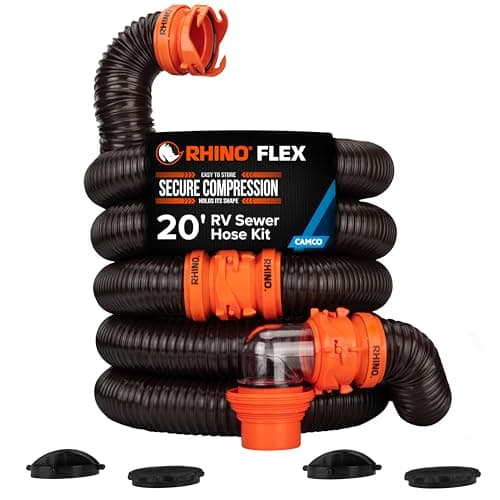
Best for The first sewer hose to own
Camco RhinoFLEX 20-Ft Sewer Hose Kit
The complete first kit: 20 ft in two sections, both fittings, and a clear elbow so you can see when the tank is actually done.
Best for Parks that require a sealed connection
Camco Rhino Sewer Hose Seal Donut
A rubber donut that seals the hose into the park's sewer inlet. Many parks require one, and most people find that out on arrival.
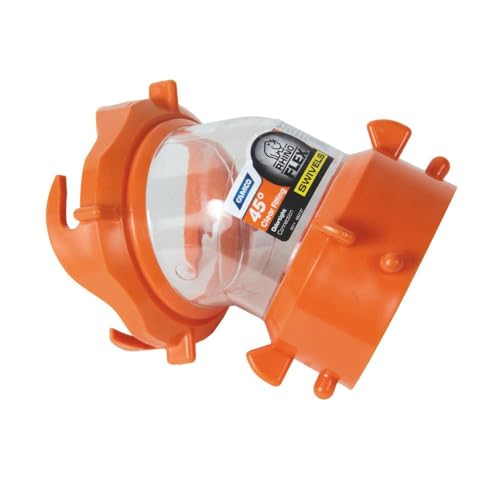
Best for Seeing when the tank is done
Camco RhinoFLEX Clear 45-Degree Sewer Adapter
The clear elbow: the cheapest way to know a black tank is genuinely empty rather than probably empty.
Seal it, or you will smell it
At a campground a loose elbow dropped into the inlet is tolerable because you are there for three days. On a connection that stays put outside a bedroom window, it is not. The house drain is vented to the roof, but an open hose into an open cleanout gives sewer gas a second route out, and it comes out at your trailer.
A threaded connection is inherently sealed, which is the main reason to use the threads rather than resting the elbow in the pipe. Where the threads are damaged or missing, a flexible seal adapter wedges into the pipe and gives you an odor-tight fit without them. Either way, cap the end of the hose when the trailer is disconnected rather than leaving an open pipe in the yard.
Should you leave the valves open?
The black valve, never. This is the one rule that does not bend. Liquid drains away, solids do not, and what you get is a compacted pile under the toilet that no amount of flushing clears. The tank needs to fill before it is dumped so the volume of water carries the solids out, and that is just as true at home as at a campground. How often to dump the black tank covers the timing.
The gray valve, with care. Leaving gray open on a sealed connection is a normal thing people do on a long stay, and it saves monitoring a small tank. The costs are that you lose the gray tank as a flush of water after dumping black, and that an open path is an odor path if the connection is not properly sealed. Our preference even at home is to keep both closed and dump deliberately, because the habit transfers to every campground you visit afterward.
Winter, if the trailer stays plugged in
A permanent hookup is exposed plumbing lying on the ground, and a hose with waste in it freezes before a house drain does. If the trailer is going to sit connected through a cold season, the hose is the first thing to fail and a split hose full of waste is a bad morning.
The honest answer for a first-season owner is to disconnect and dump deliberately in freezing weather rather than engineer a heated run, and if the trailer is not being used, to winterize it properly instead — how to winterize a travel trailer for storage is the procedure, and cold weather sewer hoses covers the hoses that stay flexible when it is cold.
What this connection does not do
It does not make the trailer a legal dwelling. Whether anybody may live in a trailer parked at a house is a separate local question from whether its waste may enter the house drain, and the two are often answered differently by the same authority. Ask about both.
It does not replace the water side. A hose from the house spigot still wants a pressure regulator and a filter, and house pressure can be higher than a campground’s — do I need an RV water filter and the pressure regulator roundup both apply at home exactly as they do on the road.
It does not mean you can skip rinsing. A tank dumped into a home line still benefits from a rinse, and the black tank flush guide is the routine. If anything a permanent spot makes it easier, because the water is right there.
Questions people actually ask
Can I connect my RV to my house sewer?
Usually, through a sewer cleanout, but whether you may is a local question rather than a plumbing one. Residential drainage rules and what may be parked or occupied on a lot vary by city and county, and some places permit the connection while prohibiting living in the trailer. One call to your local building department answers it before you buy any fittings.
What fitting do I need to connect an RV to a home sewer?
Often the one already in your sewer hose kit. Camco specifies the removable 4-in-1 elbow supplied with its RhinoFLEX kits as fitting 3 inch slip and 3, 3-1/2 and 4 inch threaded pipe, which covers the sizes a residential cleanout comes in. If your cleanout is a plain glued PVC stub with no threads, a PVC female adapter from any hardware store gives you the thread to screw into.
Where is my sewer cleanout?
Typically a short capped pipe, 3 or 4 inches across, standing just above ground near the foundation or coming out of a wall, on the side of the house the drain runs toward. If you cannot identify one with confidence, have a plumber point at it - the pipe you must not use is the roof vent, and the pipe you must never use is a yard or storm drain, which goes to surface water rather than to treatment.
Can I leave my RV sewer hose connected at home all the time?
You can, with two conditions: the run must fall continuously from the trailer to the cleanout with no low spot, and the connection must be sealed, because an open hose into an open cleanout gives sewer gas a route out next to your trailer. Keep the black valve closed regardless, and disconnect in freezing weather rather than leaving a hose full of waste to freeze.
Can I dump my RV into a septic system?
Only with the property owner's agreement and into a proper cleanout, and check local rules first. A septic system has a finite capacity and a trailer delivers a tank at once rather than a household trickle, so volume matters. Avoid formaldehyde-based tank treatments in that situation, because they interfere with the biology the system depends on.
What if the cleanout is uphill from where the trailer parks?
Gravity will not do it and no fitting changes that. This is the one situation where a macerator pump is the right purchase rather than an upsell: it grinds and pumps the waste through a small hose instead of relying on fall. If the cleanout is merely far away rather than uphill, a second standard bayonet hose section plus supports along the whole run is the cheaper answer.
Do I still need to flush the black tank if I am connected at home?
Yes, and a home hookup makes it easier because the water is right there. Dumping removes what will flow; rinsing is what stops residue building on the tank floor and on the sensors. Let the tank fill before dumping rather than dribbling it out, at home exactly as at a campground.
Sources
Read next
Sewer & Water
RV Sewer Connections Explained
The hardware between your tank valve and the campground inlet, named and explained, including the adapter for a PVC connection at home.
Sewer & Water
How to Hook Up an RV Sewer Hose (Step by Step)
The full sewer connection and dumping sequence, in order, with the two checks that prevent the story you tell for years.
Sewer & Water
Best RV Sewer Hose Support
Folding and compressing hose supports compared, plus why the homemade versions usually disappoint.
Sewer & Water
How to Flush an RV Black Tank
Black tank flushing with a built-in inlet or an add-on rinser, and why the sensors read wrong.
Reviewed October 19, 2026. Spot something out of date? Tell us and we will fix it.