Best Heated RV Water Hose for a Travel Trailer
A heated hose is the difference between a cold morning and a trip that ends at 6am with no water. It is also an electrical appliance lying in the mud, which is why the cheapest one is not automatically the wrong answer and the dearest one is not automatically the right one.
Heads up: this page contains affiliate links. If you buy through one, Camp & Chock may earn a commission at no extra cost to you. It never changes which product we put first — how this site is funded.
The short answer
Buy a 25 ft heated hose with a 5/8 in inside diameter and a thermostat, and buy it before the first forecast that says 28 degrees. The thing that decides whether you are happy with it is not the headline temperature rating — it is the diameter. A 1/2 in heated hose is cheaper, is sold in the same listings as the 5/8 in ones, and throttles your shower for the rest of the hose’s life. Go longer than 25 ft only if you have actually measured the run to the spigot, because a heated hose joined to an ordinary extension freezes at the joint, which defeats the entire purchase.
Part of our sewer and water guide. For warm-weather camping the ordinary fresh water hose roundup is the page you want, and what size water hose for an RV explains the diameter and thread numbers this page keeps referring to. The sewer side of cold weather is a separate problem, covered in the cold-weather sewer hose roundup.
Our picks at a glance
Tap any row to jump to the full write-up.
| # | Product | Best for | Beginner fit | Price |
|---|---|---|---|---|
| 1 | 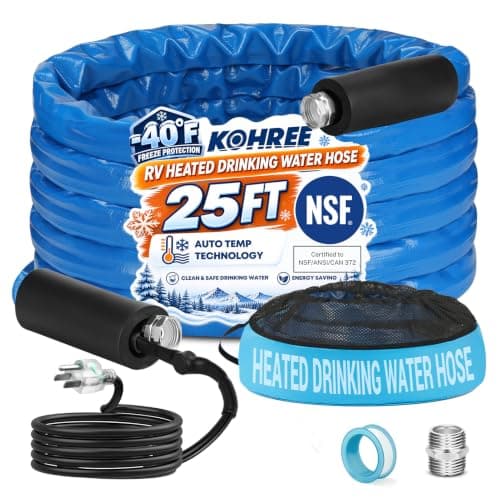 Kohree 25 ft Heated RV Water HoseThe heated hose to buy for a first cold-weather season: right diameter, a thermostat, and a price that does not make you question whether you needed one. | A first winter on full hookups without paying resort-brand money | Strong | |
| 2 | 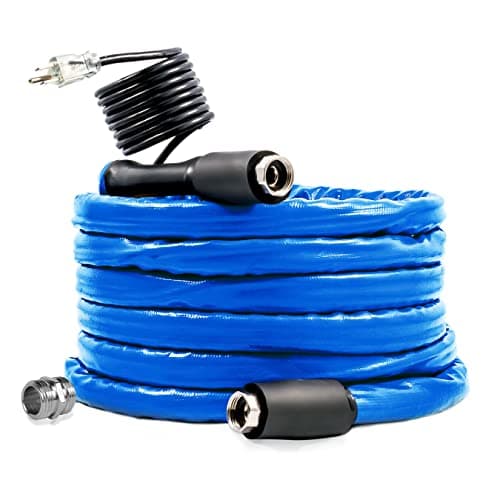 Camco 25 ft Heated RV Drinking Water Hose (22922)The known-brand heated hose: maker-published specs, a real warranty path, and a price that only makes sense if those things matter to you. | Buying from a brand with a dealer network behind it | Strong | |
| 3 | 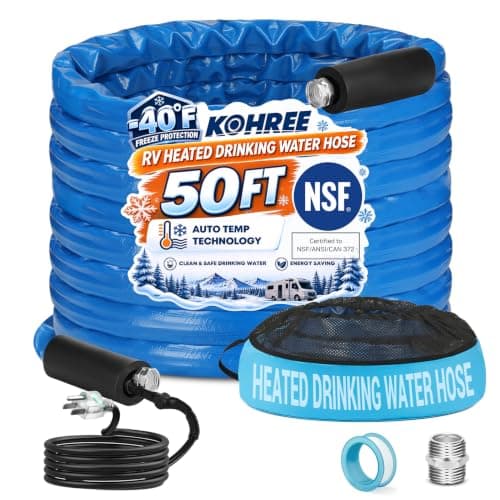 Kohree 50 ft Heated RV Water HoseBuy this only if you have measured the run and 25 ft does not reach. If it does reach, the shorter hose is the better product. | A seasonal site where the spigot is nowhere near the trailer | Good | |
| 4 | 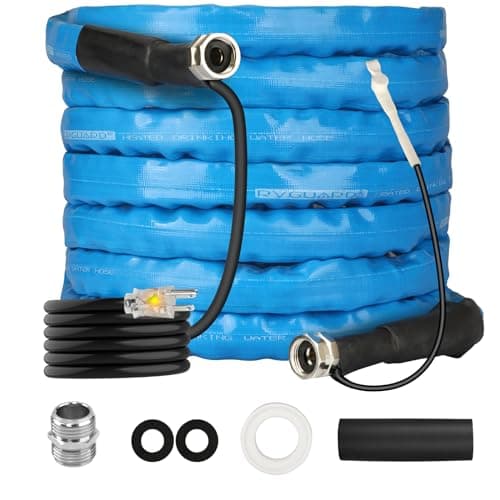 RVGUARD 25 ft Heated Water HoseThe right buy if you are protecting against frost rather than winter: the same convenience for the least money, at a rating you should check against your own climate. | A trailer that meets frost, not winter | Strong | |
| 5 | 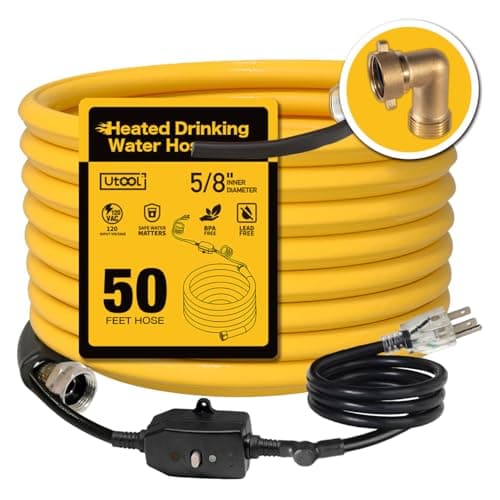 UTOOL 50 ft Heated RV Water HoseThe long heated hose for anyone who has already cracked a city-water inlet: the elbow protects the fitting the whole hose hangs off. | The connection detail nobody thinks about until the inlet cracks | Good |
Prices come from Amazon and were last checked November 12, 2026. They change constantly, so a price older than 48 hours is withdrawn rather than shown stale — those rows read “Check price on Amazon” instead and go straight to the current listing. #ad — these are affiliate links.
What a heated hose actually does, and what it does not
Inside the jacket of a heated hose runs an electric heat cable. Plug it into a 120 V outlet and the cable warms the water column enough to stop it turning to ice. That is the whole mechanism, and understanding its limits is most of what you need to shop well.
It protects the hose, not your plumbing. The heat cable stops at the fittings. The last few inches at the pedestal, the last few inches at your city-water inlet, the regulator, the filter canister and the inline fittings are all unheated, and in a hard freeze they are what fails first. A heated hose plus an unprotected brass regulator sitting in the open is a half-finished job.
It needs power all night, every night. This is obvious and still catches people. If the pedestal breaker trips at 2am, or you unplug the hose to run the heater on the same outlet, the hose is just a hose. A heated hose is not a passive safeguard like insulation — it is a device with an uptime requirement.
It does not keep your tanks or your pipes warm. Water in the hose is the easiest thing to protect because it is the thinnest and most exposed. The gray tank valve, the low-point drains and the plumbing in an uninsulated underbelly are a different and harder problem, and a heated hose has no opinion about any of them.
The honest alternative, stated up front. For a handful of cold nights you do not need one. Fill the fresh tank, disconnect the hose, drain it, and run the water pump — which is what the pump is for. A heated hose is for people who are hooked up for weeks at a time, or who want the hookup to simply work without thinking about it. If you camp four weekends a year and one of them is cold, the pump is cheaper, simpler and already installed.
How we choose
Inside diameter first, always. Five-eighths of an inch is the standard for RV fresh-water hoses and the size the rest of your gear assumes. A 1/2 in heated hose is a real product sold in this category at a tempting price, and the flow penalty shows up every single shower. Every pick on this page is 5/8 in. If a listing does not state the inside diameter, that is the answer to the question.
Who publishes the temperature rating, and where. There is a meaningful difference between a figure on a manufacturer’s own material and a figure in a marketplace bullet point. Camco publishes -40 degrees F for part number 22922; the marketplace brands state -20, -40 and even -45 degrees F on their listings and nothing independent backs any of it. We say which kind of number each one is, every time.
A thermostat, not a hose that heats all October. A thermostatic hose only draws power when it is cold enough to matter. On a metered site, or on a trailer sharing a 30 amp pedestal with a space heater, that is the difference between a sensible appliance and a constant load. Every pick here has one.
Drinking-water certification, stated honestly. NSF-61 covers the whole hose for drinking-water contact; NSF 372 covers lead content. “Lead-free and BPA-free” in a listing bullet is a material claim, not a certification. All three are better than nothing and they are not the same thing, so each pick below says which one it actually carries.
Length, decided by measuring rather than by hoping. Twenty-five feet reaches at almost every site. Fifty is for a seasonal spot where you already know the spigot is far away. Joining a heated hose to an unheated one creates an unheated section, and water freezes in the unheated section. There is no clever way around this.
We do not test products and say so on how we choose. Nothing below is a hose we froze in a chest freezer and nothing is a flow rate we metered. What we can do is read what each maker publishes, be explicit about whose number each figure is, and be blunt about the diameter trap and the unheated-fittings problem that the listings all skip.
The picks
1. Best for A first winter on full hookups without paying resort-brand money
Kohree 25 ft Heated RV Water Hose
The heated hose to buy for a first cold-weather season: right diameter, a thermostat, and a price that does not make you question whether you needed one.
- Specification
- 25 ft length, 5/8 in inside diameter, 3/4 in garden hose thread ends
- Specification
- Listing states freeze protection to -40 degrees F
- Specification
- Energy-saving thermostat, so the heat cable is not drawing power all day
- Specification
- Listing states NSF 372 certification (lead-free) for drinking water contact
- Specification
- Heavy-duty outer jacket and a sealed, leak-free fitting design
- Specification
- 120 V AC, plugs into a pedestal or exterior outlet
What it does well
- Does the one job that matters - water keeps flowing on a night that would otherwise end the trip - for roughly a third of the brand-name price
- 5/8 in inside diameter, which is the size the rest of your fresh-water gear assumes. Several cheap heated hoses are 1/2 in and you feel it in the shower
- The thermostat means it is not heating all day in October for nothing, which matters when the site meters your electric
- Standard hose thread at both ends, so it drops into the regulator and filter you already own
The real tradeoff
- Kohree is an Amazon-native brand with no dealer network: if it fails in year three there is nobody local to take it to
- The -40 degrees F figure is the listing's claim and nobody independent has verified it. Treat it as design intent, not a guarantee
- A heated hose is an electrical appliance lying in the mud. It wants its own GFCI-protected outlet, and that is true of every hose on this page
- It should not be coiled tightly while powered, which makes storage bulkier than a plain hose
How it measures up
These are judgments from published specifications and what we see at the lodge, not laboratory results. How we choose.
- Beginner fit
- Strong — Plug it in, connect it, forget it.
- Flow
- Strong — 5/8 in ID, so no shower penalty.
- Cold rating
- Strong — -40 F claimed, past what most owners ever see.
- Value
- Strong — A third of the brand-name price for the same job.
Specifications from Kohree.
2. Best for Buying from a brand with a dealer network behind it
Camco 25 ft Heated RV Drinking Water Hose (22922)
The known-brand heated hose: maker-published specs, a real warranty path, and a price that only makes sense if those things matter to you.
- Specification
- 25 ft length, 5/8 in inside diameter
- Specification
- Freeze protection to -40 degrees F / -40 degrees C, published for part number 22922
- Specification
- Energy-saving thermostat
- Specification
- NSF-61 listed hose for drinking water, lead-free, BPA-free and phthalate-free
- Specification
- Both ends female, with a female-to-male adapter included so either end can be the pedestal end
- Specification
- Sold through RV dealers and hardware chains as well as Amazon, so parts and support exist
What it does well
- The only pick here from a company that has sold RV plumbing for decades and has a dealer network behind it
- Either end can plug in, which sounds trivial until the only outlet on the pedestal is on the wrong side
- NSF-61 on the hose itself rather than a lead-free claim about the fittings
- The specification is published by the maker, not only in a marketplace listing
The real tradeoff
- Roughly three times the price of the Amazon-brand hoses on this page, for the same length and the same claimed rating
- Stock comes and goes and the street price swings hard between retailers - check the current price before you commit
- Retailer listings across Camco's heated range disagree about which part number is rated -20 F and which is -40 F. Buy by part number, not by the photo
- Heavy and stiff next to a plain fresh-water hose, and it does not want to be coiled tight
How it measures up
These are judgments from published specifications and what we see at the lodge, not laboratory results. How we choose.
- Beginner fit
- Strong — Adapter included, either end plugs in.
- Flow
- Strong — 5/8 in ID.
- Cold rating
- Strong — -40 F published by Camco for 22922.
- Value
- Weak — Three times the price of an equivalent-spec hose.
Specifications from Camco.
3. Best for A seasonal site where the spigot is nowhere near the trailer
Kohree 50 ft Heated RV Water Hose
Buy this only if you have measured the run and 25 ft does not reach. If it does reach, the shorter hose is the better product.
- Specification
- 50 ft length, 5/8 in inside diameter, 3/4 in garden hose thread ends
- Specification
- Listing states freeze protection to -40 degrees F
- Specification
- Energy-saving thermostat
- Specification
- Listing states NSF 372 certification (lead-free)
- Specification
- 120 V AC, cord at one end
What it does well
- The honest answer when the pedestal is 35 ft away: one 50 ft heated hose beats a heated hose plus an unheated extension, because the unheated section is the part that freezes
- Costs somewhat more than the 25 ft version rather than double, so if you know you need the reach it is not a punishing upgrade
- Same diameter and thread as the 25 ft hose, so nothing else in the setup changes
The real tradeoff
- Fifty feet of stiff heated hose is genuinely awkward to store, and it will be the bulkiest thing in the compartment
- Twice the hose means twice the heat cable and a higher running cost on a cold night
- More water standing in the hose, which on a mild afternoon means warm water at the tap
- The -40 degrees F figure is the listing's claim, not an independent measurement
How it measures up
These are judgments from published specifications and what we see at the lodge, not laboratory results. How we choose.
- Beginner fit
- Good — Same hose, more of it to wrestle.
- Flow
- Strong — 5/8 in ID at 50 ft.
- Cold rating
- Strong — -40 F claimed.
- Value
- Good — Cheaper than a short hose plus an extension that freezes.
Specifications from Kohree.
4. Best for A trailer that meets frost, not winter
RVGUARD 25 ft Heated Water Hose
The right buy if you are protecting against frost rather than winter: the same convenience for the least money, at a rating you should check against your own climate.
- Specification
- 25 ft length, 5/8 in inside diameter
- Specification
- Listing states freeze protection to -20 degrees F
- Specification
- Energy-saving thermostat
- Specification
- Lead-free and BPA-free per the listing
- Specification
- 120 V AC
What it does well
- The cheapest way to stop worrying about an overnight freeze, and for a trailer that camps April to October that is the entire requirement
- Twenty below zero is colder than most campgrounds in the lower 48 ever get, so the lower rating is less of a compromise than it looks on paper
- RVGUARD is one of the more established marketplace RV brands and supports its products directly
The real tradeoff
- Rated -20 degrees F rather than -40. If you are parked somewhere that genuinely reaches twenty below, buy up
- No NSF certification stated on the listing - lead-free and BPA-free are material claims, not a drinking-water certification
- Like every hose here it is an outdoor electrical device and wants a GFCI-protected outlet
How it measures up
These are judgments from published specifications and what we see at the lodge, not laboratory results. How we choose.
- Beginner fit
- Strong — The simplest product on the page.
- Flow
- Strong — 5/8 in ID.
- Cold rating
- Adequate — -20 F claimed, enough for most shoulder seasons.
- Value
- Strong — The cheapest credible heated hose here.
Specifications from RVGUARD.
5. Best for The connection detail nobody thinks about until the inlet cracks
UTOOL 50 ft Heated RV Water Hose
The long heated hose for anyone who has already cracked a city-water inlet: the elbow protects the fitting the whole hose hangs off.
- Specification
- 50 ft length, 5/8 in inside diameter, 3/4 in garden hose thread adapter included
- Specification
- Listing states freeze protection to -40 degrees F and NSF 372 drinking-water certification
- Specification
- Thermostat-controlled heat cable
- Specification
- 90-degree elbow at the inlet end
- Specification
- Listing states a power-off safety feature
What it does well
- The 90-degree elbow is the detail worth paying for: it takes the sideways load off the city-water inlet instead of levering on it all season
- NSF 372 stated, which is more than several hoses in this price band claim
- Priced like the other marketplace 50 ft hoses rather than at a premium for the extra fittings
The real tradeoff
- Fifty feet of heated hose is a storage problem wherever you put it
- UTOOL is another marketplace brand - no dealer, no local warranty path
- The safety and temperature claims are the listing's, unverified by anybody independent
- The elbow adds one more threaded joint, which is one more place a washer can fail
How it measures up
These are judgments from published specifications and what we see at the lodge, not laboratory results. How we choose.
- Beginner fit
- Good — A couple more fittings to get right.
- Flow
- Strong — 5/8 in ID.
- Cold rating
- Strong — -40 F claimed.
- Value
- Good — Extra fittings at the ordinary 50 ft price.
Specifications from UTOOL.
The five on the things that decide this
| Pick | Length / ID | Cold rating, and whose number it is | Drinking-water claim |
|---|---|---|---|
| Kohree 25 ft | 25 ft, 5/8 in | -40 F, stated on the listing | NSF 372 stated |
| Camco 22922 | 25 ft, 5/8 in | -40 F, published by Camco for this part number | NSF-61 listed hose |
| Kohree 50 ft | 50 ft, 5/8 in | -40 F, stated on the listing | NSF 372 stated |
| RVGUARD 25 ft | 25 ft, 5/8 in | -20 F, stated on the listing | Lead-free and BPA-free claimed, no certification stated |
| UTOOL 50 ft | 50 ft, 5/8 in | -40 F, stated on the listing | NSF 372 stated |
Note what the table does not contain: a column where the expensive hose wins on performance. The Camco costs roughly three times what the marketplace hoses cost and claims the same rating. What you are buying with it is a maker-published specification, an NSF-61 hose rather than a lead-content claim, and a company that will still exist and still answer the phone in five years. Those are real things. They are not flow rate or cold tolerance, and anyone telling you the cheap hoses freeze at zero is guessing just as much as the listings are.
If you only buy one
First cold season, 25 ft reaches, you want it to just work: the Kohree 25 ft. You would rather buy from a name with a dealer behind it and the price is not the deciding factor: the Camco 22922. You are parked on a seasonal site and have measured 35 ft to the spigot: the 50 ft, as one hose rather than two.
Best for A first winter on full hookups without paying resort-brand money
Kohree 25 ft Heated RV Water Hose
The heated hose to buy for a first cold-weather season: right diameter, a thermostat, and a price that does not make you question whether you needed one.
Best for Buying from a brand with a dealer network behind it
Camco 25 ft Heated RV Drinking Water Hose (22922)
The known-brand heated hose: maker-published specs, a real warranty path, and a price that only makes sense if those things matter to you.
Best for A seasonal site where the spigot is nowhere near the trailer
Kohree 50 ft Heated RV Water Hose
Buy this only if you have measured the run and 25 ft does not reach. If it does reach, the shorter hose is the better product.
The 1/2-inch trap, in plain numbers
Search this category and you will find 25 ft heated hoses at a very attractive price whose specification line reads 1/2 in inner diameter rather than 5/8 in. They are not fake products and they are not badly made. They are simply a smaller pipe, and a smaller pipe moves less water at the same pressure.
You will notice it in exactly one place: the shower, while the water heater is also trying to keep up. A travel trailer shower is already a compromise. Narrowing the supply line to it, permanently, to save twenty dollars on a hose you will own for a decade, is the kind of decision that is only cheap on the day you make it. Buy the 5/8 in version of whatever brand you like.
The same logic runs the other way too. There are 3/4 in RV hoses and they are heavier, bulkier and more expensive for no benefit you will ever notice, because the restriction in your fresh-water system is the inlet and the pump, not the hose. Five-eighths is not a compromise between two extremes — it is the size the whole system is built around. There is more on this in what size water hose for an RV.
Protect the fittings, or the hose was pointless
The heat cable warms the hose. It does not warm the hardware at either end, and on a cold night the hardware is where the ice forms. This is the single most common way a heated hose disappoints somebody.
Wrap the pedestal end. Foam pipe insulation from a hardware store, split lengthwise, over the spigot and the first few inches of hose, taped shut. Two dollars, five minutes, and it addresses the coldest, most exposed, most unheated part of the whole run.
Keep the regulator and filter out of the wind, or inside. A brass pressure regulator full of standing water freezes and splits, and a canister filter is worse: it holds a lot of water in a plastic housing. In genuinely cold weather, move the filter inside the wet bay or accept that it is a summer accessory. The order to connect them in does not change, but where they live does.
Do not let the hose lie in standing water. A puddle that freezes around a hose traps it in ice, and freeing it in the morning is how jackets get cut. Route it along the gravel or up off the ground where you can.
Leave the heat cable along the inlet. Most heated hoses are designed so the cable runs the full length to the fitting; coiling the spare loosely near the trailer rather than pulling it tight keeps the warm part where you want it.
Electrical sense, because this is an appliance outdoors
Use a GFCI-protected outlet. Campground pedestals generally provide one. If you are running the hose from a house or a barn, use a GFCI outlet, not an unprotected one.
Count the load before you plug it in. A heated hose, an electric space heater and the water heater on electric can put a 30 amp pedestal into the red on a cold evening — which is why the space heater roundup is written around the low setting rather than the high one. Our electrical hookup guide covers how to count it, and the extension cord sizing guide matters doubly here: a heated hose on a long, thin, cheap cord is a fire-safety question, not an inconvenience.
Do not run it coiled. A heat cable powered up inside a tight coil has nowhere to shed heat. Manufacturers say this for a reason. Unroll it before you plug it in, even if you are only testing it in the driveway.
Never cut, splice or shorten one. If 50 ft is too long, buy the 25 ft hose. The cable is not a thing to modify.
Heated hose, heat tape, or neither
Heat tape on an ordinary hose. Self-regulating heat cable wrapped along a drinking-water hose and covered with insulation is cheaper per foot and is genuinely used by people living in trailers through real winters. It is also a project: you are taping an electrical element to a water line yourself, and the result is only as safe and as tidy as your work. For a first-season owner looking at a forecast, a purpose-built hose is the better answer.
Insulation alone. Foam sleeving slows freezing; it does not prevent it. Insulation with no heat source buys you a few hours on a marginal night and nothing at all on a cold one. Useful on the fittings precisely because the hose next to them is heated.
A hose dedicated to the job, kept separate. Whatever you buy, the heated hose is a cold-weather hose. Store it on its own, uncoiled loosely rather than wound tight, and keep using your ordinary white hose the rest of the year — which should still be a drinking-water hose, not a garden hose.
Mistakes that cost people a heated hose
Buying on the temperature number alone. The ratings cluster between -20 and -45 degrees F and almost nobody camps anywhere near the bottom of that range. Diameter, thermostat and build quality affect you every day; the last twenty degrees of rating probably never will.
Plugging in a coiled hose. Covered above. It is the error that damages the product itself.
Joining it to a normal hose to reach. The unheated section freezes, blocks the line, and you end up believing the heated hose failed.
Leaving the filter canister connected all winter. A plastic housing full of standing water in a freeze is a split housing and a wet bay full of water.
Assuming it protects the trailer. It protects the supply. Tanks, valves and underbelly plumbing are a separate job, and if you are not staying hooked up, the real answer is often to winterize properly instead.
Forgetting the pedestal has a breaker. Check the hose is actually powered before bed on the first cold night. Most of them have an indicator light at the plug; look at it.
Where this sits in a first season
Nobody needs a heated hose in their first month. It belongs to the moment you realize the season does not have to end in September — a late-October weekend at a quiet site, a Thanksgiving trip, a seasonal spot you keep the trailer on. By then you already own the hose, the regulator and the filter, and this is the one part that lets all of it keep working below freezing. Buy the 25 ft 5/8 in version, wrap the fittings, and check the light at the plug before you go to sleep.
Questions people actually ask
What is the best heated RV water hose for a beginner?
A 25 ft hose with a 5/8 in inside diameter and a thermostat. That combination covers almost every site, matches the diameter the rest of your fresh-water gear assumes, and only draws power when it is actually cold. The Kohree 25 ft is the value pick; the Camco 22922 is the same job from a brand with a dealer network, at roughly three times the price.
Do I really need a heated water hose?
Not for one cold weekend. Fill the fresh tank, disconnect and drain the hose, and run off the water pump - that is what the pump is for, and it costs nothing. A heated hose is for staying hooked up through freezing weather for weeks at a time, or for not wanting to think about it every cold trip.
What does a -40 degree rating on a heated hose mean?
It is the temperature the maker says the hose is designed to keep water flowing at. Camco publishes -40 F for part number 22922 on its own material; the marketplace brands state -20 F, -40 F or -45 F on their listings. None of those figures is independently verified, and we did not test any of them. In practice the rating matters less than the diameter, because almost nobody camps at twenty below.
Will a heated hose stop my RV pipes from freezing?
No. It protects the water in the hose, and the heat cable stops at the fittings. Your pressure regulator, filter canister, city-water inlet, tank valves and any plumbing in an uninsulated underbelly are all still exposed. Wrap the fittings with foam pipe insulation and keep the filter out of a hard freeze.
Can I join a heated hose to a regular hose to reach the spigot?
You can, and it is the most common way people end up with no water anyway. The unheated section freezes and blocks the line. If 25 ft does not reach, buy one 50 ft heated hose rather than two hoses - and measure before you buy either.
Is a 1/2 inch heated hose fine if it is cheaper?
It will work, and you will notice the lower flow in the shower for as long as you own it. Five-eighths of an inch is the standard RV fresh-water size and the one the rest of your gear is built around. If a listing does not state the inside diameter, assume you have found the reason it is cheap.
How much electricity does a heated water hose use?
Enough to count on a 30 amp pedestal in winter, which is why a thermostat matters: it only heats below roughly freezing rather than all day. Add it to the space heater and the electric water heater before you decide what else can run at the same time, and never run the hose coiled.
Can I use a heated RV hose for drinking water?
Yes, if it carries a drinking-water claim - but read which one. NSF-61 covers the whole hose for potable contact; NSF 372 covers lead content; 'lead-free and BPA-free' in a listing bullet is a material claim with no certification behind it. Each pick on this page says which of the three it actually states.
Sources
Read next
Sewer & Water
What Size Water Hose Do I Need for an RV?
The 5/8 inch diameter, the 3/4 inch garden hose thread and the 25 foot length explained, with the sizing mistakes that cost flow or money.
Power & Surge Protection
Best RV Space Heater for a Travel Trailer
Space heaters for a travel trailer, ranked by what they cost you in amps: thermostats, low settings, and the propane option's conditions.
Sewer & Water
Best RV Antifreeze for a Travel Trailer
RV plumbing antifreeze for a first winter: how many gallons, what -50 F really means, and the two tools worth ordering online.
Sewer & Water
Best RV Sewer Hose for Cold Weather
Which hose to run when it is cold, why the heaviest wall is the wrong pick, and the drain routine that prevents the failure no hose can.
Reviewed November 2, 2026. Spot something out of date? Tell us and we will fix it.