Best Camper Security System for a Travel Trailer
Searching for a camper security system turns up house alarms with an RV photo on the box. A towable needs something different: a stack of layers, bought in order, each one covering what the last one cannot.
Heads up: this page contains affiliate links. If you buy through one, Camp & Chock may earn a commission at no extra cost to you. It never changes which product we put first — how this site is funded.
The short answer
There is no single camper security system for a travel trailer, and the products sold under that name are mostly house alarms in RV packaging. What works is a short stack of layers, and the first one is a coupler lock — because the way a trailer gets stolen is that somebody backs up to it, drops it on their own ball and drives off, and a coupler lock is the only product that blocks exactly that. Add a wheel lock for the visible deterrent, a GPS tracker for the one job no lock can do, and a cheap pair of door alarms for the nights you are asleep inside it. That is the system, and no part of it is the most expensive thing in its aisle.
Part of our towing and security guide. If you have already decided which layer you want, the dedicated roundups go deeper: coupler locks and hitch locks, and hitch lock vs coupler lock settles which of those two words you actually want.
Our picks at a glance
Tap any row to jump to the full write-up.
| # | Product | Best for | Beginner fit | Price |
|---|---|---|---|---|
| 1 | 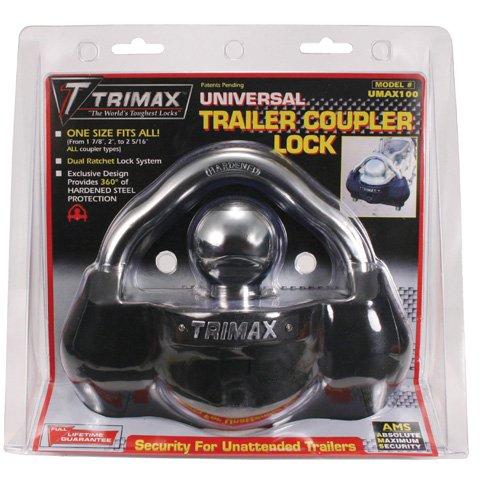 Trimax UMAX100 Universal Coupler LockThe lock that matters when the trailer is parked and unhitched: it blocks the coupler so it cannot be dropped onto another ball. | Locking the trailer itself | Good | |
| 2 | 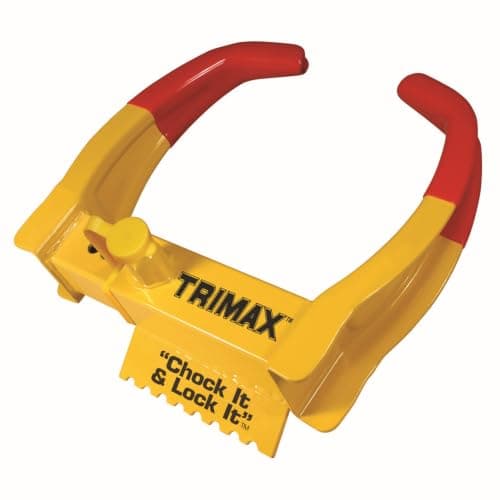 Trimax TCL75 Trailer Wheel LockThe visible deterrent: a steel clamp around the wheel that cannot be towed away, and it doubles as a chock. Check your wheel size first, because this one is sized rather than universal. | Making the trailer impossible to roll or tow quietly | Good | |
| 3 | 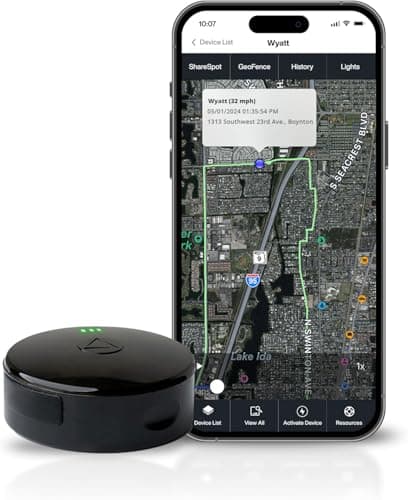 LandAirSea 54 GPS TrackerThe recovery layer. Every lock on this page is a delay; this is the only thing that tells you where the trailer went. Price the subscription in before you buy. | Getting the trailer back after it is already gone | Good | |
| 4 | 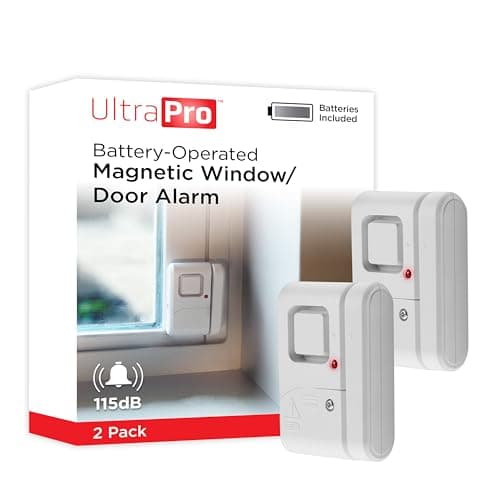 UltraPro Personal Security Window and Door Alarm (2-pack)Cheap noise covering the one case the locks do not: somebody opening the door while you are inside. Treat it as a smoke alarm for intrusion, not as a system. | Knowing a door opened while you were asleep | Strong | |
| 5 | 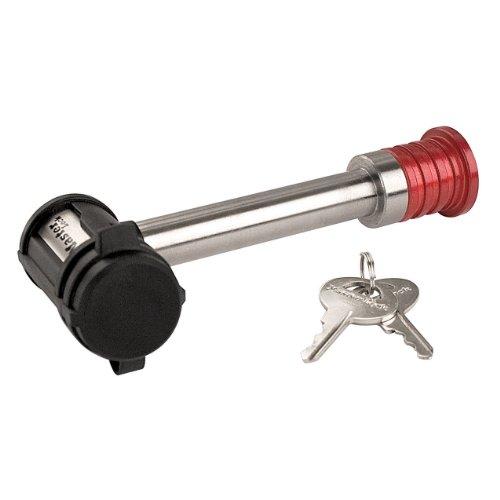 Master Lock Receiver Hitch Pin LockReplaces the clip pin anyone can pull out in a parking lot. It protects the ball mount, not the trailer. | Keeping the ball mount | Strong |
Prices come from Amazon and were last checked November 12, 2026. They change constantly, so a price older than 48 hours is withdrawn rather than shown stale — those rows read “Check price on Amazon” instead and go straight to the current listing. #ad — these are affiliate links.
Why a camper security system is the wrong thing to shop for
Type that phrase into a retailer search box and you get hub-and-sensor kits designed for a house: a keypad by the front door, contact sensors on windows, a siren, and a monthly monitoring plan. Several of them have a motorhome on the box.
Almost none of it fits how a travel trailer is actually used, or how one is actually lost. A house alarm assumes mains power, permanent internet and a fixed address. Your trailer spends most of the year parked with the battery disconnected, then sits for three nights in a campground with no wifi, then sits in a truck stop for four hours while you eat. And the loss you are insuring against is usually not somebody picking the door lock. It is the trailer itself leaving.
That is why this page is a stack rather than a product. Each layer below answers one specific failure, and the order matters more than the brand: the cheapest useful setup is the first two items, and the most expensive alarm kit in the catalog will not cover either of them.
What actually goes missing, in rough order of likelihood
The ball mount out of the receiver. It is worth real money, it is held in by a clip pin anybody can pull out with their fingers, and it sits at knee height in a parking lot. This is the one that happens to people constantly and that nobody writes articles about.
The whole trailer, unhitched. A parked towable has a coupler on the front designed to accept any standard ball. That is the entire theft: back up, drop, drive. It takes under a minute and makes no noise a campground would question.
Gear out of the exterior bays. Pass-through doors on a lot of trailers use the same handful of factory key codes, which is a well-known weakness and a good argument for not storing anything valuable in them.
Things from inside, while you are out. Real, but much less common than the three above, and the cheapest of the four to deter.
Read that list and the shape of the answer is obvious. Three of the four are solved by locks and one by a tracker. None of them is solved by a siren with a keypad.
How we choose
Does it block a specific theft, or does it only make noise? This is the whole ranking. A coupler lock physically prevents the thing you are most afraid of. An alarm reports it. Both have a place, but one of them is bought first.
Is it visible from where the thief is standing? Most trailer theft is opportunistic, which means it is decided in a few seconds by somebody looking down a row of parked trailers. A bright steel clamp on a wheel is doing work before anyone touches it. A clever device hidden under the frame is not.
Will you still be using it in month six? Security you stop bothering with is worth nothing. A layer that adds thirty seconds to leaving the site survives the season; one that adds ten minutes does not. We weight this heavily for a first-season owner, because the honest failure mode of camper security is not defeat, it is disuse.
Does it work with the power and signal you really have? Stored trailers have no mains power, boondocking sites have no wifi, and some of the best places to camp have no cell signal either. Anything that needs all three is a worse buy than it looks.
What does it cost against what it protects? A locking receiver pin costs a fraction of the ball mount it protects, which makes it close to a free decision. A tracker costs a subscription for as long as you keep it, so it has to be weighed against the trailer rather than against the device.
We do not test products and say so on how we choose. Nothing on this page is a measured defeat time or a tested deterrence rate, because those figures do not exist in any form we could stand behind. What we can do is read every manufacturer’s published specification, be straight about which layer covers which failure, and name the weakness of each one. The sources are linked at the end.
The picks, in the order to buy them
1. Best for Locking the trailer itself
Trimax UMAX100 Universal Coupler Lock
The lock that matters when the trailer is parked and unhitched: it blocks the coupler so it cannot be dropped onto another ball.
- Specification
- Universal coupler lock
- Specification
- Hardened steel body
- Specification
- Fits a range of coupler sizes
What it does well
- Blocks the coupler so nobody can drop your trailer onto their own ball and drive away
- The universal fit covers common coupler sizes, so it survives a trailer upgrade
- Heavy enough to look like more trouble than the next trailer along
The real tradeoff
- Bulky and heavy to stow
- Universal fit means it is not a perfect fit on anything in particular
How it measures up
These are judgments from published specifications and what we see at the lodge, not laboratory results. How we choose.
- Beginner fit
- Good — Fitting it the first time takes a minute of fiddling.
- Install effort
- Strong — None.
- Deterrence
- Strong — Visible, heavy and slow to defeat.
- Value
- Good — Real money, real deterrence.
Specifications from Trimax.
2. Best for Making the trailer impossible to roll or tow quietly
Trimax TCL75 Trailer Wheel Lock
The visible deterrent: a steel clamp around the wheel that cannot be towed away, and it doubles as a chock. Check your wheel size first, because this one is sized rather than universal.
- Specification
- Jaws open 7 in closed to 11-1/4 in, with a 10-1/2 in arm reach
- Specification
- Published fit includes common trailer sizes such as 195/75R14, 205/70R15 and 235/75R15
- Specification
- Built-in chock, so it blocks rolling as well as locking the wheel
- Specification
- Lifetime warranty
- Specification
- Heavy-duty powder-coated steel with rubber-coated arms and a pick-resistant core
What it does well
- A wheel lock is the one security product a thief can see from the road, and a visible obstacle is most of what deters an opportunist
- The built-in chock means it also stops the trailer rolling, so it earns its storage space on a sloping driveway
- Rubber-coated arms, so a season of fitting it does not chew up the wheel finish
The real tradeoff
- Sized by tire width, not universal. The published jaw range is 7 to 11-1/4 in, so read your own sidewall first - Trimax sells several wheel locks with different jaws and the model numbers are easy to mix up
- Heavy and awkward to stow next to a coupler lock, and you will be crouching in the dirt to fit it
- It protects one wheel. A tandem-axle trailer still has three others
How it measures up
These are judgments from published specifications and what we see at the lodge, not laboratory results. How we choose.
- Beginner fit
- Good — Simple to fit; sizing is the only real decision.
- Install effort
- Good — Crouch, clamp, lock. About a minute.
- Deterrence
- Strong — The layer a thief sees before getting out of the truck.
- Value
- Good — Real money for real steel.
Specifications from Trimax TMX75FR published dimensions.
3. Best for Getting the trailer back after it is already gone
LandAirSea 54 GPS Tracker
The recovery layer. Every lock on this page is a delay; this is the only thing that tells you where the trailer went. Price the subscription in before you buy.
- Specification
- IP67 rated for water and dust, with a built-in magnet mount
- Specification
- Housing roughly 2.3 in across
- Specification
- 4G LTE CAT M1 / CAT NB1 / EGPRS cellular, GNSS positioning
- Specification
- Monthly subscription required for the SIM service
What it does well
- The only item on this page that still works after the trailer has left. Locks buy you time; a tracker buys you a location
- The magnet means there is no install - it goes somewhere out of sight on the frame and stays there
- Small and sealed enough not to be obvious, which is the entire point of it
The real tradeoff
- There is a monthly subscription. Budget for the service as well as the device, because the hardware does nothing without it
- Battery life depends on how often you ask it to report - the manufacturer quotes roughly 1 to 3 weeks at frequent reporting and far longer in a low-power mode, so a stored trailer needs a charging habit
- It needs cellular coverage. In the remote spot where you would most want a tracker, it may have none
How it measures up
These are judgments from published specifications and what we see at the lodge, not laboratory results. How we choose.
- Beginner fit
- Good — App setup, then a magnet on the frame.
- Install effort
- Strong — None. It sticks.
- Deterrence
- Weak — Hidden by design, so it deters nobody.
- Value
- Adequate — Modest hardware; the subscription is forever.
Specifications from LandAirSea 54 specification sheet.
4. Best for Knowing a door opened while you were asleep
UltraPro Personal Security Window and Door Alarm (2-pack)
Cheap noise covering the one case the locks do not: somebody opening the door while you are inside. Treat it as a smoke alarm for intrusion, not as a system.
- Specification
- Rated at 120 dB by the manufacturer
- Specification
- Three-position switch: off, chime, or alarm
- Specification
- Magnet-and-sensor pair, mounted with double-sided tape
- Specification
- Four LR44 cells per unit, included, with a low-battery indicator LED
- Specification
- Model 45115, sold as a pair; the same device has also carried the GE brand name, and larger packs exist
- Specification
- Rated for indoor use
What it does well
- Among the least expensive layers here, and the only one that covers the gap every lock on this page leaves: somebody opening a door while you are inside asleep
- Chime mode is useful well away from theft - it tells you a kid or a dog just opened the screen door
- No wiring, no app, no hub, nothing to pair. Tape it up, close the door, set the switch
- Sold as a pair, which is the right count for a camper: the entry door and the one window you would actually reach through
The real tradeoff
- It is a noise, not a security system. It does not call anyone, record anything, or lock anything
- The two halves have to sit within about half an inch of each other when the door is closed, and a camper door that flexes will either false-alarm or fail to arm
- Taped mounting on an RV wall is a weak point in summer heat, and buyers report the sensor refusing to stay put on some metal doors
- Indoor rated, so it is for doors and windows, not for the exterior storage bays
How it measures up
These are judgments from published specifications and what we see at the lodge, not laboratory results. How we choose.
- Beginner fit
- Strong — Peel, stick, switch.
- Install effort
- Strong — Two minutes per door.
- Deterrence
- Adequate — Noise moves an opportunist along.
- Value
- Strong — Two units for less than any lock here.
Specifications from Jasco UltraPro alarm specifications.
5. Best for Keeping the ball mount
Master Lock Receiver Hitch Pin Lock
Replaces the clip pin anyone can pull out in a parking lot. It protects the ball mount, not the trailer.
- Specification
- Locking receiver pin
- Specification
- Common 5/8 in diameter for 2 in receivers
- Specification
- Weather-resistant
What it does well
- Replaces the clip pin anyone can pull out in a parking lot in two seconds
- Stops the ball mount walking off, which is the cheap theft that happens constantly
The real tradeoff
- Protects the ball mount, not the trailer. A coupler lock is a different product
- The lock cylinder wants a squirt of lubricant once a season
How it measures up
These are judgments from published specifications and what we see at the lodge, not laboratory results. How we choose.
- Beginner fit
- Strong — Swap it for the clip pin.
- Install effort
- Strong — None.
- Deterrence
- Good — Stops opportunists, not a determined thief.
- Value
- Strong — Cheap relative to a ball mount.
Specifications from Master Lock.
What each layer covers, and what it leaves open
| Layer | The theft it blocks | Needs power or signal? | Visible to a thief? |
|---|---|---|---|
| Coupler lock | Trailer towed away while unhitched | No | Yes, at the tongue |
| Wheel lock | Trailer towed or rolled away | No | Yes, from across the lot |
| GPS tracker | None - it recovers after the fact | Cell signal and a charged battery | No, deliberately |
| Door or window alarm | Entry while you are inside or nearby | Button cells only | Only once it goes off |
| Locking receiver pin | Ball mount lifted out of the receiver | No | Yes, if anyone looks |
The table is the argument for buying in order rather than buying one thing. Every row has a blank in it, and the blanks are different. Two layers cover most of what can go wrong, and four cover nearly all of it — without a hub, a keypad or a monitoring contract.
The two layers people skip, and should not
The locking receiver pin. It is one of the least expensive items on this page and the one most likely to earn its money this year, because the ball mount is the thing a thief can take in four seconds while you are inside a diner. Buy it, fit it once, and forget it exists. There is nothing to maintain beyond a squirt of lubricant on the cylinder each season.
The door alarm. A pair of battery-powered noisemakers, for less than any single lock on this page, is the only layer here that does anything while you are asleep in the trailer with the door locked. The locks on this page all protect the trailer as property; this one is aimed at the situation where you are inside it. Chime mode also turns out to be the thing people keep using long after the trip is over — it tells you when a kid has opened the screen door.
What to skip in a first season
Hub-and-sensor home alarm kits. They assume mains power and a fixed internet connection, neither of which a trailer has. The cluster of searches for an RV security system without wifi exists for exactly this reason.
Wifi cameras in storage. A camera needs power and a network. A storage lot has neither, and a camera that stops recording when its battery dies is a false sense of security rather than a layer. The exception is a cellular camera with its own solar panel, which is the only type that works unattended — the RV security camera roundup sorts the picks by whether there is power and signal where the trailer sits.
Replacing the factory door lock on day one. Keyless and rekeyable entry handles are a genuine upgrade on the shared factory key codes, but they are handed, they are sized to the door cutout, and getting the wrong one is a trailer you cannot lock. That is a job for later in the season with the measurements in front of you, not a first-week purchase — the door lock roundup starts with the two measurements to take.
A second coupler lock in place of a wheel lock. Two locks on the same component defeat the same single attack. The point of a stack is that the layers are different.
If you only buy part of this
Buying one thing: the coupler lock, every time. Buying two: add the wheel lock, because it is the layer a thief sees from the road. Storing the trailer somewhere you cannot see it: add the tracker, and budget the subscription as part of the price.
Best for Locking the trailer itself
Trimax UMAX100 Universal Coupler Lock
The lock that matters when the trailer is parked and unhitched: it blocks the coupler so it cannot be dropped onto another ball.
Best for Making the trailer impossible to roll or tow quietly
Trimax TCL75 Trailer Wheel Lock
The visible deterrent: a steel clamp around the wheel that cannot be towed away, and it doubles as a chock. Check your wheel size first, because this one is sized rather than universal.
Best for Getting the trailer back after it is already gone
LandAirSea 54 GPS Tracker
The recovery layer. Every lock on this page is a delay; this is the only thing that tells you where the trailer went. Price the subscription in before you buy.
Where you park changes the answer
Your own driveway, in view of the house. The coupler lock and the receiver pin are most of what you need. You are the deterrent; the locks cover the hours you are asleep or at work.
A storage lot you visit once a month. This is the case for the full stack, and particularly for the tracker — nobody is going to notice the trailer is gone for weeks. Check whether the lot has its own cameras and a gate log before you decide how much to spend.
A campground, with you in it. The risk shifts from the trailer to the contents and to the ball mount, so the cheap layers matter most. Lock the coupler anyway at a site you leave for a day trip.
A truck stop or a motel lot, mid-trip. The worst case, because the trailer is hitched, loaded and sitting somewhere anonymous. If you are unhitching, the coupler lock goes on before you walk away. There is no version of this where it stays in the storage bay.
Three habits that outperform any of this
Photograph the VIN plate and keep the paperwork somewhere that is not the trailer. Recovery depends on proving which trailer is yours, and the registration in the trailer’s drawer leaves with the trailer.
Do not store anything in the pass-through you would be upset to lose. Shared factory key codes are a known weakness across a lot of trailers. Treat the bays as weatherproof, not secure.
Make the trailer look occupied and awkward. Stabilizers down, a step rug out, blocks under the jacks. Opportunistic theft is decided in seconds, and a trailer that is clearly set up reads as more work than the bare one three spaces along.
The way a layer stack actually fails
Keys left in the trailer. A coupler lock key in the kitchen drawer of the trailer it locks is a decoration. Keys live on the tow vehicle keyring or in the house, and the spare lives somewhere that is neither.
Too many different keys. Four locks with four keys is how people end up leaving three of them off. Several lock ranges can be keyed alike on request or sold as matched sets, and it is worth asking before you buy the second one, because one key for the coupler, the receiver pin and the wheel lock is the difference between a routine and a chore.
Seized cylinders. Outdoor locks live in grit, salt and rain. A lock you cannot open is a lock you stop fitting, and one squirt of lubricant into each cylinder at the start and the end of the season is the entire maintenance program.
Fitted wrong, or not at all, in a hurry. The last five minutes before leaving a site is when the coupler lock gets skipped. Putting it on the same list as the chocks and the stabilizers is what makes it happen — the setup checklist is where ours lives.
What none of this fixes
A determined thief with time and tools. Every lock on this page is a delay, and all of them are honest about it. The purpose of a stack is to make your trailer the slower target in a row of trailers, not to be unbreakable.
The trailer rolling away on its own. That is chocks, and it is a different product with a different job — the wheel chock roundup covers it. The wheel lock above happens to include a chock, which is a bonus rather than the reason to buy it.
Anything about towing safely. Security is the parked problem. The moving one is covered in the towing safety checklist, and the first-trip version of the whole shopping list is RV must-haves for beginners.
Questions people actually ask
Is there such a thing as a camper security system?
Not as a single product for a travel trailer. What is sold under that name is usually a house alarm kit that assumes mains power and permanent internet, which a trailer does not have. The working equivalent is a stack of layers: a coupler lock, a wheel lock, a GPS tracker for recovery, a cheap door alarm, and a locking receiver pin.
What is the single best security device for a travel trailer?
A coupler lock. The common theft is somebody backing up to an unhitched trailer, dropping it onto their own ball and driving away, and a coupler lock is the only device that physically blocks that. Everything else on this page covers a different failure.
Do I need a GPS tracker for my camper?
It depends where it lives. A tracker prevents nothing - it is the recovery layer, and the only thing that still works after the trailer has gone. If the trailer sits in a storage lot you visit once a month, that is worth a lot. If it sits in your driveway, the locks matter more. Budget for the monthly subscription as part of the price, because the hardware does nothing without it.
Can I use an RV security system without wifi?
Yes, and for a towable you usually have to. Every layer on this page except the tracker runs on nothing at all or on button cells, and the tracker uses the cell network rather than wifi. Hub-and-sensor home alarm kits are the ones that need a network, which is why they suit a house and not a trailer.
Are RV compartment locks all the same key?
Not all, but a lot of trailers ship with exterior compartment locks cut to a small number of factory key codes, which is a well-known weakness. The practical response for a first season is to treat the exterior bays as weatherproof rather than secure and keep nothing valuable in them. Replacing the main entry handle with a keyless or rekeyable one is a real upgrade, but handing and cutout size have to be measured first.
Does a wheel lock stop a trailer being towed?
It makes towing it impractical rather than impossible, which is the point. A steel boot clamped over the wheel is visible from across a parking lot and signals that this trailer will take tools and time. On a tandem-axle trailer one lock still only covers one wheel, so it is a deterrent layer rather than an absolute block.
How much should I spend on camper security?
Less than people expect. A coupler lock and a locking receiver pin together cost a fraction of the ball mount and tongue they protect, and a pair of door alarms costs less than either of them. The wheel lock and the tracker are the two items with real cost, and both are decided by where the trailer is parked between trips rather than by the value of the trailer.
Sources
Read next
Towing & Security
Best Trailer Coupler Lock
Coupler locks compared on deterrence, fit and weight, with fitting instructions and the sizing check to do first.
Towing & Security
Best RV Hitch Lock
Receiver locks and coupler locks explained, with what each actually protects and why you want both.
Towing & Security
Hitch Lock vs Coupler Lock: What Each One Protects
The two lock types compared on what they protect, when each applies, and the situations that need both at once.
Towing & Security
RV Towing Safety Checklist
A pre-departure towing checklist covering hitch, chains, brakes, tires, loading and the rooftop items people forget.
Reviewed October 19, 2026. Spot something out of date? Tell us and we will fix it.