Best RV Tongue Jack for a Travel Trailer
A tongue jack is rated against the weight on your coupler, not the weight of your trailer - and the number that decides whether it is usable is stroke, not capacity. This is how to size one, and what to buy once you have.
Heads up: this page contains affiliate links. If you buy through one, Camp & Chock may earn a commission at no extra cost to you. It never changes which product we put first — how this site is funded.
The short answer
For most travel trailers the Lippert Power Tongue Jack (285318) is the right electric upgrade: Lippert publishes 3,500 lb of lift capacity, 18 in of stroke and a 30 amp draw, and the listing adds a manual override for the day your battery is flat. If you do not want to wire anything, the Lippert Quick Drop is a published 2,000 lb bolt-on jack you spin with a cordless drill for about a third of the money — correct for a light single-axle trailer, and genuinely not enough for a heavy tandem. Whichever you pick, spend a few dollars more on a jack block and a drill socket: they are the cheapest things on this page and they fix the two problems owners actually complain about. And before you buy anything, read the next section — the capacity figure in this category is not measured against what you think it is.
Part of our leveling and chocks guide. If what you actually want is to stop the trailer moving once it is parked, you want stabilizer jacks instead — those are a different product doing a different job, and stabilizers versus levelers separates the three.
Our picks at a glance
Tap any row to jump to the full write-up.
| # | Product | Best for | Beginner fit | Price |
|---|---|---|---|---|
| 1 | 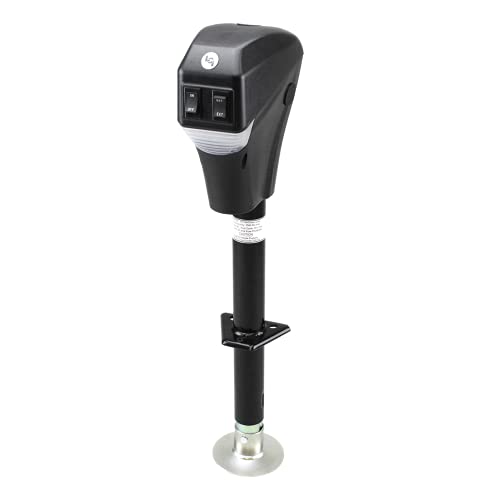 Lippert Power Tongue Jack (285318)The mainstream electric upgrade: a published 3,500 lb capacity and 18 in of stroke on a bolt-on A-frame mount, from the company that built the jack most trailers came with. | Most travel trailers replacing a hand-crank jack | Strong | |
| 2 | 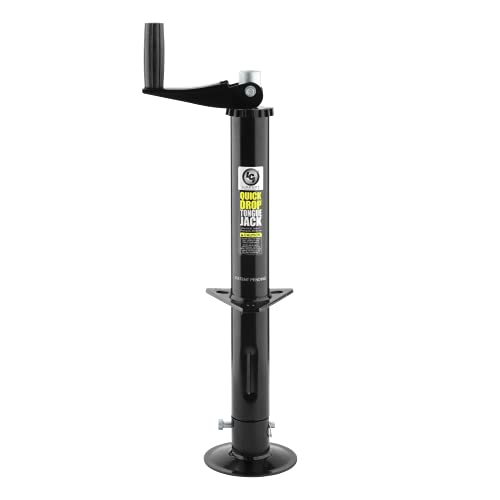 Lippert Quick Drop Tongue JackThe no-electrics option: a published 2,000 lb bolt-on jack you spin with a drill. Right for a light trailer, wrong if your tongue weight is anywhere near its rating. | Light trailers, and anyone who does not want to wire anything | Strong | |
| 3 | 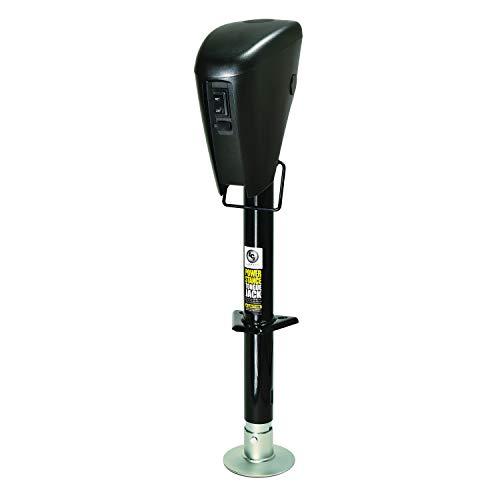 Lippert Power Stance Tongue Jack (813748)The same capacity and stroke as the standard Lippert jack with its power coming through the 7-way. The right answer if your trailer battery is the weak link. | Running the jack off the tow vehicle instead of the trailer battery | Good | |
| 4 | 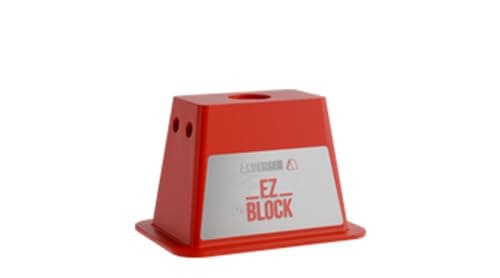 Andersen Hitches EZ Block Jack Block (3621)Height, not just a footprint. The block to buy when a jack will not reach the ground, rather than the one to buy four of. | A jack that cannot reach the ground | Strong | |
| 5 | 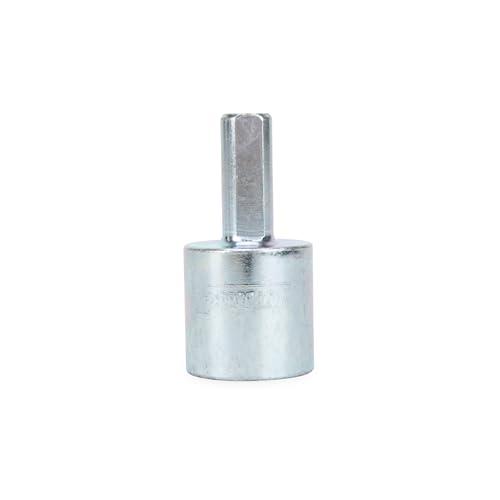 Camco RV Leveling Scissor Jack Socket Drill Adapter (57363)A few dollars that remove four minutes and a sore shoulder from every single arrival. Buy it with whatever jacks you choose. | Turning four jacks down without the crank handle | Strong |
Prices come from Amazon and were last checked November 27, 2026. They change constantly, so a price older than 48 hours is withdrawn rather than shown stale — those rows read “Check price on Amazon” instead and go straight to the current listing. #ad — these are affiliate links.
The sizing rule, which is not the one people assume
Almost every bad tongue jack purchase comes from reading the capacity figure against the wrong number, so this is worth getting right before you look at a single product.
A tongue jack is rated against your tongue weight, not your trailer weight. etrailer’s trailer jack FAQ puts the rule plainly: choose a jack with a capacity that matches or surpasses your tongue weight, and tongue weight is typically 10 to 15 percent of gross trailer weight. So a 6,000 lb loaded travel trailer is carrying roughly 600 to 900 lb on its coupler, and a 3,500 lb jack is not “barely enough” — it is four times the load, which is the margin you want on a part that works outdoors in the rain for ten years. The same FAQ gives the A-frame jack category a range of 2,000 lb to 5,000 lb, and most travel trailer owners land in the middle of it rather than at the top.
The number that actually decides usability is stroke. A jack with enormous capacity and not enough travel cannot lift your coupler over the ball, and that is a far more common failure than running out of strength. etrailer’s rule here is the useful one: the jack should extend about 4 in higher than the level height of your coupler, so you can raise the coupler clear of the ball rather than exactly to it. Every electric jack on this page publishes 18 in of stroke. The drill-driven Quick Drop publishes 14 in, and those 4 in are the whole difference between the two classes.
How we choose
We do not lift trailers for a living and we have not load-tested a jack, so this page does not rank on strength we measured. It ranks on four things a first-season owner can check and we can verify:
Published capacity against a real tongue weight. The rating has to come from the manufacturer, in writing, for that exact part number. A jack whose capacity exists only in a marketplace listing cannot be checked against the sizing rule above, which is the entire method of this page.
Published stroke, and the retracted height. Extended reach decides whether the jack works at your coupler height. Retracted height decides whether it survives your driveway. Both have to be published.
What happens when the power is gone. An electric jack on a flat battery is a dead jack unless there is another way to turn it. This matters more than speed, and it is the reason the drill-driven option is ranked second rather than last.
Install reality. Three bolts through an existing A-frame is a morning. A weld-on pipe mount is a trip to a welder, and we do not recommend those to someone replacing a factory bolt-on jack.
The picks
1. Best for Most travel trailers replacing a hand-crank jack
Lippert Power Tongue Jack (285318)
The mainstream electric upgrade: a published 3,500 lb capacity and 18 in of stroke on a bolt-on A-frame mount, from the company that built the jack most trailers came with.
- Specification
- Lift capacity 3,500 lb (Lippert)
- Specification
- Jack stroke 18 in (Lippert)
- Specification
- Power consumption 30 amps (Lippert)
- Specification
- Bolt-on A-frame mount, three mounting bolts included (Lippert)
- Specification
- Bracket height 10-3/4 in retracted, 28-3/4 in extended; 5-3/8 in footpad (Lippert)
- Specification
- Manual override and four work LEDs (Amazon listing for 285318)
What it does well
- The 3,500 lb rating covers the tongue weight of essentially every single-axle and most tandem-axle travel trailers, with the margin the sizing rule asks for
- 18 in of stroke is enough to lift a level coupler clear of the ball and keep going, which is the measurement that decides whether a jack is usable rather than merely strong
- Lippert publishes the bracket height retracted and extended, so you can check clearance against your own A-frame before you order rather than after
- Bolt-on with the hardware in the box: three bolts through the A-frame and no welding
The real tradeoff
- 30 amps is a real load on a single battery. Lifting a heavy tongue repeatedly with no shore power and a tired battery is how people discover their battery is tired
- Lippert does not publish a drop leg for this jack, so on a tall coupler or a deeply sloped site you are relying on the 18 in of stroke alone
- A manual override gets you out of a dead battery, but it is a socket on top of the jack and a wrench, not a crank handle - practice once before you need it in a dark campground
- Replacing a jack is a bolt-out, bolt-in job, but it is still a job - the trailer has to be supported while the old jack comes off
How it measures up
These are judgments from published specifications and what we see at the lodge, not laboratory results. How we choose.
- Beginner fit
- Strong — One switch. The crank handle goes in a drawer.
- Install effort
- Good — Three bolts and a power feed.
- Capacity headroom
- Strong — 3,500 lb against a tongue weight in the hundreds.
- Value
- Good — Mid-priced for a published-spec electric jack.
Specifications from Lippert - Power Tongue Jack 285318 specifications.
2. Best for Light trailers, and anyone who does not want to wire anything
Lippert Quick Drop Tongue Jack
The no-electrics option: a published 2,000 lb bolt-on jack you spin with a drill. Right for a light trailer, wrong if your tongue weight is anywhere near its rating.
- Specification
- Lift capacity 2,000 lb (Lippert)
- Specification
- Jack stroke 14 in vertical range (Lippert)
- Specification
- Raised and lowered with a power drill and a 3/4 in socket head, not included (Lippert)
- Specification
- Bolt-on A-frame mount; 5.4 in footpad (Lippert)
- Specification
- No electrical draw - Lippert publishes no amp or voltage figure, because there is no motor
What it does well
- No wiring, no motor, no amp draw and nothing to fail electrically, while still being driven by a drill rather than by your shoulder
- The 3/4 in hex drive is the same standard as RV scissor jacks, so one drill socket adapter runs this jack and your stabilizers
- At a published 2,000 lb it is correctly sized for a small single-axle trailer, a teardrop or a utility trailer, where a 3,500 lb electric jack is money spent on headroom you will never use
- A dead battery does not strand you, which is the single honest advantage over every electric jack on this page
The real tradeoff
- 2,000 lb is the lowest capacity here and is genuinely not enough for a heavy tandem-axle trailer. Weigh your tongue before you choose it
- 14 in of stroke is 4 in less than the electric jacks, and on a tall coupler or a nose-down site that is the difference between reaching the ball and not
- You have to be holding a charged drill at the moment you want to hitch up, and the 3/4 in socket is not included
- No powered convenience at all - this is a faster manual jack, not an electric one, and the listing should not be read as a cheap electric
How it measures up
These are judgments from published specifications and what we see at the lodge, not laboratory results. How we choose.
- Beginner fit
- Strong — Chuck a socket in a drill. That is the method.
- Install effort
- Strong — Bolt-on only. Nothing to wire.
- Capacity headroom
- Adequate — 2,000 lb. Fine for light, tight for tandem.
- Value
- Strong — Cheapest published-spec jack in the category.
Specifications from Lippert - Quick Drop Tongue Jack 733926 specifications.
3. Best for Running the jack off the tow vehicle instead of the trailer battery
Lippert Power Stance Tongue Jack (813748)
The same capacity and stroke as the standard Lippert jack with its power coming through the 7-way. The right answer if your trailer battery is the weak link.
- Specification
- Lift capacity 3,500 lb (Lippert)
- Specification
- Jack stroke 18 in (Lippert)
- Specification
- 2-way-to-7-way plug powering system; Power Swap Auxiliary Cord required (Lippert)
- Specification
- Bolt-on A-frame mount, three mounting bolts included (Lippert)
- Specification
- Foot pad 5.4375 in; item weight 40 lb (Lippert)
- Specification
- Amp draw not published by Lippert
What it does well
- Draws its power through the 7-way rather than depending on the trailer battery being charged, which is the exact failure the mainstream electric jack has
- Same published 3,500 lb capacity and 18 in stroke as the standard Power Tongue Jack, so you give up no capability for the different power path
- Useful on a trailer stored without a battery, or one whose battery you pull over winter, because the jack still works when the tow vehicle is plugged in
The real tradeoff
- The Power Swap Auxiliary Cord is required and is not in the box. Budget for it or the jack does not run
- Lippert publishes no amp figure for this jack, so you cannot compare its draw against the 30 amps published for the standard model
- Powering from the tow vehicle means the jack is at its most convenient while hitched and least convenient once you have unhitched and driven away
- At a published 40 lb it is the heaviest jack here, which matters when you are holding it against the A-frame to start the bolts
How it measures up
These are judgments from published specifications and what we see at the lodge, not laboratory results. How we choose.
- Beginner fit
- Good — Simple to use; the required cord is an extra step.
- Install effort
- Adequate — Three bolts plus the auxiliary cord.
- Capacity headroom
- Strong — 3,500 lb, same as the standard jack.
- Value
- Adequate — Costs more once the required cord is counted.
Specifications from Lippert - Power Stance Tongue Jack 813748 specifications.
4. Best for A jack that cannot reach the ground
Andersen Hitches EZ Block Jack Block (3621)
Height, not just a footprint. The block to buy when a jack will not reach the ground, rather than the one to buy four of.
- Specification
- Rated by Andersen at 2,000 lb per block
- Specification
- 8 in tall, or 14 in when two are stacked
- Specification
- Base 12 x 8.5 in, top pad 8 x 4.5 in
- Specification
- About 3.1 lb each, sold singly
- Specification
- Recessed 2.5-in post hole; fits scissor, post and pad jacks
What it does well
- Solves the problem a thin pad cannot: a jack with nothing under it, on a site where the pad has been dug out or the trailer is sitting high
- Stacks to two blocks for 14 inches of height, with the rating held at 2,000 lb
- The recessed post hole locates a post or scissor jack so the block cannot squirt out sideways
- Light enough at 3.1 lb that two of them live in the truck without comment
The real tradeoff
- Several times the price of a four-pack of thin plastic pads, per block
- Sold singly, so covering four stabilizer jacks gets expensive quickly
- 2,000 lb per block is plenty for a tongue or stabilizer jack and is not a rating to take liberties with
- Overkill if your jacks already reach the ground comfortably
How it measures up
These are judgments from published specifications and what we see at the lodge, not laboratory results. How we choose.
- Beginner fit
- Strong — Set it down, lower the jack into the recess.
- Stability once set
- Strong — 2,000 lb per block, and the post hole locates it.
- Speed to level
- Strong — Faster than stacking loose blocks.
- Value
- Adequate — Expensive per block. Buy it where height is the problem.
Specifications from Andersen Hitches.
5. Best for Turning four jacks down without the crank handle
Camco RV Leveling Scissor Jack Socket Drill Adapter (57363)
A few dollars that remove four minutes and a sore shoulder from every single arrival. Buy it with whatever jacks you choose.
- Specification
- Fits 3/8 in and 1/2 in power drills (Camco)
- Specification
- Works with all 3/4 in hex drive jacks (Camco)
- Specification
- Camco also sells a 1/4 in quick-connect version for impact drivers, which is a different part number
- Specification
- Camco part number 57363
What it does well
- The cheapest upgrade to your setup routine on this entire site: four jacks go down in well under a minute instead of four separate sessions with a crank handle
- Fits the 3/8 in and 1/2 in chucks that ordinary cordless drills actually have, rather than the 1/4 in hex quick-connect that only an impact driver takes
- Works with almost any scissor jack, because 3/4 in hex is the standard drive on all of them
The real tradeoff
- A drill applies more torque than your arm does, and these jacks are not meant to lift. Run it down until it touches and the load comes on, then stop - over-cranking on a drill is how a jack or a frame mount gets bent
- Does nothing on a stack jack or a hand-spun jack, which have no hex head to drive
- You are now carrying a drill as camping equipment, which is either a feature or a nuisance depending on the person
How it measures up
These are judgments from published specifications and what we see at the lodge, not laboratory results. How we choose.
- Beginner fit
- Strong — Push into the chuck; that is the install.
- Install effort
- Strong — None.
- Stability gained
- Adequate — No extra stability - it is speed.
- Value
- Strong — The best few dollars in the hub.
Specifications from Camco.
Published figures, as the maker states them
| Jack | Capacity | Stroke | Power |
|---|---|---|---|
| Lippert Power Tongue Jack (285318) | 3,500 lb | 18 in | 12 V electric, 30 amps |
| Lippert Quick Drop | 2,000 lb | 14 in | None - drill, 3/4 in socket |
| Lippert Power Stance (813748) | 3,500 lb | 18 in | Electric via 2-way to 7-way; amps not published |
Every figure in that table is Lippert’s own published specification for that part number. Where Lippert publishes nothing — the Power Stance’s amp draw, for instance — the table says so rather than borrowing a number from a similar product.
Why the cheap 5,000 lb electric jacks are not ranked here
Search this category and you will find 5,000 lb and even 7,500 lb electric A-frame jacks from marketplace brands — POLESTAR, Kohree, VEVOR, SEALIGHT and others — priced well below the Lippert units, often with a weatherproof cover and an LED thrown in. They are real products, plenty of people are happy with them, and we are not going to pretend otherwise.
They are not ranked on this page for one specific reason. This page works by checking a published capacity against a tongue weight you measured, and none of those brands publishes a manufacturer specification sheet we can read for a given part number — the rating exists in the listing title and nowhere else. A number in a listing title is a marketing claim; a number on a spec page with a part number attached is something you can hold the maker to. On a part that holds several hundred pounds a foot off the ground while you stand under the front of a trailer, we would rather recommend the one whose rating is published, and tell you plainly that cheaper options exist.
If you do buy one, the sizing rule does not change: work out your tongue weight, confirm the stroke clears your coupler height by about 4 in, and treat the headline capacity as the least reliable figure in the listing.
The two cheap parts that matter more than the jack
Both items at the bottom of the pick list cost less than the cheapest jack here, and between them they fix the two things owners actually complain about.
The jack sinks. A tongue jack foot is a disc about 5-3/8 in across on the Lippert 285318, carrying hundreds of pounds. On concrete that is fine. On gravel, grass or a soft pad after rain it presses in, the nose drops, your carefully leveled trailer goes out of level overnight, and in the worst case the foot is buried by morning. A jack block spreads that load over a much wider area and keeps the foot out of the dirt. This is not an optional accessory; on anything but concrete it is part of the install.
The drill socket. The Quick Drop is driven by a 3/4 in socket head, and Lippert does not include the socket. The same 3/4 in hex is the standard drive on RV scissor jacks, so one adapter runs this jack and all four of your stabilizer jacks. If you buy the Quick Drop you need this part; if you buy an electric jack you still want it for the stabilizers. One caution either way: a drill delivers far more torque than your arm does. Run the jack until the load comes on and stop.
Electric, drill-driven or leave the crank alone
The honest answer for a lot of first-season owners is the third one. The hand crank that came on your trailer works, it will never run out of battery, and the thing people are really buying when they upgrade is ninety seconds and a sore shoulder per hitch. That is a completely legitimate thing to buy, and it is worth saying out loud rather than pretending a jack upgrade is a safety improvement. It is a convenience improvement.
Go electric if you hitch and unhitch often, if you camp alone, or if raising a loaded tongue by hand is genuinely hard for you. The 285318 is the mainstream answer and the 30 amp draw is the thing to plan around: it is a real load, and a jack is the worst possible moment to discover your battery is tired. Keep the manual override in mind and know where the socket goes before you need it in the dark.
Go drill-driven if your trailer is light, if you do not want to run a power feed, or if the idea of an electrical part failing at a trailhead bothers you more than cranking does. You get most of the speed and none of the wiring. Just be honest about the numbers: 2,000 lb of capacity and 14 in of stroke are both real limits, and a heavy tandem-axle trailer wants the electric jack.
Go Power Stance in one specific case: your trailer battery is the weak link. Pulling the battery for winter, storing without one, or fighting a battery that will not hold charge all make a jack that draws through the 7-way the better answer. Budget for the Power Swap Auxiliary Cord, because Lippert lists it as required and it is not in the box.
Where this sits in a first season
A tongue jack is not a first-trip purchase. Your trailer came with one, and the gear that genuinely stops you camping is in the first-season starter kit: a sewer hose, a water hose, a regulator, a surge protector, blocks and chocks. Buy those, go camping, and come back to this page in your second season or the first time your factory jack seizes. The one maintenance item worth owning before you need it is a tube of roof sealant, and every sealant for an RV roof costs under $25, so there is no reason to be caught without one.
When you do, the order of operations at a site is worth remembering, because the jack sits in the middle of it. Blocks under the low-side wheels get you level side to side. The tongue jack gets you level front to back. Chocks go on before you unhitch. Only then do the stabilizer jacks come down. Doing that in the wrong order is how people end up using a stabilizer jack to lift, which is exactly what it is not rated to do. If you want the whole arrival as one list, the RV leveling kit page sequences it, and how to hitch a travel trailer covers the half of the job the jack is actually for.
Questions people actually ask
What size tongue jack do I need for my travel trailer?
Size it against your tongue weight, not your trailer weight. etrailer's trailer jack FAQ says to choose a jack whose capacity matches or surpasses your tongue weight, and that tongue weight is typically 10 to 15 percent of gross trailer weight - so a 6,000 lb loaded trailer carries roughly 600 to 900 lb on the coupler. A 3,500 lb jack is a large margin over that, which is what you want. Then check stroke: the jack should extend about 4 inches higher than the level height of your coupler so you can lift it clear of the ball.
Is 3,500 lb enough for a tongue jack?
For almost every travel trailer, comfortably. The figure is a rating against the load on the coupler, and a loaded travel trailer typically puts 10 to 15 percent of its gross weight there. A 3,500 lb jack on a trailer with 700 lb of tongue weight is working at a fifth of its rating. The 5,000 lb jacks exist for heavy fifth wheels and large tandem trailers, not because 3,500 lb is marginal on a normal travel trailer.
How many amps does an electric tongue jack draw?
Lippert publishes 30 amps for the Power Tongue Jack 285318. That is a real load on a single battery, which is why a jack is often the thing that reveals a tired battery rather than the thing that killed it. Lippert publishes no amp figure for the Power Stance, which draws through a 2-way to 7-way plug system instead, so we do not quote one. Plan for the draw rather than the duration: a lift takes seconds, but it takes them at a high current.
What happens if my electric tongue jack battery dies?
On the Lippert 285318 the listing publishes a manual override, which is a socket on top of the jack you turn with a wrench rather than a crank handle - find it and try it once at home, not in a dark campground. Not every electric jack has one, and that is worth checking before you buy. A drill-driven jack like the Quick Drop sidesteps the problem entirely: there is no motor to go dead, only a drill to keep charged.
Do I need a block under my tongue jack?
On anything other than concrete, yes. The foot is a disc roughly 5 inches across carrying several hundred pounds, and on gravel, grass or a soft pad it presses in. The nose settles, the trailer comes out of level, and on a bad site the foot ends up buried. A jack block spreads the load over a much wider area. It is the cheapest part of the install and the one most often skipped.
Can I replace a tongue jack myself?
On a bolt-on A-frame jack, usually yes. Lippert's 285318 is a bolt-on mount and ships with three mounting bolts, and on most travel trailers it goes through the existing A-frame holes. The real work is supporting the trailer safely while the old jack comes off and running a power feed for an electric jack. A weld-on pipe-mount jack is a different story and needs a welder, which is why we do not recommend those as replacements for a factory bolt-on.
Is an electric tongue jack worth it?
As a convenience, often yes; as a safety upgrade, no - and it is worth being clear about which you are buying. A hand crank works and never runs out of charge. What you get for the money is about ninety seconds and a sore shoulder per hitch, which is genuinely worth it if you hitch often, camp alone, or find cranking a loaded tongue hard. If none of those is true, your factory jack is fine and the money is better spent on the starter-kit gear that decides whether you can camp at all.
Sources
Read next
Leveling & Chocks
Best RV Stabilizer Jacks for a Travel Trailer
RV stabilizer jacks compared: scissor, stack and triangulating kits, what each is rated for, and what actually stops the rocking.
Leveling & Chocks
RV Stabilizers vs Levelers: What Each One Is For
The difference between leveling gear and stabilizing gear, and why using a stabilizer jack to lift can damage the frame.
Leveling & Chocks
Best RV Jack Pads for a Travel Trailer
Jack pads and jack blocks compared on the one number that matters: how much ground they spread the load across.
Towing & Security
How to Hitch a Travel Trailer (Step by Step)
The full hitching sequence with the latch and jack checks that prevent a trailer coming off the ball.
Reviewed November 24, 2026. Spot something out of date? Tell us and we will fix it.