Best RV Fresh Water Hookup Gear Under $50
The whole fresh water side of a hookup - regulator, hose, filter - costs less than one tank of fuel. Here is each piece under $50, in the order it goes in the line.
Heads up: this page contains affiliate links. If you buy through one, Camp & Chock may earn a commission at no extra cost to you. It never changes which product we put first — how this site is funded.
The short answer
Start with the Camco brass pressure regulator. It is the cheapest thing here and it prevents the most expensive failure — an unregulated campground spigot splitting a line inside a wall — which makes it both the top pick and the budget pick of the whole hookup. Then the Camco TastePURE drinking water hose, because a garden hose is not rated for water you will drink, and the TastePURE inline filter for sediment and chlorine taste. If you want to see and set the pressure rather than accept a preset, the Renator adjustable regulator with a gauge is still under $50. Every item on this page is individually under the cap, and all four together is still under the price of a single heated hose.
Part of our sewer and water guide. Each piece has a full roundup behind it: regulators, hoses and filters. The connection order is on which order the filter and regulator go in.
Our picks at a glance
Tap any row to jump to the full write-up.
| # | Product | Best for | Beginner fit | Price |
|---|---|---|---|---|
| 1 | 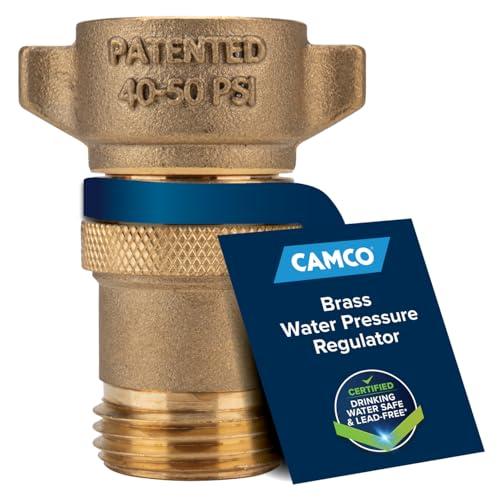 Camco Brass Water Pressure RegulatorThe cheapest single item that prevents the most expensive damage. Fixed preset, brass body, screws on in four seconds. | The cheapest thing that prevents the worst damage | Strong | |
| 2 | 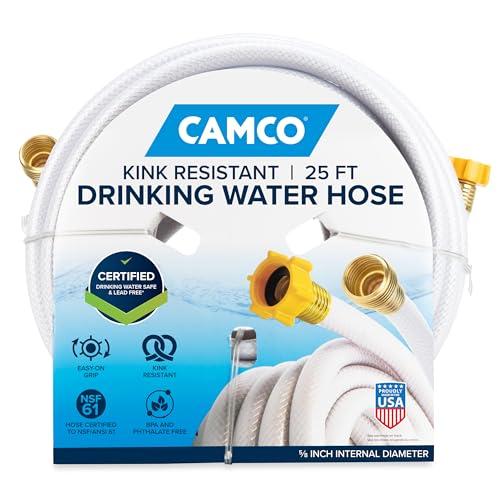 Camco TastePURE Drinking Water Hose (25 ft)The correct part rather than an upgrade: a drinking-water-rated hose, in white so it never gets mixed up with the sewer gear. | The default fresh water hose | Strong | |
| 3 | 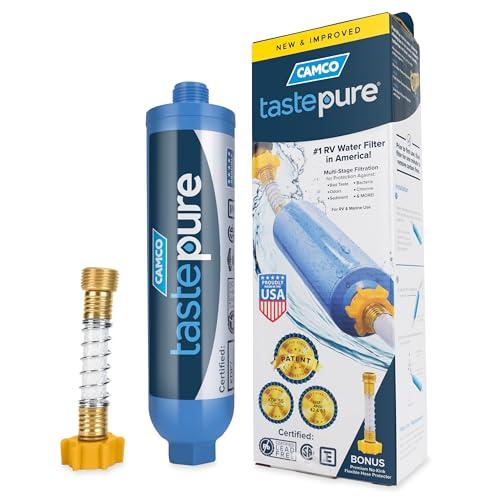 Camco TastePURE Inline RV Water FilterThe one most people start with: screws on, improves the taste, keeps grit out, and gets thrown away at the end of the season. | The simple first filter | Strong | |
| 4 | 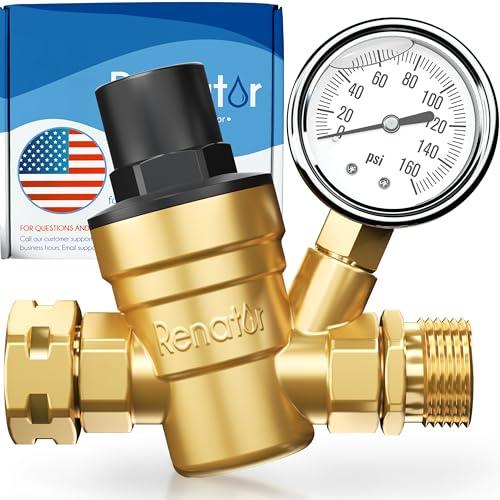 Renator Adjustable Water Pressure Regulator with GaugeThe one with a dial: it shows what the park is delivering and lets you keep usable shower flow instead of a fixed trickle. | Seeing and setting the pressure | Good | |
| 5 | 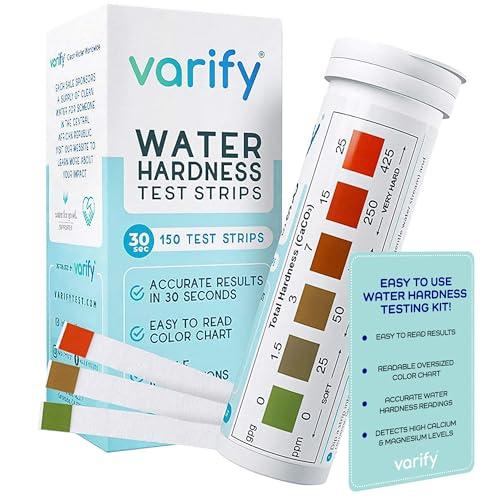 Varify Water Hardness Test Kit (150 strips)A few dollars that decide whether you need to spend anything else on this page. Buy this first, every time. | Finding out whether you need a softener at all | Strong |
Prices come from Amazon and were last checked November 27, 2026. They change constantly, so a price older than 48 hours is withdrawn rather than shown stale — those rows read “Check price on Amazon” instead and go straight to the current listing. #ad — these are affiliate links.
The whole fresh water hookup, in order
Spigot → regulator. First, always. Campground pressure is unknown and occasionally very high, and everything downstream — your filter, your hose, your trailer’s plumbing — is protected by this one part. A brass regulator with a preset limit does the job; an adjustable one with a gauge lets you see what you are being given.
Regulator → filter. Sediment and chlorine taste. An inline carbon filter is a few dollars of cartridge and it is the difference between campground water you will drink and campground water you will buy bottles to avoid.
Filter → drinking water hose → trailer. A white or blue hose rated for potable water. A garden hose is made to a different standard, tastes of it, and should not be carrying water you will drink or brush your teeth with.
And a test strip in the drawer. Not part of the line, but the thing that tells you whether you have a hardness problem worth spending real money on. Most campgrounds do not.
What $50 excludes
A water softener. Portable softeners start well above this cap, and most owners should test their water before considering one. The case is made on best RV water softener.
A canister filter with replaceable cartridges. The larger housings that take a standard cartridge sit above $50. They filter more and cost less per gallon over time; an inline filter is the right starting point and the right answer for a weekend owner.
A heated hose. Different product, different season, different page: heated hoses under $100.
Nothing else. The complete, functional fresh water hookup for a travel trailer genuinely fits under $50 per item, which is not true of any other category on this site.
How we chose
Prevents damage first. The regulator outranks everything because it is the only item here whose absence costs money rather than comfort.
Drinking water rated, published. On anything carrying water you will drink, we want the maker to say so rather than imply it.
Cheap cartridges, so you will replace them. A filter whose refills are expensive is a filter run past its useful life.
A gauge is a feature, not a requirement. The adjustable gauge regulator is genuinely nicer and it is not a protection upgrade over a good preset one. We rank it accordingly.
We do not test products and say so on how we choose. No pressure was metered and no water was analysed here. Every psi, micron and material figure is the maker’s own, and prices carry the date they were checked.
The picks
1. Best for The cheapest thing that prevents the worst damage
Camco Brass Water Pressure Regulator
The cheapest single item that prevents the most expensive damage. Fixed preset, brass body, screws on in four seconds.
- Specification
- Brass inline regulator
- Specification
- Fixed preset pressure
- Specification
- Standard hose thread at both ends
What it does well
- Fits between the spigot and your hose in about four seconds and then protects the whole plumbing system
- Brass rather than plastic, so it survives being over-tightened and left on all season
- A fixed preset means there is nothing to get wrong
The real tradeoff
- You cannot adjust it and you cannot see what it is doing
- Fixed regulators restrict flow more than an adjustable one set higher
How it measures up
These are judgments from published specifications and what we see at the lodge, not laboratory results. How we choose.
- Beginner fit
- Strong — Screw it onto the spigot. There is no step two.
- Control
- Adequate — No adjustment and no gauge.
- Flow
- Adequate — Noticeably more restrictive than an adjustable unit.
- Value
- Strong — The best money-to-risk ratio on the whole site.
Specifications from Camco.
2. Best for The default fresh water hose
Camco TastePURE Drinking Water Hose (25 ft)
The correct part rather than an upgrade: a drinking-water-rated hose, in white so it never gets mixed up with the sewer gear.
- Specification
- 25 ft
- Specification
- Drinking-water safe
- Specification
- White jacket, never confused with sewer gear
What it does well
- Drinking-water rated, which a garden hose is not. This is not an upgrade, it is the correct part
- White for a reason: you will never grab it thinking it is the sewer hose
- Twenty-five feet reaches the spigot at essentially every site
The real tradeoff
- Kinks if you coil it lazily
- Stiff in cold weather
How it measures up
These are judgments from published specifications and what we see at the lodge, not laboratory results. How we choose.
- Beginner fit
- Strong — A hose, in the right color.
- Control
- Adequate — Not applicable.
- Flow
- Good — Standard diameter, no surprises.
- Value
- Strong — Buy two: one for fresh water, one for tank rinsing.
Specifications from Camco.
3. Best for The simple first filter
Camco TastePURE Inline RV Water Filter
The one most people start with: screws on, improves the taste, keeps grit out, and gets thrown away at the end of the season.
- Specification
- Disposable inline filter
- Specification
- Screws between spigot and hose
- Specification
- Typically replaced each season
What it does well
- The cheapest way to stop tasting the campground and to keep grit out of your faucets
- No housing, no cartridge, nothing to assemble
The real tradeoff
- Disposable, so the cost repeats
- Clogs faster on genuinely sedimented water than a canister filter
How it measures up
These are judgments from published specifications and what we see at the lodge, not laboratory results. How we choose.
- Beginner fit
- Strong — Screw it on.
- Control
- Adequate — None.
- Flow
- Adequate — Restricts a little, and more as it clogs.
- Value
- Strong — Low entry cost. Buy the canister later.
Specifications from Camco.
4. Best for Seeing and setting the pressure
Renator Adjustable Water Pressure Regulator with Gauge
The one with a dial: it shows what the park is delivering and lets you keep usable shower flow instead of a fixed trickle.
- Specification
- Adjustable regulator
- Specification
- Dial gauge
- Specification
- Lead-free brass body
What it does well
- The gauge shows what the park is actually delivering, which is how you learn that campground pressure varies wildly
- Adjustable means you can set a sensible pressure and still get usable flow in the shower
The real tradeoff
- You have to set it, and a beginner will not know what to set it to without reading first
- More expensive, and one more thing that can be knocked out of adjustment
How it measures up
These are judgments from published specifications and what we see at the lodge, not laboratory results. How we choose.
- Beginner fit
- Good — One decision to make, and this guide makes it for you.
- Control
- Strong — Set it where you want it.
- Flow
- Strong — The real reason people upgrade.
- Value
- Good — Costs more, changes the shower.
5. Best for Finding out whether you need a softener at all
Varify Water Hardness Test Kit (150 strips)
A few dollars that decide whether you need to spend anything else on this page. Buy this first, every time.
- Specification
- 150 strips, reading calcium and magnesium hardness (listing)
- Specification
- Dip and compare against a printed color scale, with a result in seconds
- Specification
- Costs a small fraction of any softener on this page
What it does well
- The only item here that can save you the entire cost of the other four - plenty of campgrounds are not hard enough to need a softener
- 150 strips is enough to test every site you stay at for years, which is the point: hardness belongs to the campground, not to your trailer
- Reads the actual number you need in order to turn a grain capacity into a run length
The real tradeoff
- A color-match strip, not a laboratory titration, so read the result as a band rather than as a precise figure
- Does nothing about hard water on its own. It only tells you what you are dealing with
- Strips are time-sensitive once wet, so read them when the instructions say to
How it measures up
These are judgments from published specifications and what we see at the lodge, not laboratory results. How we choose.
- Beginner fit
- Strong — Dip, wait, compare.
- Capacity per dollar
- Strong — Not a softener, and still the best value here.
- Published data
- Adequate — Listing claims; it is a test strip.
- Portability
- Strong — A pocket vial.
The hookup, piece by piece, under $50 each
| Piece | Where it goes | What it prevents | Skip it? |
|---|---|---|---|
| Camco brass regulator | At the spigot, first | A high-pressure site splitting a line in a wall | Never. Cheapest part, worst consequence. |
| Camco TastePURE hose, 25 ft | Between filter and trailer | Drinking from a hose not rated for it | No. A garden hose is not a substitute. |
| Camco TastePURE inline filter | After the regulator | Sediment, chlorine taste and smell | Only if you drink bottled water exclusively |
| Renator adjustable regulator | At the spigot, instead of the brass one | The same thing, with a gauge to see it | Yes - it is the upgrade, not the baseline |
| Varify hardness test strips | In the drawer | Buying a softener you do not need | Yes, until scale appears |
The three-item hookup
Regulator, hose, filter. In that order, at the spigot, every time you arrive. Nothing else in this hub costs so little or prevents so much.
Best for The cheapest thing that prevents the worst damage
Camco Brass Water Pressure Regulator
The cheapest single item that prevents the most expensive damage. Fixed preset, brass body, screws on in four seconds.
Best for The default fresh water hose
Camco TastePURE Drinking Water Hose (25 ft)
The correct part rather than an upgrade: a drinking-water-rated hose, in white so it never gets mixed up with the sewer gear.
Best for The simple first filter
Camco TastePURE Inline RV Water Filter
The one most people start with: screws on, improves the taste, keeps grit out, and gets thrown away at the end of the season.
Using it so the cheap parts do their job
The regulator goes at the spigot, not at the trailer. Putting it at the trailer end leaves the whole hose under full campground pressure, which is the thing you were trying to avoid. Full walkthrough on how to use an RV water pressure regulator.
Replace the filter cartridge on a schedule. A saturated carbon filter stops helping and starts holding. Season is a reasonable interval for an inline unit.
Do not use the fresh water hose for anything else. Not for rinsing the sewer hose, not ever. Different colour hoses exist for exactly this reason.
Drain and store everything above freezing. All of it holds water. See the winterizing kit.
Mistakes on a $50 budget
Skipping the regulator because the site “seems fine”. You cannot feel pressure through a hose, and the site that splits a line is the one you did not expect.
Using a garden hose because it was in the garage. Not rated for potable water, tastes of itself, and the subject of its own page: can you use a regular hose for RV water.
Buying a softener before testing. Hardness is a property of the campground. Strips cost a fraction of a softener.
Buying a 50 ft hose for a 15 ft reach. More hose is more water standing in the sun. Measure first; see what size water hose for an RV.
Questions people actually ask
What do I need for an RV fresh water hookup?
Three things in this order: a pressure regulator at the spigot, an inline filter after it, and a drinking-water rated hose into the trailer. Every one of those is individually under $50 at the prices shown here. A hardness test strip kit is a useful fourth item that lives in a drawer rather than in the line - it tells you whether you have a hardness problem worth spending real money on.
Does the pressure regulator go at the spigot or at the RV?
At the spigot, every time. Putting it at the trailer end leaves the whole hose sitting under full campground pressure, which is exactly the thing you bought the regulator to prevent. Regulator first, then filter, then hose, then the trailer's city water inlet.
Can I use a garden hose for RV fresh water?
Not for water you will drink or brush your teeth with. Garden hoses are made to a different standard, they can impart taste, and they are not sold as potable water rated. A drinking-water hose costs very little - it is one of the cheapest items in the whole hookup - and the colour difference also stops you ever confusing it with the hose you rinse the sewer gear with.
Is an adjustable water pressure regulator worth the extra money?
It is nicer, not safer. A good preset brass regulator limits the pressure reaching your trailer, which is the protection you are buying. An adjustable unit with a gauge lets you see what the site is giving you and set your own limit, which is genuinely satisfying and useful for diagnosing low flow - but both sit under $50, so this is a preference rather than a budget decision.
How often should I change an inline RV water filter?
Treat an inline carbon filter as a per-season item for weekend use, and more often if you are hooked up full time or the water is visibly dirty. A saturated carbon filter stops adsorbing and starts simply holding what it caught, so running one well past its life is worse than running none at all.
Do I need a water softener as well?
Only if the water where you park is actually hard, which is a property of the campground rather than of your trailer. Test with a hardness strip before spending anything - portable softeners sit well above this page's $50 cap, and a good share of campgrounds do not need one at all.
Sources
Read next
Sewer & Water
Best RV Water Pressure Regulator
Fixed and adjustable pressure regulators compared, with the flow tradeoff explained and a pressure to aim for.
Sewer & Water
Best RV Fresh Water Hose
Drinking-water-safe hoses compared on length, flexibility and storage, plus why two hoses is the right answer.
Sewer & Water
Best RV Water Filter
Inline and canister water filters compared, with an honest account of what filtration at this level achieves.
Sewer & Water
RV Water Filter and Pressure Regulator: Which Goes First
The order of the regulator and filter on a city water line, why it matters, and which of the two you actually need.
Reviewed November 22, 2026. Spot something out of date? Tell us and we will fix it.