Best RV Accessories for Full-Time Living
Weekend gear fails on a schedule you never see in a weekend. These are the five upgrades that matter once the trailer is connected all month instead of all Saturday.
Heads up: this page contains affiliate links. If you buy through one, Camp & Chock may earn a commission at no extra cost to you. It never changes which product we put first — how this site is funded.

The short answer
Full-time living changes which failures matter, and the first one is the sewer hose: a weekend hose connected permanently to a concrete pad abrades, so the Camco RhinoEXTREME with its heavier reinforced wall is the pick. The second is electrical: a Progressive Industries EMS-PT30X watches for the sustained low voltage that a full park produces on hot evenings, which is the fault that kills compressors and converters slowly. Add a sloped hose support, because a hose that pools is a hose that smells, and water treatment sized to the water you are actually parked in. The budget pick is the Camco TastePURE inline filter — the cheapest item here, and the one you will re-buy most often.
Part of our first-season starter kit guide. If you are not full-time yet, start with RV must-haves for beginners and accessories for inside and outside.
Our picks at a glance
Tap any row to jump to the full write-up.
| # | Product | Best for | Beginner fit | Price |
|---|---|---|---|---|
| 1 | 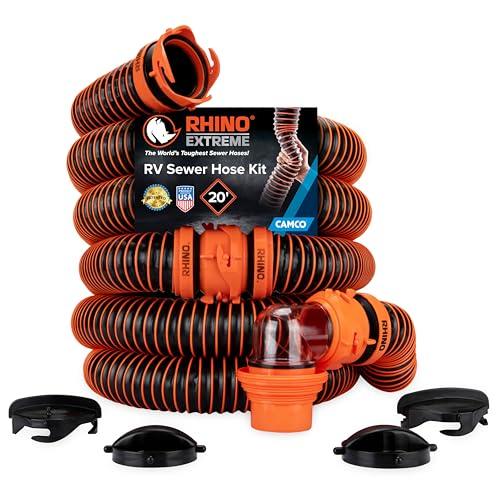 Camco RhinoEXTREME 20-Ft Sewer Hose KitThe same kit with a heavier wall. Worth the upgrade if your hose gets dragged across gravel rather than laid on grass. | Full-season and rougher sites | Strong | |
| 2 | 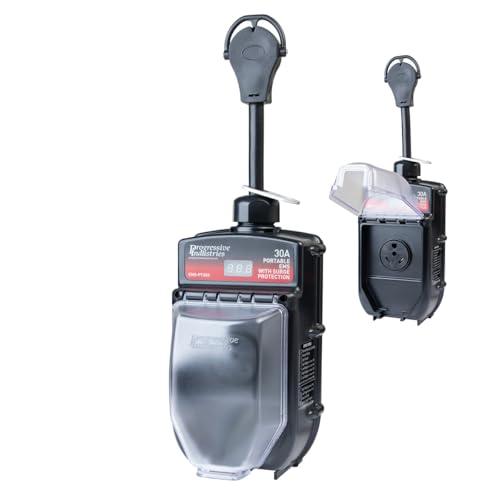 Progressive Industries EMS-PT30X Portable EMS (30 amp)A full electrical management system rather than a surge protector: it watches voltage and wiring and cuts power before a bad pedestal reaches your rig. | 30-amp rigs, no compromise | Good | |
| 3 | 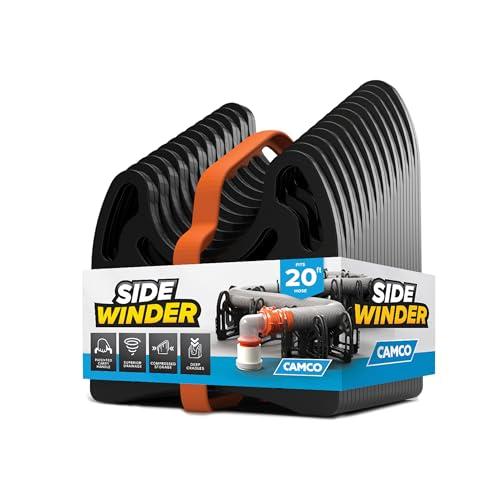 Camco Sidewinder RV Sewer Hose Support (20 ft)The item first-timers most often arrive without: a fixed-slope cradle that makes the tank actually drain instead of sit. | The support most people should buy | Strong | |
| 4 | 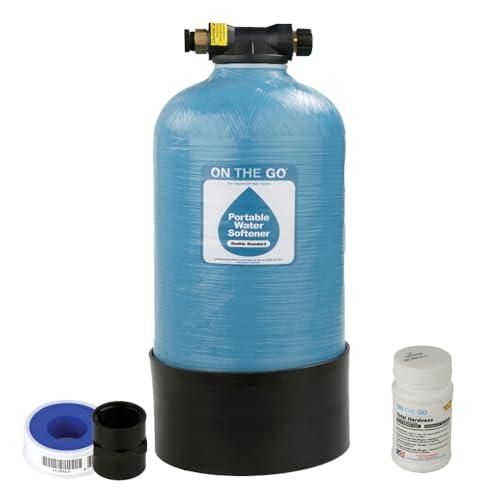 On The Go Portable Water Softener, 16,000 Grain Double StandardThe default portable softener for a travel trailer: the most resin per dollar in the category, and the only brand here that publishes enough to check. | Most travel trailers, and anyone parked in genuinely hard water | Strong | |
| 5 | 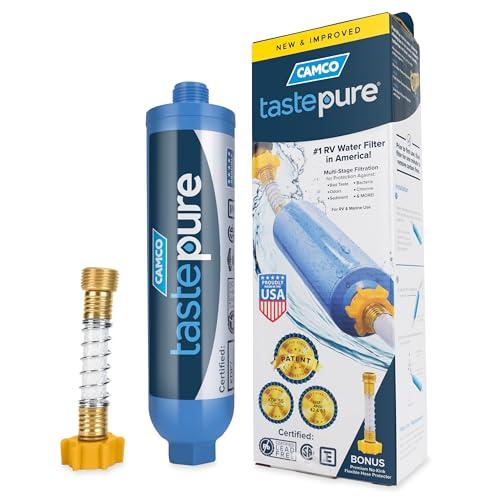 Camco TastePURE Inline RV Water FilterThe one most people start with: screws on, improves the taste, keeps grit out, and gets thrown away at the end of the season. | The simple first filter | Strong | |
| 6 | 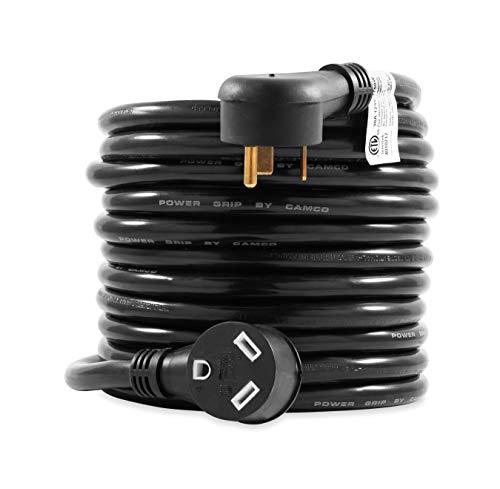 Camco Heavy-Duty RV Power Cord (30 amp, 25 ft)The replacement cord. Buy it when yours is damaged, not before, and replace it the day it is rather than the season after. | Replacing a damaged cord | Strong |
Prices come from Amazon and were last checked November 27, 2026. They change constantly, so a price older than 48 hours is withdrawn rather than shown stale — those rows read “Check price on Amazon” instead and go straight to the current listing. #ad — these are affiliate links.
What changes when the hookups are permanent
Time under load, not peak load. A sewer hose used for four days a month and a sewer hose lying on concrete for thirty days a month are the same product in two different jobs. Abrasion, UV and repeated flexing at the fittings are what finish a hose, and all three are a function of time connected. This is the entire case for the heavier wall, and it is made in full on best RV sewer hose for long-term use.
You see the park’s bad evenings. A weekender camps on a Saturday. A full-timer is plugged in on the hottest Tuesday of August when every air conditioner in the park is running and the pedestal voltage sags. Sustained low voltage does not announce itself and it is what degrades motors and converters. A surge suppressor does not act on it; an electrical management system disconnects.
Water quality becomes cumulative. A weekend of hard water is nothing. A season of it scales fixtures, and a filter cartridge that lasts a season of weekends saturates in a month of full-time use. Both are consumables now, with a schedule.
Everything is now a maintenance item. The cord, the hose, the filter, the seals. You are not camping; you are running a small building’s utilities, and the gear that is fine for occasional use needs to be the gear that is rated for continuous use.
How we chose
Rated for continuous use, or built like it. The heavier hose, the heavier cord, the hardwired-grade electrical protection. Where a maker publishes a continuous-duty specification we rank it above one that does not.
Protective behaviour over indicator lights. On a permanent hookup, a device that tells you about a fault after it has passed it through is not enough. We rank devices that disconnect.
Consumables with cheap, available refills. A filter whose cartridges are expensive is a filter run past its life, and on full-time use that happens four times faster.
Serviceable, not sealed. Parts you can replace individually beat assemblies you replace whole, because over a year you will replace something.
We do not test products and say so on how we choose. Nothing here was run for a year by us. Every wall specification, voltage threshold and flow figure is the maker’s own.
The picks
1. Best for Full-season and rougher sites
Camco RhinoEXTREME 20-Ft Sewer Hose Kit
The same kit with a heavier wall. Worth the upgrade if your hose gets dragged across gravel rather than laid on grass.
- Specification
- 20 ft as two 10 ft sections
- Specification
- Heavier wall than the standard kit
- Specification
- Same swivel fittings and clear elbow
What it does well
- A noticeably tougher wall, which matters if the hose gets dragged over gravel rather than laid on grass
- Same fittings as the standard kit, so sections interchange with what you already own
The real tradeoff
- Heavier and stiffer to coil, especially in the cold
- Costs more for a difference you may never need if you camp on grass
How it measures up
These are judgments from published specifications and what we see at the lodge, not laboratory results. How we choose.
- Beginner fit
- Strong — Identical to use.
- Durability
- Strong — The reason to buy it.
- Storage
- Adequate — Slightly bulkier than the standard hose.
- Value
- Good — Pays back over a full season, not a weekend.
Specifications from Camco.
2. Best for 30-amp rigs, no compromise
Progressive Industries EMS-PT30X Portable EMS (30 amp)
A full electrical management system rather than a surge protector: it watches voltage and wiring and cuts power before a bad pedestal reaches your rig.
- Specification
- 30 amp portable unit
- Specification
- Full EMS: monitors voltage and pedestal wiring, not only surges
- Specification
- Cuts power on a fault and reconnects automatically once it clears
What it does well
- It disconnects on low voltage, which is the fault that actually destroys air conditioners. A surge-only device will not
- Tells you what is wrong at the pedestal before the trailer is plugged in
- Reconnects on its own after a fault clears, so you do not come home to a warm fridge
The real tradeoff
- Several times the price of a surge-only protector
- Portable units get stolen, so budget for a lock or buy the hardwired version
- The display is small and you will be reading it in the dark
How it measures up
These are judgments from published specifications and what we see at the lodge, not laboratory results. How we choose.
- Beginner fit
- Good — Plug in, read the code, wait. The codes take one read of the manual.
- Protection breadth
- Strong — Low voltage, high voltage, miswired pedestal, surges.
- Diagnostics
- Strong — It tells you why it refused, which is most of the value.
- Value
- Good — Expensive against a surge strip, cheap against a converter.
Specifications from Progressive Industries.
3. Best for The support most people should buy
Camco Sidewinder RV Sewer Hose Support (20 ft)
The item first-timers most often arrive without: a fixed-slope cradle that makes the tank actually drain instead of sit.
- Specification
- 20 ft folding support
- Specification
- Fixed slope molded in
- Specification
- Folds flat, accordion style
What it does well
- Holds the slope by itself. No adjusting, and no collapsing halfway through a dump
- Folds flat rather than telescoping, so it does not jam with grit
- This is the single most common thing first-timers arrive without
The real tradeoff
- Long when folded, and it needs a full-length storage space
- A fixed slope means a badly placed sewer connection still fights you
How it measures up
These are judgments from published specifications and what we see at the lodge, not laboratory results. How we choose.
- Beginner fit
- Strong — Unfold it, lay the hose in, done.
- Durability
- Good — Folding beats telescoping over a season of grit.
- Storage
- Adequate — Flat, but long.
- Value
- Strong — Cheap, and it fixes the slow-drain complaint outright.
Specifications from Camco.
4. Best for Most travel trailers, and anyone parked in genuinely hard water
On The Go Portable Water Softener, 16,000 Grain Double Standard
The default portable softener for a travel trailer: the most resin per dollar in the category, and the only brand here that publishes enough to check.
- Specification
- 16,000 grain capacity (maker's figure)
- Specification
- Camping World publishes 1,600 gallons of soft water, up to 40 days, without stating the hardness behind it
- Specification
- Regenerates with 2 boxes of common table salt in under 30 minutes (maker)
- Specification
- 22 in tall x 9-1/2 in diameter, 34.18 lb (Camping World)
- Specification
- Standard hose connection, with a back-flush adapter and a 4 ft drinking hose in the box
- Specification
- Assembled in Indiana per the listing
What it does well
- Double the resin of the 8,000 grain model for a price difference that is usually small enough to be a rounding error, which makes it the obvious buy of the two
- Regenerates on table salt from any grocery store rather than on a proprietary cartridge, so running it costs a couple of dollars a month
- The brand actually publishes capacity, dimensions and a regeneration procedure, which most of this category does not
- Tall and narrow, so it stands in a wet bay or beside the pedestal instead of needing floor space
The real tradeoff
- Heavy to carry when wet, and it is one more 34 lb object to find room for in a trailer that is already full
- The published 1,600 gallon figure has no hardness attached to it, so treat it as marketing rather than as a number you can plan around
- Regeneration takes half an hour and a place for salty flush water to go, which is awkward at a tight site
- It softens. It does not filter sediment or improve taste, so you still want a filter in the line
How it measures up
These are judgments from published specifications and what we see at the lodge, not laboratory results. How we choose.
- Beginner fit
- Strong — Hose in, hose out, salt once in a while.
- Capacity per dollar
- Strong — 16,000 grains for close to the 8,000 price.
- Published data
- Good — Capacity, size and procedure; no hardness behind the gallons.
- Portability
- Adequate — Narrow, but 34 lb wet.
Specifications from Camping World published specifications.
5. Best for The simple first filter
Camco TastePURE Inline RV Water Filter
The one most people start with: screws on, improves the taste, keeps grit out, and gets thrown away at the end of the season.
- Specification
- Disposable inline filter
- Specification
- Screws between spigot and hose
- Specification
- Typically replaced each season
What it does well
- The cheapest way to stop tasting the campground and to keep grit out of your faucets
- No housing, no cartridge, nothing to assemble
The real tradeoff
- Disposable, so the cost repeats
- Clogs faster on genuinely sedimented water than a canister filter
How it measures up
These are judgments from published specifications and what we see at the lodge, not laboratory results. How we choose.
- Beginner fit
- Strong — Screw it on.
- Control
- Adequate — None.
- Flow
- Adequate — Restricts a little, and more as it clogs.
- Value
- Strong — Low entry cost. Buy the canister later.
Specifications from Camco.
6. Best for Replacing a damaged cord
Camco Heavy-Duty RV Power Cord (30 amp, 25 ft)
The replacement cord. Buy it when yours is damaged, not before, and replace it the day it is rather than the season after.
- Specification
- 30 amp, 25 ft
- Specification
- Outdoor-rated
- Specification
- Standard RV connector at the rig end
What it does well
- A direct replacement when the factory cord gets crushed in a compartment door, which happens more than you would think
- Cheaper than the consequences of continuing to use a damaged cord
The real tradeoff
- Bulky
- Not an upgrade over a healthy factory cord, only a replacement
How it measures up
These are judgments from published specifications and what we see at the lodge, not laboratory results. How we choose.
- Beginner fit
- Strong — Swaps straight in.
- Protection breadth
- Adequate — Not a protector.
- Diagnostics
- Adequate — Not applicable.
- Value
- Good — Sensible money against the alternative.
Specifications from Camco.
Weekend gear versus full-time gear
| System | Fine for weekends | What full-time needs | Why |
|---|---|---|---|
| Sewer | Standard 20 ft kit | Reinforced wall, on a sloped support | Abrasion and UV are a function of days connected |
| Electrical | Basic surge protector | Full electrical management system | Sustained low voltage in a busy park is the real killer |
| Fresh water | Inline filter, replaced each season | Inline filter on a monthly schedule | A cartridge saturates on use, not on the calendar |
| Hard water | Live with it | Test, then soften if the strips say so | Scale is cumulative; a weekend of it is nothing |
| Power cord | Factory cord | Heavy-duty cord, inspected | Continuous load plus repeated plugging wears the ends |
The three upgrades to make first
A hose rated for the time it will spend connected, electrical protection that disconnects rather than just reporting, and a support so the hose drains. These three cover the failures that actually cost money on a permanent site.
Best for Full-season and rougher sites
Camco RhinoEXTREME 20-Ft Sewer Hose Kit
The same kit with a heavier wall. Worth the upgrade if your hose gets dragged across gravel rather than laid on grass.
Best for 30-amp rigs, no compromise
Progressive Industries EMS-PT30X Portable EMS (30 amp)
A full electrical management system rather than a surge protector: it watches voltage and wiring and cuts power before a bad pedestal reaches your rig.
Best for The support most people should buy
Camco Sidewinder RV Sewer Hose Support (20 ft)
The item first-timers most often arrive without: a fixed-slope cradle that makes the tank actually drain instead of sit.
Habits that matter more than gear
Keep the black tank valve closed. Leaving it open on a permanent hookup drains the liquid and leaves the solids, which is the origin of nearly every blocked tank story. Fill, then dump. The timing is on how often to dump an RV black tank.
Rinse and dry the sewer hose properly. Four times a month instead of once, and the cleaning routine becomes the difference between a hose that lasts two years and one that lasts four months.
Inspect the roof twice a year. A full-time trailer is a building with a flat roof. Seams, vents and screw heads, and lap sealant before water gets in rather than after. Keep two or three tubes on board: sealant under $25 makes a spare the cheapest decision on the trailer.
Log your filter and cartridge dates. Nobody remembers. A note on the inside of a cabinet door is the whole system.
Keep the winterizing kit on board regardless. A full-timer in a cold climate needs the winter kit and the ability to shut the water system down at short notice.
Mistakes full-timers make with weekend gear
Running a weekend sewer hose permanently. It will fail, and it will fail at the fitting, at the worst moment.
Relying on a surge protector to handle low voltage. It does not. That is what the management system is for, and the distinction is explained on surge protector versus EMS.
Buying a softener without testing the water. Hardness belongs to the site. Test strips cost a fraction of a softener and a good share of parks do not need one.
Letting the hose lie flat on the pad. No slope, no drainage, and a hose full of standing waste.
Treating consumables as permanent. Cartridges, sealant, tank treatment and hose seals are all on a schedule now.
Questions people actually ask
What RV accessories do you need for full-time living?
Five upgrades cover the failures that only appear with time connected: a sewer hose with a reinforced wall rather than a weekend kit, a full electrical management system rather than a basic surge protector, a sloped hose support so the hose actually drains, water treatment sized to the water you are parked in, and a heavy-duty power cord you inspect. Everything else is comfort rather than consequence.
Do I need a different sewer hose for full-time RV living?
Yes, in practice. Abrasion against a concrete pad, UV exposure and repeated flexing at the fittings are all functions of how many days the hose spends connected, and a hose rated for weekends spends thirty days a month doing what it used to do for four. A reinforced-wall hose on a sloped support is the upgrade, and it is far cheaper than the failure it prevents.
Is a surge protector enough for full-time RV living?
Not really. A surge protector clamps a spike; what damages appliances in a busy park is sustained low voltage on hot evenings when every air conditioner is running. An electrical management system disconnects your trailer when voltage goes out of range, as well as on reversed polarity and an open ground. On a permanent hookup you see those bad evenings far more often than a weekender does.
How often should I change the water filter if I live in my RV?
Far more often than the seasonal interval a weekend owner uses - a cartridge saturates on volume of water passed, not on the calendar. Treat an inline filter as a monthly item under full-time use and write the date on the housing, because a saturated carbon filter stops adsorbing and starts simply holding what it caught.
Should I leave the black tank valve open on a permanent hookup?
No. Leaving it open drains the liquid and leaves the solids behind to dry out, which is the origin of almost every blocked-tank story. Keep the valve closed, let the tank fill to roughly two thirds, then dump it in one go so the volume of water carries everything out. Our how often to dump an RV black tank page covers the timing.
Do I need a water softener for full-time RV living?
Only if the water where you are parked is hard, which is a property of the park rather than of your trailer - so test with a hardness strip before spending anything. The difference from weekend camping is that scale is cumulative: a weekend in hard water is nothing, and a season of it will visibly scale your fixtures and stop soap lathering.
Sources
Read next
Sewer & Water
Best RV Sewer Hose for Long Term Use
What fails on a hose left connected for a season, and the kit and support combination that survives it.
Power & Surge Protection
RV Surge Protector vs EMS: What the Cheaper One Misses
The clearest explanation of surge-only versus full electrical management, and which faults each one actually catches.
First-Season Starter Kit
RV Accessories for Inside a Camper
The inside gear that earns its cupboard space in a first season, and the popular categories that quietly do not.
First-Season Starter Kit
Winter RV Camping Accessories for a Travel Trailer
Heated hose, overnight electric heat, moisture control and the winterizing parts to keep on board.
Reviewed November 22, 2026. Spot something out of date? Tell us and we will fix it.